Tag Archives: Line

Line Gisters and Line Nazis

Balak said to Balaam, “What have you done to me? I brought you to curse my enemies, but you have done nothing but bless them!”

He answered, “Must I not speak what the Lord puts in my mouth?”
Numbers 23:11-12 (NIV)

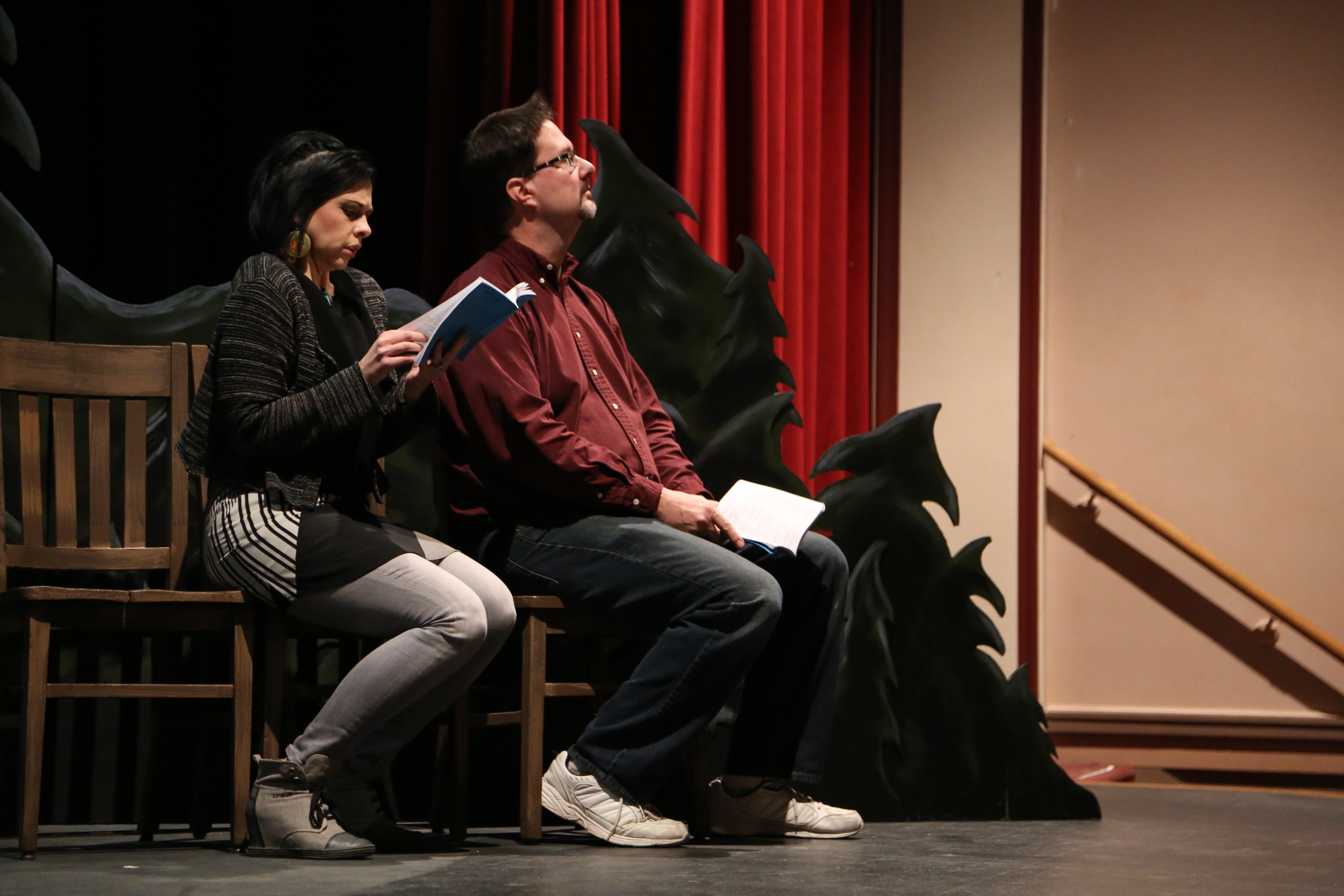
I have found among actors that there is a rarely discussed spectrum. It parallels the ongoing legal debate about our Constitution here in America, between those who interpret the Constitution as a “living document” versus those who interpret it in context of its “original intent” as written.

On one end of the on-stage spectrum are those who memorize their part of the script and present the general gist of a line. They call it good. Let’s call them the “Line Gisters.” At the other end of the spectrum are those we will lovingly refer to as “Line Nazis.” Line Nazis are rabid defenders of the script, word-for-word, as written.

The playwright wrote these words for a reason,” a Line Nazi will passionately admonish his/her fellow actors. The Line Nazi then explains that changing a word or two here or there can change the entire interpretation of a line (and thus the play itself, and the intent of the playwright).  In my experience it’s at this point that the “Line Gisters” proceed to roll their eyes, the Line Nazis grumble in frustration, and the rehearsal continues.

I’ll confess to you that I have spent most of my theatre journey at the Line Gister end of the spectrum. Then, I actually wrote a couple of plays and had the privilege of watching them being produced. For the first time I began to feel personally what my Line Nazi brethren had been preaching to me all along. I was suddenly on the other side of the spectrum seeing things from a different perspective. Line Gisters would memorize and deliver a loose version of the words that I had written. Sometimes it wasn’t a big deal, but other times I had specifically crafted that line for a reason! Just getting the “gist” of it didn’t cut the mustard.

In today’s chapter, the mysterious seer Balaam continues his cameo role in the story of the Hebrews wilderness wanderings. King Balak of Moab hires Balaam to curse the Hebrew hoard camping on his borders. Multiple times Balaam speaks the words God gives him, and each time it is not what Balak paid Balaam to say. Rather than cursing the Hebrews, Balaam blesses them.

Must I not speak what the Lord puts in my mouth?” Balaam asks his prophetic patron.

Balaam understood that it was important to deliver the line as written.

God’s Message is just like the Constitution or any playwright’s script. Words can be interpreted in context or out of context. Lines can be quoted verbatim or butchered in an effort to communicate the gist. The words end up in the hands of the expositor and out of the control of the originator and/or author.

As a reformed Line Gister I confess that my years on that end of the spectrum were rooted in a generous portion of laziness and a general lack of discipline. This morning I find myself appreciating Balaam’s fidelity to deliver the words as given to him by God, heedless of the reaction of his patron. I find it honorable. I’m not sure you can call me a full-fledged Line Nazi (still working on that laziness and self-discipline), but it is a character trait I increasingly desire to exemplify in my own life, both on stage and off.

(Line Nazis Unite!)

Playing the Line vs. Playing the Want

This is what the Lord says to Israel: “Seek me and live;”
Amos 5:4a (NIV)

One of the core activities in the acting process is discovering what is motivating your character; Understanding what it is your character wants in each action and conversation. Whenever I get a script for a new part, whether the part is large or small, I first go through and break scenes down into “beats” which are small sections in which my character is focused on a particular action or dialogue.  I then go back and determine my character’s “want” for each beat.

I want to know if my uncle killed my father.
want to be with Juliet so bad I can hardly contain it.
want to be King of Scotland.

The beats and “wants” may change during the rehearsal process as I make new discoveries and my character runs up against how the other characters are playing their respective wants. As the rehearsals progress, I identify my characters overarching motivation in the entire play.

Good actors play more than just the lines, they play the want.

This came to mind as I read this morning’s chapter. The prophet Amos is writing a prophetic poem focused on the ancient kingdom of northern Israel. Connecting the poem together are three direct commands:

Seek me and live.” vs 5

Seek the Lord and live. vs 6

Seek good and not evil. vs 14

The question for Israel that Amos was poking at is the same question an actor asks of his or her character: “What (or who) are you seeking?” What is motivating you? What is it you desire?

It didn’t take me long as a young actor to realize that the acting process is applicable as the living process. It’s crucial that I examine and understand my own motivations in life, in my relationships, in my words, in my actions, in my activities, and in my work.

Along my life journey I’ve observed that uptight religious people (I know because I have been one) are immature actors playing just the lines of God’s Message. Their focus is the surface of each black and white command. I have found, however, that the Great Director is always calling me deeper into life’s script. He wants me to play more than just the religious lines. He wants me to play life from the most critical, core motivations…

Jesus said, “‘Love the Lord your God with all your passion and prayer and intelligence.’ This is the most important, the first on any list. But there is a second to set alongside it: ‘Love others as well as you love yourself.’ These two commands [and motivations] are pegs; everything in God’s Law and the Prophets hangs from them.”

“You will seek me and find me when you seek me with all your heart.”

What am I seeking?

Some Things Bear Repeating

Gnomeo & Juliet
Gnomeo & Juliet (Photo credit: Wikipedia)

My heart, O God, is steadfast;
    I will sing and make music with all my soul.
Awake, harp and lyre!
    I will awaken the dawn.
I will praise you, Lord, among the nations;
    I will sing of you among the peoples.
For great is your love, higher than the heavens;
    your faithfulness reaches to the skies.
Be exalted, O God, above the heavens;
    let your glory be over all the earth.
Psalm 108:1-5 (NIV)
[and Psalm 57:7-11 (NIV)]

Wise King Solomon said, “There is nothing new under the sun.” We are always taking what has been and repurposing it, recycling it, or building on it anew. It’s part of the creative process God bred into us when He, the master Creator, molded us in His own image. For example, consider Shakespeare’s famous romance Romeo and Juliet. One does not have to search far to find countless adaptations of the Bard’s timeless story:

Adaptations and regurgitations aren’t inherently wrong or bad (though some of them are certainly poor reflection of the original). The truth is that some things bear repeating. As children we hear our parents repeat the same things over, and over, and over. As parents we repeat the same things to our children over, and over, and over. It often takes us hearing the same message repeated ad nauseam before it finally sinks in and gets applied. As an actor, I repeat the same lines over and over and over again as part of the memorization and rehearsal process. It never ceases to amaze me how often I will say a particular line countless times, but find new depth of understanding and meaning after hundreds of repetitions.

When reading through the collective lyrics of the Psalms, it’s easy to feel like we’re reading the same thing over and over. That’s because, in some cases, we are. The opening verse of Psalm 108 is an almost word-for-word repeat of the last verse of Psalm 57. Likewise, the third verse of Psalm 108 is a repeat of last verse of Psalm 60.

Some things bear repeating, and some do not. Wisdom is knowing the difference.

Chapter-a-Day Psalm 16

The land you have given me is a pleasant land.
    What a wonderful inheritance!
Psalm 16:6 (NLT) 

Wendy and I have been thinking a lot about our land in recent weeks. We’ve been dreaming about some things we’d like to do with our house and garage. To that end we’ve been looking at how our lot is laid out. We’ve been talking with our city’s Building Inspector about lot lines and property pins. The abstract to our house and land is sitting right next to the computer here at my desk.

We love Iowa with its beautiful rolling hills and landscape that constantly changes color and texture with the seasons. We love this quirky, quaint little town with all its Dutch heritage and small town silliness. We love this little lot and our little brick tudor house.

When I read the verse above this morning my heart sighed an “Amen!” God has given us an inheritance in a pleasant land. Today, I’m thankful for a pleasant land and a wonderful inheritance.