Tag Archives: Structure

“Right in Front of You”

While they were listening to this, he went on to tell them a parable, because he was near Jerusalem and the people thought that the kingdom of God was going to appear at once.
Luke 19:11 (NIV)

There is an art to storytelling.

In novels and in movies, and in the spoken word there is a structure to a well-told story that sucks listeners in, keeps them on the edge of their seats, and leaves them wanting more.

With the advent of streaming and binging entire seasons of television shows it easier than ever to see that writers structure an entire season of episodes like one giant story.

I have always said that all good stories are a reflection of the Great Story.

God is the Master Storyteller.

Luke is a careful apprentice—watching, learning, and telling the story with intention.

He sees the story of Jesus, and he is writing it capably.

One of the hallmarks of a good story is that as the narrative moves towards the climax, the pace of the story speeds up.

Things happen quickly.
Conflicts rise.
Tension builds.

Back in chapter 9 Luke informed us that Jesus resolutely set out for Jerusalem. He did so knowing that He would be arrested, tried, and executed. He predicted plainly… twice.

Over the next 9 chapters Luke slowly introduces the conflict with the prominent religious leaders. Jesus’ teachings and parables only stoke the flames of that conflict.

The religious establishment wants a king who conquers.
Jesus insists on a kingdom that transforms.

Jesus repeatedly frustrates them with His description of God’s Kingdom, and criticizes them for their inability to see it or accept it.

Today’s chapter. There’s movement here. Urgency. A heartbeat that quickens as Jesus draws closer to Jerusalem… and everything starts to come to a head.

The chapter unfolds like a series of charged moments:

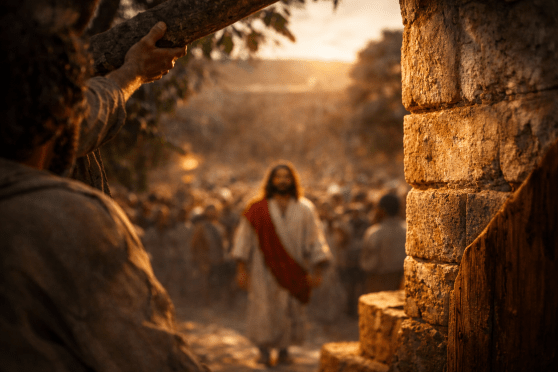
  • In Jericho, a wealthy, compromised man named Zacchaeus climbs a tree just to see Jesus—and ends up being seen instead.
    Scandalous. Not that Zacchaeus sought Jesus—but that Jesus wanted Zacchaeus. Salvation doesn’t wait for you to clean up. It invites itself into your messy house and sits down at your table like it owns the place.
  • Jesus tells a parable about servants entrusted with money (the minas), exposing what we do with what we’ve been given while the King is away. The minas aren’t just about stewardship—they’re about loyalty in the waiting. What I do with what God has placed in my hands—my influence, my voice, my time—isn’t neutral. It reveals my heart.
  • Then comes the triumphal entry—Jesus rides into Jerusalem as a king… but not the kind anyone expected.
    Not on a war horse like the religious establishment wants, but a colt. This isn’t power, or intimidation, or conquest…peace. But don’t mistake gentleness for weakness. This King knows exactly who He is… and exactly where He’s going.
  • And finally, He weeps over the city and clears the temple, confronting a people who missed what was right in front of them.
    A haunting moment as Jesus looks at Jerusalem… and cries. Not because He’s rejected. Because they didn’t recognize “the time of God’s coming.” They were looking for God… and missed Him when He stood right in front of them. And the temple cleansing isn’t random anger—it’s surgical. The establishment has turned God’s house into a cash cow of commerce. Religion without presence, activity without intimacy, noise without God — and Jesus won’t have it.

Today’s chapter is about recognition… and the tragedy of missing it.

Here’s where the chapter leans in close… and Holy Spirit whispers something uncomfortably personal.

“Tom? You’re in this story.”

  • Sometimes I’m Zacchaeus—curious, hungry, hiding in the branches, hoping to see without being seen.
  • Sometimes I’m the cautious servant—playing it safe, burying what I’ve been given because risk feels… well… risky.
  • Sometimes I’m a face in the crowd—cheering Jesus when it’s exciting, missing Him when it’s inconvenient.
  • And sometimes… I’m Jerusalem.

Busy.
Religious.
Close.

And still missing Him.

In the quiet this morning, I’m reminded that God’s Kingdom starts with me. Jesus always begins at the one-on-one relationship.

Not in theory.

Not in theology.

But in the quiet nudge…
The inconvenient interruption…
The invitation that feels a little too personal, a little too close for comfort…

Because Jesus still walks through every town like Jericho.

He still looks up into trees.

He still calls names.

And He still says, “I’m coming to your house today.”

When He does?

Things get rearranged.

Tables flip.
Priorities shift.
Wallets open.
Hearts soften.

And salvation doesn’t just pass by—

It moves in…
kicks off its shoes…
and stays awhile.

If you know anyone who might be encouraged by today’s post, please share.

Promotional graphic for Tom Vander Well's Wayfarer blog and podcast, featuring icons of various podcast platforms with a photo of Tom Vander Well.
These chapter-a-day blog posts are also available via podcast on all major podcast platforms including Apple, Google, and Spotify! Simply go to your podcast platform and search for “Wayfarer Tom Vander Well.” If it’s not on your platform, please let me know!
An orange square icon featuring an open book outline in white.

“The One Thing”

"The One Thing" (CaD Jhn 20) Wayfarer

Jesus performed many other signs in the presence of his disciples, which are not recorded in this book.
John 20:30 (NIV)

For a number of years, I was tasked by my local gathering of Jesus’ followers to mentor several individuals who were developing their preaching skills. It was a fun challenge, and I think I probably learned more than my protégés.

One of the things that I stressed to my charges was the importance of determining what I called “the one thing.” I encouraged them to identify “the one thing” they wanted listeners to hear and remember when they walked away.

“The one thing” is helpful in three key ways. First, it helps in developing the content by giving me a clear goal: “I want my listeners to walk away having clearly heard this one thing. So, how am I going to get there? Next, it helps to keep the message lean and on point. If I review my content and find that a certain point or illustration doesn’t really help to communicate “the one thing,” I cut it out. Third, I can be very clear with my listeners in my delivery. Sometimes I will even say, “If you hear one thing from my message this morning, I want you to hear this…”

In writing his account of Jesus’ story, John has been selective and structured in choosing the events and episodes to share. The same is true of his account of Jesus’ resurrection.

In today’s chapter, John chooses to share four quick episodes.

Early Sunday morning, Mary Magdalene arrives to tell Peter and John that Jesus’ body is missing. They run to the tomb to find Jesus’ linen grave clothes neatly folded, but Jesus’ body missing. John says of his anonymous self, “He saw and believed.”

Peter and John return to where they were staying, but Mary Magdalene remains at the grave where a very alive Jesus appears to her.

Sunday evening, Jesus’ disciples (without Thomas) are together behind locked doors. Jesus suddenly appears among them.

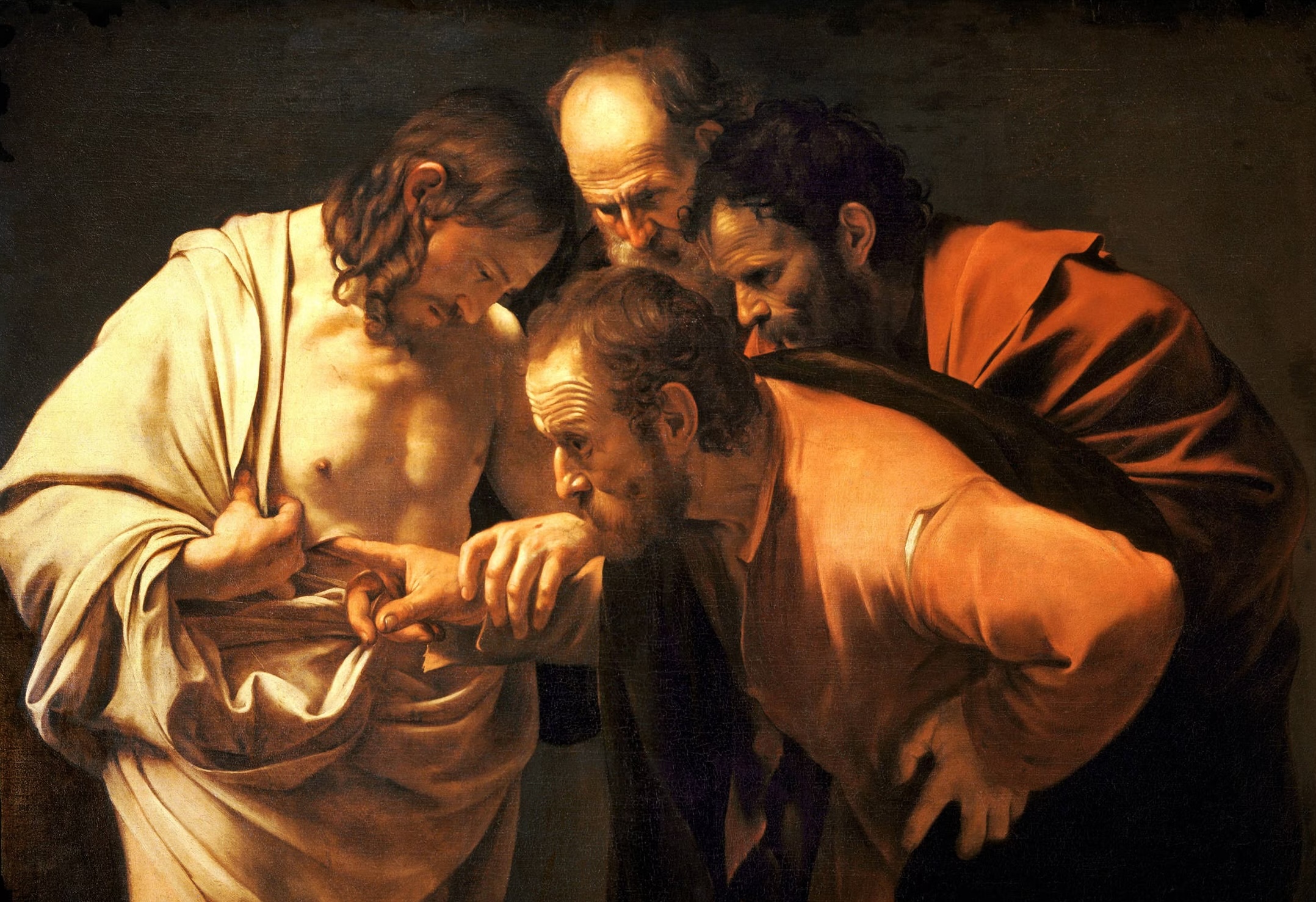
One week later, the disciples are once more together behind locked doors. This time, Thomas is present. Jesus again appears among them. He invites Thomas to put his finger in the nail wounds on his hands, his hand in the spear wound on his side. Thomas believes, and Jesus states “Blessed are those who have not seen and yet have believed”

John then shares his “one thing” when he writes: “But these are written that you may believe that Jesus is the Messiah, the Son of God, and that by believing you may have life in his name.”

In looking back at the resurrection episodes John chooses to share while being mindful of his “one thing” I can see why he chose to share the episodes he did:

John was at the empty tomb. He didn’t see Jesus, but with the empty tomb he “saw and believed.” He didn’t see the risen Christ, but already believed.

Mary saw the risen Jesus. John wants his readers to know that it wasn’t a conspiracy of “The Twelve.” Others saw the risen Jesus, talked to Him, and touched Him.

Jesus appeared to the disciples, but Thomas doubted until Jesus provided physical proof that it was Him. When Jesus shares, “blessed are those who have not see yet have believed,” John is leading his readers to the “one thing.” We, his readers, are among those who “have not seen” and he wants us to believe.

In the quiet this morning, I am mindful of the season of Lent in which believers annually walk with Jesus to the cross on Good Friday and run with John and Peter to the empty tomb on Easter Sunday. It is a time of reflection on the “one thing” of our faith: that Jesus sacrificed Himself for my sins, died on a cross, and was resurrected on the third day. This morning I glanced back on over forty years of believing in and following Jesus. Time and life have not diminished my belief. They have honed it.

I have not seen the risen Christ, but I have experienced His indwelling. I have heard His Spirit in my spirit. I have experienced His moving and working in my life so many times and in so many ways. And, I believe that I will see Him when this earthly journey is over. I’m reminded of Paul’s words to the believers in Corinth:

“For now we see only a reflection as in a mirror; then we shall see face to face. Now I know in part; then I shall know fully, even as I am fully known.”

Until then, “blessed are those who have not seen and yet have believed.”

If you know anyone who might be encouraged by today’s post, please share.

Living a Great Story

Living a Great Story (CaD Jud 13) Wayfarer

The woman gave birth to a boy and named him Samson. He grew and the Lord blessed him, and the Spirit of the Lord began to stir him while he was in Mahaneh Dan, between Zorah and Eshtaol.
Judges 13:24-25 (NIV)

Our daughters happened to grow up as J.K. Rowling was writing and releasing the seven volumes of her epic Harry Potter series. Forgive the pun, but it did seem like a bit of a magical time. The story about Harry and his friends growing up, going through adolescence, and figuring out life was unfolding right along with our daughters’ own adolescent years. For their generation, the story was layered with meaning that perhaps no other generation will experience because it was happening right along with them. I’ve often thought that the entire series should ideally be gifted to a child, one book a year, from ages 11-17. Not that you could keep an inquisitive child from learning everything from movies, friends, and the internet.

Today’s chapter begins the final story of the five major judges raised up by God to deliver the Hebrew tribes from their enemies. The first four were Ehud, Deborah, Gideon, Jephthah, and now Sampson. One of the things that I’ve learned about the ancient Hebrews is that the structure of their writing is typically as important to them as the content of it. Just as God metaphorically layers creation with meaning, the ancient Hebrews layered their writing with structural and mathematical meaning.

Just as with the psalm writers, the center is the core where you place the central theme. The author of Judges places Gideon, who represents the “ideal” Judge, and his son, Abimelek, who represents the antithesis. One step out from the center are two atypical leadership choices from each of Joseph’s tribes. The major Judges are bookended by two “loners” who single-handedly delivered the people from their enemies. They remind me of the achetype of the Lone Stranger I’ve written about before.

But there’s something different about Samson that sets him apart from the others which we see right from the beginning of the story in today’s chapter. Samson’s birth is divinely announced to a barren woman and he is “set apart” by God from the very beginning, much like Moses who escaped Egyptian infanticide. There’s something special about this one, which we will uncover in the coming days.

This brings me back to thinking about our daughters who as preteens began a story about a special baby with a lightning-bolt scar. Stories connect me to themes that are larger than myself. Stories connect me with others and provide source material for Life-giving conversations. Stories help me navigate my own life journey. This Great Story I’ve been trekking through again and again for over forty years is a collection of stories that connect me with God.

When my life journey is over, I will cross into eternity. Here on earth, I will become a story. I will become a story told by children to grandchildren shared with old photographs, snippets of video, and snatches of first-hand memories of moments we shared together once upon a time.

What will that story be, I wonder? What layers of meaning might my story have for the lives of those who hear it?

I guess that’s still somewhat undetermined. The story is still being written. It’s a work in progress.

How can I live a great story today?

If you know anyone who might be encouraged by today’s post, please share.

Structure and Flow

In every province and in every city to which the edict of the king came, there was joy and gladness among the Jews, with feasting and celebrating.
Esther 8:17 (NIV)

Over the past few years, I have served as a mentor to a group of teachers. I will typically review outlines and provide encouragement and advice prior to their message, and then give feedback after the delivery of their messages. It’s been rewarding to watch individuals improve their preparation and presentation skills, and it’s challenged me in a number of unexpected ways. I honestly think I’ve been a better learner than I have a  teacher in the process.

One of the biggest observations I’ve made over my tenure in this role is the importance of structure. If you have a well-ordered structure then your words and ideas have flow. The hearer, almost sub-consciously, follows the flow and ends up right where you want them at the end. Without structure, there is no flow. Transitions are clunky and the hearer gets lost not being able to follow how what you’re saying now related to what you just said before. When an audience is lost they check out. Casual observers rarely appreciate how a great story, song, play, painting, building, sculpture, movie, or presentation is almost always well-structured.

Which brings us to today’s chapter of Esther in which the villain, Haman, has been dispatched. Mordecai, his nemesis, is elevated to Haman’s position and given his possessions. It’s such a good story, but the casual reader does not realize that the story-teller has carefully structured the narrative in what’s known as a “chiastic” style. The author uses the same phrasing in both introducing Haman and then describing Mordecai’s redemption to highlight the reversal of fortune. Commentators Karen Jobes and Janet Nygren help us see the structure:

In the quiet of my office this morning I find myself thinking about structure and flow. The further I get in my life journey the more aware I’ve become that everything is connected. It’s the design of creation. Even a seemingly random sight of trees in a forest has what scientists call a fractal structure. Whether it’s my work, a message I’m giving, a story I’m telling, our weekly schedule, the vacation plan, our meal plan for the week, or how our living room is arranged there is both structure and flow. If I structure things well then things flow better and the results are generally good. If things are disjointed, disconnected, and there’s no real flow, then everything feels unstable and out of whack.

And with that, I enter the structure of my day.

Flow well, my friend.

Organism and Organization

“While they were worshiping the Lord and fasting, the Holy Spirit said, “Set apart for me Barnabas and Saul….”
Acts 13:2 (NIV)

For anyone who is interested in how organizations and human systems grow and function, the book of Acts provides some fascinating insights. The Jewish tribe from which the Jesus movement sprung was a rigidly structured religious system based on  tribes, families, and descent (thus all the endless lists of genealogies). Only descendants of Aaron could be priests and offer sacrifices. Only members of the Levite clan could work in the Temple. If you were a woman or you weren’t genetically connected to the Jewish tribe, then you were always held a lower class position. This was the centuries old system that the first believers were raised in. It’s all they knew.

Within weeks of Jesus’ ascension the “new” system turned everything these believers had once known on its head. Thousands upon thousands of people became believers. And it wasn’t just people from the Jewish tribe, but people from every walk of life. Holy Spirit power poured out on everybody regardless of gender, tribe, class, age, nationality, socio-economic position, or education. Not only was the movement organically growing exponentially, but everyone had a role to play. Everyone had a spiritual gift with which to contribute to the good of the whole. Read between the lines of Acts and you can feel the heady mess that Jesus’ followers had on their hands.

In today’s chapter there’s a little hint of this reality. Barnabas had been among the first believers, but certainly wasn’t one of Jesus’ original twelve. We find Barnabas in the town of Antioch where he seems to have some position of leadership along with guys named Simeon (Wait a minute. Who!?) and Lucius (What?!) and a dude named Manaen (Who is that?!) whose claim to local fame was having been the foster brother of Herod Antipas when he was a kid. Notice that Saul (Yes, that Saul, the one we know as the Apostle Paul) is named last on the list.

Welcome to the Jesus movement, the early church, where groups of believers sprung up everywhere out of nowhere and people you never heard of are suddenly leading local groups of Jesus’ followers.

This group in Antioch is worshipping and a person with the gift of prophecy gives Holy Spirit direction that Barnabas and Saul need to go on a journey to take the good news about Jesus to other towns. Notice that this sending didn’t come from the central authority, The Twelve, in Jerusalem. There was no committee formed, no delegation sent from Antioch to petition approval from the leadership in Jerusalem. Holy Spirit spoke direct to some dudes we’ve never heard of telling Barnabas and Saul to go. The dudes we’ve never heard of laid hands on Barnabas and Saul because they had the authority of Holy Spirit. It is an organic, living, breathing, growing, multiplying system.

And, it was messy.

It fascinates me to look at this organism of the early Jesus movement and then look at the denominations that make up most of the Christian churches in the world. When I look at denominations from Roman Catholic to Greek Orthodox, Lutheran, Methodist, Reformed, and Assemblies of God with their hierarchical org charts, their strict rules about who can do what, their educational systems, and their religious hoops it reminds me more of the old Jewish system from which Jesus freed the early believers.

In the book of Acts we witness the early church struggling to create systems to keep up with all that Holy Spirit was doing. An organization evolved and structures were clearly put into place. We as humans need structure and organization in order for things to work well. At the same time, what differentiated the early Jesus movement was that Holy Spirit was given free reign to work in and through everyone just as God designed the body of Christ to work. Along my journey I’ve observed that we always seem to put Holy Spirit back into the well ordered boxes of our human systems and organizational structures. When the Body of Christ is no longer allowed to be the organism it was designed to me and it is forced into rigid human organizational structures, it’s like putting a leash on Holy Spirit. Explosive, dunamis (the Greek word from which we get “dynamite”) power Jesus unleashed at Pentecost is reduced to a safe, child-proof sparkler.

There is a need for structure and organization, but I believe that we need to unleash Holy Spirit and rediscover the organic, living, breathing, growing, multiplying organism the Body of Christ was created to be.

Good Doctor Luke

Mattias Stom's depiction of Mark (distracted and looking at us - he probably already finished his 16 chapter cliff notes version on Jesus' life) and Luke (still hard at work with his research).
Mattihas Stom’s depiction of Mark (distracted and looking at us – he probably already finished his 16 chapter cliff notes version on Jesus’ life) and Luke (still hard at work with his research).

With this in mind, since I myself have carefully investigated everything from the beginning, I too decided to write an orderly account for you, most excellent Theophilus….
Luke 1:3 (NIV)

This morning I was up early and spent some time hyperlinking all of the chapters of 1 Chronicles, which we just finished yesterday, into the Chapter-a-Day Index. As I was doing this mundane task I began to think about all of these posts I’ve written day-by-day for over eight years. My brain, still fogged by sleep, had a silly thought: “If I was running for President [talk about a nightmare for all of us], and both the press and public started pouring over my blog to find out more about me, what would they conclude about me based on what I’ve written?”

I then opened to the Luke’s biography of Jesus to start on this morning’s chapter and read Luke’s introduction to Theophilus, the person to whom Luke addressed his account of Jesus’ life. Having just been thinking about what your writing reveals about the person, I realized how much Dr. Luke [traditional holds that he was a physician] revealed about himself in his introduction.

  • He is methodical, making sure that his “orderly” account was properly introduced. There’s a formality to Luke’s style and structure.
  • He notes that his account is the result of “careful investigation,” and I could imagine the brain of a scientist at work.
  • He had researched everything “from the beginning.” The good doctor was thorough as well as methodical.

As I’ve poured over the “big four” biographies of Jesus countless times, I’ve come to appreciate particular things that are unique to each. The thing that I quickly observed in reading Dr. Luke’s investigative report, and which I have come to greatly appreciate over the years, is that it contains small details and entire episodes in the story of the life of Jesus that aren’t found in the accounts of Matthew, Mark, and John. A physician diagnosing the events he’d witnessed, you can feel Luke’s brain systematically questioning, researching, cataloging, and filing all of the facts so as to lay them out to Theophilus in the most clear and logical manner. These details and episodes provide incredible color and context to the story.

This morning, I am thankful for context and color. I’m thankful for diverse peoples and personalities whom God created to bring that color and context to both His-story and to each of our own stories. I’m thankful for Dr. Luke, whose physician’s brain does not work like mine (I think I’m more like John), and his meticulous investigation which I have enjoyed and from which I have greatly benefitted.

Chapter-a-Day Leviticus 14

“If the fungus breaks out again in the house after the stones have been torn out and the house has been scraped and plastered, the priest is to come and conduct an examination; if the fungus has spread, it is a malignant fungus. The house is unclean.” Leviticus 14:43-44 (MSG)

A few weeks ago, we had the upper portion of our house resided. The old siding was taken off and new siding replaced it. I had some fears about what the contractor would find when he pulled off the old siding. In one area, there had been water damage inside and carpenter ants had eaten away the wood structure beneath the siding. Fortunately, it was limited to one small area. We had the underlying structure rebuilt, sprayed the remaining wood, and made sure the water would not return.

Today’s chapter discussed the ancient prescription for dealing with the problem of mold and fungus in a house. Often, you don’t know what’s going on behind a wall, or behind your siding, until it’s too late to capably deal with the problem.

What an awesome word picture for our lives. We all tend to place siding on our lives with the way that we talk, the way we behave in public, the way we dress, and the way that we project ourselves. The real measure of a person, however, is what is happening beneath the public veneer we display to others. What really matters is not who we are when everyone is looking, but who we are in the places the public does not see. If we allow rotten and putrid things to grow unchecked behind the siding, it could very well mean the whole structure will eventually have to be torn down.