Tag Archives: Jonathan Haidt

Words for “The Anxious Generation”

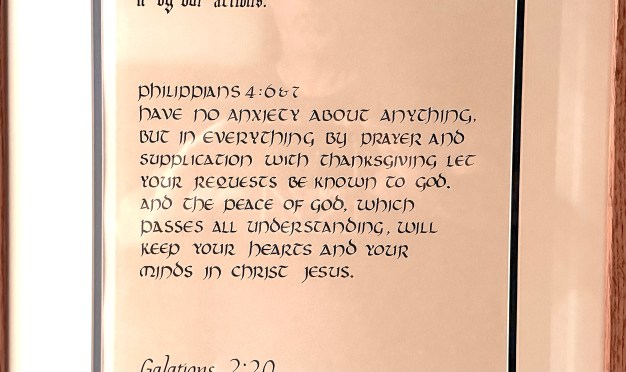
Do not be anxious about anything, but in every situation, by prayer and petition, with thanksgiving, present your requests to God. And the peace of God, which transcends all understanding, will guard your hearts and your minds in Christ Jesus.
Philippians 4:6-7 (NIV)

The paper is so old that it’s faded. I noticed just the other day how it’s showing the wear of time. There’s a large square section that is discolored because of the years it hung where a small ray of sunlight hit it in the same place every day.

When you open the door to my office there hangs a framed piece of paper with three verses written out in three different types of calligraphy. The three verses are among the first I memorized as a young man, and they have spiritually served me more than I can capably communicate along my earthly journey. They were a gift from my brother who was taking a calligraphy class when I was graduating from college almost forty years ago.

One of the verses is from today’s chapter, the verses I pulled and placed/mentioned at the top of today’s post/podcast.

One of the most popular and influential books in the past year or two has been The Anxious Generation by Jonathan Haidt. It tells of the research showing that today’s emerging generation is experiencing unprecedented levels of anxiety and mental illness. I’ve been doing a lot of thinking and meditating on this for multiple reasons. First, the customer and market research my company, Intelligentics, is doing on a regular basis reveals the same things on which Haidt is focused in his scholarly research. Also, I have so many young people in my life, my family, and my circles of influence whom I love deeply. My desire for them is not to be mired in anxiety, but to experience the “peace of God, which transcends all understanding.”

In the quiet this morning, I found myself wondering what I would say to this anxious generation. I think Paul has some sage wisdom for those whose minds and hearts are open to receive it.

First, Jesus is alive, very real, and He offers true hope. Paul experienced a transforming relationship with Christ. I have experienced and am experiencing it, too. If you pay attention, you’ll notice that the world very much wants to dismiss, diminish, and deny this. If you’ll give Jesus a chance, I believe you’ll experience a transformation, as well.

Next, there is power in the words I pasted above. I memorized them. Countless times, in the midst of anxiety, I have recounted them, whispered them, prayed them, thought them, and stated them over and over and over again. I beg you to give it a shot. Can’t hurt, might change your life.

Paul goes on to tell the believers in Philippi “I have learned to be content whatever the circumstances. I know what it is to be in need, and I know what it is to have plenty. I have learned the secret of being content in any and every situation…I can do all things through Christ who strengthens me.” Our world and our economy are based on a system designed to keep us perpetually discontent with ourselves, our lives, our bodies, our circumstances, and our status. It does this because it wants to sell us things and keep us always reaching for the never-ending “more” it claims to offer that will make us happy. There are forces at work that want you to be anxious. Anxious and fearful people are much easier to manipulate and control. Paul, however, discovered a secret that Jesus taught:

“If you decide for God, living a life of God-worship, it follows that you don’t fuss about what’s on the table at mealtimes or whether the clothes in your closet are in fashion. There is far more to your life than the food you put in your stomach, more to your outer appearance than the clothes you hang on your body. Look at the birds, free and unfettered, not tied down to a job description, careless in the care of God. And you count far more to him than birds.

“Has anyone by fussing in front of the mirror ever gotten taller by so much as an inch? All this time and money wasted on fashion—do you think it makes that much difference? Instead of looking at the fashions, walk out into the fields and look at the wildflowers. They never primp or shop, but have you ever seen color and design quite like it? The ten best-dressed men and women in the country look shabby alongside them.

“If God gives such attention to the appearance of wildflowers—most of which are never even seen—don’t you think he’ll attend to you, take pride in you, do his best for you? What I’m trying to do here is to get you to relax, to not be so preoccupied with getting, so you can respond to God’s giving. People who don’t know God and the way he works fuss over these things, but you know both God and how he works. Steep your life in God-reality, God-initiative, God-provisions. Don’t worry about missing out. You’ll find all your everyday human concerns will be met.

“Give your entire attention to what God is doing right now, and don’t get worked up about what may or may not happen tomorrow. God will help you deal with whatever hard things come up when the time comes.”
Matthew 6:25-34 (MSG)

Finally, Paul told the believers to confine our thoughts to things that are:

True
Noble
Right
Pure
Lovely
Admirable
Excellent
Praiseworthy

The next time you find yourself scrolling, I encourage you to ask how much of what you see, hear, and read as you scroll fits these adjectives. May I humbly and respectfully suggest that perhaps there is cause-and-effect at work creating “the anxious generation.”

I was a young man when the personal computer came to be. When I was in high school we had a “computer club” for the very first time in history. The very first thing that I learned in computer club, the first lesson everyone was taught about this emerging technology was this: “Garbage in, garbage out.”

Underlying all of Paul’s sage instructions is a simple truth:

I have free will. I choose.

As a young man I chose to believe words written on what is now faded and discolored paper that reminded me daily not to be anxious but that instead I could pray, be thankful, and seek after things of eternal worth. They served me well. They will serve you well, too.

I’m praying for you.

If you know anyone who might be encouraged by today’s post, please share.

Promotional graphic for Tom Vander Well's Wayfarer blog and podcast, featuring icons of various podcast platforms with a photo of Tom Vander Well.
These chapter-a-day blog posts are also available via podcast on all major podcast platforms including Apple, Google, and Spotify! Simply go to your podcast platform and search for “Wayfarer Tom Vander Well.” If it’s not on your platform, please let me know!
An old and faded piece of paper framed on a wall, featuring three verses written in different styles of calligraphy.

Outward Appearances, Inward Realities

Therefore we do not lose heart. Though outwardly we are wasting away, yet inwardly we are being renewed day by day.
2 Corinthians 4:16 (NIV)

Around our house there is a lot of conversation about generations. In our company’s customer research we are regularly discovering that our clients’ customers are segmented into very different generational groups who have very different expectations and preferences. Companies who don’t recognize and address the differences risk losing business. Personally, I fear that if the institutional church does not recognize and address the differences we may risk losing souls.

For several years now, Wendy and I have followed the writing of Dr. Jonathan Haidt. He has been at the forefront of understanding the negative effects that smart phones have had on children. He was also among the first to cry the warning of what closing schools during COVID was doing to our children. He is also seeing how these things are creating differences in generations of children. Haidt has signed on a young woman named Freya India to his team. She has written an amazing post about Gen Z that everyone should read about why Gen Z will not look back with nostalgia at their own childhood, but rather they are nostalgic about the childhood of previous generations that they never had.

What’s fascinating to me as I ponder the emerging generation of young people is that they are arguably the product of the most blessed, advanced, and affluent society in the history of human civilization. Nevertheless, they are experiencing record levels of anxiety and depression.

This came to mind this morning as I read today’s chapter in which Paul shares with the believers in Corinth the troubles and sufferings that he and his companions have been experiencing as they tirelessly share the message of Jesus with others and lovingly concern themselves with the Corinthians’ well-being. Paul describes his daily realities as “hard pressed on every side…perplexed…persecuted…struck down.” Despite these external physical hardships, Paul says that they are “being renewed inwardly” daily.

As I read this, I thought what a contrast this is to the description that Haidt and India provide us with our current younger generation. Outwardly, it would appear that they are outwardly blessed with affluence, education, technology, safety, security, and health in ways and in levels that no generation before them has ever experienced. Nevertheless, they are inwardly wasting away. In today’s chapter Paul calls his sufferings “treasure” inside the “jar of clay” that is his body. It reminded me of a contrasting reality Ms. India wrote about recently:

I worry because young women like me were raised with only one vision of hell. Now our only nightmare is being restricted by religion, by a relationship, or burdened by responsibilities. But what if hell is also the opposite? What if hell isn’t the faith that makes you stay, but the doubt that makes you leave? What if sometimes the devil is not the voice keeping you trapped, but the one whispering that you are being restricted, wronged, held back—deserve a fresh start? Have we ever considered that the most dangerous ideology might not be the one asking us to have faith through hard things but the one training us to doubt what is good, to see something that should be treasured as a trap?

In the quiet this morning, my heart and mind are pondering how much all of us in this affluent, technologically advanced, safe, secure, and healthy modern reality are suffering the same malady as Gen Z, just not to the same extreme. Outwardly we appear to be healthy, wealthy, and blessed. Factually, we are. Is our “inward” reality the same?

Jesus repeatedly told His disciples that the requirement of being His follower was selflessness, sacrifice, service, and even suffering. For almost every one of His twelve disciples that included suffering excruciating death. It will be the same for Paul. Yet, Paul says his inward reality is Life and love that is renewed daily and flourishing.

God’s ways are not our ways.

As Paul put it, “So we fix our eyes not on what is seen, but on what is unseen, since what is seen is temporary, but what is unseen is eternal.”

I’m in daily need of this reminder.

Where are my eyes fixed this morning?

If you know anyone who might be encouraged by today’s post, please share.

These chapter-a-day blog posts are also available via podcast on all major podcast platforms including Apple, Google, and Spotify! Simply go to your podcast platform and search for “Wayfarer Tom Vander Well.” If it’s not on your platform, please let me know!

Silent and Deadly

Silent and Deadly (CaD Gal 5) Wayfarer

Let us not become conceited, provoking and envying each other.
Galatians 5:26 (NIV)

There are mornings on this chapter-a-day journey when I experience synchronicity. Something in the chapter dovetails perfectly with something else that I’ve read, seen, or considered in the recent past. It happened this morning with regard to a commencement address published in the Free Press by Robert Parham, an Assistant Professor at the University of Virginia’s McIntire School of Commerce. Entitled, “To the Class of 2024: You are All Diseased,” it is well worth the few minutes it will take to read it in its entirety.

The following section, in particular, caught my attention:

You live in the wealthiest country in the history of the world, yet you feel economic anxiety. The late Charlie Munger summarized it succinctly: “The world is not driven by greed. It’s driven by envy.” And in this era of instantaneous communication networks and social media, envy has been put into hyperdrive.

But envy has also been transformed and rebranded. Once a deadly sin, it became a virtue. We call it “fairness” (or sometimes “equity”) now and concentrate our attention on all the ways the world is “unfair.” Mostly the ways that lead to others in our peer group having more than us.

The world is unfair. Deeply so. It’s just that you’re the lucky ones. You won the birth lottery.

In today’s chapter, envy makes the list of “works of the flesh” that stand in opposition to the “fruits of the Spirit” that should be increasingly evident in the lives of every follower of Jesus. Envy makes the list along with things like sexual immorality, orgies, witchcraft, and drunkenness. Along my life journey, I’ve observed that it’s much easier for the institutional church to hone in on the ugly, scandalous, and often public sins like being an addict, sexually immoral, or a member of the local Wiccan coven. Envy is a “pretty” sin that gets both overlooked and ignored. I don’t remember one lesson or sermon in 40 years that took a good look at how destructive envy can be to both our spiritual health and our very lives.

If you’ve had your head buried in the sand somewhere, it should be noted that we are living in a culture with epidemic mental health issues in children and young adults. Drug overdoses, suicides, anxiety, and depression have increased to epidemic proportions. Researcher Jonathan Haidt traces this epidemic back to the introduction of the iPhone with a front-facing camera and an app called Instagram. Suddenly, everyone is taking selfies and publicly sharing their lives with the masses hoping to get “likes,” comparing themselves to others, and wanting to become “influencers.” It’s all driven by envy. We don’t compare ourselves to the billions of human beings who would love to live in our affluent sneakers. We compare ourselves to those few who have more than us: more likes, more fame, more followers, more money, more fashionable clothes, more prestige, more influence, prettier homes, cuter kids, etc.

I think we’re overdue in giving envy the attention it deserves. It is destroying the spiritual and mental health of an entire generation. The institutional church is silent on the subject.

I confess to you that one of the reasons that this topic resonates so deeply within me is because I have always struggled with envy. I didn’t even realize it until I started to really dig into my own flaws and weaknesses as an adult. One of the things I recognized in myself was the fact that I would feel intense antipathy, even hatred, towards certain people. In most cases, it was people I didn’t even know personally. As I confessed this and began digging into why I had these intensely negative feelings towards people I didn’t even know (and were probably really nice people), I realized that underneath it was envy. I wanted to experience the fame, influence, popularity, and prosperity these individuals had experienced. It was silly. It was nonsense. I feel awkward even admitting it, but it’s the truth. I had to repent of my attitude and address the envy that had crept into my heart and brain, silently influencing me for years without me recognizing it.

In the quiet this morning, I find myself grateful for the abundant blessings I enjoy every moment of every day without even thinking about it or stopping to recognize how good I have it. I am reminded of the unhealthy ways envy affected my life without me even recognizing it. I am motivated to continue to reduce the influence that the “works of the flesh” had in my life and increase the “fruits of the Spirit” in my motivations, my thoughts, my words, and my actions.

If you know anyone who might be encouraged by today’s post, please share.