Tag Archives: Mental Illness

Words for “The Anxious Generation”

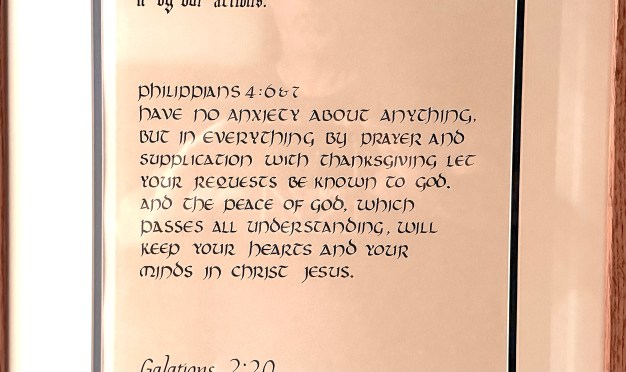
Do not be anxious about anything, but in every situation, by prayer and petition, with thanksgiving, present your requests to God. And the peace of God, which transcends all understanding, will guard your hearts and your minds in Christ Jesus.
Philippians 4:6-7 (NIV)

The paper is so old that it’s faded. I noticed just the other day how it’s showing the wear of time. There’s a large square section that is discolored because of the years it hung where a small ray of sunlight hit it in the same place every day.

When you open the door to my office there hangs a framed piece of paper with three verses written out in three different types of calligraphy. The three verses are among the first I memorized as a young man, and they have spiritually served me more than I can capably communicate along my earthly journey. They were a gift from my brother who was taking a calligraphy class when I was graduating from college almost forty years ago.

One of the verses is from today’s chapter, the verses I pulled and placed/mentioned at the top of today’s post/podcast.

One of the most popular and influential books in the past year or two has been The Anxious Generation by Jonathan Haidt. It tells of the research showing that today’s emerging generation is experiencing unprecedented levels of anxiety and mental illness. I’ve been doing a lot of thinking and meditating on this for multiple reasons. First, the customer and market research my company, Intelligentics, is doing on a regular basis reveals the same things on which Haidt is focused in his scholarly research. Also, I have so many young people in my life, my family, and my circles of influence whom I love deeply. My desire for them is not to be mired in anxiety, but to experience the “peace of God, which transcends all understanding.”

In the quiet this morning, I found myself wondering what I would say to this anxious generation. I think Paul has some sage wisdom for those whose minds and hearts are open to receive it.

First, Jesus is alive, very real, and He offers true hope. Paul experienced a transforming relationship with Christ. I have experienced and am experiencing it, too. If you pay attention, you’ll notice that the world very much wants to dismiss, diminish, and deny this. If you’ll give Jesus a chance, I believe you’ll experience a transformation, as well.

Next, there is power in the words I pasted above. I memorized them. Countless times, in the midst of anxiety, I have recounted them, whispered them, prayed them, thought them, and stated them over and over and over again. I beg you to give it a shot. Can’t hurt, might change your life.

Paul goes on to tell the believers in Philippi “I have learned to be content whatever the circumstances. I know what it is to be in need, and I know what it is to have plenty. I have learned the secret of being content in any and every situation…I can do all things through Christ who strengthens me.” Our world and our economy are based on a system designed to keep us perpetually discontent with ourselves, our lives, our bodies, our circumstances, and our status. It does this because it wants to sell us things and keep us always reaching for the never-ending “more” it claims to offer that will make us happy. There are forces at work that want you to be anxious. Anxious and fearful people are much easier to manipulate and control. Paul, however, discovered a secret that Jesus taught:

“If you decide for God, living a life of God-worship, it follows that you don’t fuss about what’s on the table at mealtimes or whether the clothes in your closet are in fashion. There is far more to your life than the food you put in your stomach, more to your outer appearance than the clothes you hang on your body. Look at the birds, free and unfettered, not tied down to a job description, careless in the care of God. And you count far more to him than birds.

“Has anyone by fussing in front of the mirror ever gotten taller by so much as an inch? All this time and money wasted on fashion—do you think it makes that much difference? Instead of looking at the fashions, walk out into the fields and look at the wildflowers. They never primp or shop, but have you ever seen color and design quite like it? The ten best-dressed men and women in the country look shabby alongside them.

“If God gives such attention to the appearance of wildflowers—most of which are never even seen—don’t you think he’ll attend to you, take pride in you, do his best for you? What I’m trying to do here is to get you to relax, to not be so preoccupied with getting, so you can respond to God’s giving. People who don’t know God and the way he works fuss over these things, but you know both God and how he works. Steep your life in God-reality, God-initiative, God-provisions. Don’t worry about missing out. You’ll find all your everyday human concerns will be met.

“Give your entire attention to what God is doing right now, and don’t get worked up about what may or may not happen tomorrow. God will help you deal with whatever hard things come up when the time comes.”
Matthew 6:25-34 (MSG)

Finally, Paul told the believers to confine our thoughts to things that are:

True
Noble
Right
Pure
Lovely
Admirable
Excellent
Praiseworthy

The next time you find yourself scrolling, I encourage you to ask how much of what you see, hear, and read as you scroll fits these adjectives. May I humbly and respectfully suggest that perhaps there is cause-and-effect at work creating “the anxious generation.”

I was a young man when the personal computer came to be. When I was in high school we had a “computer club” for the very first time in history. The very first thing that I learned in computer club, the first lesson everyone was taught about this emerging technology was this: “Garbage in, garbage out.”

Underlying all of Paul’s sage instructions is a simple truth:

I have free will. I choose.

As a young man I chose to believe words written on what is now faded and discolored paper that reminded me daily not to be anxious but that instead I could pray, be thankful, and seek after things of eternal worth. They served me well. They will serve you well, too.

I’m praying for you.

If you know anyone who might be encouraged by today’s post, please share.

Promotional graphic for Tom Vander Well's Wayfarer blog and podcast, featuring icons of various podcast platforms with a photo of Tom Vander Well.
These chapter-a-day blog posts are also available via podcast on all major podcast platforms including Apple, Google, and Spotify! Simply go to your podcast platform and search for “Wayfarer Tom Vander Well.” If it’s not on your platform, please let me know!
An old and faded piece of paper framed on a wall, featuring three verses written in different styles of calligraphy.

The Depressed Prophet

Cursed be the day I was born!
    May the day my mother bore me not be blessed!
Cursed be the man who brought my father the news,
    who made him very glad, saying,
    “A child is born to you—a son!”
May that man be like the towns
    the Lord overthrew without pity.
May he hear wailing in the morning,
    a battle cry at noon.
For he did not kill me in the womb,
    with my mother as my grave,
    her womb enlarged forever.
Why did I ever come out of the womb
    to see trouble and sorrow
    and to end my days in shame?
Jeremiah 20:13-18 (NIV)

Across the ages, the ancient prophet Jeremiah has been labeled with  the moniker “The Weeping Prophet.” In our bedroom at the lake Wendy and I have a copy of Rembrandt’s portrait of Jeremiah looking depressed and sullen as he sits amidst the ruins of Jerusalem. It reminds me that the lake is a thin place where any who are burdened can find rest for their souls. Alas, it would seem that Jeremiah had no such place.

In today’s chapter we read of a confrontation between Jeremiah and a priest named Pashur, who was “the official in charge of the Temple of the Lord.” The fact that the one “in charge” was out to get Jeremiah is a good indication of just how corrupt the system had become in Jeremiah’s day. The priest in charge of the Temple was overseeing all of the pagan rituals and cults operating out of the Temple. The Temple had become a religious corporation, a powerful money-maker for those in charge (not unlike the way Jesus’ found the Temple in His day).

While Jeremiah had been protected from the death-threats that had already been made against him, Pashur decided to at least punish the prophet for his inflammatory prophesies of doom and destruction. I’m quite sure they were bad for business. In fact, I can almost hear Pashur saying, “This isn’t personal, Jer. It’s strictly business.” Once again, this is not unlike Jesus who, after His repeated rants against their corruption and His stirring up of the people, pressured the Temple leaders to plot His death .

After his time in the stocks, Jeremiah immediately confronts Pashur with a stubborn and willful repeating of his prophetic message: Jerusalem will be destroyed and its people led into captivity at the hands of Babylon. Obviously the prophet wanted Pashur to know his punishment did not have the desired effect. In fact, it simply appears to have pissed Jeremiah off.

What comes next is fascinating. The weeping prophet goes into a depression and pens a dark poem that graphically expresses his wish that he’d never been born. Obviously, the burden of his role, his prophecies, and the steady threats and persecution were getting to him. Of course they were. It would get to me too.

This morning I’m thinking about how common it is for humans to go through periods of depression. If you were privy to my medical records you’d find that I’ve had a few bouts with the blues along my life journey, and I never faced anything like what Jeremiah was dealing with. I’m also thinking about how common it is for individuals in history (artists, musicians, writers, thinkers) who saw and expressed things no one else could see were given to depression, madness, mental illness, and even suicide. I’d certainly put Jeremiah alongside the likes of Van Gogh, Hemingway, and Parker.

I’m struck by the contrast this morning between the spit-shined image I believe we often have of a “godly” person or a “servant of God.” We demand so much, expect so much, and are so quick to scapegoat individuals for their weaknesses and shortcomings. Jeremiah reminds me this morning that God’s servants were fully human, carried human flaws and weaknesses, were susceptible to all the shortcomings known to humanity, and were even given to deep depression and suicidal thoughts. Jeremiah reminds me to cut others a break. He even reminds me to be a bit more gracious with myself.

Wendy and I were at the lake late last week opening it up for the coming summer season. Once again, I saw and pondered Jeremiah’s portrait as I lay in bed.

I’m looking forward to getting back there.

(FWIW: My latest message was added to the Messages page.)