Tag Archives: Safety

Chapter-a-Day Numbers 34

Note to readers: This is an old post from back in 2011 that got lost in my “Drafts” folder and was never published. So, I’m publishing it today. Better late than never. Cheers!

This post is to be found at the entrance to Ki...
Image via Wikipedia

God spoke to Moses: “Command the People of Israel. Tell them, When you enter Canaan, these are the borders of the land you are getting as an inheritance:” Numbers 34:1 (MSG)

When I was a child my family vacationed each year on Rainy Lake in the boundary waters between Minnesota and Ontario, Canada. One summer I went out by myself in a boat deep into the middle of the lake where there were several uninhabited islands. I anchored the boat on the shore of one of the islands and began to explore. There on the island, set in a rock, was a bronze boundary marker designating the border between the U.S. and Canada. I thought it was pretty cool when I stood over the boundary marker with one foot in the United States and the other foot in Canada.

Borders and boundaries are invisible lines, and because they are invisible we often disregard their subtle importance in life and relationships. Boundaries separate but they can also define. They sometimes isolate but they can also bring tremendous clarity. Conflicts (international, local, and interpersonal) are often rooted in the violation of boundaries whether it be geographic, personal, relational, social, spiritual or physical. Having and maintaining clearly defined boundaries provides an environment of self-definition, safety, and health out of which growth, life, and abundance can spring.

Today I’m thinking about my own personal boundaries and the boundaries of my friends and loved ones. I’m praying for the courage and wisdom to define and maintain my own boundaries as well as the love and self-control required to respect the boundaries of others.

The Illusion of Security

Alas for those who are at ease in Zion,
    and for those who feel secure on Mount Samaria….
Amos 6:1a (NRSV)

I have done a fair amount of business travel over the years. It’s interesting to fly in an out of different airports. I’ve been through virtually every major hub in the United States at one time or another, and I’ve also been to a host of tiny, remote airports with only a gate or two. Making your way through the lines of the Transportation Safety Administration (TSA) can be a very different experience from airport to airport.

Over the years I’ve had zealous TSA agents confiscate any number of small objects from my bags which had been ignored by TSA agents at an earlier airport. I just shake my head and let it go. Trying to pick a fight with a surly TSA agent is a losing proposition. At the same time, I have any number of sharp,  roller ball pens which would do real damage to a person’s jugular. As I’m making my way through the TSA line I often think of a scene in the movie Gross Pointe Blank in which John Cusack kills a guy with a cheap ballpoint pen. (I’m a bit hesitant to actually write that. I don’t want the TSA taking away a good pen!)

We talk a lot about the need for safety and security in society, and by all means we should do what we can to eliminate common dangers and threats. The truth is, however, that the idea of complete safety and security are illusions by-and-large. Those who are hell-bent on death and destruction find a way. They always have, and they always will. In recent months we’ve watched as killers who, seemingly unable to acquire guns and bombs, used trucks and vehicles to kill people in crowded streets.

In today’s chapter the ancient prophet Amos addresses those who are sitting in relative safety, security and ease around him. In their ease, luxury, and comfort they remain unaware of the problems surrounding them or the looming threats on the horizon. Amos prophetically warns them of death and destruction to come. It came about 15 years later when the Assyrians rolled over the northern kingdom of Israel. It came about 65 years later for the southern kingdom of Judah when the Babylonians came to town.

What Amos faults his people for in his prophetic poem is their casual disregard for what’s going on around them. They isolated and insulated themselves from the social, spiritual, and political problems of their day. They felt safe and secure, but it was an illusion that left them unprepared for what was coming.

Please don’t read what I’m not writing this morning. I’m all for doing what we can to ensure safety and security. I’m simply reminded this morning that no amount of security or safety measures can eliminate tragedy from striking. This morning I have an image playing in my head of Mad-Eye Moody in Harry Potter and Goblet of Fire demanding of his students “Constant vigilance!” Indeed. I cannot stop tragedy from striking in this fallen world, but I can remain open-eyed and vigilant.

Lesson of the Prophetic Prodigal

In that day people will look to their Maker
    and turn their eyes to the Holy One of Israel.
Isaiah 17:7 (NIV)

Isaiah is taking a prophetic tour of the region of his day. In previous days we’ve been to Moab and Aram. The tour of doom continues today to the kingdoms of Syria, and even to Israel’s northern kingdom.

The Kingdom of Israel split during the time of David’s grandson (Solomon’s son). The southern Kingdom of Judah (David’s tribe) along with the tribe of Benjamin, continued to make Jerusalem its capital city, and continued to put descendants of the line of David on the royal throne. Isaiah was a prophet of Judah. With Solomon’s temple a prominent fixture in Judah, the worship of God was more likely to be central to the lives of citizens there.

The northern kingdom was made up of the other ten of Israel’s tribes. There were different capital cities, but in the days of Isaiah it was in Samaria. The monarchy in Israel was a political free-for-all, and religion was seemingly a free-for-all as well. While Judah was more apt to be faithful to God and the worship of God at Solomon’s temple, the tribes of the northern kingdom were more given to worship of Canaanite deities.

In today’s chapter, Isaiah’s apocalyptic, regional prophecies include their northern kin, though the coming doom does not mean total destruction for Israel. Isaiah speaks of a gleaning (harvest) in which some fruit remains. Isaiah’s message predicted the regional invasion of the Assyrians, in which the Assyrians would take many captive and leave a few behind. This was a common practice of siege warfare in that day.

From a spiritual perspective, the tribes of Israel and Judah are bit like Jesus’ parable of the prodigal son. While Jesus’ parable was not intended as a political allegory, the the metaphor of the parable resonates. Judah the more dutiful older son and Israel the rebellious younger son. God has a pattern of allowing His children freedom of will to accept or reject His ways, and equally allowing his children to experience the painful fruits of their own actions and decisions.

This morning I am thinking about how easy it is as parents to want to protect our children from themselves. When we control all behavior, control all exposure to the world, and protect children from all harm they are more likely to be safe. They are also less likely to be wise. It is only in the distant country, and in the painful consequences of his own actions, that the prodigal realizes his folly and makes a choice to return home.

Isaiah’s prophecy of Israel pre-figures the lesson of the parable. Israel will suffer the devastation of an Assyrian siege, its best and brightest will be taken into captivity, but the painful lesson will turn the hearts of the prodigal back to their spiritual Father.

The Luxury of Relative Peace and Safety

Ar in Moab is ruined,
    destroyed in a night!
Kir in Moab is ruined,
    destroyed in a night!
Isaiah 15:1 (NIV)

It’s hard to believe that those now graduating from high school have no recollection of life before 9/11. How quickly life, as we knew it, changed that day. I can still remember walking by the cafeteria inside my client’s office building that morning and catching a crowd of people huddled beneath a suspended television. Out of my peripheral vision I saw it, and it caused me to stop and wonder what was going on. I slipped quietly to the back of the crowd and watched the first tower burning. While I was standing there watching the second tower was struck. I packed up my things and went home. I knew that all of our meetings would be cancelled that day.

It had really been 50 years since the last time an event of that magnitude shook the U.S. From the accounts I have read, and from the testimony of my family members I know that Pearl Harbor had a similar effect. Everything changed in a moment.

It is a luxury to live in relative peace and safety.

I read the words of Isaiah’s prophecy against the ancient cities in Moab. I try to imagine what it was like in that day. How hard life must have been. How dangerous. A wandering raiding party could change everything for you and your family in a moment. I have to believe that is how it is for many people today living in certain villages of  Syria, Iraq, Afghanistan, the Ukraine, and other war zones.

It is a luxury to live in relative peace and safety.

This morning I’m waking up to a beautiful morning. I will go to my client’s office. I will conduct my training sessions and return to my hotel. My concern this morning is not fear of life, of safety, of security or provision for me and my loved ones. My concern is finding my way in a city strange to me, finding favor with the new team with whom I’m working, where I’m going to eat tonight among the myriad of choices, and my beloved Cubs finding their offense tonight against a formidable Cleveland pitching staff.

It is a luxury to live in relative peace and safety.

Thank you God, for blessings I so often take for granted. Shower your peace, safety, and provision on those who know they afford no such luxury this day.

chapter a day banner 2015

Featured image courtesy of Jason E Powell via Flickr

Status Quo

source: pictoquotes via Flickr

They said, “What will we do with them? For it is obvious to all who live in Jerusalem that a notable sign has been done through them; we cannot deny it. But to keep it from spreading further among the people, let us warn them to speak no more to anyone in this name.” Acts 4:16-17 (NRSV)

Along life’s journey, I have had the opportunity of finding myself in leadership of different groups and organizations. As a leader, I am always looking for ways that things can be improved. I want to be effective and for whatever I’m involved in to have a positive and lasting impact. Often, this means I have to fight against the entrenched attitudes of others.

I have found that there will always be individuals who are motivated by a need for a sense of safety and stability. These individuals can easily equate sameness with safety. If things remain exactly the same then the anxiety produced in their spirits by the fear of change is reduced to acceptable levels. Sameness becomes tradition which is zealously protected. When personal authority and power is attached to the tradition, the desire to shun change and maintain the status quo becomes even stronger.

I was amazed reading today’s chapter that the priests and temple leaders gave little thought to the fact that a well known person in their community, a man who had been lame his entire life, was healed and dancing in the streets. They were not the least bit concerned about the miracles which were taking place or the thousands of individuals in whom God was working with life changing power. Their only concern appears to have been maintenance of the status quo and their vice grip hold on power.

Today, I’m praying that I never become one who fears change. Jesus said, “you don’t put new wine in old wineskins, otherwise the skins will burst and the wine is lost.” I want my heart and mind to remain fresh and pliable so that any new thing God is doing will fill me with Life rather than cracking and bursting my spirit because of some false sense of security to which I cling. I want to be part of whatever new thing God is doing in our midst.

Carte Blanche Companions


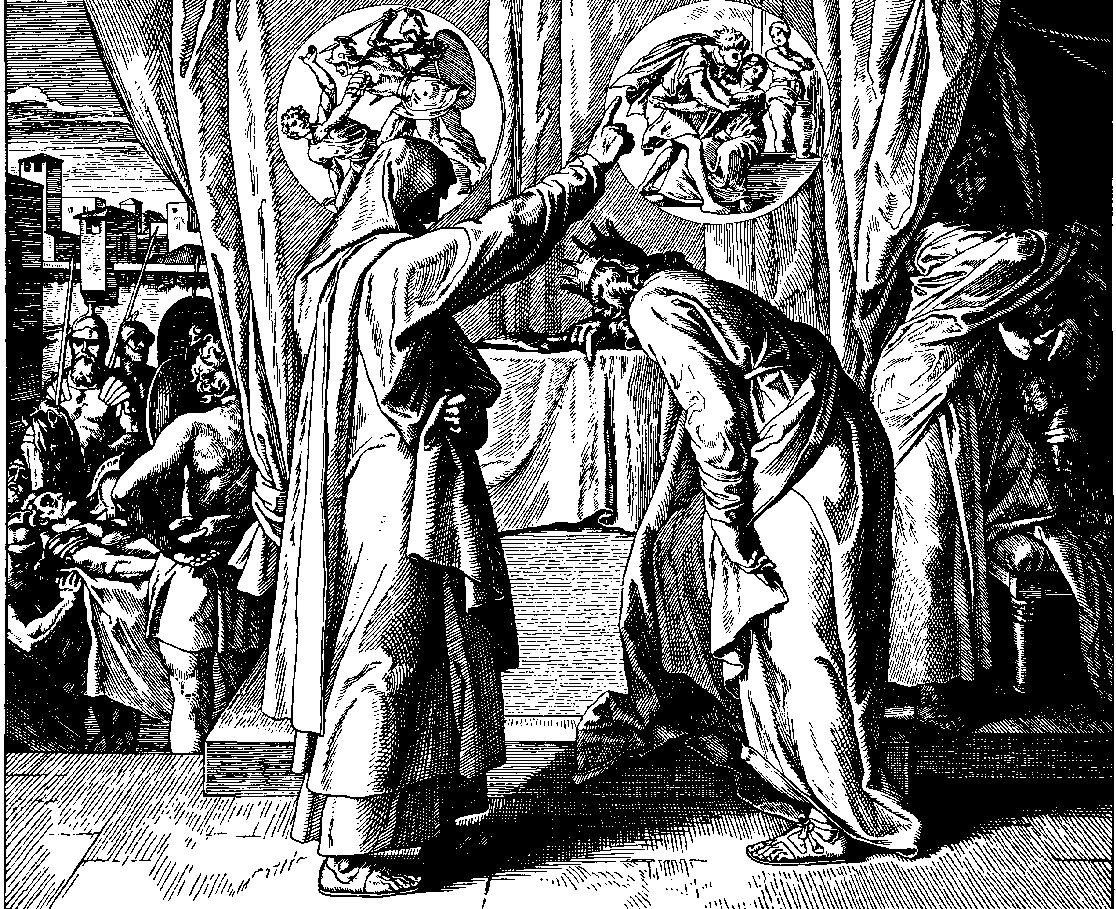
Joab confronts the grieving King David

Then Joab went into the house to the king and said, “Today you have humiliated all your men, who have just saved your life and the lives of your sons and daughters and the lives of your wives and concubines. You love those who hate you and hate those who love you. You have made it clear today that the commanders and their men mean nothing to you. I see that you would be pleased if Absalom were alive today and all of us were dead. Now go out and encourage your men. I swear by the Lord that if you don’t go out, not a man will be left with you by nightfall. This will be worse for you than all the calamities that have come on you from your youth till now.” 2 Samuel 19:5-7 (NIV)

One of the most fascinating aspects of my day job is the opportunity I have to work with many different companies and to interact with people at diverse levels of the organization from the front-line to the executive suite. Long ago I realized that the culture of a company is a trickle-down affair that begins with the man or woman at the very top. I remember one client whose CEO ran the company by fear and intimidation. No one would stand up to him, even when he is clearly mistaken or making a wrong move, for fear of losing their proverbial heads in a board meeting (and, perhaps, their jobs). The result was a highly dysfunctional organization which mirrored the CEO. The entire corporate culture was one of intimidation, fear, and c.y.a. which permeated virtually every level of the operation.

One of the things I’ve observed about David as we’ve been reading his story the past few months is the fact that David had a select group of men in his life who could get in his face and call him to account even if they had to be careful about how they did it. In today’s chapter, David’s general and right-hand man Joab confronts David about the grave danger he’s putting himself in by allowing his grief for Absalom overshadow his duty as king. The kingdom was in a precarious political situation and David was close to losing it all. Joab lost no time in getting in David’s face and speaking the truth to him. To his credit, David listened to his long-time trusted general and advisor.

I have a handful of people in my life, people with whom I have intentionally surrounded myself, who have carte blanche to get in my face whenever necessary. These are people with whom I talk about and share life with on a regular basis. We talk about business, church, family, friendships, finances, and relationships. If they think I’m screwing something up, then they have permission to question me or call me out, and they would expect the same from me.

This journey through life can be a long hike. The first rule any child learns about hiking in the wilderness is “buddy up.” To go it alone is to put yourself in danger. Ironically, our greatest danger often resides within ourselves. Without faithful companions who can catch it and call us out, we may not realize it until it’s too late.

Today, I’m thankful for my faithful companions on this life journey.


Enhanced by Zemanta

Assurance for “a Dangerous Business”

United FlightThe Lord will keep you from all harm—
    he will watch over your life;
the Lord will watch over your coming and going
    both now and forevermore.
Psalm 121:7-8 (NIV)

Compared to passionate travelers and corporate road warriors, this wayfaring stranger is a relative lightweight. Yes, my parents claim never know where I am on any given day, friends joke with me about my regular business travels, and Wendy and I think we’re apart, way, way, way too much. Despite my closing in on a half-million lifetime miles with United and my pocket full of rewards memberships, however, I am usually 28th on the list of 34 people on my flight’s upgrade list. I keep an annual eye on my status with both United and Marriott just to make sure I get the few meager perks they dish out to travelers like me so as to make road trips a tad bit easier.

When I’m on the road and away from home, there are always thoughts of safety and making it home in one piece. Whenever I take off on a trip, Bilbo’s words to Frodo in The Lord of the Rings always flit through my head:

“It’s a dangerous business, Frodo, going out your door. You step onto the road, and if you don’t keep your feet, there’s no knowing where you might be swept off to.”

As I sit in my hotel room a thousand miles from home this morning and look forward to tomorrow’s return trip , I deeply appreciated the lyrics of today’s psalm. Mired somewhere between being a homebody and a road warrior, it’s wonderful to have the assurance of God vigilantly watching over me.


Enhanced by Zemanta

Chapter-a-Day Psalm 28

The Lord gives his people strength.
    He is a safe fortress for his anointed king.
Psalm 28:8 (NLT)

When I was a kid, my grandfather was fond of saying that he was “King of this castle!” Usually, it was said in jest at the dining room table as he pounded his fist and asserted his authority (before being reminded that he had his wife’s permission to say so). Still, our jests are often rooted in deeper truths and I observed throughout my childhood that my grandfather’s home was, in fact, his castle. It was the place he found refuge. He loved being at home.

From the time we are young, we have a natural affinity for building forts, fortresses, and tree houses. I can remember constructing fortresses made of mattresses and pillows, blankets and tables, and the ever present snow of an Iowa winter. Forts are a place of imaginative play. They are a safe place, a protective place, and place away from outside threat where we can rest and re-create.

I believe that adults are more like children than we care to admit. As we get older we still need our forts and places of refuge. My office here at home is my fortress. It is here that I find quiet each morning to converse with God, meditate on His Message, and write my blog posts. It is here that I imagine and read and write. I’m blessed to get to work here, too. It is my safe place, and when I am gone on the road or at the lake for extended periods of time, I find myself missing it.

Today, I’m thinking about the safety and security I feel in my little 12′ x 12′ fort each morning. I’m grateful to have a physical place of refuge; to be “King of this Castle” (and to have my wife’s permission to say so). I’m considerate this morning of the fact that God’s ever-presence is a place of refuge no matter where I find myself; no matter what the circumstance.

Chapter-a-Day Psalm 3

Hammer365: 108/257 Grandma's Mantle Clock
Hammer365: 108/257 Grandma’s Mantle Clock (Photo credit: David Reber’s Hammer Photography)

I lay down and slept,    
     yet I woke up in safety,    
     for the Lord was watching over me. 
I am not afraid of ten thousand enemies    
     who surround me on every side.
Psalm 3:5-6 (NLT)

I’ve never been a great sleeper. When I was a little tike I was that kid. At 5:30 a.m. I was at my parents bedside.

Come on. Mom? Dad?
I’m awake.
Somebody get up.

I remember my dad marching me into the dark living room. There was an antique mantle clock on the shelf. It chimed the hours. My dad pointed to it.

“Until that clock strikes six. I don’t want to see your face!”

Point taken.
But, it doesn’t change the fact that I’m awake at 5:30.
And, you didn’t say I couldn’t get up. You just said you didn’t want to see my face.

So, I would get out of bed each morning and scamper down the steps to the dark living room where I hid behind the gold rocking chair in the far corner (you never know if Dad might get up early; Can’t let him see my face). From there I could peek around the chair and keep my eyes glued to the mantle clock. I could listened to it tick…tick…tick…tick. I waited…for…it…to…chime…six.

I’ve gotten better about sleeping, though I still have bouts with insomnia. I appreciate the blessing of a good night’s sleep. This morning’s chapter makes me think about the millions of people who sleep each night in terror or in hunger or in anxious thought for how they will survive another day. I think about waking in safety and hope of a new dawn and a new day of uncounted blessings. I think about the joy of seeing the faces of those I love and through whom I am loved (after six o’clock, of course; well, with Wendy make it seven o’clock…or eight).

Today, I’m grateful for sleeping in safety; God watching over me. I’m thankful to be able to enter the day with hope and assurance.

Chapter-a-Day Leviticus 18

creative commons photo via Flickr & eyeliam

God spoke to Moses: “Speak to the People of Israel. Tell them, I am God, your God. Don’t live like the people of Egypt where you used to live, and don’t live like the people of Canaan where I’m bringing you. Don’t do what they do. Obey my laws and live by my decrees. I am your God. Keep my decrees and laws: The person who obeys them lives by them. I am God. Leviticus 18:1-5 (MSG)

When, as parents, we make rules for our children there is generally a reason behind the rules. A young child doesn’t like, nor does he or she understand, the need to be strapped tightly into a car seat. It’s uncomfortable and confining to a little one naturally given to constant movement and squirming. Any parent can attest to the screams, tears and rebellious striving which occurs when strapping a squirmy toddler into a car seat. We as parents understand, however, that in the big picture we’re preserving and protecting life.

As I journey through Leviticus, I’m not just looking at God’s rules, but trying to discern our Heavenly Father’s motivation in making the rule in the first place. As I read through the laundry list of rules regarding sexual behavior in today’s chapter, a couple of thoughts came to mind:

  • The cultures of that day were given to sexual immorality. The beginning of today’s chapter makes it clear that these rules were meant to differentiate God’s people from the people around them. Incestuous relationships in ancient Egypt are well documented by historians. God wanted His people marked by their purity, not their perversions.
  • There is a constant theme in the chapter, not just about sexual acts, but the violation which takes place within the act.  Sex outside the lines creates personal, relational, spiritual and societal violations. Rather than building healthy souls, relationships and a stronger society, sexual violations tear individuals and relationships apart, weakening the societal fabric. Historians have clearly linked moral decline with the demise of multiple ancient societies. It’s not rocket science.
  • There is a direct connection between the sexual and the spiritual. Many of the gods and idols in ancient times were fertility gods whom cultures worshipped by committing sexual acts. Fertility gods became a kind of spiritual cover for prostitution and any number of sexual behaviors the fell outside God’s intentions. There is a particular reference to Molech (a.k.a. Moloch) in today’s chapter, who was a god worshipped by many of the cultures in the area where the Israelites wandered. People brought their children to be sacrificed (typically burned alive) to Molech. It is often argued that gods like Molech rose from sexually dysfunctional, spiritually dead cultures as they sought to justify their behavior and eliminate the unwanted consequence of their illicit sexual activities. It was a pretty preverse cycle. Give yourself over to unbridled sexual activity in the worship of a fertility god, but when the sexual act actually results in fertility you sacrifice the baby back to the fertility god.

I have to connect the dots here. Sex outside the lines creates personal and relational violations in which individuals are victimized. To perpetuate and justify the repeated violation,  we must depersonalize and diminish the victim, as well as eliminate the unwanted result [read: children].

I have to dig one level deeper. I have to believe that it is not just about society as a whole with which God is concerned. Any who have struggled with pornography or sex outside the lines can attest to the truth that a microcosm of this same destructive spiritual regression can occur within the individual human soul.

God made his motivation clear in his preamble to the sexual rules in today’s chapter. The rules were intended to preserve and promote individual, spiritual, relational and societal life. God was tightly buckling his young nation of sinful people into a cultural car seat knowing that death would result on many levels for not doing so.