Tag Archives: September 11

Generations

But Rehoboam rejected the advice the elders gave him and consulted the young men who had grown up with him and were serving him.
1 Kings 12:8 (NIV)

When I was a young man, I had all the confidence in the world. I had an intense belief that I could do anything to which I set my mind. I didn’t even question it. The only question was what it was to which I would set my mind and heart. I was three years old when Neil Armstrong stepped foot on the moon, and for my generation, I believe there was a certain anticipation and belief that we could shoot for the stars. Our grandparents were “the greatest generation” who grew up during the Great Depression and gave their lives to save the world from tyrannical evil in World War II. Our parents’ generation put men on the moon. There was no limit to what our generation could accomplish.

In those early years, I don’t remember having much anger or animosity toward the previous generations other than what I perceived to be their blind obedience to institutions and institutional traditions. I was an obedient and good kid for the most post, but I bucked traditions that I found silly and void of any tangible purpose.

By way of contrast, our daughters’ childhood and youth were marked by September 11, 2001, and a post-9/11 world. Taylor was 11, and Madison was not quite 10. Now in their 30s, I look at their generation and find them to have a very different mindset. My personal observation has been that they’ve largely rejected the faith and belief systems of previous generations outright. Despite being arguably the most affluent and privileged generation in the history of humanity, theirs is a pessimistic and cynical worldview of a world made perpetually evil by the previous generations and their belief systems, an assuredly apocalyptic future from any number of doomsday scenarios from climate change to capitalism, and their conviction that only they can change the world and save it for subsequent generations.

Generations are fascinating.

In today’s chapter, Solomon’s son Rehoboam takes over his father’s throne. I couldn’t help but think through the experience of the generations:

Generation #1: David
David has an incredibly difficult journey to the throne. Despite his early victory over Goliath and popular acclaim, David lives as a mercenary in the desert with a price on his head for well over a decade. He’s a middle-aged man by the time he ascends to the throne. He earned the kingdom through grit, faith, perseverance, and conquest.

Generation #2: Solomon
David’s marriage to Bathsheba and the subsequent birth of Solomon came relatively late in David’s life and reign. Solomon was born into the wealth and power of the royal family, but he was relatively young when he ascended the throne and inherited a vastly larger and wealthier nation that his father had spent a lifetime building. Solomon enjoyed the heck out of it, but his excess and extravagance came at a heavy expense to the everyday people of the nation.

Generation #3: Rehoboam
From what we can surmise, Rehoboam never knew a difficult day in his life. He great up, not only in the Royal palace like his father, but he also experienced the wealth, extravagance, and excess with which his father lived. Solomon may have known privilege, but Rehoboam knew only privilege and fortune on steroids. When he finally has his chance at the throne, he has no regard for his people or his nation. He and his entourage of similarly privileged and wealthy friends treat the throne as if it’s their golden ticket to continue their extravagant living while using their power to lord themselves over others.

In the quiet this morning, I ponder my place in the Great Story from a historical and generational perspective. On one hand, I feel humble in accepting the reality that generations are often unwitting products of the generations before them and the circumstances around them over which they have no control. On the other hand, I find myself desiring to not be fatalistic about the differences between generations but rather to help other generations with the wisdom of experience. Ultimately, you can’t control whether another generation will listen to or accept that wisdom.

The elders who tried to speak wisdom into Rehoboam learned that the hard way.

If you know anyone who might be encouraged by today’s post, please share.

The Luxury of Relative Peace and Safety

Ar in Moab is ruined,
    destroyed in a night!
Kir in Moab is ruined,
    destroyed in a night!
Isaiah 15:1 (NIV)

It’s hard to believe that those now graduating from high school have no recollection of life before 9/11. How quickly life, as we knew it, changed that day. I can still remember walking by the cafeteria inside my client’s office building that morning and catching a crowd of people huddled beneath a suspended television. Out of my peripheral vision I saw it, and it caused me to stop and wonder what was going on. I slipped quietly to the back of the crowd and watched the first tower burning. While I was standing there watching the second tower was struck. I packed up my things and went home. I knew that all of our meetings would be cancelled that day.

It had really been 50 years since the last time an event of that magnitude shook the U.S. From the accounts I have read, and from the testimony of my family members I know that Pearl Harbor had a similar effect. Everything changed in a moment.

It is a luxury to live in relative peace and safety.

I read the words of Isaiah’s prophecy against the ancient cities in Moab. I try to imagine what it was like in that day. How hard life must have been. How dangerous. A wandering raiding party could change everything for you and your family in a moment. I have to believe that is how it is for many people today living in certain villages of  Syria, Iraq, Afghanistan, the Ukraine, and other war zones.

It is a luxury to live in relative peace and safety.

This morning I’m waking up to a beautiful morning. I will go to my client’s office. I will conduct my training sessions and return to my hotel. My concern this morning is not fear of life, of safety, of security or provision for me and my loved ones. My concern is finding my way in a city strange to me, finding favor with the new team with whom I’m working, where I’m going to eat tonight among the myriad of choices, and my beloved Cubs finding their offense tonight against a formidable Cleveland pitching staff.

It is a luxury to live in relative peace and safety.

Thank you God, for blessings I so often take for granted. Shower your peace, safety, and provision on those who know they afford no such luxury this day.

chapter a day banner 2015

Featured image courtesy of Jason E Powell via Flickr

Sudden Realization

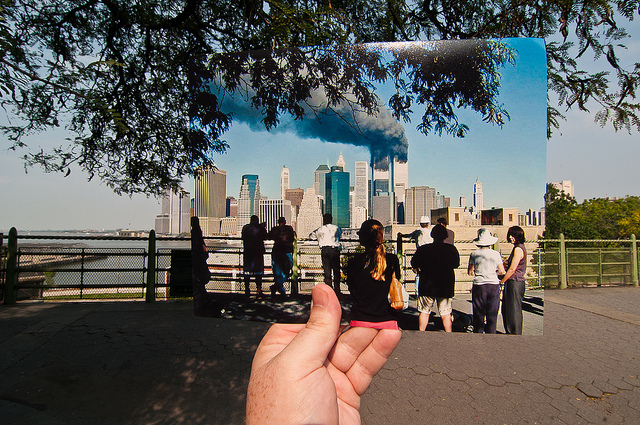
September 11, 2001 attacks in New York City: V...
(Photo credit: Wikipedia)

Terrified at her torment, they will stand far off and cry:
“‘Woe! Woe to you, great city,

    you mighty city of Babylon!
In one hour your doom has come!’
Revelation 18:10 (NIV)

I had arrived at a client’s office first thing on the morning of September 11, 2001. I was scheduled to conduct a number of call coaching sessions that day. As I entered the building I passed by the corporate cafeteria and glanced inside. A large crowd of people were huddled beneath one of the televisions that were mounted on the wall. There was something eerie and surreal about the silent crowd and the empty stares on their faces. It stopped me in my tracks.

I stepped into the cafeteria and stood on the outskirts of the silent, huddled mass. I looked up at the television and viewed for the first time the iconic image of the World Trade Center with a giant plume of smoke billowing out of it. For the first few moments I took in what was being said by the reporters and the hushed whispers around me. “Tragic accident,” was what everyone was saying. It was only a minute or so later that there was a blur on the screen and everything shook. A second plane struck the other tower. In that moment I knew two things: 1) It was not an accident and 2) I would be doing no call coaching that day. I grabbed my briefcase and headed home where I sat and watched the horrific events of that day unfold.

One of the things that I took away from that day is how quickly things can fall apart. When John had his vision, the world was a very different place. Great cities were not destroyed in an hour, they were subject to long sieges that could take months and years. There were, of course, natural disasters like ancient Pompeii which could and still can bring about rapid and massive destruction. Nevertheless, the idea of a great city being brought to its knees in an hour was almost unfathomable.

Until now. I had seen the black and white news reels of the German blitz on London and the reciprocal Allie bombings in Europe. I had seen the documentaries of Hiroshima and Nagasaki. They were all, however, scratchy black and white film from a time before I was born. Even growing up in the Cold War era of “duck and cover” drills, the idea of sudden destruction was simply that – an idea. On 9-11, along with everyone else, I witnessed how quickly things can fall apart.

I see today’s chapter differently than I did before that fateful day. I have heard the endless speculation of prophetic junkies who wax ceaselessly their theories about the identity of Babylon and the beast she rides in John’s vision. I don’t find the chatter worthwhile. When I read the chapter I see the big picture that is painted in John’s vision of the prophesied future: Sudden destruction followed by economic chaos. For the past thirteen years I have lived with a greater understanding that the fulfillment of that vision could be a sudden reality almost any day. I do not live in fear and anxiety of that day, but I do enter this day with the realization of how fragile our world really is, and of what is truly important.

Enhanced by Zemanta