Tag Archives: Jeremiah 3

Faith-less or Un-faithful?

The Lord said to me, “Faithless Israel is more righteous than unfaithful Judah.”
Jeremiah 3:11 (NIV)

There is a stretch of my life journey that I look back on and call “the dark years.” I was angry for a number of reasons, and underneath the anger was an internal struggle with God, with myself, and with my circumstances. In this struggle, I acted out in unhealthy ways.

A therapist friend of mine says that “everyone is having a conversation with Life,” and I have found this to be true in my own experience. During my dark years, I wasn’t ignoring God or pretending He didn’t exist. I was in constant conversation with God. Like a rebellious teenager, I screamed at God. I threw tantrums. I argued with God, I swore at God, and I defiantly did things I was forbidden to do out of spite. And, when my attitude and actions led to really painful places, I found myself walking in the shoes of the Prodigal. I was humbled. I was broken. I was ashamed of the pain I had caused my loved ones, and I returned to the arms of my Heavenly Father and learned what “amazing grace” really means.

The dark years came to mind as I read today’s chapter. It begins with God addressing the southern kingdom of Judah. Judah couldn’t make up their mind regarding their relationship with God. Of their 20 monarchs, nine of them were somewhat faithful to God, while 11 of them followed after the local pagan gods. I can’t help but think of the words of the prophet Elijah from a couple hundred years before Jeremiah: “How long will you waver between two opinions? If the Lord is God, follow him; but if Baal is God, follow him.”

I have to remember that Jeremiah is addressing the people of Judah amidst the religious reforms enforced by King Josiah. The people of Judah are pining for their idols despite the fact that the king has destroyed and outlawed them. They feel no shame about this. Theirs is a life of duplicity and wavering. They want it both ways. They contend to have an open marriage with God. “I should be able to make love to my pagan idols, and God should love and bless me anyway.”

God then tells Jeremiah to consider the northern kingdom of Israel. At the time of Jeremiah’s prophetic sermon, Israel had been destroyed by the Assyrians and led into captivity a hundred years before. Unlike Judah, Israel didn’t waver. They wholeheartedly went after idolatry. Not one of their 19 kings was faithful to God. Like me in my dark years, they flipped off their Heavenly Father in oppositional defiance. And, then they hit rock bottom thanks to the Assyrian Empire.

Now God speaks to Jeremiah as a frustrated yet loving Father. He sees Israel’s outright rebellion as more honest than the duplicitous wavering of her sister, Judah. God uses two different Hebrew adjectives. Israel was “faith-less” (there was no attempt to even pretend they cared) while Judah was “un-faithful” (they toyed and pretended they would be faithful, only to betray God over and over again). Father God then has Jeremiah face the leftover remnants of His people in the north and pleads for the Prodigal to return.

In the quiet this morning, I find myself mulling over my dark years. Ugh! I honestly see the shadow of both Judah and Israel in my own oppositional defiance, neither of them good. But today’s chapter has me contemplating the fact that there is something that God respects in those sinners who don’t even pretend to care about Him in contrast to those who say they love Him and then live as if they love the world and the things of the world. I see this in the way Jesus hung out with the outright “sinners” like Israel while directing His sharpest criticism and condemnation on the “religious” leaders who, like Judah, pretended they were faithful, but whom Jesus described as “whitewashed tombs, which look beautiful on the outside but on the inside are full of the bones of the dead and everything unclean.”

I head into the day with this episode from Matthew 9:11-13 resonating in my spirit:

Later when Jesus was eating supper at Matthew’s house with his close followers, a lot of disreputable characters came and joined them. When the Pharisees saw him keeping this kind of company, they had a fit, and lit into Jesus’ followers. “What kind of example is this from your Teacher, acting cozy with crooks and misfits?”

Jesus, overhearing, shot back, “Who needs a doctor: the healthy or the sick? Go figure out what this Scripture means: ‘I’m after mercy, not religion.’ I’m here to invite outsiders, not coddle insiders.”

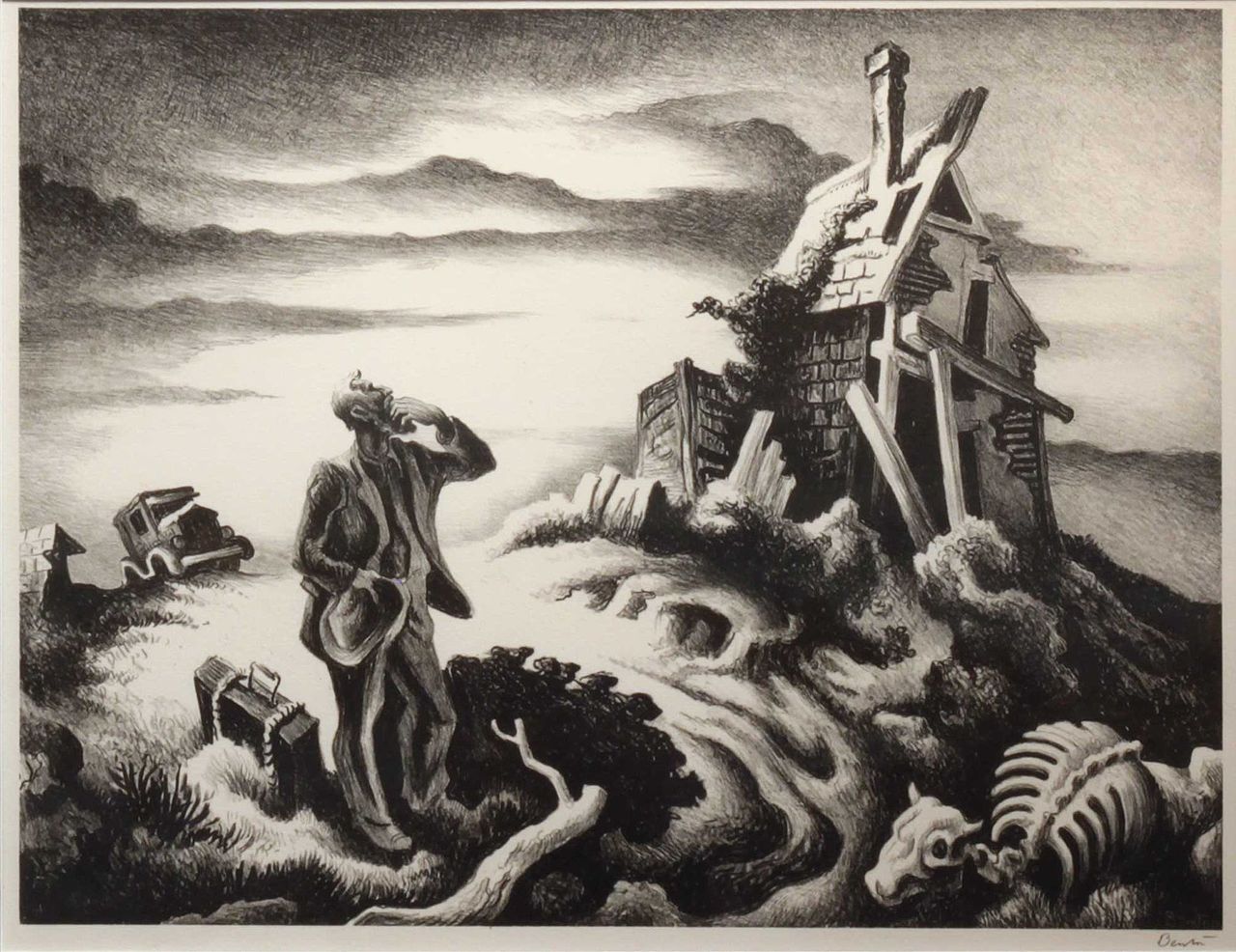
Featured Image: Prodigal Son by Thomas Hart Benton

If you know anyone who might be encouraged by today’s post, please share.

Return

Return, O faithless children,
    I will heal your faithlessness.
“Here we come to you;

     for you are the Lord our God.”
Jeremiah 3:22 (NRSVCE)

I recall an episode with one of our daughters a number of years ago. The details of the episode are irrelevant. Our daughter had placed a considerable amount of relational distance between herself and me. She made some choices that she assumed would not make me very happy, and she basically hid from me for a period of time.

When things were eventually revealed I was, admittedly, upset. My anger, however, was not so much with the choices she feared would upset me as it was with the fact that she felt she must hide and distance herself from me.

“When have we ever been unable to talk things out?”
“When have I ever been unreasonable?”
“When have I ever demanded my own way of you?”
“When have I not allowed you to make your own choices?”
“What must you think of me that you can’t be honest with me?”
“Do you honestly think I would reject you?”
“Do you not realize how much I love you?”
“Do you honestly think my love for you is so conditional?”

These are the questions that plagued me. The injury I felt ultimately had less to do with the choices she had made, for they affected me very little. The injury I felt had more to do with the relational choices   between her and me. They affected me deeply. I love her so much.

Eventually, we talked. We reasoned. There were injuries and misunderstandings that lay underneath the surface. I am not a perfect parent. She is not a perfect child. We slogged through the hard stuff. We forgave. We reconciled. We restored. We learned valuable lessons about ourselves and each other in the process. We let go of what was behind and pressed forward. Old things pass away.

In today’s chapter, Jeremiah’s prophetic poem is about a heavenly father’s frustration with wayward Israel and wayward Judah. Anger and frustration are present, but ultimately there is simply a call to return, to come home, to be reconciled, and for relationship to be restored.

“Return” is a recurring theme throughout the Great Story. Jesus took it to a new level in the beautiful parable of the Prodigal son. Jesus would experience the theme interpersonally in Peter’s denial and ultimate restoration on the shores of Galilee. It is a human story and a Spirit story. We all experience it in various forms both relationally and spiritually in our own respective journeys.

This morning in the quiet I am thinking about the theme of “return” in my own multi-layered experiences across 50-plus years. I’m thinking about my own wayward actions as a son of my parents. I’m thinking about my experiences as a father. I’m thinking about my own prodigal stretches in life when I walked in the shoes of my own daughter; When I made the same mistaken projections and misguided choices.

It’s easy to read God’s Message and to feel the weight of a Father’s frustration so acutely as to miss the heart and the hurt of a loving parent aching for His child to return. Jesus came to recalibrate our thinking and to reconcile us to God…

“When he was still a long way off, his father saw him. His heart pounding, he ran out, embraced him, and kissed him. The son started his speech: ‘Father, I’ve sinned against God, I’ve sinned before you; I don’t deserve to be called your son ever again.’

“But the father wasn’t listening. He was calling to the servants, ‘Quick. Bring a clean set of clothes and dress him. Put the family ring on his finger and sandals on his feet. Then get a grain-fed heifer and roast it. We’re going to feast! We’re going to have a wonderful time! My son is here—given up for dead and now alive! Given up for lost and now found!’ And they began to have a wonderful time.”

Return. The Father is waiting.

Chapter-a-Day Jeremiah 3

NYC - Brooklyn Museum - Auguste Rodin's The Pr...
Image by wallyg via Flickr

The sound of voices comes drifting out of the hills, the unhappy sound of Israel’s crying,
Israel lamenting the wasted years, never once giving her God a thought.

“Come back, wandering children!  I can heal your wanderlust!”

Jeremiah 3:21-22 (MSG)

There are multiple paths from which to choose in life. Each day we make choices which way we are going to go. Which one of us have not, at one time or another, willingly chosen the road we know is wrong for us? Who among us has not found ourselves in places we regret?

I think it’s a good reminder on New Year’s Eve, as we all consider where we’ve been, where we are, and where we’re going. No matter where this day finds us and no matter how lost we might be (as the prodigal son discovered) it is never too late to turn and head back home.

Enhanced by Zemanta