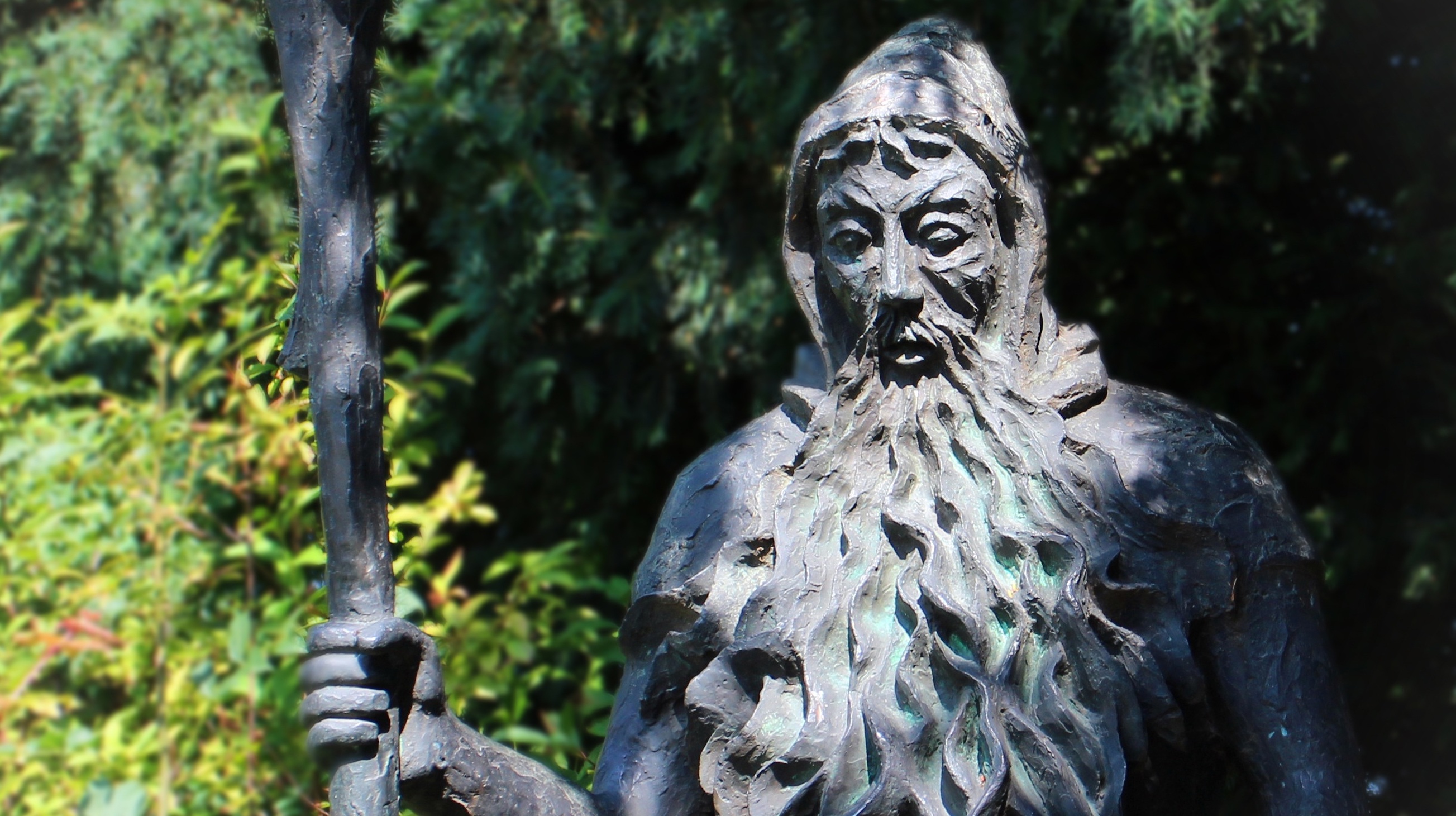
Tag Archives: Archetype

Trailblazer

In bringing many sons and daughters to glory, it was fitting that God, for whom and through whom everything exists, should make the pioneer of their salvation perfect through what he suffered.
Hebrews 2:10 (NIV)

A month or so ago I had to make a trip to northwest Iowa for work. I decided to take a little extra time on that gorgeous autumn day to enjoy the road trip. The Missouri River provides Iowa’s western border and along this stretch is a geological formation, Loess Hills, that is only found one other place on Earth, in China. I took my time traveling up the backroads of Loess Hills and along the Missouri River Valley. The featured photo on today’s post is one I took that afternoon.

220 years ago, Lewis & Clark and the Corp of Discovery made their way up the Missouri River along the same stretch. The only member of that legendary crew of pioneers to die on the voyage, Sergeant William Floyd, did so near Sioux City, where my meanderings led that afternoon. The references to Floyd, Lewis, and Clark are everywhere in that part of the state, from highways to backroads to towns, and rivers.

“Pioneer” is layered with meaning for many Americans. My very life here in Iowa is rooted in my pioneer great-grandfather who risked all to leave the Netherlands as a young man and, by himself, create a new life in America. American history itself is steeped in the legendary stories of pioneers like Lewis and Clark who blazed the trail for others.

It was the word “pioneer” that leapt off the page at me in the quiet this morning. It’s not a word that appears anywhere in the Great Story except two uses by the author of Hebrews. The Greek word translated “pioneer” is archēgos which comes from two words, the first meaning “origin” or “first” and the second “to lead.”

Jesus was the first to lead. He was the trailblazer. In yesterday’s chapter, Jesus was described as the celestial Alpha of all creation. In today’s chapter, the author of Hebrews brings the divine trailblazer to the humble dusty human trail of earthly existence. Jesus blazed the “trail of salvation” right here, by being one of us, experiencing this world of woe right along side us, and suffering the same human death that awaits each one of us. The God who spoke galaxies into being also whispers comfort beside our hospital beds and tax forms and broken dreams. He doesn’t rescue from afar; He wades into the flood beside us. He sanctifies our suffering by sharing it.

My meditations this morning led me to dig deeper into the Greek word archēgos because I suspected there was an etymological connection to another English word: archetype. Sure enough, the two words share the same Greek root. The words are related much like the author of Hebrews describes the pioneering Jesus making us all family. The English word archetype is from the Greek archétypon meaning “first form” or “original pattern.” Which makes the author’s choice of archēgos in today’s chapter all the more poetic: Jesus isn’t merely one who leads; He’s the original pattern of all who follow, the archetypal pioneer.

I don’t know about you, but it’s easy for me to feel small and unseen in the long daily slog of this earthly journey. I’m reminded this morning that I am following in the steps of the original pioneer. The One who “was made a little lower than the angels” has already walked this valley and suffered through it — and in His footprints, glory grows. These footprints will lead me home.

If you know anyone who might be encouraged by today’s post, please share.

Promotional graphic for Tom Vander Well's Wayfarer blog and podcast, featuring icons of various podcast platforms with a photo of Tom Vander Well.
These chapter-a-day blog posts are also available via podcast on all major podcast platforms including Apple, Google, and Spotify! Simply go to your podcast platform and search for “Wayfarer Tom Vander Well.” If it’s not on your platform, please let me know!
An image depicting a scenic view of the autumn landscape in northwest Iowa, highlighting the geological formation of the Loess Hills along the Missouri River.

Preparing the Way

Preparing the Way (CaD Lk 3) Wayfarer

[John the Baptist] went into all the country around the Jordan, preaching a baptism of repentance for the forgiveness of sins.
Luke 3:3 (NIV)

One of my mother’s first cousins passed away recently. She and my mother were dear to one another, and the fact that the two of them both descended into dementia and died in the same year doesn’t surprise me in the least. Along my life journey, I’ve observed that there can be unexplainable “connections” of spirit between certain family members. Our families got together on an occasional basis when we were growing up, and when it happened it was always a major event. There was so much fun and so much laughter. I have so many good memories with my cousins.

My mom and her cousin, and my childhood memories of our families, came to mind as I meditated on today’s chapter in the quiet this morning. I find John the baptist to be one of the most intriguing people we meet in the entire Great Story. Luke provides us with more background information about John than Matthew, Mark, and John put together. Much of it in today’s chapter.

The fact that John and Jesus were related through their mothers Elizabeth and Mary (exactly how they were related is not explained) and that Mary stayed with Elizabeth during their pregnancies leads me conclude that John and Jesus spent time together growing up. How fascinating to think of the two playing together and hanging out as boys when the families got together.

The connection between John and Jesus was more than DNA. God made clear from their respective miraculous births and angelic pronouncements that they were an integrated part of the same chapter of the Great Story.

As I meditate on the person of John, there are two major themes that come to mind. First, the adult John is the archetype of the Lone Stranger that is already established in the Great Story before in persons like Melchizedek, Elijah, and Elisha. In fact, Jesus makes clear that John is the fulfillment of Malachi’s prophetic words that conclude the Old Testament:

“See, I will send the prophet Elijah to you before that great and dreadful day of the Lord comes….”

John the Baptist is like the fulfillment of all the Old Testament prophets. He represents the ending of one section of the Great Story as Jesus is about to usher the beginning of an entirely new section. Jesus repeatedly noted that God’s people murdered the prophets God sent to them. John became the last living example.

The other things that comes to mind as I think about John is water. The act of ritual baptism was prevalent in those days. Even at the base of the Temple mount, archaeologists have uncovered baptismal pools about the size of a modern hot tub. Three steps in and three steps out. It is likely that people would be ritually baptized or “cleansed” before ascending to the Temple mount. In the area of the wilderness around the Dead Sea where John operated, a sect known as the Essenes lived in caves in which there were vast networks of these ritual baptismal pools. Baptism was not a novel ritual concept that John created. It was a well-known ritual in which individuals cleansed themselves as a form of spiritual preparation.

That’s what John was doing. His baptism, Luke tells us in today’s chapter, was a baptism of repentance. John’s baptism was a preparation for Jesus and the forgiveness He would bring through His death, as well as the baptism of Holy Spirit that would follow His resurrection.

In the quiet this morning, I find myself thinking about the season of Advent that we are in. John and Jesus are connected on multiple levels, but primarily in John I find God modeling for us the importance of spiritual preparation. Like John’s baptism, Advent is spiritual preparation for what has done in Jesus first coming, for what God is doing in my own heart and life in this season, and for what God will do when Christ comes again in the climactic end of this Great Story.

I can’t help but believe that the better my preparation, the more transformative the full-fill-ment.

If you know anyone who might be encouraged by today’s post, please share.

“Blessed”

"Blessed" (CaD 1 Sam 19) Wayfarer

Saul tried to pin him to the wall with his spear, but David eluded him as Saul drove the spear into the wall. That night David made good his escape.
1 Samuel 19:6 (NIV)

If you’ve followed my blog/podcast for any length of time, you know that Wendy and I typically have a “word” on which we focus every year. My word for this year is “blessed,” and this has led me to memorize Matthew 5:3-12, which is the opening of Jesus’ “Sermon on the Mount” also known as “the Beatitudes.”

A few weeks ago I was with a friend who was asking me some really good questions about life. I recounted with him some of the life challenges Wendy and I have experienced and are experiencing this year. As I got through the list, my friend exclaimed, “Wow!” He then asked me, “And what is your word for this year?”

“Blessed.”

We shared a good laugh together.

One of the observations I’ve made along my spiritual journey is that it’s quite common for people, myself included, to assume that life should be easy. When I encounter troubles or trials on life’s road, it surprises me. I didn’t see it coming. I wasn’t prepared. My natural response is often pessimism, complaint, and descent into a funk of despair.

In today’s chapter, Saul’s madness and obsession with killing his rival, David, only intensifies. David has done nothing wrong to deserve Saul’s homicidal rage. In fact, David is living a “blessed” life. A shepherd boy from a backwater town, he has been anointed king by Samuel, become a royal minstrel, defeated Goliath, become a national hero, proven himself a gifted military leader, and married a princess. Despite all this, David has big troubles. Saul is hell-bent to kill him, and because of this, his life has become untenable.

The famous psychologist, Carl Jung, would point out that David is on an archetypical “hero’s journey.” Heroes always face trials and obstacles. At some point, they find themselves in the wilderness. It’s a repetitive pattern in the epic stories we love.

It’s also a repetitive pattern in life.

As I’ve been meditating on the Beatitudes in my memorization process, it has struck me that what Jesus is really getting at is an attitude of embracing the trials, obstacles, suffering, and tragedies with humility, trust, lament, right motive, and peace (props to Mark Scandrette and his book The Ninefold Path of Jesus). There are blessings within the struggle if I will stop fighting them as some kind of heinous and unexpected aberration in life, and start to flow with God in the midst of them.

Life is filled with trials, obstacles, suffering, and unexpected tragedies.

But it doesn’t mean I’m not blessed.

Like me, David’s going to learn this the hard way.

If you know anyone who might be encouraged by today’s post, please share.

#8: The Archetype of the Lone Stranger

Top Chapter-a-Day Post #8 (CaD) Wayfarer

Note: I’m on a holiday hiatus through January 9, 2022. While I’m away, I thought it would be fun to reblog the top 15 chapter-a-day posts (according to number of views) from the past 15 years. Cheers!

Originally published on August 8, 2017

The king asked them, “What kind of man was it who came to meet you and told you this?”

They replied, “He had a garment of hair and had a leather belt around his waist.”

The king said, “That was Elijah the Tishbite.”
2 Kings 1:7-8 (NIV)

Wendy and I have no cable or satellite television at our place on the lake. We can’t even get a digital broadcast signal. So, when we’re at the lake we tend to watch movies from our collection of DVDs. A while back we watched a young Clint Eastwood in one the spaghetti westerns that made him famous (The Good, the Bad, the Ugly, A Fist full of Dollars, For a Few Dollars More, Hang ‘Em HighHigh Plains Drifter). His character became known to audiences as “the man with no name.” Clint Eastwood became the iconic lone stranger who shows up out of nowhere and becomes justice incarnate.

The lone stranger who shows up out of nowhere and brings justice on the gang of bad guys is a popular archetype in our stories and film. We see it in our classic heroes like The Lone Ranger and our comic book heroes like The Dark Knight. Clint Eastwood would continue to embody that archetype, updated for the “modern West” in his Dirty Harry movies of the 1970s. Akira Kurosawa used the archetype in an entire genre of Japanese Samurai movies (e.g. Yojimbo) which were sometimes translated into different American settings like the prohibition era story in Last Man Standing.

Writers and filmmakers use “archetype” characters and stories because they resonate deeply within us. We connect with them, and we love them. There seems to be something deeply woven spiritually and psychologically in our creation that connects to The Great Story God is telling in and through history. The psychologist Jung spent much of his career studying it.

This morning on my chapter-a-day journey I waded into the ancient historical book of 2 Kings which, of course, follows 1 Kings. So, we’re picking up a story in the middle of the telling. Kind of like starting the Star Wars saga with The Empire Strikes Back.

What’s fascinating about the story we read in today’s chapter is that from ancient days we have the archetype lone stranger come to life. The nation of Israel had been torn in two. The northern kingdom of Israel and its long string of evil kings and queens (Israel’s Queen Jezebel became the archetype of the evil queen a’ la Snow White) had become a cesspool of corruption, debauchery, and idolatry. The nation had abandoned faith in the one God of Abraham and Moses. They had given themselves to all sorts of local gods with their rituals of sex and violence. The king of Israel sends his messengers to one of the priests of one of these local gods to have his fortune told.

Then on the dusty road in the wilderness, the king’s messengers meet a lone drifter; A wild-looking man, a man with no name, who wore a coat made out of camel hair and a big leather belt. Elijah speaks God’s truth and when the corrupt king sends his hoard of bad guys to get the lone Elijah, justice strikes in the form of lightning from heaven.

All good stories are a reflection of The Great Story. Elijah, the original High Plains Drifter.

This morning I’m thinking about the archetype of the lone stranger. I think it resonates within us all for different reasons. There are times on life’s journey that I feel alone and preyed upon by systems and powerful people with no recourse. I long for someone, anyone to show up and make the wrong right. I also think there are times in life when I feel like I’m standing alone against the crowd. I’m desperately trying to do the right thing, but the odds (and seemingly everyone else) are hopelessly stacked against me.

I’m thankful in the quiet this morning for Elijah and the archetype of the lone stranger. It’s the archetype of Jesus, the stranger from heaven; The lone savior who single-handedly took on my sin, and the sin of the world. Jesus, who tells me, even when the bad guys are surrounding me and the odds are stacked against me, “I will never leave you nor forsake you.”

And some days, if my eyes, ears, heart, and spirit are open, I realize that I have the opportunity to be “the lone stranger” for someone else. As Jesus said, “As I have loved you, so you should love one another.”

If you know anyone who might be encouraged by today’s post, please share.

A Sage in the Story

A Sage in the Story (CaD Gen 14) Wayfarer

Then Melchizedek king of Salem brought out bread and wine. He was priest of God Most High, and he blessed Abram, saying,

“Blessed be Abram by God Most High,
    Creator of heaven and earth.
And praise be to God Most High,
    who delivered your enemies into your hand.”

Then Abram gave him a tenth of everything.

Genesis 14:18-20 (NIV)

In all great epic stories, we encounter mysterious and oracular figures who Carl Jung labeled the Sage archetype. Sometimes these sages are ever-present in the storyline like Dumbledore in Harry Potter, Gandalf in The Lord of the Rings, and Yoda in the Episodes I-III of Star Wars. Sometimes a Sage appears for a brief moment in the story, but their words and presence linger as an important thread of the story. In the original Star Wars trilogy of movies, the sage Obi-wan (“He’s just a crazy old man” Luke’s Uncle said of him) was physically present in the story for a relatively brief time, but his presence and words came back at important moments. Likewise, the Oracle played a crucial role in the Matrix trilogy, though we only saw her briefly on screen.

Remember: All great stories are reflections of the Great Story.

Genesis means “beginnings” and in it God establishes many things that are crucial to the Great Story He is going to tell through the final chapter of Revelation. In today’s chapter, we are briefly introduced to a mysterious figure, a sage character who appears on stage for a moment, but whose presence is dripping with foreshadowing in the larger Great Story which will only be come clear thousands of years later.

Abram, to whom God has promised to make a great nation, allowed his nephew Lot to choose the land he wanted. Lot chose what looked to be the land where the grass was greener for his herds, but it turned out to be a land full of violence, political turmoil, and war. Lot, his family, and his possessions are taken as spoils of war amidst the tumult. Abram, meanwhile, has prospered greatly where he settled and he goes on a successful rescue mission to recapture Lot and his family.

As they return, we meet the mysterious Melchizedek, King of Salem and priest of God-Most-High who blesses Abram, and Abram gives Melchizedek “ten percent of everything.”

On the surface, this doesn’t seem like much of a big deal, but in fact it is. Melchizedek will be an important figure in Jesus’ story. He is what scholars call a “type” or parallel of Jesus. A few things to note:

Melchizedek (meaning “Righteous King”) is King of Salem, which is a word related to peace and part of the more familiar Jeru-salem. Therefore, a “righteous king of peace.” Not only is Mel King, but he’s also priest of God-Most-High. We’re not even to the part of the Great Story where God prescribes to Moses the sacrificial system He wants the Hebrew people to use, but in that system the priesthood and the monarchy are two separate entities. Mel brings out to Abram a gift of “bread and wine,” which was a cultural tradition at that time, but the allusion to Jesus’ last supper can’t be ignored. King Mel is also priest of God-Most-High at a time before we have any knowledge that God was doing anything in persons outside the narrative we’ve been given, yet Abram acknowledges this mysterious King-Priest. He honors Mel with a tithe of everything which was a “king’s share” in that day.

Melchizedek will later make a brief and mysterious appearance in David’s lyrics in Psalm 110. This is ironic since God promised that it would be David’s throne that would be established forever, and through David’s line through which the Messiah would come. In this, God declares through David that the monarchy and priesthood would, once again, be interwoven in the Messiah as had been foreshadowed in the mysterious sage, Melchizedek in today’s chapter. As for the Mosaic sacrificial system? Well, “old things pass away, new things come,” yet what is new was established in the mystery of Melchizedek in the ancient past. The author of Hebrews brings clarity to how Melchizedek and Christ are connected.

So, what does this whole thing have to do with my life on this 20,254th day of my earthly journey? There are a couple of things that I’m contemplating in the quiet.

First, Melchizedek reminds me that I am part of a connected story. It is thousands of years between the events of Genesis 14 and the Jesus story. Yet, like all epic stories, you look back in retrospect to see how all things work together and are connected. This reminds me that I, and my story, are also connected to the Great Story in mysterious ways that I can’t see in the moment, but I believe I will one day stand on the other side and look back to see it revealed. This, in turns, inspires me to press on in the journey today.

Melchizedek also reminds me that God is at work in the lives and stories of others in ways that I don’t know nor can I comprehend. As I have progressed in my own journey I have increasingly come to acknowledge this fact whenever I encounter anyone. In those who have believed and received, God is actively engaged in weaving their stories into the Great Story. In those who have not, I believe God is actively engaged in drawing them in to Himself. I have also come to believe that their stories, even in their unbelief, antagonism, or passivity, are ultimately connected to the Great Story in ways I can’t humanly imagine. If I really believe this, and I do, then it motivates me to relate to every human being I encounter with grace, respecting that they are a person whom Jesus loves, and in whom Jesus is actively at work to draw them in.

And so, I enter this day, and this new work week, reminded that I and my life are connected to the Great Story in ways I can scarcely imagine, and believing that so is everyone with whom I will interact this day. And that should dictate the way I think, act, speak, interact and proceed.

If you know anyone who might be encouraged by today’s post, please share.

When Obedience Seems Not Such a Wonderful Life

From inside the fish Jonah prayed to the Lord his God.
Jonah 2:1 (NIV)

In the film classic, It’s a Wonderful Life, Jimmy Stewart plays the leading role of George Bailey. Stewart, with his easy-going manner and “aw, shucks” charm, was the perfect person to play the role. George Bailey is a character referred to as an “everyman” because he’s a basic human archetype to whom every viewer can relate.

Late in the film, as he feels his life unraveling, Bailey stands on a train trestle and talks to God. “I’m not much of a praying man,” he says as he begins to address the Almighty. It’s a great line because it reaches those viewers who are not religious. Religious people know all about prayer and will identify, but for the non-religious viewer, it makes both Bailey’s character and prayer accessible.

In today’s chapter, we find Jonah, the runaway prophet, trapped in the belly of a giant fish. The chapter records the prophet’s distressed prayer from his precarious predicament.

What I found ironic as I read the chapter this morning was the placement of the prayer in the story. Jonah is not a George Bailey, for whom prayer is reserved for life’s foxhole desperation. Jonah was a prophet of God. It was his life. It was his job. Prayer, study, and the proclamation of God’s word was his daily preoccupation. Jonah didn’t pray when God told him to go to Nineveh and preach to the Assyrian people. He didn’t wrestle with God on the subject or seek guidance, clarification, or the grace to help him understand the command. He simply, and defiantly ran the other direction.

Nineveh was the capital of Assyria. A generation before Jonah the Assyrians had waged a bloody war against his nation. A generation later they would do the same. The people of Nineveh were Jonah’s enemies and the enemies of his people. Jonah’s struggle was not what God was calling him to do, but those to whom God was calling him to do it.

Our local gathering of Jesus’ followers has spent the better part of a year studying the Jesus Movement of the first century in the Book of Acts. One of the major themes in the book is the racism that surfaces between different groups of believers. Those of Jesus’ followers who were Jews from Palestine discriminated against those who were from Greece. Those Jews who were from Greece discriminated against believers who were non-Jewish Gentiles. It was a hot mess, but it pointed to a heart issue that is present in Jonah as well.

In asking Jonah to preach to the Assyrians, God is proclaiming that He cares about the Assyrians. He wants the Assyrians to repent of their ways and turn to Him. God is, in fact, demonstrating the very message His Son would preach a few hundred years later:

“You’re familiar with the old written law, ‘Love your friend,’ and its unwritten companion, ‘Hate your enemy.’ I’m challenging that. I’m telling you to love your enemies. Let them bring out the best in you, not the worst. When someone gives you a hard time, respond with the energies of prayer, for then you are working out of your true selves, your God-created selves. This is what God does. He gives his best—the sun to warm and the rain to nourish—to everyone, regardless: the good and bad, the nice and nasty. If all you do is love the lovable, do you expect a bonus? Anybody can do that. If you simply say hello to those who greet you, do you expect a medal? Any run-of-the-mill sinner does that.

“In a word, what I’m saying is, Grow up. You’re kingdom subjects. Now live like it. Live out your God-created identity. Live generously and graciously toward others, the way God lives toward you.”
Matthew 5:38-48 (MSG)

Jonah now becomes the everyman archetype of his people who loved taking pride in being “the people of God” and “God’s chosen people” but had no interest in sharing the love or favor. Jonah doesn’t want to go to God’s enemies because he wants nothing to do with their repentance. He is like the Prodigal’s dutiful, hard-hearted older brother, only this time the father is asking him to go find his lost brother and see if he’ll come home.

Jonah is so adamant in refusing the call that he’s not even willing to pray and ask a few questions or to try and understand God’s heart in the request. But having barely survived a storm at sea, having been thrown overboard by non-Jewish sailors (who repent and turn to God), and having been swallowed by a giant fish, Jonah finally prays.

This morning I find myself standing in Jonah’s sandals. I have been a follower of Jesus for almost forty years. How willing have I been to show love for those who hate me? Jesus repeatedly points out, in His sermon on the Mount, that He doesn’t want His followers to do the easy thing (like loving the homers who love you) but the hard thing (reaching out to the evil Assyrians of Nineveh). Am I even willing to consider how I might have settled into the former while conveniently ignoring the latter?

Jonah is an everyman, a character with whom we can relate. In the quiet this morning I confess I find myself relating to him more than I care to admit. I am called to love, even those I would much rather ignore.

The Archetype of the Lone Stranger

 The king asked them, “What kind of man was it who came to meet you and told you this?”

They replied, “He had a garment of hair and had a leather belt around his waist.”

The king said, “That was Elijah the Tishbite.”
2 Kings 1:7-8 (NIV)

Wendy and I have no cable or satellite television at our place on the lake. We can’t even get a digital broadcast signal. So, when we’re at the lake we tend to watch movies from our collection of DVDs. A while back we watched a young Clint Eastwood in one the spaghetti westerns that made him famous (The Good, the Bad, the Ugly, A Fist full of Dollars, For a Few Dollars More, Hang ‘Em HighHigh Plains Drifter). His character became known to audiences as “the man with no name.” Clint Eastwood became the iconic lone stranger who shows up out of nowhere and becomes justice incarnate.

The lone stranger who shows up out of nowhere and brings justice on the gang of bad guys is a popular archetype in our stories and film. We see it in our classic heroes like The Lone Ranger and our comic book heroes like The Dark Knight. Clint Eastwood would continue to embody that archetype, updated for the “modern West” in his Dirty Harry movies of the 1970s. Akira Kurosawa used the archetype in an entire genre of Japanese Samurai movies (e.g. Yojimbo) which were sometimes translated into different American settings like the prohibition era story in Last Man Standing.

Writers and filmmakers use “archetype” characters and stories because they resonate deeply within us. We connect with them, and we love them. There seems to be something deeply woven spiritually and psychologically in our creation which connects to The Great Story God is telling in and through history. The psychologist Jung spent much of his career studying it.

This morning on my chapter-a-day journey I waded into the ancient historical book of 2 Kings which, of course, follows 1 Kings. So, we’re picking up a story in the middle of the telling. Kind of like starting the Star Wars saga with The Empire Strikes Back.

What’s fascinating about the story we read in today’s chapter is that from ancient days we have the archetype lone stranger come to life. The nation of Israel had been torn in two. The northern kingdom of Israel and its long string of evil kings and queens (Israel’s Queen Jezebel became the archetype of the evil queen a’ la Snow White) had become a cesspool of corruption, debauchery and idolatry. The nation had abandoned faith in the one God of Abraham and Moses. They had given themselves to all sorts of local gods with their rituals of sex and violence. The king of Israel sends his messengers to one of the priests of one of these local gods to have his fortune told.

Then on the dusty road in the wilderness the king’s messengers meet a lone drifter; A wild-looking man, a man with  no name, who wore a coat make out of camel-hair and big leather belt. Elijah speaks God’s truth and when the corrupt king sends his hoard of bad guys to get the lone Elijah, justice strikes in the form of lightning from heaven.

All good stories are a reflection of The Great Story. Elijah, the original High Plains Drifter.

This morning I’m thinking about the archetype of the lone stranger. I think it resonates within us all for different reasons. There are times on life’s journey that I feel alone and preyed upon by systems and powerful people with no recourse. I long for someone, anyone to show up and make the wrong right. I also think there are times in life when I feel like I’m standing alone against the crowd. I’m desperately trying to do the right thing, but the odds (and seemingly everyone else) are hopelessly stacked against me.

I’m thankful in the quiet this morning for Elijah and the archetype of the lone stranger. It’s the archetype of Jesus, the stranger from heaven; The lone savior who single-handedly took on my sin, and the sin of the world. Jesus, who tells me, even when the bad guys are surrounding me and the odds are stacked against me, “I will never leave you nor forsake you.”

And some days, if my eyes, ears, heart, and spirit are open, I realize that I have the opportunity to be “the lone stranger” for some one else. As Jesus said, “As I have loved you, so you should love one another.”


Elijah, the Spaghetti Western, and Me

28857-man-with-no-nameThe Lord said, “Go out and stand on the mountain in the presence of theLord, for the Lord is about to pass by.”

Then a great and powerful wind tore the mountains apart and shattered the rocks before the Lord, but the Lord was not in the wind. After the wind there was an earthquake, but the Lord was not in the earthquake. After the earthquake came a fire, but the Lord was not in the fire. And after the fire came a gentle whisper. When Elijah heard it, he pulled his cloak over his face and went out and stood at the mouth of the cave.

Then a voice said to him, “What are you doing here, Elijah?”
1 Kings 19:11-12 (NIV)

Elijah is such an intriguing character. His personality seemed uniquely created to be the person God needed. He appears on the scene like Clint Eastwood‘s “man with no name” in Sergio Leone‘s spaghetti westerns. Out of the wild comes this charismatic loner displaying miraculous qualities and a passion for God. He seems invincible. Outnumbered 450 to 1, Elijah gets into a spiritual shoot-out with the prophets of Baal and, thanks to a heaven-sent fiery climax, he finds himself the last man standing. It’s the stuff of a Hollywood action blockbuster.

Then, the story takes an unexpected twist. The invincible hero does a complete 180 degree turn and becomes shockingly human.  Fresh from the miraculous victory at Mount Carmel, Elijah learns that Queen Jezebel has put a price on his head and he withers on the vine. After three years of famine, scratching out an existence in the wilderness, and the big showdown on Carmel, God’s heroic prophet is physically, mentally, and spiritually shot. He shows the all too familiar human qualities of fear, anxiety, depression, despair, and suicide.

Elijah runs away. He gives up. He throws in the towel, lays down to die, and begs God to bring the end quickly. He then goes on a self-pitying pilgrimage to the mountain of God. Upon his arrival, there is a cyclonic wind, a great earthquake, and a raging fire. God was nowhere to be found in the cataclysmic manifestations.

God appears in a whisper, and asks His man a profoundly simple question: “What are you doing here?

I find in this story of Elijah so much of my own frail humanity. I experience amazing, miraculous moments along the journey and then seem to forget them when petty anxieties paralyze me. I have episodes of victorious faith, then run from the next challenge. Given to blind, self-centric drama I fail to see all that God is doing in and through those around me while I project the weight of the world on my  own shoulders, blow my own problems grossly out of proportion, and then slink into a corner to obsess and lick my petty emotional wounds.

Lord, have mercy on me, a sinner.

And yet, I am strangely encouraged by Elijah’s story. I am no different than this hero of the faith. Human frailties are common to every spiritual hero, because every hero is limited by his or her own humanity. The question is not whether I will experience common human episodes of fear, anxiety, insecurity, despair, depression, self-pity, weakness, and conflict. We all experiences these things. The question is how I will respond when they happen. And, they will happen. Too often I pray for and expect God to send dramatic winds of change, a seismic shift in circumstance, or a explosive miracle to sweep away my humanity. I am beginning to learn that what I need to listen for is God’s still, small voice meeting me right where I am, in the midst of my all too human condition.

Chapter-a-Day John 9

David Tennant used the skull of pianist Andre ...
David Tennant used the skull of pianist Andre Tchaikowsky for Yorick's skull in a 2008 Royal Shakespeare Company production. (Photo credit: Wikipedia)

Then Jesus told him, “I entered this world to render judgment—to give sight to the blind and to show those who think they see that they are blind.” John 9:39 (NLT)

Wendy and I love Shakespeare, and we love to see Shakespeare staged whether it’s our local Pella Shakespeare Company‘s performance in the park or the Royal Shakespeare Company in England. One of the things that I’ve learned in watching the Bard’s work is that you always want to pay particular attention to the fool. The fool is never quite as foolish as you think he is, and quite often the fool winds up confounding the wise.

That’s why I’ve always loved today’s chapter. It has all the qualities of a great Shakespearean scene. On one side we have the wise, learned, pompous religious leaders with all of their power, wealth and education. Before them stands a lowly, poor, once blind beggar who is not the fool they think he is. Jesus gave physical sight to the blind fool so that the spiritual blindness of those who claim to see could be revealed. That’s great drama.

This morning I’m chewing on the reality that Jesus, while repeatedly reminding his followers that they were not to judge anyone, continually explained that He came to judge. I find that we love Jesus the lover and healer, but no one really wants much to do with Jesus the Righteous Judge. Today’s chapter reminds me that Jesus not only came to give sight to the blind, but to judge those who think they see for their spiritual blindness. Jesus said He came to both save and condemn. One without the other makes for both a boring story and a weak character.

Chapter-a-Day Luke 7

St. Mary Magdalene in the House of Simon the P...
Image via Wikipedia

One of the Pharisees asked him over for a meal. He went to the Pharisee’s house and sat down at the dinner table. Just then a woman of the village, the town harlot, having learned that Jesus was a guest in the home of the Pharisee, came with a bottle of very expensive perfume…. Luke 7:36-37 (MSG)

Having lived in a few different towns of different sizes and I’ve discovered that there are community archetypes. Within any community I find the respected local politician, the business leader/power broker, the local pastor or priest who is the community religious leader, the high school star athlete who never quite got beyond his glory days, the person with special needs for whom the entire community looks out, and etc.

Years ago I had the opportunity to walk through the ruins of some of the villages along the northern shore of Galilee where Jesus carried out his ministry. They were small fishing villages not unlike the small farming towns in which I’ve lived. Through today’s chapter I get a sense of similar small town archetypes to the familiar ones I know: the Roman captain who represented the occupational civic authority, the town’s poor widow for whom life has been an on-going tragedy, the proud and pious religious leader, and the town whore.

I can’t think of a more dramatic small town scene. A regional celebrity comes for a visit. The entire town is buzzing with news and gossip. The local coffee shop is churning with stories about this Jesus and what they’d heard about him. Jesus is scheduled to go to the house of Simon for dinner. Of course he is. Simon is the town’s religious V.I.P. He is wealthy, he is powerful, and when it comes to spiritual matters in the town he calls the shots. Simon is the final word; God’s local judge, jury and executioner. Of course Jesus would go to Simon’s house.

Then she walks in. They all know about her. In fact, truth be told, some of the pious men in attendance at this private dinner party know her, in the Biblical sense, if you catch my drift. Publicly despised, privately used, and generally dismissed as dirt, she is known by all the town as a simple whore. Then, in a bold move guaranteed to turn heads, the sullied slut walks right into the religiously scrubbed crib of the local holy man. Imagine the snickers, the glares, the gossip ready to drip off the small town lips of the onlookers.

She carries expensive perfume purchased with lust money (we all knew where she got the money for that), and she falls at Jesus’ feet. Her river of tears pour across her cheeks and drip onto Jesus’ feet. They mix with the perfume she humbly, and gently spreads with her hands across his toes.

For each person in that moment, and for each archetype, Jesus is present. For each there is a lesson. For each there is a blessing. For each there is a crossroads and a transformational opportunity. That’s the way Jesus is. No matter who we are or where we find ourselves on life’s road, Jesus dramatically meets us right where we are, turns us away from where we’ve been, and points us where we need to go.

Enhanced by Zemanta