Tag Archives: Advent

Not History – A Moment Relived

Three times a year all your men must appear before the Lord your God at the place he will choose: at the Festival of Unleavened Bread, the Festival of Weeks and the Festival of Tabernacles. No one should appear before the Lord empty-handed: Each of you must bring a gift in proportion to the way the Lord your God has blessed you.
Deuteronomy 16:16-17 (NIV)

Last week we enjoyed our Christmas celebration with family. I enjoyed going to the Christmas Eve candlelight service and marking the climactic end of the Advent season and welcoming the Christ-child, God-with-us.

There is definitely a connection between the annual celebration of the Advent season and Christmas and today’s chapter. God through Moses reminds His people that when they settle in the Promised Land they are to have three great pilgrimage festivals. Everyone makes a pilgrimage to “the place God will choose” at three different times of year for three different purposes:

  1. Passover / Feast of Unleavened Bread – a remembering of liberation.
  2. Feast of Weeks (Shavuot) – a remembering of provision.
  3. Feast of Booths (Sukkot) – a remembering of dependence.

These festivals provided structure, not only for the calendar, but also for the soul.

My meditation on today’s chapter led me to a Hebrew word: Z’manim.

In its simple definition z’manim means “times” or “appointed moments.” But God’s base language is metaphor, and metaphors are layered with meaning. I’ve learned that this is especially true with the Hebrew language.

Z’manim gives breath to time.

Appointment (something set, not random)

Readiness (a moment that has ripened)

Intended timing (not just when, but why now)

This is not clock time. This is meaningful time. It is time with purpose stitched into it. Time that has been noticed. Claimed. Set apart.

God does not dwell just in places. He inhabits moments.

Which brings me back to Christmas Eve and the end of the Advent Season. Why do this every year? Why did God prescribe three festivals every year? The intention was never a rote, prescribed, go-through-the-motions religious activity. That’s dead religion not a Living God. Annual seasons and festivals were moments in time in which I commune with the divine and together we embrace a moment new and afresh.

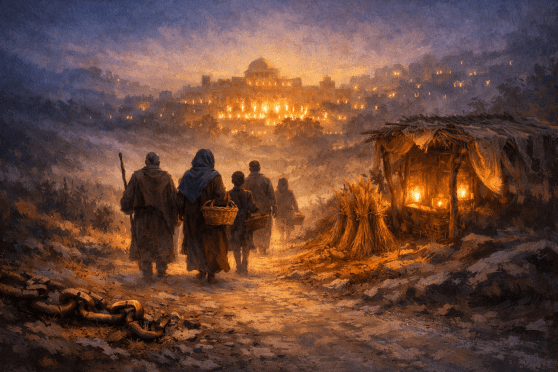
Freedom from chains that bind me.
Gratitude for the abundance of my blessings.
Reminder that security is always borrowed.
The birth of God who became flesh and pitched His tent among us.

Along my spiritual journey I have been largely naive and ignorant of the ways God has historically revealed Himself in fullness. I understand more than ever how easy it is for institutional religion to become rote and repeated motions that are Spiritually empty and void of meaning. But from ancient days through this current day, God has invited me to meet him in z’manim – moments of time filled with His presence and a banquet of meaning on which my soul can feast and be satisfied.

On Christmas Eve, bathed in candlelight and singing Silent Night with loved ones, we welcomed a newborn baby, wrapped in swaddling clothes and lying in a manger. It wasn’t just a commemoration. It was not dusting off history. It was, once again, the event relived – together with God and with loved ones.

It was z’manim.

And in the next few days the z’manim shifts. Old things pass away with 2025. New things come with 2026.

In the quiet I am reminded that I dare not ponder what that means for me apart from the reality of “God with us.”

If you know anyone who might be encouraged by today’s post, please share.

Promotional graphic for Tom Vander Well's Wayfarer blog and podcast, featuring icons of various podcast platforms with a photo of Tom Vander Well.
These chapter-a-day blog posts are also available via podcast on all major podcast platforms including Apple, Google, and Spotify! Simply go to your podcast platform and search for “Wayfarer Tom Vander Well.” If it’s not on your platform, please let me know!
An orange icon featuring an open book symbol, representing learning or knowledge.

Preparing the Way

Preparing the Way (CaD Lk 3) Wayfarer

[John the Baptist] went into all the country around the Jordan, preaching a baptism of repentance for the forgiveness of sins.
Luke 3:3 (NIV)

One of my mother’s first cousins passed away recently. She and my mother were dear to one another, and the fact that the two of them both descended into dementia and died in the same year doesn’t surprise me in the least. Along my life journey, I’ve observed that there can be unexplainable “connections” of spirit between certain family members. Our families got together on an occasional basis when we were growing up, and when it happened it was always a major event. There was so much fun and so much laughter. I have so many good memories with my cousins.

My mom and her cousin, and my childhood memories of our families, came to mind as I meditated on today’s chapter in the quiet this morning. I find John the baptist to be one of the most intriguing people we meet in the entire Great Story. Luke provides us with more background information about John than Matthew, Mark, and John put together. Much of it in today’s chapter.

The fact that John and Jesus were related through their mothers Elizabeth and Mary (exactly how they were related is not explained) and that Mary stayed with Elizabeth during their pregnancies leads me conclude that John and Jesus spent time together growing up. How fascinating to think of the two playing together and hanging out as boys when the families got together.

The connection between John and Jesus was more than DNA. God made clear from their respective miraculous births and angelic pronouncements that they were an integrated part of the same chapter of the Great Story.

As I meditate on the person of John, there are two major themes that come to mind. First, the adult John is the archetype of the Lone Stranger that is already established in the Great Story before in persons like Melchizedek, Elijah, and Elisha. In fact, Jesus makes clear that John is the fulfillment of Malachi’s prophetic words that conclude the Old Testament:

“See, I will send the prophet Elijah to you before that great and dreadful day of the Lord comes….”

John the Baptist is like the fulfillment of all the Old Testament prophets. He represents the ending of one section of the Great Story as Jesus is about to usher the beginning of an entirely new section. Jesus repeatedly noted that God’s people murdered the prophets God sent to them. John became the last living example.

The other things that comes to mind as I think about John is water. The act of ritual baptism was prevalent in those days. Even at the base of the Temple mount, archaeologists have uncovered baptismal pools about the size of a modern hot tub. Three steps in and three steps out. It is likely that people would be ritually baptized or “cleansed” before ascending to the Temple mount. In the area of the wilderness around the Dead Sea where John operated, a sect known as the Essenes lived in caves in which there were vast networks of these ritual baptismal pools. Baptism was not a novel ritual concept that John created. It was a well-known ritual in which individuals cleansed themselves as a form of spiritual preparation.

That’s what John was doing. His baptism, Luke tells us in today’s chapter, was a baptism of repentance. John’s baptism was a preparation for Jesus and the forgiveness He would bring through His death, as well as the baptism of Holy Spirit that would follow His resurrection.

In the quiet this morning, I find myself thinking about the season of Advent that we are in. John and Jesus are connected on multiple levels, but primarily in John I find God modeling for us the importance of spiritual preparation. Like John’s baptism, Advent is spiritual preparation for what has done in Jesus first coming, for what God is doing in my own heart and life in this season, and for what God will do when Christ comes again in the climactic end of this Great Story.

I can’t help but believe that the better my preparation, the more transformative the full-fill-ment.

If you know anyone who might be encouraged by today’s post, please share.

The Wait

The Wait (CaD Lk 2) Wayfarer

Now there was a man in Jerusalem called Simeon, who was righteous and devout. He was waiting for the consolation of Israel, and the Holy Spirit was on him.
Luke 2:25 (NIV)

Here at Vander Well Manor, it’s beginning to look a little bit like Christmas. Wendy fractured her foot a few weeks ago, had surgery to repair it, and has been rolling around the house on a scooter. So, the decorations are not up yet, but there’s seasonal music playing in the kitchen each morning and boxes of toys and books and other Christmas gifts for the kids have begun to arrive daily. Our crew in Scotland is moving back to the States and will be with us, which has Yaya and Papa pretty excited for this year’s Christmas celebration.

As I looked at the latest delivery of children’s gifts on the counter yesterday, I thought about our grandson and the giddy excitement he must be feeling about Christmas. I suddenly had a nostalgic flood of memories from my own childhood. Back in the day, the Sears Christmas Wish Book catalog that arrived each year would be tattered and dog-eared as the toy section was perpetually reviewed daily. The list for Santa was endless. The anticipation of Christmas morning was excruciating.

This past Sunday, I gave a message among my local gathering of Jesus’ followers. My message was an unpacking of what’s known as the season of Advent. Among my local gathering are people of very diverse religious backgrounds, and many have no experience with or understanding of Advent. Among followers of Jesus around the world, there are those who follow a liturgical calendar in which there are seasons coinciding with key celebrations throughout the year. The season of Advent is the traditional season that leads up to the celebration of Jesus’ birth on Christmas Day.

Advent comes from the Latin word Adventus, meaning “coming or arrival.” It is a season of waiting that traditionally included an Advent calendar which counts down the days until Christmas. Advent calendars used to have little candies or pieces of chocolate for each day, helping children get a little daily fix before the main event arrives. Today, you can get Advent calendars with just about any kind of treat for each day before Christmas including different wine samples or a shot of a different brand of bourbon. Ya gotta love commercialism.

Today’s chapter is a traditional Christmas chapter. What is once again fascinating about Luke’s account is the detail he provides that you won’t find in Matthew, Mark, or John’s biographies of Jesus. As part of his investigation into Jesus’ story, tradition tells us that Luke spent time with Jesus’ mother, Mary. The first two chapters read like a recitation of what must have been Mary’s first-person account of the events surrounding Jesus’ birth.

Among those stories is a simple, but meaningful story of a man named Simeon. Simeon was a sincere believer in God, and he was waiting for God’s messiah, the savior, to arrive. God’s Spirit had assured him that he would not die until he had seen this messiah with his own eyes. Prompted and led by God’s Spirit, he goes to the courts of the Temple. The temple courts would have teeming with people like a shopping mall the week before Christmas. There among the crowd were Joseph, Mary, and 40-day-old baby Jesus. They were there to perform a traditional purification ritual prescribed in the Law of Moses.

Luke doesn’t go into details, but Simeon is led to the infant Jesus by the Spirit. That which he had been waiting for is finally fulfilled. He hold’s God’s promise, and speaks hard prophetic words to Mary. The waiting over, Simeon boldly proclaims that he is now ready to die, having seen “God’s salvation” with his own eyes.

In the quiet this morning, I can’t help but think about the stories of today’s chapter in connection to my message this past Sunday and the season of waiting that has commenced leading to Christmas. Christmas toys and Advent calendars filled with bourbon shots aside, the traditional season of Advent calls me back from the precipice of nostalgia and commercialism to something deeper, more personal, and more meaningful. Simeon provides the example.

Simeon’s wait was individual and personal. Simeon’s was connected to God’s Spirit which was both the source of the wait and its fulfillment. Once it was fulfilled, Simeon experienced a spiritual freedom, release, and satisfaction.

As a child, I remember the hangover that descended when all the presents had been opened and a few days had gone by for the newness to wear off. That’s bound to happen if my treasure is found in the Sears Wish Book. Simeon found something deeper and far more satisfying. Advent softly beckons me to join him, if I only can hear the whisper amidst Mariah Carey beckoning for the 100th time that all she wants for Christmas is me.

If you know anyone who might be encouraged by today’s post, please share.

Spiritual Famine

Spiritual Famine (CaD Am 8) Wayfarer

“The days are coming,” declares the Sovereign Lord,
    “when I will send a famine through the land—
not a famine of food or a thirst for water,
    but a famine of hearing the words of the Lord.”

Amos 8:11 (NIV)

We’ve enjoyed a very mild autumn this year with temps that feel warmer on average than usual. At least, that was until the past few days. The first blast of arctic air has blown in with a reminder of winter’s scheduled arrival. It’s a little chilly in the quiet this morning.

Along with the change in weather, the chill reminds me that the season of Advent is right around the corner. While not universally observed among followers of Jesus, Advent is a traditional time of spiritual preparation and “waiting” for the celebration of Jesus’ birth. It is also a reminder of our “waiting” for Jesus’ promised return. Many followers of Jesus will fast as a part of the season, and of course you can find almost any kind of Advent calendar with a little treat for each day leading up to Christmas.

In today’s chapter, Amos makes a rather strange prophetic proclamation. He says that there is a coming famine, but it won’t be food that will be scarce, but the word of the Lord. People will search for a word from the Lord and be unable to find it.

What’s interesting about this prophecy is that Jesus famously replied to the evil one when He was tempted, “It is written: ‘Man shall not live on bread alone, but on every word that comes from the mouth of God.’” In the same way that bread is a staple form of physical sustenance, so God’s words are a form of staple spiritual sustenance. This chapter-a-day journey is a form of daily spiritual nourishment. When Amos declares that there will be a famine of God’s word, he’s declaring a spiritual famine.

What’s equally interesting is that after the last prophet, Malachi, there is a roughly 400 year period of prophetic silence until the birth of Jesus. Amos’ prophesy was eventually realized. More than just a celebration of Christmas, the annual season of Advent is a yearly reminder of the 400 years of spiritual famine that preceded the baby, wrapped in swaddling clothes, and lying in a manger.

I’m thinking this morning not just about physical seasons but spiritual seasons. As a child, the season of Advent and countdown to Christmas morning is agonizing. In the same way, my spiritual journey has contained long seasons of waiting, when each day felt spiritually parched and the fulfillment of promise seems perpetually on the horizon. Looking back, I realize that times of spiritual famine have exercised my faith, on which I have to rely like a starving person getting by on meager provisions. I have also experienced that seasons of spiritual famine do end. Christmas morning dawns. A time of harvest and blessing eventually arrives like spiritual rain. As Jesus put it, “Ask and it will be given to you; seek and you will find; knock and the door will be opened to you. For everyone who asks receives; the one who seeks finds; and to the one who knocks, the door will be opened.”

Sometimes, you have to wait.

If you know anyone who might be encouraged by today’s post, please share.

Listening Opportunities

Hey friend, I hope your weekend is going well! I wanted to thank my friend Reuel Sample at the Pastor’s Voice Podcast for inviting me to be a guest this past week. I had a fantastic time and look forward to future conversations. You can listen online at thepastorsvoice.net and you can subscribe to the podcast on your favorite podcasting platform.

Below you’ll find my latest message from this past Sunday. Don’t forget that there’s an archive of past messages on the Messages Page at tomvanderwell.com.

Do I Want Him to Come, or Go?

Then all the people of the region of the Gerasenes asked Jesus to leave them, because they were overcome with fear. So he got into the boat and left. Luke 8:37 (NIV)

Now when Jesus returned, a crowd welcomed him, for they were all expecting him. Luke 8:40 (NIV)

Life is filled with mysterious paradoxes. As a follower of Jesus for almost 40 years, I have witnessed many debates and intense conversation spring up over the years among theologians, zealous followers, and various boxes of institutional Christianity who argue perpetual questions of faith and life. There are those questions that produce endless debates which are endlessly renewed and rehashed with every subsequent generation.

At the top of the list of these perpetual debates is a simple question. Does God choose us, or do we choose God? In theological terms it is worded: Are our lives predestined, or do we have free will to make our own choices?

Don’t worry, I’m not about to jump into the deep end of theology on you here to renew and rehash the question in this post. You’ll have to buy me a pint if you want me to discuss my thoughts on the matter. I simply raise the matter because of an observation in today’s chapter.

As Dr. Luke continues his biography of Jesus, he continues in today’s chapter to relate stories from Jesus’ miraculous ministry tour. He’s in one region along the shores of Galilee. There’s a local in the area who has been a lunatic his whole life and everyone in the town knew it. The man’s insanity was rooted in things spiritual. He was possessed by numerous demons. Jesus casts out the demons. The people of the town, rather than being impressed, are freaked out completely. They beg Jesus to leave them.

Jesus and his entourage get in their boat and sail back across the Sea of Galilee, returning to a town that had become a sort of base of operations for Jesus’ tour. When they arrive, a crowd is there at the dock waiting expectantly for Jesus to arrive.

Here is my simple observation from within the quiet this morning:t my spirit’s attitude towards God matters. The people in the region of the Gerasenes were afraid and freaked out. They asked Jesus to leave, and He did. The people on the dock, in contrast, were eager, expectant, seeking, desiring, and waiting for Jesus’ return. Immediately a woman is healed and a girl is raised from the dead.

Followers of Jesus around the world are in the middle of a five week ancient tradition called the season of Advent. In simple terms, it is about the attitude of one’s heart toward Jesus. It is a time of heart preparation, expectation, seeking, and longing for Jesus’ arrival like the people at the dock. We celebrate His first arrival at Christmas, and we look expectantly towards His second arrival which He promised on a day and hour that is, itself, one of this earthly life’s perpetual mysteries.

Along my spiritual journey, I’ve discovered that under the weight of endless theological debate I often find a very simple spiritual truth.

I can ask Jesus to leave and stay away.

I can seek, desire, and expectantly welcome Jesus in.

Jesus responds accordingly.

Grappling With “Never”

“And now you will be silent and not able to speak until the day this happens, because you did not believe my words, which will come true at their appointed time.” Luke 1:20 (NIV)

“I don’t know what to with never,” Wendy confessed to me one afternoon.

There are some moments in this life journey that are etched indelibly in my brain’s memory bank, and this is one of them. When the two of us were married Wendy inherited two teenaged daughters. Still, we had always desired to have a child together. After multiple surgeries and what seemed like endless months of fruitless attempts to conceive, Wendy’s admission of fear as we stood silently in our despair on the back porch felt like a giant weight on our souls.

The story of John the Baptist’s parents in today’s chapter holds a special place in my heart. There is so much happening in the subtext of Zechariah’s conversation with the angel Gabriel that is completely lost on any reader who has not walked through the long, depressing, desolate path of infertility.

A few of observations:

  • I find it ironic that Dr. Luke diagnoses Zech and Liz’s infertility as “Elizabeth was unable to conceive.” Perhaps there’s more to this story than is told. Nevertheless, having walked this journey I know that it’s also possible the low sperm count or poor motility were the culprits of their childlessness. Of course, this medical knowledge was not available in their day, but it makes me sad that Elizabeth got the blame.
  • I’ve been digging into the theme of exile on this chapter-a-day journey over the past months. The truth is that Elizabeth and her husband were in a personal exile of their own. When you are walking the path of infertility you realize that the vast majority of people don’t understand and it’s usually emotionally painful when they try. Furthermore, you’re not sure you want to talk to those who’ve been through it themselves. Those who walked the path and ultimately conceived are just a depressing reminder that it hasn’t worked for you. Those who never conceived are a reminder that “never” is a possibility which you don’t want to face and don’t know what to do with (a la Wendy’s confession). Infertility can be horrifically isolating for the couple going through it.
  • When the angel tells Zech “Your prayer has been answered.” My husband’s heart shoots back with a cynical “Which one?” If Zech’s heart was like mine, then there’s a section of it calloused over from month-after-month, year-after-year of fervent, unanswered prayers and wiping away his wife’s river of tears.
  • When Zech asks Gabriel “How can I be sure of this?” he is, once again, being defensive and protective of the hearts of both his wife and his own. Infertility is a vicious cycle of summoning faith, raising hopes, and having them dashed again and again and again and again. The last thing the elderly husband wants to do is put his wife through it one more time.

It’s easy for the casual reader to point the finger at Zech’s lack of faith. I’m sure many Jesus followers will hear messages this Advent season comparing Mary’s simple acceptance of Gabriel’s message to Zech’s rather obvious doubt. My heart goes out to the dude. He’s been made the Steve Bartman of the Christmas story for two thousand years, but I get where he’s coming from.

In the quiet this morning I find myself contemplating the long-term effects that disappointment and unanswered prayer can have on one’s spirit. As for what to do with “never,” Wendy and I worked through it together with God. We discovered, and continue to discover, deep lessons about joy, grief, faith, perseverance, character, maturity, and hope. At the same time, there is a lingering sadness that rears itself unexpectedly at odd times, which in turn pushes me back to the lessons already learned. I plumb their depths once more.

Still, if Gabriel showed up in my office this morning and told me Wendy was going to have a baby, I totally believe that the subtext of my reaction would land somewhere between sarcastic and cynical.

Zechariah would understand.

Parade of the Downhearted

English: Christmas lights in Sanok
(Photo credit: Wikipedia)

Chapter-a-Day Psalm 68

God places the lonely in families;
he sets the prisoners free and gives them joy.
Psalm 68:6a (NLT)

“Christmas is such a happy time of year,” Wendy said to me as we drove to rehearsal the other night. The Christmas lights on the businesses along Franklin Street were shining bright in the crisp night air and the Vermeer Windmill was decked out with all of its holiday decorations.

I wasn’t trying to be a Scrooge, but the first thought that came to my mind and my response to Wendy was “It’s not a happy time of year for everyone.” I know that the holidays can be incredibly stressful for some. For those who have lost loved ones or who struggle with loneliness, the holidays can be a time of increased anxiety and depression.

I can tell in the quiet this morning that my heart and mind have made the turn toward Advent. Advent comes from the latin term meaning “revealing.” It is traditionally the season followers of Jesus prepare their hearts each year to celebrate the birth of our Jesus on Christmas Day. Psalm 68 is a song of procession and was meant to be sung as people paraded to the temple to worship. It made me think about all of us who are making a procession towards Christmas. As I read the lyrics of the opening stanza of Psalm 68, I found it interesting those whom it describes in this processional to praise:

  • Fatherless
  • Widows
  • Lonely
  • Prisoners

How appropriate, I think, for the downhearted to be called out for this parade. The whole reason for Christ to come as a baby, to live among us, to die for our sins, and to be raised back to life, is that which is broken in all of us might be healed. Consider that in His first public message, Jesus proclaimed his personal mission statement when He quoted these words:

“The Spirit of the Lord is on me, because he has anointed me to proclaim good news to the poor. He has sent me to proclaim freedom for the prisoners and recovery of sight for the blind, to set the oppressed free, to proclaim the year of the Lord’s favor.”

This morning I’m thinking about the upcoming Christmas holiday in relation to the downhearted, the lonely, the grieving, those in bondage to their destructive thoughts and behaviors, and those who are suffering emotionally and physically. As we proceed toward Christmas, I’m praying that those of us who are suffering. Instead of experiencing increased levels of loneliness, isolation, anxiety and pain, I’m praying for us all – myself absolutely included – to find the healing and hope which can be found wrapped in swaddling clothes, lying in a manger.

Chapter-a-Day James 5

English: Deer on Winter road in Alberta, Canad...
Image via Wikipedia

Dear brothers and sisters, be patient as you wait for the Lord’s return. Consider the farmers who patiently wait for the rains in the fall and in the spring. They eagerly look for the valuable harvest to ripen. James 5:7 (NLT)

As I read this verse from today’s chapter I thought about the season of Advent. Our church is focusing on the Christian calendar this year, so the messages leading up to Christmas have been about Advent, which is a latin word meaning “coming” or “revealing.” It’s the season of expectation prior to Christmas as we await the coming of the birth of Jesus.

As I read this verse in today’s chapter I thought about the warm autumn rain that’s been falling for the past day here in Iowa. The fields are brown and death-like, and yet there is already anticipation of next year’s crop. The moisture is a welcome sight for farmers who are waiting and already thinking and planning for planting next Spring.

As I read this verse in today’s chapter I thought about my dinner conversation last night with Wendy. With our Vikings at a miserable 2-11, we are already talking about baseball and all of the changes for our beloved Cubs this off season. Christmas is almost here, then  a sojourn through January. February means the beginning of Spring Training and suddenly it doesn’t seem that far away.

Through the journey I’ve learned that I can be an impatient person. I don’t like waiting. God’s timing is so rarely my timing. More often than not I find myself waiting and expecting. It is woven into the fabric of the journey. We stand on the path, but our eyes stare ahead to the horizon.

God, help me to find the balance between contentment and expectation. Help me to balance my desire to get to my destination with the patience to appreciate the place that I find myself at the moment and accept all that the journey is creating within me.

Chapter-a-Day Luke 12

“Keep your shirts on; keep the lights on! Be like house servants waiting for their master to come back from his honeymoon, awake and ready to open the door when he arrives and knocks. Lucky the servants whom the master finds on watch!” Luke 12:35-36 (MSG)

It’s interesting how God’s message meets us right where we are. It gets filtered through the lens of our momentary circumstances, and sheds light on the exact place we need illumination. There’s a certain synchronicity to it. Sometimes God’s Message joins with disparate threads of our life, and weaves together important life lessons.

This week has, obviously, been focused on the opening of Annie. As I read Jesus’ example of the house servants being awake and ready for the arrival of their master, I couldn’t help but think of my first entrance in the show tonight.

With his opening entrance, Warbucks enters his mansion after being away on a six-week trip. His servants bustle about having everything ready, anticipating his arrival. There is sense of anxiety, preparation, and excitement in the air as they worry about having everything ready.

The season of Christmas is known as Advent, which literally means “arrival” or “coming.” This past Sunday in worship the message was about preparing our hearts for the arrival of Jesus. How would our thoughts, words, and actions change if we knew that Jesus was literally returning on the eve of December 24th, 2010?

Today, Jesus weaves different thoughts from my week into one strand, reminding me to be mindful of what Christmas is really about: the arrival of the Master. Christmas is more than goodies and presents and even more than family and friends. Christmas is when the Master arrives.

I want to be prepared.

Enhanced by Zemanta