Tag Archives: Galilee

Signs

Signs (CaD Jhn 2) Wayfarer

What Jesus did here in Cana of Galilee was the first of the signs through which he revealed his glory; and his disciples believed in him.
John 2:11 (NIV)

As I read a chapter in the quiet each morning, I try very hard to approach the text without any expectations. Even when it’s a passage I have read countless times over the years, I do my best to make both my head and my heart a clean slate. The question my spirit silently begs God’s Spirit is “What have you got for me today?”

As I read, I take note of little things that capture my attention. I might catch a detail I hadn’t noticed before. Sometimes, I’ll notice repetition in the text and start circling the repeated word or phrase. This might lead me to meditate on the word or phrase, digging deeper into what the repeated use might mean.

So it was this morning as I noticed John’s repeated use of the word “sign” in reference to Jesus’ miracles:

2:11: What Jesus did here in Cana of Galilee was the first of the signs through which he revealed his glory; and his disciples believed in him.

2:18: The Jews then responded to him, “What sign can you show us to prove your authority to do all this?”

2:23: Now while he was in Jerusalem at the Passover Festival, many people saw the signs he was performing and believed in his name.

As I dug deeper, I discovered the fact that John repeatedly used the word “signs” when referencing Jesus’ miracles. I think the choice of words is deliberate. Jesus’ miracles were intended as “signs” to point people to who Jesus is. There was a purpose in His performing of miracles. In addition, while the other three accounts of Jesus’ story report 18-20 miracles each, John chooses just seven miracles Jesus performed during his ministry to share with us, his readers. He then adds a bonus miracle in the epilogue after Jesus’ resurrection. This is not an accident.

Seven has significant meaning in the Great Story. It is the number that signifies “completeness” or “perfection.” As I mentioned in yesterday’s post/podcast, John writes his version of Jesus’ story, not in a journalistic reporting style, but in a thematic style. He carefully chooses seven miracles to share with us. It’s also interesting to note that five of the miraculous “signs” he shares are unique to John’s account. Matthew, Mark, and Luke do not include them. John carefully chooses each “sign” to contribute to the larger understanding of Jesus to whom he is introducing us.

Two quick observations from my meditation on John’s use of signs this morning:

The first concerns Jesus’ signature miracle of turning water into wine at a wedding feast. Jesus used large ceremonial jars used in the Jewish tradition to hold water used in ritual purification to make one “clean.” Jesus will later use the metaphor describing His teaching as “new wine” and God would later work through Peter (Acts 10) and Paul (Galatians 5) to change the old ceremonial ideals of what made a person clean or unclean, acceptable or not. Jesus also regularly used the metaphor of a wedding in parables and in the eternal union of Christ and the church in Revelation. Jesus’ miracle was not only a blessing to the wedding hosts, but it also served as a “sign” to His larger eternal mission.

I also found it fascinating that there were two responses to the “signs” of Jesus’ miracles. Those listening to Jesus in the Temple became believers after seeing the miracles He was performing. The religious authorities and Temple officials, however, not only refused to ignore the “signs” that had made believers of others, but they asked for a different, bigger, better, and more definitive “sign.” I referenced Jesus’ response in yesterday’s post when Jesus told them He would destroy the Temple and raise it in three days. It seems to me that Jesus understood from the very beginning that there were those individuals who would refuse to believe no matter how big of a “sign” He performed.

John confesses in today’s chapter that it was only after Jesus’ resurrection that he and the boys realized what Jesus meant when He referenced “destroying the temple and raising it in three days.” Along my spiritual journey, I’ve observed that God often provides signs along life’s road. I may not realize it in the moment, but I will later look back and realize that the sign was there all along. It comforts me to know that the Story is already written. I can’t help but think of Jesus’ words:

“You have a saying that goes, ‘Red sky at night, sailor’s delight; red sky at morning, sailors take warning.’ You find it easy enough to forecast the weather—why can’t you read the signs of the times?”

God, open the eyes of my heart to see the signs and grant me the courage to follow.

If you know anyone who might be encouraged by today’s post, please share.

Raised in Flyover Country

Nevertheless, there will be no more gloom for those who were in distress. In the past he humbled the land of Zebulun and the land of Naphtali, but in the future he will honor Galilee of the nations, by the Way of the Sea, beyond the Jordan—

The people walking in darkness
    have seen a great light;
on those living in the land of deep darkness
    a light has dawned.
Isaiah 9:1-2 (NIV)

When I visited Israel just over ten years ago, the first days of our journey were in and around Jerusalem. Jerusalem is a big city, and it has all the hustle and bustle of a big city. When you layer the never-ending religious tension between Christians, Jews, and Muslims on top of the din of activity, it is a fascinating experience. If found that my guard was always up in Jerusalem. I felt that I always had to be aware of my surroundings. I don’t know that I ever felt relaxed.

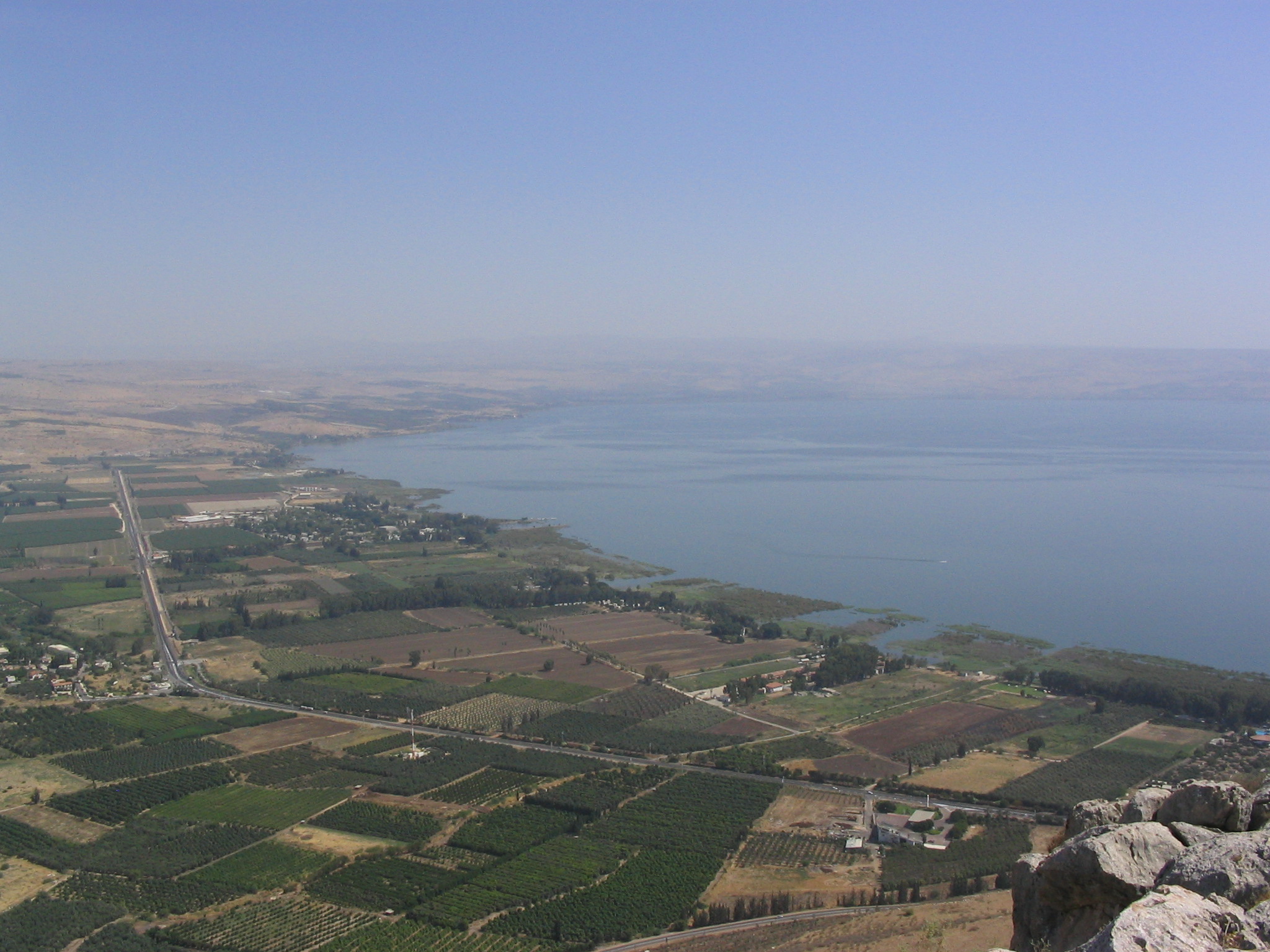
Several days later we headed north, to the region of Galilee. There was something in the transition from Jerusalem to Galilee that felt very natural. It was like leaving downtown Chicago and finding yourself in the farms and fields of Illinois and Iowa. I stood on Mt. Arbel and looked out over the fields sprawled around the Sea of Galilee (see featured image). Small towns and villages dot the landscape. Farming and fishing are the livelihoods in what Jerusalem residents surely consider the “backwater” area of the nation. Israel’s version of “flyover country.” And, I felt right at home.

Even nominal church attenders who make an annual pilgrimage on Christmas would recognize a couple of the verses the prophet Isaiah penned in today’s chapter. One is pasted at the top of this post. The other is:

For to us a child is born,
    to us a son is given,
    and the government will be on his shoulders.
And he will be called
    Wonderful Counselor, Mighty God,
    Everlasting Father, Prince of Peace.

What I had never connected before, is that Isaiah calls out that this Light that will shine, the child that is born, will honor Galilee. It wasn’t going to be in the hubbub of Jerusalem and the center of the region’s worldly power. The Messiah would bless the simple folks scratching out a living from the land and the water far from the pomp and prestige of civic and religious authority. It was of Nazareth, in Galilee, that Jesus’ own disciple sarcastically asked, “Does anything good come from there?

There’s a sentiment that every child of Iowa knows.

This morning I’m thinking about life in flyover country. I’m thinking about my small town, filled with good people who live in concert with the land and the seasons. I live in a place that generally brings up vague, usually incorrect, notions from the people you talk to on the streets of New York or Los Angeles.

“Iowa? Oh yeah. With all the potatoes.” [No, that’s Idaho.]
“Iowa? I heard of it.” [Nice. You still remember 2nd grade geography!]
“Iowa? I had a great Aunt that was from there.” [But, you still couldn’t find it on a map, could you?]

This morning I’m taking solace in the fact that the Messiah came from a place like Iowa. He grew up working with his hands in the trades. He knew small town people scratching out a living from the land, living in concert with the seasons of planting and harvesting. It was here in flyover country where God wanted Jesus to be raised. I get it. We grow good kids here, as well as crops.

Chapter-a-Day Luke 7

St. Mary Magdalene in the House of Simon the P...
Image via Wikipedia

One of the Pharisees asked him over for a meal. He went to the Pharisee’s house and sat down at the dinner table. Just then a woman of the village, the town harlot, having learned that Jesus was a guest in the home of the Pharisee, came with a bottle of very expensive perfume…. Luke 7:36-37 (MSG)

Having lived in a few different towns of different sizes and I’ve discovered that there are community archetypes. Within any community I find the respected local politician, the business leader/power broker, the local pastor or priest who is the community religious leader, the high school star athlete who never quite got beyond his glory days, the person with special needs for whom the entire community looks out, and etc.

Years ago I had the opportunity to walk through the ruins of some of the villages along the northern shore of Galilee where Jesus carried out his ministry. They were small fishing villages not unlike the small farming towns in which I’ve lived. Through today’s chapter I get a sense of similar small town archetypes to the familiar ones I know: the Roman captain who represented the occupational civic authority, the town’s poor widow for whom life has been an on-going tragedy, the proud and pious religious leader, and the town whore.

I can’t think of a more dramatic small town scene. A regional celebrity comes for a visit. The entire town is buzzing with news and gossip. The local coffee shop is churning with stories about this Jesus and what they’d heard about him. Jesus is scheduled to go to the house of Simon for dinner. Of course he is. Simon is the town’s religious V.I.P. He is wealthy, he is powerful, and when it comes to spiritual matters in the town he calls the shots. Simon is the final word; God’s local judge, jury and executioner. Of course Jesus would go to Simon’s house.

Then she walks in. They all know about her. In fact, truth be told, some of the pious men in attendance at this private dinner party know her, in the Biblical sense, if you catch my drift. Publicly despised, privately used, and generally dismissed as dirt, she is known by all the town as a simple whore. Then, in a bold move guaranteed to turn heads, the sullied slut walks right into the religiously scrubbed crib of the local holy man. Imagine the snickers, the glares, the gossip ready to drip off the small town lips of the onlookers.

She carries expensive perfume purchased with lust money (we all knew where she got the money for that), and she falls at Jesus’ feet. Her river of tears pour across her cheeks and drip onto Jesus’ feet. They mix with the perfume she humbly, and gently spreads with her hands across his toes.

For each person in that moment, and for each archetype, Jesus is present. For each there is a lesson. For each there is a blessing. For each there is a crossroads and a transformational opportunity. That’s the way Jesus is. No matter who we are or where we find ourselves on life’s road, Jesus dramatically meets us right where we are, turns us away from where we’ve been, and points us where we need to go.

Enhanced by Zemanta