Tag Archives: Foreshadow

The Mark and The Choice

The Mark and The Choice (CaD Ezk 9) Wayfarer

Then the Lord called to the man clothed in linen who had the writing kit at his side and said to him, “Go throughout the city of Jerusalem and put a mark on the foreheads of those who grieve and lament over all the detestable things that are done in it.”
Ezekiel 9:3-4 (NIV)

When I was a young man serving as a pastor, I once got in hot water with certain members of my congregation when I used the abbreviation “Xmas” in reference to “Christmas.” It’s always amazing to me what gets people’s undies in a bunch and just how upset they can get. I apologized for offending the offended, but I also used the opportunity to offer an explanation.

In the early days of the Jesus Movement, especially during times of persecution, disciples of Jesus used symbols and metaphors for referring to Jesus rather than writing the name out. The icthus, or fish symbol, can still be seen on car bumpers everywhere. But the Greek letter Chi which looks like an X, was also commonly used. Why? Crucifixions were often carried out on an X-shaped cross. It was a sign of the cross, and it logically became a metaphor for referring to Christ. Therefore, the abbreviated “Xmas” does not technically “take the Christ out of Christmas” as my critics with bunched undies believed. Christ is still there for all to see for those who aren’t blind to metaphor.

In today’s chapter, Ezekiel’s vision continues from the previous chapter. God took Zeke to the Temple in Jerusalem and gave him a tour of the temple and all of the pagan idols and altars that had been set up inside the Temple for people to worship instead of Yahweh. Now, Zeke sees six men with weapons in hand along with a seventh man who had a scribe’s kit. He tells the scribe to start at the Temple and go throughout the city of Jerusalem and place a “mark” on the foreheads of all those who had been faithful in their worship of God and had lamented the detestable things that were happening in the wake of all the pagan worship.

Much like in the final plague of Egypt when the Angel of Death “passed over” the homes that had the blood of the lamb coating their doorposts, those who had the mark were spared as the six executioners spread out across the city to judge and put to death any who didn’t have the “sign.”

The “sign” was a Taw, the last letter of the Hebrew alphabet. In ancient Paleo-Hebrew script, that letter was an “X.” The same sign that some 400 years later will become a metaphor for Christ and the disciples who place their faith in Him.

In the quiet this morning, I’m simply marveling at the way certain metaphorical threads and themes weave their way throughout the Great Story and tie it together. Ezekiel’s vision echoes the same theme as the Passover in Exodus. It foreshadows the Judgment Day that Jesus promised will one day arrive for everyone. All three instances end with either life or death based on the acceptance or rejection of God as evidenced by faith or no faith.

As I meditated on these things this morning, I couldn’t help but hear God’s words to the Hebrew people at the very beginning of their formal relationship in Deuteronomy:

This day I call the heavens and the earth as witnesses against you that I have set before you life and death, blessings and curses. Now choose life, so that you and your children may live and that you may love the Lord your God, listen to his voice, and hold fast to him.
Deuteronomy 30:19-20 (NIV)

Thousands of years later, the choice is the same.

I choose life.

If you know anyone who might be encouraged by today’s post, please share.

Walking the Talk

Walking the Talk (CaD Lk 13) Wayfarer

“In any case, I must press on today and tomorrow and the next day—for surely no prophet can die outside Jerusalem!”
Luke 13:33 (NIV)

I’m excited this Christmas to see the movie Freud’s Last Session with Anthony Hopkins. It’s an adaptation of an amazing little one-act play that imagines a conversation between a dying Sigmund Freud and a young Oxford professor named C.S. Lewis in 1939 London. Sadly, my friend Kevin and I were preparing to produce the show in conjunction with a college theatre department a few years ago until an individual got us cancelled. It remains a huge disappointment we never got to do the show.

There are several scripts and books that have been written over the years imagining conversations between different historical figures or imagined events around historical characters. I’ve always found the genre fascinating. When I was just a kid, the youth of our local church performed a play in which Pontius Pilate is placed on trial for Jesus’ murder. Members of the audience acted as the jury. If I remember correctly, my father was the Jury foreman. They acquitted Pilate.

Sadly, the death of Jesus was historically used as a reason for antisemitism. In our current wave of public and institutional antisemitism, I feel it important to acknowledge this sad historical fact. It is rooted in the Roman Emporer Constantine’s decision to make Christianity the official religion of Rome in the early fourth century. It was one of many bad things that happened after the organic Jesus Movement became the Holy Roman Empire. Constantine planted the seeds of antisemitism that would lead to centuries of Jewish persecution by the institutional church.

As I have studied the final days of Jesus for many years, I’ve concluded that the death of Jesus was the result of a perfect storm of antagonist power brokers representing the earthly kingdoms of politics, commerce, and religion. (A few years ago I presented my review of Jesus’ arrest and trials in a Good Friday message, FWIW)

A few chapters ago, Luke records that Jesus “resolutely set out for Jerusalem.” Jesus has been traveling toward Jerusalem and is getting close to His destination. In today’s chapter, Luke foreshadows the three key players who will have Jesus crucified.

It begins in the first verse of today’s chapter as Jesus hears news of the Roman governor’s cruelty. Pontius Pilate represents the Empire, and in the political powder keg of Jerusalem, Pilate is not afraid to use force and violence to quell issues. There was a group of people from Galilee who ended up creating trouble. Their offense is not known, but Pilate had them slaughtered and their blood was mixed with their sacrifices. It was a highly blasphemous act of imperial power, intended to send a message to the many zealots who sought to defy Rome.

The next episode Luke records is the religious leaders who continue to antagonize and oppose Jesus. He heals a crippled woman on the Sabbath day of rest, and the religious leaders call Him out for it. Jesus turns the tables on them and Luke records that Jesus’ “opponents were humiliated.” As Jesus continues to humiliate and threaten the power and wealth of the religious establishment, those religious leaders with the most to lose are motivated to have Jesus eliminated.

But Luke also records that “the people were delighted with all the wonderful things He was doing.” Even some of the religious establishment became fans and followers, and Jesus was drawing crowds that numbered in the thousands. The crowds alone were a threat.

At the end of Today’s chapter, Luke mentions the third piece of the unholy trinity of power brokers who will have Jesus’ killed. Some Pharisees who were fans and followers of Jesus told Him to change course and avoid Jerusalem because Herod had already put a price on Jesus’ head. Herod was the regional ruler who had John the Baptist murdered because John had antagonized Herod and turned the crowds against him. Herod had heard the rumors that Jesus might just be John the Baptist risen from the dead. Herod had learned from his father, Herod the Great, that remaining in power means the swift and violent elimination of potential threats, like having all the baby boys two years or younger slaughtered because of rumors the messiah had been born in Bethlehem.

Jesus, however, remains “resolute” in His trek to Jerusalem. He has no illusions about what is going to happen. In fact, everything that He does and says in public only pushes the hands of these political, religious, and commercial power brokers. Jesus states that He must press on to Jerusalem “for surely no prophet can die outside of Jerusalem.”

Jesus knows He is going to Jerusalem to be killed.

In the quiet this morning, I find myself thinking about my post yesterday in which Jesus implores me and all of His followers to approach our earthly realities in context to the larger eternal realities of God’s Kingdom. Jesus is walking the talk.

How can I follow in His footsteps today?

If you know anyone who might be encouraged by today’s post, please share.

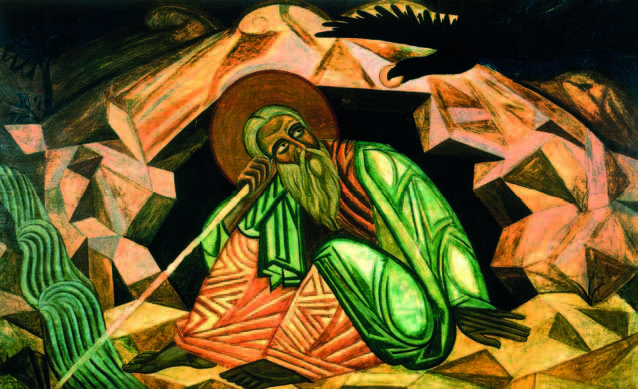
Elijah: a Pivotal Character

Elijah: a Pivotal Character (CaD 1 Ki 17) Wayfarer

Now Elijah the Tishbite, from Tishbe in Gilead, said to Ahab, “As the Lord, the God of Israel, lives, whom I serve, there will be neither dew nor rain in the next few years except at my word.”

Then the word of the Lord came to Elijah: “Leave here, turn eastward and hide in the Kerith Ravine, east of the Jordan. You will drink from the brook, and I have directed the ravens to supply you with food there.”

1 Kings 17:1-2 (NIV)

One of the things that constantly amazes me in my ongoing journey through the Great Story is how events separated by hundreds and thousands of years and recorded by different authors are so interconnected.

Today’s chapter launches one of the most exciting and action-packed episodes in all of the Great Story. King Ahab is on the throne in the northern Kingdom of Israel. The Kingdom of Israel has abandoned Yahweh, the God of Moses and David, and has embraced one of the most popular regional deities, a fertility/storm god named Baal. This had been largely a business strategy for Israel which desired lucrative trade alliances with their neighboring Kingdoms (who all worshipped Baal). Ahab marries a Phoenician princess named Jezebel, who is a faithful advocate for the worship of Baal and other regional deities. The marriage was also a strategic trade alliance.

Out of nowhere there arrives a lone stranger, a prophet of God named Elijah. Elijah proclaims that there will be no rain, nor dew, except by his word. A catastrophic drought and famine begin.

What was fascinating for me in the rest of the chapter was the way that the events point back in time to earlier events and foreshadow future events of Jesus and His followers.

First, there’s the drought, which is a powerful metaphor for spiritual decline and need. Jesus said that He was “living water.” Water is a repetitive metaphorical theme God uses throughout the Great Story to communicate spiritual nourishment, abundance, and life. In the Garden of Eden at the beginning of Genesis and the new heaven at the end of Revelation I find the “river of life” watering the Tree of Life. Drought and the subsequent famine were, therefore, living word pictures of the spiritual consequences (lack, need, thirst, starvation, decline, death) that the Kingdom of Israel faced in giving themselves over to Baal worship.

God tells Elijah to go “east” beyond the Jordan River. East is the direction God told Adam and Eve to go out of the Garden of Eden. East is the direction of exile that the people of God at the hands of Assyria and Babylon. Elijah is also going into exile, into the wilderness across the Jordan where Moses and the Hebrew tribes wandered while seeking the Promised Land. For the Israelites of Elijah’s day, this was a stinging rebuke that the man of God was metaphorically separating from God’s people in the Promised Land and returning to the wilderness. I couldn’t help but also see this as a foreshadowing of Jesus, His followers, and the early Jesus Movement. When the Hebrew religious institution rejects, executes, and persecutes Jesus and His followers, their ministry expands to the non-Jewish Gentiles.

Elijah is fed by Ravens in the wilderness. They bring him bread and meat every morning and every night. This points back to God providing manna (bread) and quail (meat) to His people during their wilderness wanderings in Exodus. Ravens, however, were “unclean” for the Hebrew people as would be any food that came out of their mouths. This also foreshadows events of the early Jesus Movement when God tells Peter and the rest of Jesus’ followers that every food is “clean.”

Meat was a luxury in the diet of common people of Elijah’s day. Kings were among the only ones who could afford this luxury. And, there was a famine in the land. This meant that the King of Israel was likely going hungry in his palace while Elijah feasted on meat twice a day at Yahweh’s table.

Elijah is led to go to a Gentile widow’s house in Zarephath, foreshadowing the early Jesus movement being led to take Jesus’ message to the Gentiles like Peter being led to a Roman Centurian’s house in Acts.

There is a drought and famine going on, and Elijah has the audacity to ask a Gentile widow for water and bread. This foreshadows both Jesus asking a Gentile woman from Samaria for a drink of water and the audacity of Jesus telling his disciples to feed a crowd of thousands with a couple of loaves and a few fish. Elijah goes on to tell the woman to make bread from her flour and oil jars, explaining that the jars will miraculously never be empty just like the baskets of bread and fish that Jesus’ disciples passed around the crowds.

Elijah then raises the widow’s son from the dead, foreshadowing the same miracle that Jesus would perform on multiple occasions.

The prophet Elijah himself is a pivotal figure in the Great Story, and today’s chapter is a great example of this. Elijah hearkens back to earlier chapters of the Great Story, he is a lead character in the chapter of history in which he lived, and he foreshadows John the Baptist, Jesus’ earthly ministry, and where God will ultimately lead the story in future chapters. Elijah’s life and experiences metaphorically point to what God has done, is doing, and will do later in the story.

In the quiet this morning, I’m once again amazed at how the Great Story ties together across multiple sources and across time. I’m also once again reminded that the story is still being told, and that I have a role to play.

And with that thought, I enter my day.

If you know anyone who might be encouraged by today’s post, please share.

A Confession

A Confession (CaD Jud 16) Wayfarer

Then the Philistines seized [Samson], gouged out his eyes and took him down to Gaza. Binding him with bronze shackles, they set him to grinding grain in the prison. But the hair on his head began to grow again after it had been shaved.
Judges 16:21-22 (NIV)

There is an incredibly powerful scene in The Godfather Part III that seems largely forgotten among the many memorable moments in the epic trilogy. Michael Corleone visits a Cardinal in the Vatican, seeking assistance with a business deal he’s trying to make with the Vatican bank. Michael’s health isn’t good. Between stress and Diabetes, he’s suffering. The Cardinal, however, sees that what is really torturing Michael is the spiritual consequences of a life of violence, crime, deceit, and vanity. He urges Michael to confess.

Over the past couple of weeks, our local gathering of Jesus’ followers has been focused on James 5:16: “Therefore confess your sins to each other and pray for each other so that you may be healed.” In my experience, confession is rarely discussed, and I find this tragic. Anyone who has made the spiritual journey of The Twelve Steps knows that it begins with admitting we are powerless over our addictions. That’s why every person in a Twelve Step meeting introduces themselves by confessing that they are an addict.

Today’s chapter is the climactic finale of Samson’s story. Samson’s tragic flaw, his perpetual lust for Philistine women, finally catches up with him in his love for Delilah. His blind devotion to her, despite the fact that she seems bent on learning the source of his strength for nefarious reasons, results in his tragic fall and the physical blindness that came with his capture and captivity.

In yesterday’s post/podcast, I unpacked the fact that Samson’s story is the story of the Hebrews. The parallels continue to the very end, and the events of today’s chapter prophetically foreshadow the future history of Israel. They will continue to chase after foreign gods, which will lead to their captivity and exile in Assyria and Babylon. The fact that God redeems Samson’s fall and uses it for His purposes foreshadows the redemption and return of the Israelites. Samson’s blindness foreshadows Israel’s own spiritual blindness to the Messiah who will be sent for their ultimate redemption.

In the quiet this morning, this leads me back to my own life, and my own story. I, like every other human being who has ever lived, have my own sins, flaws, and weaknesses. Left unchecked, my story would be far more tragic than it’s already been. Samson’s story is a reminder to me of two very important truths:

First, the path of Jesus, like The Twelve Steps, is one that begins with a choice to own my flaws, confess, repent, and follow in Jesus’ footsteps…every day. Without that, my own tragic shortcomings will eventually lead me to very unpleasant places, just like Samson.

Second, God is not about condemnation. God is about redemption. He ultimately redeemed Samson’s flaws. He ultimately brought His exiled people home. He ultimately, through Jesus, graciously provided a Way of forgiveness and redemption for any and all who will follow.

I have been a follower, a disciple, of Jesus for over 40 years. I confess to you that I’m not perfect, and admit to you that I’m still working on my own tragic flaws. Despite this fact, I’ve found God to be gracious, merciful, and faithful; God is about redemption. And so, I’m stepping out and pressing on today, one more day in the journey.

If you know anyone who might be encouraged by today’s post, please share.

A Sage in the Story

A Sage in the Story (CaD Gen 14) Wayfarer

Then Melchizedek king of Salem brought out bread and wine. He was priest of God Most High, and he blessed Abram, saying,

“Blessed be Abram by God Most High,
    Creator of heaven and earth.
And praise be to God Most High,
    who delivered your enemies into your hand.”

Then Abram gave him a tenth of everything.

Genesis 14:18-20 (NIV)

In all great epic stories, we encounter mysterious and oracular figures who Carl Jung labeled the Sage archetype. Sometimes these sages are ever-present in the storyline like Dumbledore in Harry Potter, Gandalf in The Lord of the Rings, and Yoda in the Episodes I-III of Star Wars. Sometimes a Sage appears for a brief moment in the story, but their words and presence linger as an important thread of the story. In the original Star Wars trilogy of movies, the sage Obi-wan (“He’s just a crazy old man” Luke’s Uncle said of him) was physically present in the story for a relatively brief time, but his presence and words came back at important moments. Likewise, the Oracle played a crucial role in the Matrix trilogy, though we only saw her briefly on screen.

Remember: All great stories are reflections of the Great Story.

Genesis means “beginnings” and in it God establishes many things that are crucial to the Great Story He is going to tell through the final chapter of Revelation. In today’s chapter, we are briefly introduced to a mysterious figure, a sage character who appears on stage for a moment, but whose presence is dripping with foreshadowing in the larger Great Story which will only be come clear thousands of years later.

Abram, to whom God has promised to make a great nation, allowed his nephew Lot to choose the land he wanted. Lot chose what looked to be the land where the grass was greener for his herds, but it turned out to be a land full of violence, political turmoil, and war. Lot, his family, and his possessions are taken as spoils of war amidst the tumult. Abram, meanwhile, has prospered greatly where he settled and he goes on a successful rescue mission to recapture Lot and his family.

As they return, we meet the mysterious Melchizedek, King of Salem and priest of God-Most-High who blesses Abram, and Abram gives Melchizedek “ten percent of everything.”

On the surface, this doesn’t seem like much of a big deal, but in fact it is. Melchizedek will be an important figure in Jesus’ story. He is what scholars call a “type” or parallel of Jesus. A few things to note:

Melchizedek (meaning “Righteous King”) is King of Salem, which is a word related to peace and part of the more familiar Jeru-salem. Therefore, a “righteous king of peace.” Not only is Mel King, but he’s also priest of God-Most-High. We’re not even to the part of the Great Story where God prescribes to Moses the sacrificial system He wants the Hebrew people to use, but in that system the priesthood and the monarchy are two separate entities. Mel brings out to Abram a gift of “bread and wine,” which was a cultural tradition at that time, but the allusion to Jesus’ last supper can’t be ignored. King Mel is also priest of God-Most-High at a time before we have any knowledge that God was doing anything in persons outside the narrative we’ve been given, yet Abram acknowledges this mysterious King-Priest. He honors Mel with a tithe of everything which was a “king’s share” in that day.

Melchizedek will later make a brief and mysterious appearance in David’s lyrics in Psalm 110. This is ironic since God promised that it would be David’s throne that would be established forever, and through David’s line through which the Messiah would come. In this, God declares through David that the monarchy and priesthood would, once again, be interwoven in the Messiah as had been foreshadowed in the mysterious sage, Melchizedek in today’s chapter. As for the Mosaic sacrificial system? Well, “old things pass away, new things come,” yet what is new was established in the mystery of Melchizedek in the ancient past. The author of Hebrews brings clarity to how Melchizedek and Christ are connected.

So, what does this whole thing have to do with my life on this 20,254th day of my earthly journey? There are a couple of things that I’m contemplating in the quiet.

First, Melchizedek reminds me that I am part of a connected story. It is thousands of years between the events of Genesis 14 and the Jesus story. Yet, like all epic stories, you look back in retrospect to see how all things work together and are connected. This reminds me that I, and my story, are also connected to the Great Story in mysterious ways that I can’t see in the moment, but I believe I will one day stand on the other side and look back to see it revealed. This, in turns, inspires me to press on in the journey today.

Melchizedek also reminds me that God is at work in the lives and stories of others in ways that I don’t know nor can I comprehend. As I have progressed in my own journey I have increasingly come to acknowledge this fact whenever I encounter anyone. In those who have believed and received, God is actively engaged in weaving their stories into the Great Story. In those who have not, I believe God is actively engaged in drawing them in to Himself. I have also come to believe that their stories, even in their unbelief, antagonism, or passivity, are ultimately connected to the Great Story in ways I can’t humanly imagine. If I really believe this, and I do, then it motivates me to relate to every human being I encounter with grace, respecting that they are a person whom Jesus loves, and in whom Jesus is actively at work to draw them in.

And so, I enter this day, and this new work week, reminded that I and my life are connected to the Great Story in ways I can scarcely imagine, and believing that so is everyone with whom I will interact this day. And that should dictate the way I think, act, speak, interact and proceed.

If you know anyone who might be encouraged by today’s post, please share.

Chapter-a-Day Numbers 16

Cover of "Harry Potter and the Philosophe...
Cover of Harry Potter and the Philosophers Stone

Aaron grabbed the censer, as directed by Moses, and ran into the midst of the congregation. The plague had already begun. He put burning incense into the censer and atoned for the people. He stood there between the living and the dead and stopped the plague. Numbers 16:47-48 (MSG)

The last Harry Potter movie comes out this weekend. Wendy and I are excited to see it and the last few days, while I’ve been on the road, I’ve been listening to the first Harry Potter book over again. It’s amazing to me as I listen again just how much of the story is foreshadowed in the early chapters, and how many key characters are subtly revealed. It’s part of what makes the series of stories so great. The fairly short and simple first installment is actually a brilliant foreshadowing of the much larger, complex story. I also happen to believe that all great stories are a shadow of the Great Story.

I admit, I don’t always get why God did things the way they happened in the ancient stories. I do know, however, that the circumstances and stories were the very early chapters of a much larger, epic story about the relationship between God and humankind. Like the early chapters of any great story, these ancient stories foreshadow and become a living word picture of God’s plan to redeem humanity. In today’s chapter, sin has brought about a plague on the people. Aaron, the high priest, runs to make atonement for the people. He “stood between the living and the dead and stopped the plague.” There is no better word picture of the role of a priest than this. A priest stands in-between and makes atonement.

A priest is a mediator, and in that moment Aaron foreshadows the much larger plan of God: that He would send His one and only Son, Jesus, to become the mediator, the priest, and the ultimate sacrifice to atone for the totality of sin of all humanity once, and for all.

“For there is one God and one mediator between God and mankind, the man, Christ Jesus.” 2 Timothy 2:5 (NIV)

We have this hope as an anchor for the soul, firm and secure. It enters the inner sanctuary behind the curtain, where our forerunner, Jesus, has entered on our behalf. He has become a high priest forever, in the order of Melchizedek. Hebrews 6:19-20 (NIV)

“Unlike the other high priests, [Jesus] does not need to offer sacrifices day after day, first for his own sins, and then for the sins of the people. He sacrificed for their sins once for all when he offered himself.” Hebrews 7:27 (NIV)

Jesus, as He hung on the cross, became the fulfillment of the word picture Aaron provided over a thousand years before: Jesus hung between the living and the dead and stopped sin’s plague.

Enhanced by Zemanta