Tag Archives: Sermon on the Mount

“How Not to Be a Dick”

“How Not to Be a Dick” (CaD Matthew 6) Wayfarer

“Be careful not to practice your righteousness in front of others to be seen by them.If you do, you will have no reward from your Father in heaven.
Matthew 6:1 (NIV)

My buddy Nathan is a senior in high school this year. When Wendy and I got married, she was the last of her “Golden Girls” friends group to get married, but none of the five of them had babies at that point. At our wedding rehearsal dinner, Nathan’s mom told the girls she was pregnant. Nine months later, Nathan was born. Wendy and I have enjoyed being a part of his life. His mother blames Wendy and me for instilling in him a love for baseball. I had the honor of mentoring him in his profession of faith. It’s hard to believe that in a few months we’ll watch him graduate from high school.

When Nathan was entering adolescence, I read a review in the Wall Street Journal of a clever little book by Meghan Doherty called How Not to Be a Dick. It’s a brilliant parody of the old Dick and Jane books that schools used to use to teach kids reading. Doherty uses the parody to teach young men some of the basics of how to be respectful and capable young men as it relates to being around others, girls, and adults. We gifted it to our young friend.

As I read the middle chapter of Jesus’ “Sermon on the Mount” this morning, my heart and mind continued to notice the contrast between His instructions and the instructions God gave His people through Moses in Leviticus. Once again, I couldn’t help but notice that there are plenty of “dos” and “do nots” but they are different.

Take for example some of the “dos” and “do nots” from Leviticus 18 contrasted with Jesus’ “dos” and “don nots” from today’s chapter:

God in Leviticus: “Obey My laws and follow My decrees.”
Jesus: “Seek first [God’s] Kingdom.”

God in Leviticus: “Don’t have sex with family member, including in-laws.”
Jesus: “Don’t brag about how much you give to the poor.”

God in Leviticus: “Don’t take your wife’s sister as a rival wife.”
Jesus: “Don’t give showy public prayers to be seen by others.”

God in Leviticus: “Don’t sacrifice your children on the altar of Molek.”
Jesus: “Don’t worry about your life, clothes, needs, or future.”

Can you see the contrast?

Leviticus was like a Dick and Jane primer helping little children figure out some of the spiritual basics of life like my five-year-old self trying to figure out how to phonetically sound out words and read a simple sentence. Jesus in His sermon on the Mount isn’t calling for strict obedience to the parent’s household rules or dealing with prohibitions of incest and child sacrifice. Jesus is talking about choosing in to a hearts desire for the things of God and more addressing spiritual issues of the heart like sincere faith, doing things with right motives, and developing faith as an antidote to fear. It’s as if Jesus is addressing a humanity moving into adolescence how “not to be a Dick.”

In the quiet this morning, I’m thinking about entire churches I know who perpetually treat their members as children as if they are spiritually learning how to read. They approach life with black-and-white rules of morality, lord over people like strict parents hovering over toddlers they expect to be naughty, and punish disobedience with tactics of fear, shame, and the threat of being ostracized. God, however, calls on me to be “mature” and Jesus moved beyond such spiritual basics to address deeper matters of the Spirit and my heart’s motives and intentions.

As a child, I learned to obey behavioral rules because my parents demanded it. As an adult, I learned to avoid certain behaviors to avoid the painful consequences while maintaining other behaviors simply because I know they are the right and healthy things to do for myself and others.

As Paul put it in his letter to the followers of Jesus in Corinth: “When I was a child, I talked like a child, I thought like a child, I reasoned like a child. When I became a man, I put the ways of childhood behind me.”

In other words, somewhere along the line I graduated from learning how to read about Dick and Jane, to choosing not to be a Dick.

If you know anyone who might be encouraged by today’s post, please share.

These chapter-a-day blog posts are also available via podcast on all major podcast platforms including Apple, Google, and Spotify! Simply go to your podcast platform and search for “Wayfarer Tom Vander Well.” If it’s not on your platform, please let me know!

Spiritual Adulting

Spiritual Adulting (CaD Matt 5) Wayfarer

“You have heard that it was said to the people long ago, ‘You shall not murder, and anyone who murders will be subject to judgment.’ But I tell you that anyone who is angry with a brother or sister will be subject to judgment. Again, anyone who says to a brother or sister, ‘Raca,’ is answerable to the court. And anyone who says, ‘You fool!’ will be in danger of the fire of hell.
Matthew 5:21-22 (NIV)

Yesterday I had the honor of presenting the results of some research that I and my colleague did for a client. The client came to us because they have observed that they are slowly losing their customer base. In particular, they’ve observed the younger generations are not doing business with them. So, we did a research study among their younger customers. They weren’t wrong. They’ve got a generational gap issue. But it’s not as simple as it might seem.

A couple of days ago I mentioned that we are living in extraordinary times. One of the things my team’s research is beginning to see over and over again is that there are stark differences between generations. It’s no longer the differences between old and young. Generations X, Y, and Z all have very unique ways of thinking and expectations when it comes to communication and experience. Businesses are having to become more refined in their marketing strategies. One marketing strategy may no longer be enough. It might require multiple strategies to target different generations of customers.

One of the observations I’ve had of recent generations is the difficulty they’ve experienced in maturing into adults. So much so that “adulting” is now a common term. When I was a kid, I fully expected that at 18 I had to go to college or move out and start a life on my own. In choosing college, I knew that part of those four years was figuring out life on my own. Today, I’ve watched as my friends have adult children who have never moved out and continue to live at home off mom and dad’s provision. I have listened to friends struggle with the reality that their adult children willfully refuse to leave home and live on their own.

Today’s chapter is the first of three of the most famous chapters in the entire Great Story. It is Jesus’ “Sermon on the Mount” and it is the most lengthy example we have of a message Jesus gave to the crowds who followed Him. As I read, I thought about our chapter-a-day trek through the ancient manual for Hebrew priests that we know as Leviticus. Time and time again I reminded us that Leviticus was an instruction manual for a fledgling people group in the toddler stages of humanity. The instructions were simple, binary, and black-and-white like a parent talking to a toddler with limited cognitive comprehension:

“Do this.”
“Don’t do that.”
“Be a good boy or girl and I’ll bless you.”
“Don’t you dare disobey Daddy, or you’ll be punished.”

Jesus’ Sermon on the Mount does not abolish those simple early principles. He even makes a point of saying so. He is, however, speaking to an older and more mature people. Humanity has matured over the 1500 years since Leviticus. It’s time for some spiritual adulting.

Throughout today’s chapter, Jesus points back to the old binary rules laid down in the toddler stage.

“Don’t murder.”
“Don’t commit adultery.”
“Stand up to bullies. An eye-for-an-eye.”

Now, Jesus transforms the principles into higher expectations the way a parent prepares their child for life on their own, making their own way as an adult.

“It’s not just about the act murder. Don’t harbor hatred. Don’t be a mean person. You can kill a person’s spirit, esteem, and ego which is just as bad.”

“It’s not just the act of adultery. If you give your mind and heart over to your lusts, you’re already completely out-of-bounds.

“Living life by violence, vengeance, and retribution is no life at all. It will shrivel your soul and keep you spiritually imprisoned. Blessed are those who are merciful, peacemakers, and hunger for righteousness.”

In the quiet this morning, it’s abundantly clear that what Jesus was offering us was the Heavenly Father’s lecture on spiritual adulting. Even in Leviticus God clearly stated that the rules and instructions He was laying down were so that the people groups around the Hebrews would notice that there is something different about the way they live and conduct themselves. They were to be an example for others to observe and follow.

Jesus says the same thing. “You are the light of the world! Shine!” How do we do that? By being examples of spiritual maturity. The world thinks nothing of vengeance, retribution, mean tweets, lust, lawfare, grudges, judgement, and self-seeking. Jesus points out that Kingdom People must live differently to offer a bright contrast that others notice and to which others will be attracted.

In the quiet this morning, I’m asking myself how well I’ve adulted spiritually. Following religious rituals and going through religious motions is simple, binary, and projects an image of righteousness. Even the religious leaders of Jesus’ day did that. But Jesus made it clear that He expected something more than that, something deeper, and something more spiritually real. “For I tell you that unless your righteousness surpasses that of the Pharisees and the teachers of the law, you will certainly not enter the kingdom of heaven.”

I told my clients yesterday that if they want to succeed in their business, they have to mature in their understanding of their customers. If I want to succeed in being a disciple of Jesus, I have to mature in my understanding of what it means to be an adult citizen of God’s Kingdom.

If you know anyone who might be encouraged by today’s post, please share.

These chapter-a-day blog posts are also available via podcast on all major podcast platforms including Apple, Google, and Spotify! Simply go to your podcast platform and search for “Wayfarer Tom Vander Well.” If it’s not on your platform, please let me know!

House of Flesh

House of Flesh (CaD 1 Chr 17) Wayfarer

When your days are over and you go to be with your ancestors, I will raise up your offspring to succeed you, one of your own sons, and I will establish his kingdom. He is the one who will build a house for me, and I will establish his throne forever.
1 Chronicles 17:11-12 (NIV)

After living over 40 years as a disciple of Jesus, I’ve come to realize that one of the greatest spiritual challenges one has on this earthly journey is to see the things of this earthly life in the context of God’s Kingdom. If I step back and look at the theme that Jesus was always preaching it was to live my life and relate to others with a Kingdom of God perspective.

So much of daily life is filled with earthbound needs and priorities. There a jobs to do, bills to pay, kids to raise, and a never-ending list of life’s daily maintenance tasks that make me empathize with Sisyphus.

I can let all of these things distract me from God’s Kingdom, which I’ve observed to be the human default. Jesus asks me to see all of it, to approach all of it, and to execute all of it with God’s Kingdom in mind. If you read Jesus’ famous Sermon on the Mount (Matthew 5-7), you’ll basically find that it is His overarching theme of the entire thing. Approach and live out daily life with God’s Kingdom in mind.

In today’s chapter, David moves into his new palace. I picture him walking out onto the balcony and viewing the tent he had constructed as a temple for God and the Ark of the Covenant. He immediately sees the contrast in earthly terms. “I live in a gorgeous palace, while I put God in a tent. Somethings not right here.” And, I have to honor David’s sensitivity. For those of us who have gone to beautiful, opulent buildings, cathedrals, basilicas, and the like for church on Sunday, David’s thinking feels right.

“For my thoughts are not your thoughts,
    neither are your ways my ways,”
declares the Lord.”

Isaiah 55:8 (NIV)

What struck me in the quiet this morning was God’s response His appointed King, the “man after His own heart.”

“Wherever I have moved with all the Israelites, did I ever say to any of their leaders whom I commanded to shepherd my people, “Why have you not built me a house of cedar?”

God didn’t ask David to build a temple. It’s a nice thought and all, but God has other things in mind in the context of God’s Kingdom. David is thinking bricks and mortar. God’s Kingdom is about flesh, blood, and Spirit. I love that God flips David’s desire 180 degrees: “Oh no, David. You’re not going to build Me a house. I’m going to build you my kind of house!”

God then explains that He is going to channel David’s earthly kingdom into God’s eternal Kingdom. From David’s line, from the House of David, will come God’s Son who will be the King of Kings. He will build God a House made of flesh-and-blood children from every nation, tribe, people, and language who sit at the table with Him eating the bread and drinking the wine of a new covenant. From tent to temple to table.

David is thinking in the context of a building in Jerusalem in 1000 B.C. God is thinking in the context of the plans He has for an eternal Kingdom beyond time.

And there it is again. David, with all good intentions, is stuck in his earthbound thinking. God invites Him to expand his heart and mind to see things in terms of the Kingdom of God. Just like His Son Jesus invites me to do in His teaching. He who would be the One to invite me to the table for a meal of bread and wine where my flesh and blood is transformed into the Temple of the Holy Spirit.

And here I sit in the quiet on a Friday morning, with every good intention to make good on the day ahead of me. I am God’s temple, God’s Spirit in me. As I head into day 21,231 of my earthly journey, a simple ordinary day, I endeavor to live in Kingdom context. I want to see each task as a Liturgy of the Ordinary, each moment with others as a divine opportunity, and each challenge as God’s classroom to educate me on Kingdom living.

If you know anyone who might be encouraged by today’s post, please share.

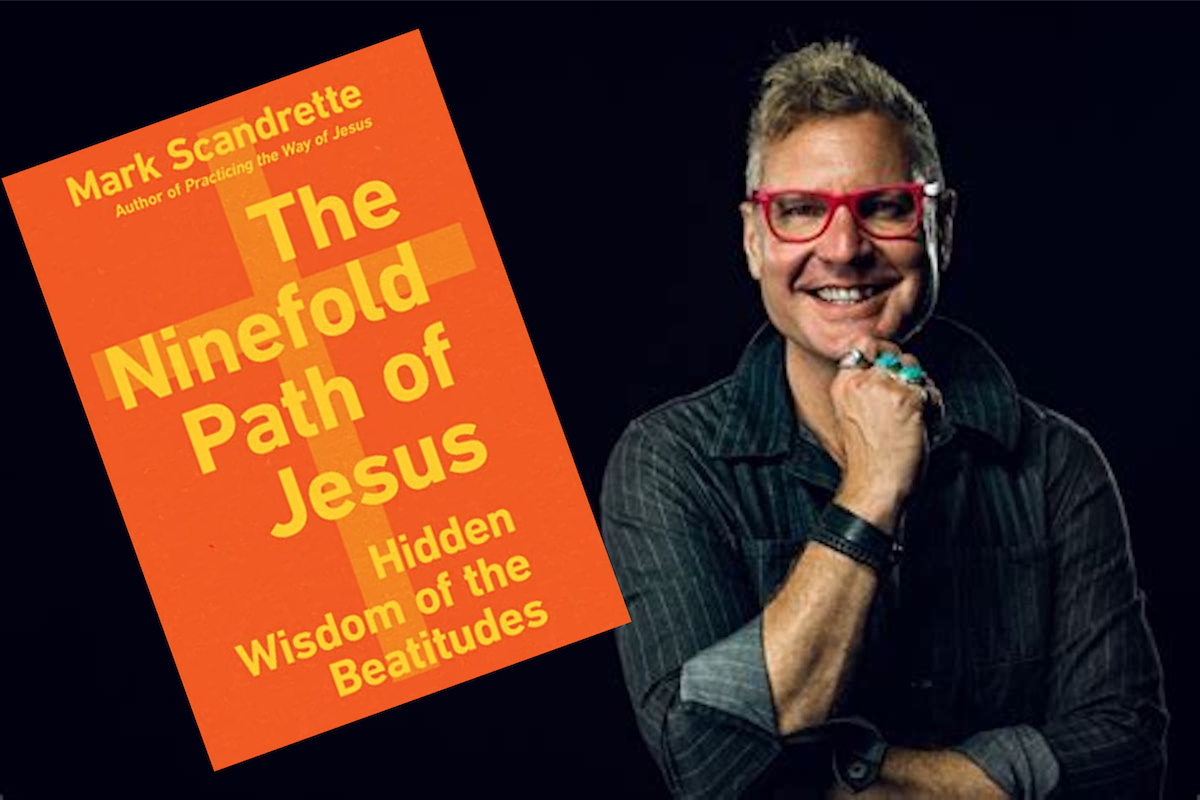
Weekend Podcast: Mark Scandrette & the Ninefold Path of Jesus

(WW) Mark Scandrette & the Ninefold Path of Jesus Wayfarer

On this Wayfarer Weekend (WW) podcast, my conversation with Mark Scandrette, author of The Ninefold Path of JesusHidden Wisdom of the Beatitudes.

“We’ve learned to live from a mentality of anxiety and greed, but what if a world of abundance with solace and comfort is actually near? We’ve learned to live by striving, competition, and comparison, but what if we all have equal dignity and worth? Whatever your story, whatever your struggle, wherever you find yourself, this way is available to you.”

Mark Scandrette is executive direction of Reimagine: A Center for Integral Christian Practice. In addition to leading learning labs worldwide, Mark teaches in the doctoral program at Fuller Seminary. He lives with his family in San Francisco’s Mission District.

http://markscandrette.com

http://ninefoldpath.org

Alignment of Being

Alignment of Being (CaD Matt 5) Wayfarer

“Blessed are….”
Matthew 5:3a (NIV)

Wendy and I were on a cruise last week with our friends, Chad and Shay. Cruising has become Wendy’s and my favorite form of vacation, though perhaps not for the same reason that many enjoy it. Being on the water has always held a spiritual connection for me. To be honest, Wendy and I spent much of our time last week together inside our cabin or on our small verandah staring out over the vast ocean. It was heavenly.

I read a couple of books as we sailed along. One of them was called The Ninefold Path of Jesus by Mark Scandrette. It practically, simply, and deeply explores a familiar passage in the Great Story found in today’s chapter, traditionally known as “the beatitudes.” The beatitudes are the opening of the most thorough record we have of Jesus’ teaching, a message Jesus gave His followers on a hill by the Sea of Galilee.

Each of the nine beatitudes describes those whom Jesus says are “blessed.” What immediately stands out is the contrast to those whom we often think of as “blessed” in this world: the rich, famous, popular, powerful, influential, famous, privileged, talented, and elite. Jesus makes it clear that those who are blessed in the Kingdom of God look very different. In fact, they are much the opposite of what subjects of the Kingdom of this world typically consider blessed. In God’s Kingdom, Jesus states, those who are blessed are:

poor in spirit (trusting God for their provision)
mourning (lamenting their brokenness, and what is broken in this world)
meek (holding any personal power in check)
hungry/thirsty for righteousness (seeking justice in life and relationship)
merciful (having compassion, even for my enemies)
pure in heart (acting, speaking, and relating with right motives)
peacemakers (finding and choosing ways to deescalate conflict)
persecuted for doing the right thing (radically loving others)

Perhaps my choice to begin reading Matthew’s biography of Jesus on the chapter-a-day journey this week was subconsciously influenced by my meditation and contemplation of the beatitudes last week. As I read them anew this morning, my head and heart were still full of all that I pondered as I watched the ocean waves roll by this past week.

As I continued on into the rest of the chapter, and the continuation of Jesus’ message, I realized for the first time that Jesus subsequent teaching about murder, curses, adultery, lust, divorce, making oaths, revenge, and love for one’s enemy all connect back to the be-attitudes of trust, lament, meekness, mercy, motive, peacemaking, and radical love. In essence, the beatitudes are the table of contents for everything Jesus is going to say after. I realize that if I don’t have my “being” and “attitude” right, I’ll never act, speak, and relate as Jesus goes on to describe.

Wendy and I have been repeatedly asked this week how our cruise went. We’ve enjoyed sharing our experiences, though I sometimes wonder if people are surprised by our description. We spent a lot of time in our cabin. We slept a lot. We read books. We talked about life on our verandah. We stared at the ocean. We watched a dolphin jumping in the water. We saw the distant, misty eruption of a whale’s exhale. As I continue to look back on it, Wendy and I spent the week trying to get our “being” centered and aligned so that the onslaught of “doing” that faced us upon our return might look more like “the nine-fold path of Jesus” and less like the vain pursuit for what the kingdoms of this world describe as the “good life.”

Note: If you’re normally one who reads my blog post or listens to my podcast, but you don’t actually read the corresponding chapter, let me encourage you to take a couple of minutes today and the next couple of days to actually read Jesus’ message on the hill in Matthew chapters 5, 6, and 7. I think it’s worth it.

If you know anyone who might be encouraged by today’s post, please share.

Shades of Schadenfreude

[Jonah] prayed to the Lord, “Isn’t this what I said, Lord, when I was still at home? That is what I tried to forestall by fleeing to Tarshish. I knew that you are a gracious and compassionate God, slow to anger and abounding in love, a God who relents from sending calamity.
Jonah 4:2 (NIV)

As I get older, I’ve grown to enjoy etymology, the study of words and their origins. I find it fascinating how these building blocks of communication become part of our everyday conversations, and how they wax and wane in popular usage. I also find it fascinating how cultures ascribe certain significance, power, and meaning to certain words, while others don’t. Our kids in Scotland have a few great anecdotes about uncomfortable social moments when they discovered that a word they used, which has a benign meaning in the States, has a very different meaning in the U.K.

There is a word I first noticed a few years ago, and I’ve found that it’s growing in popularity: schadenfreude. It’s a compound German word that comes from the root words meaning “harm” and “joy“. It means to take pleasure in another’s person’s misfortune.

There certainly is a natural and rather harmless way that we enjoy seeing the bad guy get his comeuppance. I was one of the many who watched the entire series Game of Thrones. The series was masterful in creating really bad characters who I wanted to see come to a nasty, bitter end and was happy when it eventually happened.

At the same time, there is a dark side of schadenfreude that I feel like I’m witnessing more and more in our current culture. It’s not enough to disagree with another person’s political, religious, or social worldviews, we have to publicly call them names and post antagonizing memes on social media. Just last night I found myself shutting off social media and walking away. I realized how mean-spirited the posts were that I was reading and it wasn’t having a positive effect on my psyche or my feelings towards others.

In today’s final chapter of the story of Jonah, we finally learn what was at the heart of Jonah’s mad dash to flee from what God had asked him to do. Jonah didn’t want God to be gracious and merciful with his enemies. Jonah wanted to wallow in schadenfreude and watch his enemies, the Assyrians, suffer.

In the sermon on the mount, Jesus took five common statements about matters of relationship and then told His followers He was raising the bar. Jesus’ expectation for me as a follower is that I behave in a way that goes against the grain of common human behavior:

“You’re familiar with the old written law, ‘Love your friend,’ and its unwritten companion, ‘Hate your enemy.’ I’m challenging that. I’m telling you to love your enemies. Let them bring out the best in you, not the worst. When someone gives you a hard time, respond with the energies of prayer, for then you are working out of your true selves, your God-created selves. This is what God does. He gives his best—the sun to warm and the rain to nourish—to everyone, regardless: the good and bad, the nice and nasty. If all you do is love the lovable, do you expect a bonus? Anybody can do that. If you simply say hello to those who greet you, do you expect a medal? Any run-of-the-mill sinner does that.”
Matthew 5:43-47 (MSG)

Reading Jonah’s story this week has caused me to do some real personal introspection. You can see it in the common ways my posts have ended the past few days.

As I was reading about the etymology of the word schadenfreude, I learned that many cultures and languages have a word that means the same thing. I recognize that there is a relatively harmless pleasure that I take when my favorite team’s rival loses. C’est la vie. I don’t, however, want to wake up someday and find myself in Jonah’s sandals. Following Jesus means loving, even those people who wish to see me suffer; Even those who actually act on it.

“Forgive them. They don’t realize what they’re doing.”

God, make me more like that.

When Obedience Seems Not Such a Wonderful Life

From inside the fish Jonah prayed to the Lord his God.
Jonah 2:1 (NIV)

In the film classic, It’s a Wonderful Life, Jimmy Stewart plays the leading role of George Bailey. Stewart, with his easy-going manner and “aw, shucks” charm, was the perfect person to play the role. George Bailey is a character referred to as an “everyman” because he’s a basic human archetype to whom every viewer can relate.

Late in the film, as he feels his life unraveling, Bailey stands on a train trestle and talks to God. “I’m not much of a praying man,” he says as he begins to address the Almighty. It’s a great line because it reaches those viewers who are not religious. Religious people know all about prayer and will identify, but for the non-religious viewer, it makes both Bailey’s character and prayer accessible.

In today’s chapter, we find Jonah, the runaway prophet, trapped in the belly of a giant fish. The chapter records the prophet’s distressed prayer from his precarious predicament.

What I found ironic as I read the chapter this morning was the placement of the prayer in the story. Jonah is not a George Bailey, for whom prayer is reserved for life’s foxhole desperation. Jonah was a prophet of God. It was his life. It was his job. Prayer, study, and the proclamation of God’s word was his daily preoccupation. Jonah didn’t pray when God told him to go to Nineveh and preach to the Assyrian people. He didn’t wrestle with God on the subject or seek guidance, clarification, or the grace to help him understand the command. He simply, and defiantly ran the other direction.

Nineveh was the capital of Assyria. A generation before Jonah the Assyrians had waged a bloody war against his nation. A generation later they would do the same. The people of Nineveh were Jonah’s enemies and the enemies of his people. Jonah’s struggle was not what God was calling him to do, but those to whom God was calling him to do it.

Our local gathering of Jesus’ followers has spent the better part of a year studying the Jesus Movement of the first century in the Book of Acts. One of the major themes in the book is the racism that surfaces between different groups of believers. Those of Jesus’ followers who were Jews from Palestine discriminated against those who were from Greece. Those Jews who were from Greece discriminated against believers who were non-Jewish Gentiles. It was a hot mess, but it pointed to a heart issue that is present in Jonah as well.

In asking Jonah to preach to the Assyrians, God is proclaiming that He cares about the Assyrians. He wants the Assyrians to repent of their ways and turn to Him. God is, in fact, demonstrating the very message His Son would preach a few hundred years later:

“You’re familiar with the old written law, ‘Love your friend,’ and its unwritten companion, ‘Hate your enemy.’ I’m challenging that. I’m telling you to love your enemies. Let them bring out the best in you, not the worst. When someone gives you a hard time, respond with the energies of prayer, for then you are working out of your true selves, your God-created selves. This is what God does. He gives his best—the sun to warm and the rain to nourish—to everyone, regardless: the good and bad, the nice and nasty. If all you do is love the lovable, do you expect a bonus? Anybody can do that. If you simply say hello to those who greet you, do you expect a medal? Any run-of-the-mill sinner does that.

“In a word, what I’m saying is, Grow up. You’re kingdom subjects. Now live like it. Live out your God-created identity. Live generously and graciously toward others, the way God lives toward you.”
Matthew 5:38-48 (MSG)

Jonah now becomes the everyman archetype of his people who loved taking pride in being “the people of God” and “God’s chosen people” but had no interest in sharing the love or favor. Jonah doesn’t want to go to God’s enemies because he wants nothing to do with their repentance. He is like the Prodigal’s dutiful, hard-hearted older brother, only this time the father is asking him to go find his lost brother and see if he’ll come home.

Jonah is so adamant in refusing the call that he’s not even willing to pray and ask a few questions or to try and understand God’s heart in the request. But having barely survived a storm at sea, having been thrown overboard by non-Jewish sailors (who repent and turn to God), and having been swallowed by a giant fish, Jonah finally prays.

This morning I find myself standing in Jonah’s sandals. I have been a follower of Jesus for almost forty years. How willing have I been to show love for those who hate me? Jesus repeatedly points out, in His sermon on the Mount, that He doesn’t want His followers to do the easy thing (like loving the homers who love you) but the hard thing (reaching out to the evil Assyrians of Nineveh). Am I even willing to consider how I might have settled into the former while conveniently ignoring the latter?

Jonah is an everyman, a character with whom we can relate. In the quiet this morning I confess I find myself relating to him more than I care to admit. I am called to love, even those I would much rather ignore.

“I’ve Got This”

“If God gives such attention to the appearance of wildflowers—most of which are never even seen—don’t you think he’ll attend to you, take pride in you, do his best for you? What I’m trying to do here is to get you to relax, to not be so preoccupied with getting, so you can respond to God’s giving. People who don’t know God and the way he works fuss over these things, but you know both God and how he works. Steep your life in God-reality, God-initiative, God-provisions. Don’t worry about missing out. You’ll find all your everyday human concerns will be met. Give your entire attention to what God is doing right now, and don’t get worked up about what may or may not happen tomorrow. God will help you deal with whatever hard things come up when the time comes.”
Matthew 6:30-34 (MSG)

This past week was our first trip down to the lake this year. I have said before that our family’s place on the lake always has been what many call a thin place. It’s a place where things of the Spirit are perceived with greater clarity.

So it was that I began to realize during our time at the lake just how anxious I have become about certain things in life. A bout of insomnia and some time of reflection unearthed a host of things I have been increasingly worried about. I’ve been harboring anxiety; My mind dwelling on things I ultimately can’t control. Being at heart a pessimist, my natural personality tends to take these little anxieties, hide them in the dark corners of my mind, and quietly grow them like bacteria.

On our drive home, I brought these things out into the open in conversation with Wendy. Along life’s journey I’ve discovered that fears and anxieties tend to lose their power when brought out and exposed to the light of conversation. It was helpful to talk it out, and to have Wendy challenge each anxiety with her lock-tight logic.

Yesterday after our local gathering of Jesus followers, I had a few friends praying over me. After a while in fairly routine prayer mode one of my friends, who is a prophet, said out of the blue, “You’re carrying too much. Stop worrying about…”  they then proceeded to name, specifically, the things I’ve been anxious about. There was more that was said, but suffice it to say that I got the message.

This morning I’m reminded that we as humans sometimes need repeated reminders. In today’s chapter Jesus continues His classic “Sermon on the Mount.” One of the simplest reasons I continue to daily journey through God’s Message is that often I’m given exactly the spiritual reminder I need. So it is today. It’s like Jesus personally following up on Wendy’s reasoned logic and the words spoken through my friend yesterday.

“Tom, when has worrying done anything for you? Chill out. Keep going. Stay focused on me. I’ll take care of you.

“I’ve got this.”

Marvel Movies, Meta-Communication and the Sermon on the Mount

“In a word, what I’m saying is, Grow up. You’re kingdom subjects. Now live like it. Live out your God-created identity. Live generously and graciously toward others, the way God lives toward you.”
Matthew 5:48 (MSG)

Wendy and I went on a date earlier this week to see Logan, the latest movie from the increasingly prolific Marvel franchise. We generally enjoy what Marvel puts out, but Logan took the usually entertaining action story to a new level. It even made Wendy cry. All week long Wendy has been muttering, “Oh my gosh. A Marvel movie made me cry.

And, that was what made Logan a different action film. All week long Wendy and I have been discussing why we found Logan to be a different kind of action film. We’ve been trying to step back and understand what the writers did to reach our emotions as well as our adrenal glands.

From the very beginning the writers revealed our heroes Wolverine, Charles Xavier, and Caliban in weakness, neediness, fear and frailty. This catches us off guard. We’re so used to seeing them in their confidence delivering pithy action movie lines as braggadocio. Add to our threatened, all-too-human heroes a cute, emotionally torn little girl and innocent children on the run for their lives. Mix in antagonists who, rather than silly comic book evil, seem like the truly evil people who actually appear in our morning headlines and you have a “comic book” movie that takes things to a different level than we’ve experienced before. (Attention parents: The “R” rating also means the producers took the violent action, language and one needless second of nudity to a new level as well).

As an amateur writer and professional communicator I’ve learned to look at and analyze communication from a contextual perspective. Most of us get mired in the details of what is being communicated. I tend to pull back and look at the larger picture. Scholars call it meta-communication.

In this morning’s chapter we wade into one of the most famous messages ever delivered. It’s called Jesus “Sermon on the Mount.” Even for non-religious types who have never darkened the door of a church or cracked open a Bible,  the words and metaphors Jesus delivered in this message have become part of our everyday vocabulary:

  • Turn the other cheek
  • Light of the world
  • City on a hill
  • Salt of the earth

As I read today’s chapter I could easily get mired in the abundance of inspired teaching. Virtually every line and verse could be its own blog post. But, I found myself unconsciously doing what I do with Marvel movies. I stepped back to look at the bigger picture of how Jesus was communicating at a broader level.

Jesus starts out with an attention grabber. He lists those who are “blessed” in God’s economy and the list looks nothing like we expect it to look. We tend to think of those who are rich, strong, powerful, healthy, educated, famous, connected, athletic, and popular as “blessed.” Jesus’ list starts with “poor” and goes on to list the grieving, meek, merciful, pure, peacemakers and persecuted.

Having grabbed our attention by saying what we didn’t expect to hear, Jesus goes on to tell His listeners that we are the vehicle through which God’s kingdom will advance in this world. We are the light. We are the preservative. He doesn’t qualify it. He doesn’t limit it. He doesn’t add a litmus test. Every one of his listeners is included. This is in stark contrast to our commonly held belief that God’s work is reserved for ministers, pastors, seminary graduates, religious types, “good” people and those who don’t struggle, sin and avoid church like the plague.

So this is a different kind of message than the “toe the line and follow all the rules or you’re going to hell stuff.” Does this mean that all the rules don’t matter anymore? Does Jesus mean that those ten commands I’m so bad at and all that other stuff are obsolete and out the window?

Jesus anticipates this question and answers it with an affirmative, “No way.” But he then ups the ante and changes the discussion. We tend to think of religion in a set of behavioral rules and judgmental “don’ts” that we humans use as our self-righteous measuring stick. Jesus changes the conversation. It’s not about avoiding the legalistic “don’ts” but demonstrating the heart motivated “dos” that He is calling us to:

Not “don’t murder, but “do treat people with love and respect.”

Not “treat others the way they treated me” but “treat others the way you would have like to have been treated.”

Not get revenge, but choose to forgive and give people another chance.

Not “hate my enemies” but “show my enemies real love, patience, kindness, and self-control.”

Like going to a Marvel movie and experiencing something I didn’t expect, this morning I’m struck at how very different Jesus message really is. It reveals that the ways of God run in opposite directions than the ways of this world. God’s kingdom operates far differently than we are lulled into thinking by the flaws in what we may have been taught and our earth-bound paradigms . The economy of God’s kingdom works on a completely different set of principles than what we’re used to grappling with in the day-to-day marketplace of this world. What Jesus is communicating is different. If I get mired in the minutiae of my preconceived notions and foundational prejudices, I just might miss what He’s really saying.

He’s calling me to be different, too.

Featured image courtesy of 75933558@N00 via Flickr


Chapter-a-Day Matthew 7

“These words I speak to you are not incidental additions to your life, homeowner improvements to your standard of living. They are foundational words, words to build a life on. If you work these words into your life, you are like a smart carpenter who built his house on solid rock. Rain poured down, the river flooded, a tornado hit—but nothing moved that house. It was fixed to the rock.” Matthew 7:24-25 (MSG)

Is God the bedrock of my life, or simply an incidental addition? It seems like an easy question when I answer from my own perspective. It’s when I imagine what others see when they look at my life, that the question bristles. Is God the foundation of Tom’s life? What evidence is there? What do others see when they interact with me or quietly watch me from afar?

In recent months I’ve been struck by the concept that this journey is simply about life and death. As I read the conclusion of Jesus’ famous mountainside message today, I find a thread of this concept once again woven into the very fabric of Jesus teaching. After going through a veritable plethora of detailed instructions for living, Jesus brings it all back to conclude with one central life and death question: What is the foundation on which you are building your life?

Today, as I make my way, I’m simply seeking ways to make Jesus the foundation of all that I say, do or think. I want this day to be about Life.

Creative Commons image courtesy of Flickr and ideacreamanualapps