Tag Archives: Intimacy

Grace, Served Neat

What causes fights and quarrels among you? Don’t they come from your desires that battle within you?
James 4:1 (NIV)

After yesterday’s post, I spent some time yesterday in introspection. Wendy and I met downstairs in the Vander Well Pub for a happy hour chat. We bellied-up to the bar and discussed some of the things that came out of my prayer and reflection. It was good.

Today’s chapter continues the flow from yesterday. There, streaming beneath the surface text, is the notion of God as intimate partner in relationship. It’s the same heart that God weaves through the entire Great Story. It’s a love story in the deepest sense; God as bridegroom initiating, courting, and pursuing intimate relationship with me.

So, what gets in the way of that intimacy?

I do.

James urges me to continue my honest introspection. What is it I desire? What motives are at work? As I did some spiritual cardio evaluation yesterday, I had to come clean with the fact that I sometimes allow my self-righteous desires and pride free rein when it comes to my attitudes towards certain individuals. Wendy gave me a great example during happy hour last night, that I hadn’t even considered. A person that she has noticed I love to hate. She didn’t need to make a case. The truth was sitting there in plain site. Ugh!

What did James point out earlier? A little bit of sin taints the whole loaf. My well-cloaked hatred toward one individual makes me no different, in essence, from someone spewing anonymous venom across the internet. It’s the same heart condition.

Pride, hatred, judgment, self-righteousness. That’s the way the world operates. It flies in the face of the person I want to be. It’s not the person Jesus asks me to be. And, that has relational consequences.

I can wallow in guilt and shame, but that’s not healthy for me either. It doesn’t accomplish anything but a perpetuation of spiritual dysfunction. I want to be better. I want to move the ball forward. I want positive change that will create more intimacy with God and others.

Here’s where it gets good.

James reminds me that God is not standing at a distance in condemnation of me. He “jealously longs” for me in spirit. He is leaning in towards me with more grace.

“Draw near to God, and He will draw near to you.”

The reality is that Wendy was Jesus at happy hour last night—even as she held up a mirror so I could reflect on what I didn’t really want to see.

She didn’t scoot her bar stool further away from me.
There was no relational stiff-arming.

She leaned in.
She drew close.
She was tender and gracious.

That’s what Jesus does.

He invites me to come a little closer so He can whisper into my soul. The wars in my life—external and internal—are not solved by winning. They’re healed by yielding.

Then Jesus, through James, reminds me in today’s chapter to:

  • Name my desires honestly (even the embarrassing ones).
  • Release the illusion of control (that tight grip is killing the mood anyway).
  • Kneel without theatrics—no performance, just presence.
  • Return to God not as a failure, but as a lover who wandered and came home.

Humility is not humiliation.
It is intimacy without pretense.

And grace?
Grace is Jesus lifting my chin, meeting my eyes, and smiling and saying…

“I love you. Come on — let’s move forward.”

If you know anyone who might be encouraged by today’s post, please share.

Promotional graphic for Tom Vander Well's Wayfarer blog and podcast, featuring icons of various podcast platforms with a photo of Tom Vander Well.
These chapter-a-day blog posts are also available via podcast on all major podcast platforms including Apple, Google, and Spotify! Simply go to your podcast platform and search for “Wayfarer Tom Vander Well.” If it’s not on your platform, please let me know!
Icon of an open book on an orange background

Holiness, Heart, & Hearth

…then exchange your tithe for silver, and take the silver with you and go to the place the Lord your God will choose. Use the silver to buy whatever you like: cattle, sheep, wine or other fermented drink, or anything you wish. Then you and your household shall eat there in the presence of the Lord your God and rejoice.
Deuteronomy 14:25-26 (NIV)

Year-end approaches. For Wendy and me, the already busy holidays are layered with even more good things. Wendy’s birthday on the 21st and our wedding anniversary on New Year’s Eve means the three biggest gift giving events of the year for my wife all happen in 10 days. Believe me, I’ve learned to think ahead. And there’s more than just the holidays.

Year-end also brings decisions that have to be made in the area of our business and personal finances. Giving, savings, and future planning must all be discussed and decided in meetings with various professionals who assist with those things. The dizzying world of taxes and finance produces endless questions. Navigating our labyrinthine tax code feels less like stewardship and more like trial by minotaur. Ugh! Underneath the Spirit and meaning of Christmas and New Years there remains the grind and realities of how life is managed day-to-day.

Speaking of finances and how life is managed, Wendy and I are looking forward our annual tradition of watching Guy Pearce’s dark and intense portrayal of Scrooge in FX’s version of A Christmas Carol. I highly recommend you put it at the top of your Christmas movie watch list. It cuts like a knife to the heart of the matter. What do matters of daily life, personal finance, and relationship look like when the Message and Spirit of what God did at Christmas fail to penetrate the human heart?

That same question lies at the heart of today’s chapter. God through Moses reminds his children and grandchildren that their identity as God’s treasured people is made visible in how they live, what they do with their appetites, how they manage their finances, their generosity, and how they do community each day, each season, each year.

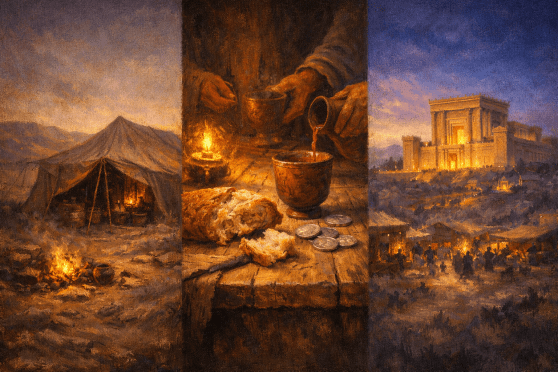
Today’s chapter also has an interesting connection to Jesus’ Story. Moses tells his people that someday, when there is a permanent Temple established it may be that it will be far away from where they live. Transporting all of their stored up tithes and offerings may not be practical. So, there was a provision to sell those tithes and offerings for silver. They could then bring the silver (easy to carry with you) to the Temple. There the silver could be used to buy what you needed for your prescribed offerings and sacrifices.

By Jesus day, the religious establishment had discovered in Moses’ rather simple financial principle a money making scheme. Poor Hebrew pilgrims making the long journey to the Temple did bring with them silver to buy what was needed for their offerings and sacrifices. The Temple established its own currency which the establishment demanded for the purchase of offerings and sacrificial animals. The local currency the pilgrims brought would need to be exchanged. With that exchange came fees and taxes and an entire industry of moneychangers. Jesus approached the Temple—meant to be a place of community, celebration, generosity, and feasting—only to find it had become a spiritual subsidiary of Scrooge and Marley, Inc.

[Cue: Jesus picks up a whip He sees lying on the ground next to the cattle pen.]

Today’s chapter is easily read as simple prescriptive rules regarding diet and religious offerings. But the directives were intended to point to matters of heart and Spirit. God through Moses is teaching his toddler nation that holiness is anchored in restraint.

Desire without boundaries becomes chaos; desire with limits becomes intimacy.

Clean and unclean are not moral categories but symbolic ones—teaching God’s people to pause, to choose, to remember God even in the most ordinary act: eating. The tithe is especially striking: food given to God is not burned, but eaten—by people—with God present. Holiness tastes like wine, bread, and belonging. God is saying “You don’t drift into holiness. You practice it daily, with fork and cup.

Tent to Temple to Table.

Which, in the quiet, brings me back to Christmas…and anniversary…and New Year’s…and year-end decisions of business and finance. Today’s chapter whispers to me of God’s heart: generous, selfless, and servant-hearted. From the beginning God’s prescription for Life flowed from His Spirit of intimacy, community, and generosity in the simple acts of gathering, celebrating, and eating.

In the coming days as Wendy and I gather with loved ones, as we watch A Christmas Carol, as we finalize business matters, I pray that it is that Spirit that rules my heart.

I have no need for the ghosts of Past, Present, and Future to awaken me in the wee hours.

God bless us, every one.

If you know anyone who might be encouraged by today’s post, please share.

Promotional graphic for Tom Vander Well's Wayfarer blog and podcast, featuring icons of various podcast platforms with a photo of Tom Vander Well.
These chapter-a-day blog posts are also available via podcast on all major podcast platforms including Apple, Google, and Spotify! Simply go to your podcast platform and search for “Wayfarer Tom Vander Well.” If it’s not on your platform, please let me know!
An image featuring the Bible logo with an open book icon and the text 'Bible Gateway'.

What’s In a Name?

For you are a people holy to the Lord your God. The Lord your God has chosen you out of all the peoples on the face of the earth to be his people, his treasured possession.
Deuteronomy 7:6 (NIV)

One of the things I love about living in a small town is being known. I love walking into a restaurant, a coffee shop, or the pub and being greeted by name. I suppose some people like to be anonymous, but research consistently shows that most of us truly want to know and be known. And the beginning of that relational journey is simply knowing one another by name.

The subject of names has been surfacing a lot in my conversations of late. My local gathering of Jesus’ followers is working on a short-term initiative intended to help people learn one another’s names. I just read a fantastic article about the neuroscience that proves just how powerful using a person’s name truly is. I talk about it in business all of the time as I deliver customer service training.

One of the things that I have learned about name-use over the years is that the deeper and more intimate the relationship the more likely we are to create nicknames and pet names for one another. Conversely, as relationships break down and marriages move toward divorce we stop using one another’s names and revert to using pronouns or impersonal descriptors like “my children’s mother.” Wendy is “my treasure.” From the very beginning of our relationship, it’s been a special moniker that is hers and only hers. Between the two of us it is a sign of affection, devotion, honor, and fidelity.

Today’s chapter is one of those chapters that is misunderstood in modern cultural context. It’s a love letter disguised as a battle plan. God reminds Israel that their chosenness isn’t about muscle or merit, but about affection and fidelity. They are to enter the land clear-eyed and clear-hearted—no half-measures, no flirtations with rival gods. Destruction of idols isn’t cruelty; it’s fidelity therapy.

God promises protection, fruitfulness, and flourishing—not as wages earned, but as the natural overflow of covenant intimacy. Obedience here is not stiff-backed compliance; it’s trust leaning its full weight into the arms of a faithful Lover.

In Jewish tradition, Deuteronomy 7 is foundational for the concept of segulah—Israel as God’s treasured possession (v.6). This chosenness is not superiority; it is purpose and calling. Israel is set apart for something: to bear God’s name and reveal Him and His character in the world.

This covenant love is a foreshadowing of Jesus, who loved the world so much that He left heaven behind and became one of us. He treasured us so much that He suffered and died to pay the penalty for our sin. Then He called us to bear witness of God’s Kingdom through our love of Him and others.

The contrast could not be clearer.

The world chooses powerful.
God prefers the weak.
The world finds security in big numbers.
God prefers faith in a few.
The world indulges in surface sensual appetites.
God prescribes deep, exclusive and intimate relationship.
The world values self-centered personal ambition.
God values faithfully putting others ahead of ourselves.

In both today’s chapter and Jesus’ example, it is God who loves first. It is God who makes the covenant. It is God who promises fidelity, provision, protection, and blessing. We are the object of His love and affection.

We are His treasure.

He whispers, “My life for yours.”

When God speaks of loving His people in verses 7 and 8, the Hebrew word is ‘ahav. It is not a giddy infatuation, it’s a choice and a volitional act. In verse 9 God’s ‘ahav blesses a thousand generations of those who ‘ahav Him. God’s love invites reciprocity. Not because it needs it, but because it awakens it. And notice: God’s covenant loyalty flows toward those who love him—not as payment, but as shared intimacy.

This is mutual devotion, not transactional obedience.

In the quiet this morning, I’m reminded that God says that those who choose to follow have their names written in the Book of Life. My name is there. God knows my name. But today’s chapter reminds me that my name being written in the Book of Life is far more than just a “Hello My Name Is” name tag knowledge. That’s just the record like Wendy’s and my marriage certificate in the safe downstairs. I am God’s “treasure.” He gave His life that I might live. That kind of love awakens love in me.

Less Hallmark card, more keeping marriage vows at 3 a.m.

If you know anyone who might be encouraged by today’s post, please share.

Promotional graphic for Tom Vander Well's Wayfarer blog and podcast, featuring icons of various podcast platforms with a photo of Tom Vander Well.
These chapter-a-day blog posts are also available via podcast on all major podcast platforms including Apple, Google, and Spotify! Simply go to your podcast platform and search for “Wayfarer Tom Vander Well.” If it’s not on your platform, please let me know!
Logo of Bible Gateway featuring an open book icon in orange and white.

Ten Words

“Oh, that their hearts would be inclined to fear me and keep all my commands always, so that it might go well with them and their children forever!
Deuteronomy 5:29 (NIV)

The bedroom is absolutely quiet but for the softness of the deep breaths of fresh slumber. All is dark but for the warm glow of the nightlight near the door. I lay stretched out on the mattress and feel the warmth of my grandchild’s little body cuddled up next to mine.

This has become one of my favorite moments in life. I am happy to lay here long after the wee one has slipped into sweet dreams. Sometimes, I choose to stay until I follow them into the land of nod. In the meantime, my soul bathes in the holiness of the moment. I consider their tender young lives and the long journey ahead of them. I pray over their parents. I pray over them. Prayers of blessing, of protection, and guidance – bedtime transformed into Papa’s quiet vigil over this precious little life that I love so much.

In today’s chapter, Moses continues his final words to the next generation of his loved ones. He takes them back to the basics. In our English translation and Christian tradition we call them the Ten Commandments. In so many minds they have become nothing more than laws. Rules. Black-and-white demands of obedience. For many they are a symbol of a tyrannical God eager to punish.

As I read and shema (e.g. really listen) to the chapter, that’s not what I see and hear at all.

In Jewish tradition it’s called “the decalogue” or “ten words.” They’re not commands. In fact, rabbis speak of it being one ineffable sound of the divine from which Moses drew the ten words. What’s more, the context is not one of a tyrannical power monger but the intimate marriage vows of a lover.

God, who initiated the relationship.
God, who made a covenant with us, not the other way around.
God, who delivered us from slavery and chains.
God, with us – not our ancestors – with us here and now.
God, who amidst the chapter lays his heart bare:

“Oh, that their hearts would be inclined to fear me and keep all my commands always, so that it might go well with them and their children forever!

The Hebrew word for “keep” is shamar. English flattens it into simple obedience. English has a way of forcing meaning into a box that can never contain it. This is a great example. Shamar is a whole-body verb—warm, protective, attentive, deeply relational. It is the Shepherd watching over his flock by night. It is a gardener guarding her precious plants from every threat. It is tending something fragile so it survives.

The root imagery of the word comes from watchmen on the walls of the city in the darkness of night, heart steady, every sense attentive. Not policing, but protecting because what they are guarding is precious.

Suddenly, my life-long perception of ten black-and-white “commands” is laid bare for the hollow and meager interpretive shell it has always been. The ears of my heart begin to shema the intimate heart’s desire that God groaned in one ineffable utterance, from which Moses teased ten words:

I am in love with you. I have proposed to you. I have delivered you.
I desire your love and devotion.
I desire to experience your honor and respect.
I desire regular rest with you, to stop and just be together.
I desire family to be a perpetual place of life, love, and security.
I desire that life, faithfulness, and truth be the core of who we are.
I desire contentment, because if we have each other – it’s always enough.

Which brings me back to the warm glow of the nightlight in the darkness. The soft repetition of a toddlers respiration as I feel the rise and fall of that little chest pressed up against me. Papa, the night watchman guarding over this precious little life. I lie there in the holiness of the moment feeling a love I can’t even describe. I think I’ll just lie here a while longer and shamar.

It’s taken nearly sixty years, Lord. I think I’m finally starting to get it.

Wendy and I celebrate our 20th wedding anniversary this New Year’s Eve. We’re leaving today for an early anniversary weekend getaway. As I read through my paraphrase of the ten words, it’s a good description of what I’m looking forward to savoring with m’luv.

Which means, I’m taking a few days sabbath from our chapter-a-day journey. See you next Thursday.

If you know anyone who might be encouraged by today’s post, please share.

Promotional graphic for Tom Vander Well's Wayfarer blog and podcast, featuring icons of various podcast platforms with a photo of Tom Vander Well.
These chapter-a-day blog posts are also available via podcast on all major podcast platforms including Apple, Google, and Spotify! Simply go to your podcast platform and search for “Wayfarer Tom Vander Well.” If it’s not on your platform, please let me know!
A tranquil bedroom scene with a warm nightlight glowing near the door. A grandparent lies peacefully on a mattress with a grandchild cuddled close, showcasing a moment of love and protection.

Knowing, or Knowing?

And I pray that you, being rooted and established in love, may have power, together with all the Lord’s holy people, to grasp how wide and long and high and deep is the love of Christ, and to know this love that surpasses knowledge—that you may be filled to the measure of all the fullness of God.
Ephesians 3:17b-19 (NIV)

A couple of years ago I had the opportunity to reconnect with the man who was preaching the night Christ became Lord of my life in 1981. Bob was an evangelist and writer at that time, continuing his graduate studies. By the time I was half-way through my undergraduate studies Dr. Bob became one of my professors. He went on to teach at larger and larger universities. As we talked about our respective journeys, Dr. Bob told me that he had been called by God to bring a voice of reason, faith, and belief regarding the Bible, Christian history, and Christian theology into an academic world that is largely antagonistic to Christianity in every way.

God, bless him.

Along my life journey I have encountered many very knowledgeable people. In my formal education of the Bible and of theology, and in my experiences with church leadership in various denominations, I’ve known amazing, intelligent people with all sorts of knowledge about the Bible and Christian theology. I’ve observed, however, that intelligence and knowledge does not always directly translate into an actual relationship with Jesus.

In today’s chapter, Paul expresses his prayer for the believers in Ephesus. Paul has just got done explaining to the non-Jewish, or Gentile, Ephesians that they are now part of something that they previously knew nothing about. God had been working through the Jewish people for centuries to begin the Story and process of redemption. Despite having all of the knowledge of the Law and the Prophets, most of the Jews did not know or recognize Jesus as the Messiah. Paul goes on to explain that he had been called by Jesus to make Him and His love known among the Gentile world. A bit like my friend Dr. Bob, Paul was in many ways a lone voice in the antagonistic, educated cultures of both Jewish Orthodoxy and Greek philosophy.

This in mind, I found it interesting that when Paul expresses his prayer for the believers in Ephesus he prays that they might grasp the immensity of Jesus’ love. He then prays that they might know Christ’s love. The word Paul uses for “know” is the Greek word ginōskō which is also used to describe the intimate knowing that happens in sex. He then goes on to describe the love of Christ as something that is incomparably surpassing of “knowledge” in which he uses the Greek world gnōsis which is simply human knowledge or understanding.

In other words, it’s one thing to know Jesus as in having a basic understanding of who Jesus is, His teachings, and what is believed about Him. It is another thing to know the love of Jesus intimately like the intimacy that happens when you have sex with your spouse.

My friend Dr. Bob was called by God to take the latter knowledge with him into an academic world that largely only experiences the former. In every church I’ve ever attended, I’ve observed many people who also appear to have only knowledge about Jesus without having experienced intimately knowing the love of Jesus that surpasses understanding.

In the quiet this morning, I pray that the intimate, experiential love of Christ that is beyond understanding will, as Paul put it in his prayer for the Ephesian believers, fill me “to the measure of all the fullness of God.” I pray that for you to, my friend.

After all, God is love itself.

If you know anyone who might be encouraged by today’s post, please share.

A collage featuring podcast platforms icons including Spotify and Apple Podcasts, alongside a portrait of Tom Vander Well with the title 'Wayfarer blog and podcast.' A figure is seen walking in a misty landscape in the background.
These chapter-a-day blog posts are also available via podcast on all major podcast platforms including Apple, Google, and Spotify! Simply go to your podcast platform and search for “Wayfarer Tom Vander Well.” If it’s not on your platform, please let me know!
Logo of a Bible app featuring an open book icon on an orange background.

To Know Better

I keep asking that the God of our Lord Jesus Christ, the glorious Father, may give you the Spirit of wisdom and revelation, so that you may know him better.
Ephesians 1:17 (NIV)

Yesterday at my desk I received an invite on my computer. The invitation came from Wendy asking to meet for a pre-dinner beverage downstairs in the Vander Well Pub. As we settled in at the bar, Wendy said she wanted to discuss a question I raised in a message I gave yesterday amidst our local gathering of Jesus’ followers. The message was about prayer, and specifically about the phrase Jesus used in teaching His disciples to pray: “give us this day our daily bread.” The question I raised in the message was “What is/are the thing(s) with which you struggle most to trust God?”

Wendy wanted to have a V-Dub Pub conversation to talk about each of our answers to that question.

I have to tell you that the conversation got gut-level honest and transparent. As we talked about some of the (admittedly stupid) things that I struggle to trust God for, the onion of my soul got peeled back a few layers deeper. I confess that it was uncomfortable, even though there is no one on this earth who knows me, my struggles, and my foibles as well as Wendy does. She loves me anyway. It was a good conversation, even if it was uncomfortable. As we headed upstairs to make dinner we knew one another a bit better, and we had been given the opportunity to extend grace to one another in expressing our love for one another despite our respective faith struggles.

Today our chapter-a-day journey continues through Paul’s “Prison Letters” which were written while he was under house arrest in Rome. With time on his hands waiting for Caesar to hear his case, Paul took the opportunity to pen letters to the local gatherings of Jesus’ followers he’d established in his travels. With the exception of the personal letter to Philemon, the Prison Letters were written to address entire gatherings of people. As with the letter to the Colossians that we just finished on this chapter-a-day trek, Paul intended his letter to the Ephesians to be read to the entire gathering for the purposes of teaching and instruction. He also expected that the local gatherings in different locations would exchange letters once they were read so that all the different local gatherings would benefit from the teaching and instructions Paul wrote to each.

In today’s opening chapter, Paul establishes that he’s got some mind-blowing spiritual truths he wants to lay on the believers in Ephesus. He’s going to expand their minds and hearts to think about God’s plans and purposes for life on a cosmic spiritual level. As he’s introducing this, he states that his purpose in doing so is so that the believers might “know [God] better.”

Which immediately took my mind to my message yesterday. I observed in my message that Jesus perpetually uses the metaphor of marriage to describe the relationship He wants to have with His followers. Jesus described Himself as “the bridegroom” and we as His “bride.” Like a marriage, Wendy and I communicate in different ways at different times for different relational purposes. Despite the many years that we have been married, and despite the fact that Wendy knows me better than anyone, there are still opportunities to sit at the bar, have a gut-level conversation, and peel back another layer of the onion of our souls.

There is always an opportunity to know one another better.

In the quiet this morning, I simply find myself acknowledging that after almost 45 years of relationship with Jesus I still have opportunity to know Him better. Perhaps I should set an appointment to meet Jesus in the V-Dub Pub for a conversation before dinner tonight.

If you know anyone who might be encouraged by today’s post, please share.

A collage of podcast and music platform icons alongside a portrait of Tom Vander Well with the text 'Wayfarer blog and podcast.'
These chapter-a-day blog posts are also available via podcast on all major podcast platforms including Apple, Google, and Spotify! Simply go to your podcast platform and search for “Wayfarer Tom Vander Well.” If it’s not on your platform, please let me know!

Refreshment

For they refreshed my spirit and yours also. Such men deserve recognition.
1 Corinthians 16:18 (NIV)

“Oh! That was such a good night!” Wendy said to me as we began our daily nocturnal preparations.

Our guests had arrived at 5:30 that evening. The agenda was simple. We would hang out here at the Vander Well Pub. We put out some simple happy hour appetizers which comprised of an assortment of leftover charcuterie elements from Christmas. I poured a round of drinks.

The next thing I knew, it was almost 11:00 p.m. and our guests were saying for the third or fourth time, “We really have to go.”

It was a conversational five-hour deep dive into one another’s lives. Children, grandchildren, conflicts we each were facing, family challenges, work challenges, marriage challenges, and our hopes for the new year. There was seemingly no subject that was “off the table” and things flowed so naturally and organically that no one even looked at the clock for hours.

“Oh! That was such a good night!” Wendy exclaimed.

Our souls had been refreshed.

Good friends. Good leftovers. Good drink. Good conversation. Simple.

When was the last time your soul was refreshed?

Many years ago I remember a business trip with my boss in which he prompted a long conversation about a verse in one of Paul’s letters that no one ever talks about or quotes. It was Paul’s letter to Philemon in which he writes:

“Your love has given me great joy and encouragement, because you, brother, have refreshed the hearts of the Lord’s people.”

We talked for hours on that car ride about what it means to have your heart “refreshed” and how we can be “refreshers” of other’s hearts. I have never forgotten that verse and that conversation. As soon as I read Paul’s words this morning about Stephanas, Fortunatus and Achaicus who delivered the Corinthian’s letter and “refreshed” his spirit, I immediately thought of the heart refresher Philemon. I thought my boss and our car ride conversation. I thought of our evening with friends just a couple of weeks ago.

As I sit in the quiet this morning and think about that night, it strikes me that there were no gifts given, there was no entertainment, and no one looked at their phones. There was, however, honesty, vulnerability, and a willingness to share with one another knowing that there would be no judgement, only love for one another and a desire for the best for one another. In a world that seems hell-bent on presenting a consistently sanitized and idealized image of ourselves and our lives online, it’s refreshing to have friends with whom we can be our challenged, flawed, and broken selves while experiencing an honest exchange of love and grace.

The truth is that I need my heart and soul refreshed on a regular basis.

I’m so grateful to have people in my life who do so.

I pray that I consistently do so for others.

If you know anyone who might be encouraged by today’s post, please share.

These chapter-a-day blog posts are also available via podcast on all major podcast platforms including Apple, Google, and Spotify! Simply go to your podcast platform and search for “Wayfarer Tom Vander Well.” If it’s not on your platform, please let me know!

The Depth’s in the Details

The Depth's in the Details (CaD 2 Sam 23) Wayfarer

…and Uriah the Hittite.
2 Samuel 23:39 (NIV)

This past weekend was our annual time at the lake with our friends Kevin and Becky. We’ve been walking the journey together for many years and our time together at the lake is always, for us, one of the pinnacles of the summer season. When Kev and Beck are here, the conversation just seems to flow non-stop from one subject to another from early morning until deep into the night’s watch.

With all of the conversations we’ve enjoyed through all of the years, you’d think we would run out of things to talk about. The truth of the matter is that the conversation simply gets deeper, more transparent, and more intimate. Late on Saturday evening, as we sat on the deck under the light of the tiki torches, the four of us were led into what I sensed was a God-ordained conversation about deeply personal matters. It was a subject we’d touched on multiple times before, but this evening we dove into details that led to what may very well be a powerfully transformational moment.

I’ve found a parallel experience in reading God’s Message day after day through the years. I can read each day, and even have read through the entirety multiple times, and I keep coming back for more. You’d think it would get old. You’d wonder why I keep reading through it. And yet, it’s a lot like conversations with Kev and Beck: It just gets deeper, more transparent, and more intimate. And sometimes you hit upon a detail that you’ve read before, but it never really registered.

So it was today that I was reading through what seems to most readers a boring list of strange, ancient names thrown into the appendices of David’s biography. This particular list was a list of men who were David’s elite warriors. These warriors were David’s special ops, his SEALs, his Rangers, his Delta Team, and his Green Berets. They were the cream of the warrior crop and their exploits were legendary in their day. And, as I’m reading through the list thanking God that most of these names were lost to antiquity, I land upon the final name in the list: Uriah the Hittite.

Uriah the Hittite, the husband of Bathsheba.
Uriah the Hittite, the man David tried to deceive to cover up his adultery.
Uriah the Hittite, whom David conspired to murder to avoid public shame.
Uriah the Hittite, whose own general betrayed him on the king’s orders.

When I read through the story of David and Bathsheba, Uriah has always been a bit of a supporting cast member. You don’t give him a lot of thought. Somehow, the realization that Uriah was part of David’s “Mighty Men,” makes David’s conspiracy all the more damnable. Uriah was not a schmuck. He was well known to David. They’d fought together. Uriah had risked his life for David. He was one of the best. And David was willing to consider his own man as expendable, collateral damage in the cover-up of his personal sin.

Sometimes the real story is in the details. Even as human beings sharing life together, what makes our community and conversation transformational is found in the depth and detail of our sharing. Today, I’m thinking about people who appear to plod through life’s journey on broad super highways of bland generalities and surface conversations, zipping by on cruise control but never moving closer to real relationships and transformational conversations. Today, I’m thankful for our good companions on this sojourn who navigate with us the rustic and rutty back roads of the soul. It is difficult and slow-going, for sure, but ultimately I’ve found that it leads to places of increasing depth, meaning, and intimacy that many, tragically, may never experience.

  A Note to Readers
I’m taking a blogging sabbatical and will be editing and re-publishing my chapter-a-day thoughts on David’s continued story in 2 Samuel while I’m taking a little time off to focus on a few other priorities. Thanks for reading.
Today’s post was originally published in May 2014
.

If you know anyone who might be encouraged by today’s post, please share.

#13: The Art and Progression of Sexual Intimacy

Top Chapter-a-Day Posts #13 (CaD) Wayfarer

Note: I’m on a holiday hiatus through January 9, 2022. While I’m away, I thought it would be fun to reblog the top 15 chapter-a-day posts (according to number of views) from the past 15 years. Cheers!

Originally published September 27, 2013

My lover tried to unlatch the door,
    and my heart thrilled within me.
Song of Solomon 5:4 (NLT)

One of the things that I love about the Song of Solomon is the way the relational give and take develops between the young man and the young woman in the duet. Like all relationships, there is a progression of the relationship from the beginning of the song to the end. There is the initial infatuation with one another as they look upon one another and are impressed with what they see. Then there is the growing desire for one another as they seek to be in one another’s presence. In today’s chapter we feel the growing desire and anticipation of sexual intimacy.

The young woman is having another dream, and this time she hears the young man attempting to unlatch the door of her bedroom. Her heart is thrilled (and, I suspect, other parts of her as well). When she gets up to let him in, she finds him gone. Disappointed, she runs through the streets in a frantic search for him. The night watchmen find her and beat her up. You can see in the dream the anticipation of intimacy, the disappointment that it has not happened, and the intense feelings of personal pain and injury that she has not been able to consummate her love.

I have learned over time that sexual intimacy in marriage is best built with anticipation, just like the progression in Solomon’s song. While sex occasionally occurs at the spur of the moment, motivated by a surprisingly sudden surge of hormones, the truth is that there is typically a subtle song and dance that happens between me and Wendy. A glance and casual touch at the breakfast table hints at the possibility that this day may come to a passionate end. Hints are dropped by the wearing of things that the other has commented pleases his or her eye. A dab of cologne on a day that none is typically warranted. There is the casual touch in public that lingers a moment longer than usual. The mind is engaged. The eyes are engaged. The sense of smell is stimulated. The ears hear coded messages: “I shaved my legs today.”

Playful thoughts flitter in and out of each other’s minds during the day. Anticipation builds. A regular evening dinner takes on new layers of sensual meaning as each become aware of what I mentioned in yesterday’s post: There is a connection between senses. The feeding of one appetite will invariably lead to another. The main course tastes so good. The wine seems downright decadent, and savoring the dessert feels almost sinful.

One of the things that Solomon’s song subtly conveys to me is that the climactic, sexually intimate event of the day does not typically just happen. It happens when husband and wife learn and know one another’s subtle, sensory dance. It is me learning how to slowly feed multiple senses of my wife during the day in the ways she best responds. It is my wife learning just how to tease the deliberate build up of anticipation that will lead to a successful, intimate feast after dinner that night. There is an art to the intimacy between husband and wife that takes on the unique characteristics of the two artists involved in creating the intimate moment.

In contrast, I find that popular media (especially pornography) likes to portray sex like it’s most awesome when easily cranked out like one of those ultra high-speed photocopiers at Kinko’s (yes, pun intended): Get it fast. Get it often. Get it easy. Everyone gets a copy. Sure, you get the picture – but it’s monochrome, impersonal, and unoriginal. Each one is just like the one before. It quickly becomes meaningless and lifeless. You crank out more copies hoping for something different in the output picture, but it will never be an original work of art.

My experience is that sexual intimacy does not become a breathtaking original work of art unless there are two people learning to create something together over time, learning to work together, make mistakes, erase errors, try something new, explore, play, complement one another’s individual style, and develop their own unique style as a couple over time together. As Solomon’s Song suggests, there is a progression. It gets better, deeper, more refined, and even more powerful in ways neither husband nor wife could scarcely imagine, even in the intoxicating infatuation of the early relationship.

Sexual intimacy between husband and wife is a work of art.

If you know anyone who might be encouraged by today’s post, please share.

Meditations on Song of Solomon

In the 11 years I’ve been writing my blog and posting my chapter-a-day meditations, I’ve not spent a ton of time worrying about whether posts are popular. I haven’t actively tried to either please or cater to a particular audience. That’s never really been the point for me. I simply post what’s on my heart and mind each weekday morning and scatter it like seed along my humble little path here in the blogosphere.

I have, however, casually noticed that my daily meditations on the Song of Solomon (aka Song of Songs), have seemed to  maintain a certain level of popularity (I use that word very loosely in the context of my subscribers and page views) that is unusual for my typical posts. It totally makes sense to me. Song of Songs is the one poetic book in all of God’s Message that focuses on man, woman, relationship, love, romance, and sex. We are ever trying to understand the mystery, aren’t we?

So, for what it’s worth, here is a compilation of my meditations from Song of Solomon, originally posted in October of 2013. Cheers!


Song of Solomon Chapter 1
A Hint of Paradise

God, the artist, created us male and female. He created us naked. He told Adam and Eve to be fruitful and multiply. Love, intimacy and sex between husband and wife was part of the original ideal….


Song of Solomon Chapter 2
With Nobody Else but Me

Be mindful and wary of misplaced and competing affections and appetites.


Song of Solomon Chapter 3
Meeting the Parents

Today, I am pondering this dance of courtship that men and women have been doing since the beginning of civilization.


Song of Solomon Chapter 4
Sensually Good

Jesus said he came to give us abundant life. This includes a healthy appreciation for the breadth of senses God gave us to properly experience the full range of creation in its sensual glory.

Song of Solomon Chapter 5
The Art and Progression of Sexual Intimacy

My experience is that sexual intimacy does not become a breathtaking original work of art unless there are two people learning to create something together over time, learning to work together, make mistakes, erase errors, try something new, explore, play, complement one another’s individual style, and develop their own unique style as a couple over time together.


Song of Solomon Chapter 6
Browsing Among the Lilies

God created us male and female. He created us as sexual beings with hormones and sexual desires. He created a natural order in which people grow, develop, desire one another and have sexual relations through which new life is created. He called it “good.”


Song of Solomon Chapter 7
A Case for Delayed Gratification

In contrast to where our culture seems to be heading, I hear in Song of Solomon the wisdom, art, and beauty of love that takes time, effort, and creativity to develop. I am reminded that delayed gratification makes the climactic sensual feast deeper, more meaningful and ultimately more pleasurable.

Song of Solomon Chapter 8
Signed, Sealed, Delivered

God’s Message has scant descriptors of marriage. It does not prescribe a particular method or ceremony for marriage, but seems to allow room for cultures and history to develop a veritable plethora of customs around the marriage ceremony. What God’s Message does simply say is that a man and woman leave their respective parents, unite themselves, and become “one flesh.”


Tom Vander Well has been writing his blog, Wayfarer, since 2006. He lives in Pella, Iowa with his wife Wendy.