Tag Archives: Deuteronomy 7

What’s In a Name?

For you are a people holy to the Lord your God. The Lord your God has chosen you out of all the peoples on the face of the earth to be his people, his treasured possession.
Deuteronomy 7:6 (NIV)

One of the things I love about living in a small town is being known. I love walking into a restaurant, a coffee shop, or the pub and being greeted by name. I suppose some people like to be anonymous, but research consistently shows that most of us truly want to know and be known. And the beginning of that relational journey is simply knowing one another by name.

The subject of names has been surfacing a lot in my conversations of late. My local gathering of Jesus’ followers is working on a short-term initiative intended to help people learn one another’s names. I just read a fantastic article about the neuroscience that proves just how powerful using a person’s name truly is. I talk about it in business all of the time as I deliver customer service training.

One of the things that I have learned about name-use over the years is that the deeper and more intimate the relationship the more likely we are to create nicknames and pet names for one another. Conversely, as relationships break down and marriages move toward divorce we stop using one another’s names and revert to using pronouns or impersonal descriptors like “my children’s mother.” Wendy is “my treasure.” From the very beginning of our relationship, it’s been a special moniker that is hers and only hers. Between the two of us it is a sign of affection, devotion, honor, and fidelity.

Today’s chapter is one of those chapters that is misunderstood in modern cultural context. It’s a love letter disguised as a battle plan. God reminds Israel that their chosenness isn’t about muscle or merit, but about affection and fidelity. They are to enter the land clear-eyed and clear-hearted—no half-measures, no flirtations with rival gods. Destruction of idols isn’t cruelty; it’s fidelity therapy.

God promises protection, fruitfulness, and flourishing—not as wages earned, but as the natural overflow of covenant intimacy. Obedience here is not stiff-backed compliance; it’s trust leaning its full weight into the arms of a faithful Lover.

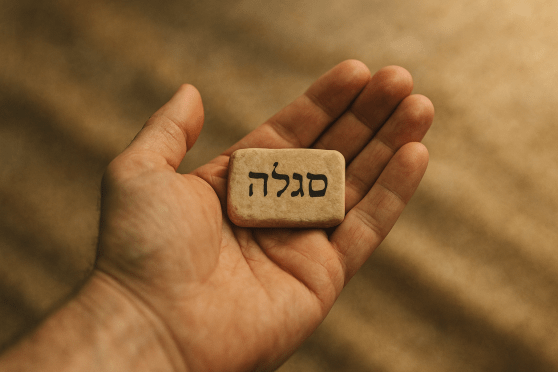
In Jewish tradition, Deuteronomy 7 is foundational for the concept of segulah—Israel as God’s treasured possession (v.6). This chosenness is not superiority; it is purpose and calling. Israel is set apart for something: to bear God’s name and reveal Him and His character in the world.

This covenant love is a foreshadowing of Jesus, who loved the world so much that He left heaven behind and became one of us. He treasured us so much that He suffered and died to pay the penalty for our sin. Then He called us to bear witness of God’s Kingdom through our love of Him and others.

The contrast could not be clearer.

The world chooses powerful.
God prefers the weak.
The world finds security in big numbers.
God prefers faith in a few.
The world indulges in surface sensual appetites.
God prescribes deep, exclusive and intimate relationship.
The world values self-centered personal ambition.
God values faithfully putting others ahead of ourselves.

In both today’s chapter and Jesus’ example, it is God who loves first. It is God who makes the covenant. It is God who promises fidelity, provision, protection, and blessing. We are the object of His love and affection.

We are His treasure.

He whispers, “My life for yours.”

When God speaks of loving His people in verses 7 and 8, the Hebrew word is ‘ahav. It is not a giddy infatuation, it’s a choice and a volitional act. In verse 9 God’s ‘ahav blesses a thousand generations of those who ‘ahav Him. God’s love invites reciprocity. Not because it needs it, but because it awakens it. And notice: God’s covenant loyalty flows toward those who love him—not as payment, but as shared intimacy.

This is mutual devotion, not transactional obedience.

In the quiet this morning, I’m reminded that God says that those who choose to follow have their names written in the Book of Life. My name is there. God knows my name. But today’s chapter reminds me that my name being written in the Book of Life is far more than just a “Hello My Name Is” name tag knowledge. That’s just the record like Wendy’s and my marriage certificate in the safe downstairs. I am God’s “treasure.” He gave His life that I might live. That kind of love awakens love in me.

Less Hallmark card, more keeping marriage vows at 3 a.m.

If you know anyone who might be encouraged by today’s post, please share.

Promotional graphic for Tom Vander Well's Wayfarer blog and podcast, featuring icons of various podcast platforms with a photo of Tom Vander Well.
These chapter-a-day blog posts are also available via podcast on all major podcast platforms including Apple, Google, and Spotify! Simply go to your podcast platform and search for “Wayfarer Tom Vander Well.” If it’s not on your platform, please let me know!
Logo of Bible Gateway featuring an open book icon in orange and white.

Shift Focus

 If you say to yourself, “These nations are more numerous than I; how can I dispossess them?” do not be afraid of them. Just remember what the Lord your God did to Pharaoh and to all Egypt….
Deuteronomy 7:17-18 (NRSV)

There is a technical term used in movie making called “shift focus.” It’s when the camera is focused on one object while another object in the shot is blurry, then then camera shifts the focus so that the other object is in focus and the first object blurs out.  Filmmakers use this technique to transition the audience’s attention and to move the story along.

When things in life go wrong and times are tough, it’s easy to get myopically focused on our present circumstances. Our brains zero in on what’s happening in the moment and, as a result, our hearts can drive all sorts of negative emotions such as fear, anxiety, doubt and depression. These emotions can be spiritually crippling and paralyzing.

In today’s chapter, Moses anticipates that his people may find themselves in such circumstances. He instructs them to do a mental and spiritual shift focus as an antidote to their fears: remember.

  • Remember when you were slaves in Egypt and God delivered you.
  • Remember when the plagues hit and you remained safe.
  • Remember when the Egyptian army was chasing you and God miraculously saved you and gave you victory.

He could have gone on:

  • Remember when you thirsty and God provided water from a rock.
  • Remember when you were hungry and God sent bread from heaven.
  • Remember when you wandered and God sent both cloud and fire to lead you.

The shift focus from our present circumstances to past situations reminds us that God has been faithful in the past (So why shouldn’t I believe He will be faithful in my current situation?), that we survived in the past (So why shouldn’t I believe I’ll get through this), and that things eventually worked out (So why shouldn’t I trust that my current situation will work out, too?). The result is that our faith begins to counter our fear and our paralysis gives way to us moving forward.

Today, I’m reminded of the many times God has provided and protected me through the years. Why then, should I fear present troubles?

chapter a day banner 2015


Chapter-a-Day Deuteronomy 7

WASHINGTON - NOVEMBER 17:  Joe Uva (L), Presid...
Image by Getty Images via @daylife

So don’t be intimidated by them. God, your God, is among you—God majestic, God awesome. Deuteronomy 7:21 (MSG)

When I was younger, I found myself easily intimidated by people. Perhaps it was from being the  baby of the family, but it didn’t take much for me to feel “less than” another person whom I perceived to be have some kind of power or authority.

Along life’s journey God has placed me in positions in which I’ve interacted with people at many different levels of worldly power and authority. I’ve worked with people in extreme poverty and have dealt with people of extreme wealth. I often work with both front-line employees fresh out of college starting their careers as well as Presidents and CEOs. I’ve had the opportunity to know leaders of business, well-known authors, and government officials.

One of the lessons that these experiences have taught me is that every person, no matter their position in life, has their own set of troubles, trials, and temptations. Means and influence do not make you a better person, and often I’ve observed how they create more problems. I’ve known some individuals in relatively impressive positions of earthly power and influence who are deeply insecure, while others with little or no earthly power and influence have incredible personal strength.

My experiences have made me far less likely to be intimidated by others. I am constantly reminded that God instructs me to be content, keep growing and be fruitful where I’ve been planted. Others may have more worldly power, more influence, more stuff, and greater means than I do, but in God’s economy we all stand on equal footing.

Enhanced by Zemanta