Tag Archives: Finance

Holiness, Heart, & Hearth

…then exchange your tithe for silver, and take the silver with you and go to the place the Lord your God will choose. Use the silver to buy whatever you like: cattle, sheep, wine or other fermented drink, or anything you wish. Then you and your household shall eat there in the presence of the Lord your God and rejoice.
Deuteronomy 14:25-26 (NIV)

Year-end approaches. For Wendy and me, the already busy holidays are layered with even more good things. Wendy’s birthday on the 21st and our wedding anniversary on New Year’s Eve means the three biggest gift giving events of the year for my wife all happen in 10 days. Believe me, I’ve learned to think ahead. And there’s more than just the holidays.

Year-end also brings decisions that have to be made in the area of our business and personal finances. Giving, savings, and future planning must all be discussed and decided in meetings with various professionals who assist with those things. The dizzying world of taxes and finance produces endless questions. Navigating our labyrinthine tax code feels less like stewardship and more like trial by minotaur. Ugh! Underneath the Spirit and meaning of Christmas and New Years there remains the grind and realities of how life is managed day-to-day.

Speaking of finances and how life is managed, Wendy and I are looking forward our annual tradition of watching Guy Pearce’s dark and intense portrayal of Scrooge in FX’s version of A Christmas Carol. I highly recommend you put it at the top of your Christmas movie watch list. It cuts like a knife to the heart of the matter. What do matters of daily life, personal finance, and relationship look like when the Message and Spirit of what God did at Christmas fail to penetrate the human heart?

That same question lies at the heart of today’s chapter. God through Moses reminds his children and grandchildren that their identity as God’s treasured people is made visible in how they live, what they do with their appetites, how they manage their finances, their generosity, and how they do community each day, each season, each year.

Today’s chapter also has an interesting connection to Jesus’ Story. Moses tells his people that someday, when there is a permanent Temple established it may be that it will be far away from where they live. Transporting all of their stored up tithes and offerings may not be practical. So, there was a provision to sell those tithes and offerings for silver. They could then bring the silver (easy to carry with you) to the Temple. There the silver could be used to buy what you needed for your prescribed offerings and sacrifices.

By Jesus day, the religious establishment had discovered in Moses’ rather simple financial principle a money making scheme. Poor Hebrew pilgrims making the long journey to the Temple did bring with them silver to buy what was needed for their offerings and sacrifices. The Temple established its own currency which the establishment demanded for the purchase of offerings and sacrificial animals. The local currency the pilgrims brought would need to be exchanged. With that exchange came fees and taxes and an entire industry of moneychangers. Jesus approached the Temple—meant to be a place of community, celebration, generosity, and feasting—only to find it had become a spiritual subsidiary of Scrooge and Marley, Inc.

[Cue: Jesus picks up a whip He sees lying on the ground next to the cattle pen.]

Today’s chapter is easily read as simple prescriptive rules regarding diet and religious offerings. But the directives were intended to point to matters of heart and Spirit. God through Moses is teaching his toddler nation that holiness is anchored in restraint.

Desire without boundaries becomes chaos; desire with limits becomes intimacy.

Clean and unclean are not moral categories but symbolic ones—teaching God’s people to pause, to choose, to remember God even in the most ordinary act: eating. The tithe is especially striking: food given to God is not burned, but eaten—by people—with God present. Holiness tastes like wine, bread, and belonging. God is saying “You don’t drift into holiness. You practice it daily, with fork and cup.

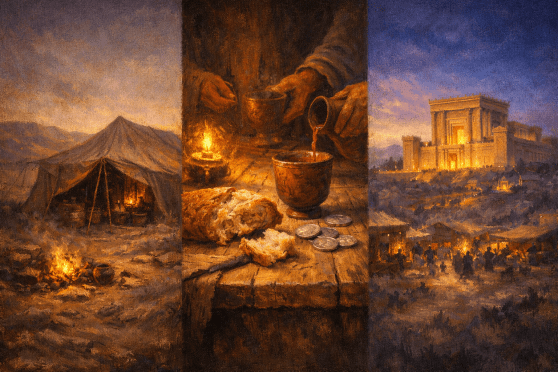
Tent to Temple to Table.

Which, in the quiet, brings me back to Christmas…and anniversary…and New Year’s…and year-end decisions of business and finance. Today’s chapter whispers to me of God’s heart: generous, selfless, and servant-hearted. From the beginning God’s prescription for Life flowed from His Spirit of intimacy, community, and generosity in the simple acts of gathering, celebrating, and eating.

In the coming days as Wendy and I gather with loved ones, as we watch A Christmas Carol, as we finalize business matters, I pray that it is that Spirit that rules my heart.

I have no need for the ghosts of Past, Present, and Future to awaken me in the wee hours.

God bless us, every one.

If you know anyone who might be encouraged by today’s post, please share.

Promotional graphic for Tom Vander Well's Wayfarer blog and podcast, featuring icons of various podcast platforms with a photo of Tom Vander Well.
These chapter-a-day blog posts are also available via podcast on all major podcast platforms including Apple, Google, and Spotify! Simply go to your podcast platform and search for “Wayfarer Tom Vander Well.” If it’s not on your platform, please let me know!
An image featuring the Bible logo with an open book icon and the text 'Bible Gateway'.

Anonymous Cogs

Then the chief priests, the teachers of the law and the elders looked for a way to arrest [Jesus] because they knew he had spoken the parable against them. But they were afraid of the crowd; so they left him and went away. Later they sent some of the Pharisees and Herodians to Jesus to catch him in his words.
Mark 12:12-13 (NIV)

Many years ago I stumbled upon a business blogger who went by the pseudonym Anonymous Cog. “AC” was one of those front-line minions in the institutional labyrinth known as corporate America. His vocation was fodder for the comic strip Dilbert and he blogged about the daily travails of being an “anonymous” cog in the giant corporate machine. AC and I began a back channel correspondence. I almost instantly recognized a kindred spirit in his words. Now, whenever I see people working inside of any human institution, I think to myself: “Anonymous cogs.”

Enneagram Type Fours are often known as the Individualists, and that’s me. Along my life journey, one of the things that I’ve learned about myself is that I’m typically (not always) better off when I am able to operate independently. Whenever I’ve found myself operating inside a large bureaucratic system it brings out a rebellious streak in me because they are typically full of silliness, foolishness, inefficiency, and injustice. They become insularly focused on power, internal politics, and of course money.

The Great Story is, at the heart of it, about an eternal conflict between the Kingdom of God and human empire. I’ve observed that human empire can be embodied in an individual human being, but it’s easiest to see it at work in the large institutions of this world. This includes, but is not limited to, the worldly kingdoms of government, commerce, finance, labor, academia, and even religion.

In today’s chapter, Mark is careful to name all of the institutional cogs that had set themselves up against Jesus. He names chief priests, teachers of the law, elders, Pharisees, Sadducees, and Herodians. Jerusalem was a regional seat of power, not only for religion, but also for government and commerce. The Roman Empire, the regional government of Herod, and the Chief Priests of the temple were all separate institutional powers who fought for wealth, clung to power, and controlled the lives of the anonymous cogs living in the region. These institutions held a constant and uneasy tension in the flow of power and wealth.

Jesus was a wrench in the works for all of them.

The clearing of the money-changers out of the Temple courts was Jesus’ way of shining a holy light on the corruption of the religious institutional human empire that the Hebrew leaders had assembled at the Temple. The crowds Jesus was drawing and Jesus’ sharp criticism was a potential powder keg. If riots broke out it would bring down the wrath of Rome, and that threatened both the power and money that flowed out of the Temple and into the hands of Herod and the Chief Priests.

The Son of God, an upstart outsider from rural Galilean backwaters, stands alone against the human institutional empires of government, commerce, and religion. That’s the picture that Mark is painting for us in today’s chapter. One of the things I’ve observed along my life journey is that human empires will always attempt to crush or eliminate any anonymous cog who threatens their system or the power and wealth of its leaders. I refer you to any daily news outlet for evidence.

In the quiet this morning, my individualist heart is stirred by this David vs. Goliath scenario that emerges from Mark’s stylus and the events he reports. At the same time, I have to return to what I wrote just a few paragraphs back. Human empire can exist in me. My individualism can be transformed into a personal empire with me on the throne of my own life, rigging everything I control to consolidate the flow of power, wealth, status, influence, and appearances so that it benefits me above all else. If I allow this to happen, I become a microcosm of the very institutional worldly empires that stand in opposition to God’s Kingdom. The anonymous cog becomes emperor of his own world.

Jesus calls me to live a Kingdom of God life amidst a world of human empires. He calls me as His disciple to seek after eternal things rather than temporal things. He calls me to serve rather than expect to be served. He tells me to be extravagant in my generosity rather than hoard things and money for myself. He calls me to humbly surrender my personal desires rather than demand my own way.

Kingdom of God or personal human empire? That’s the daily conflict. Every day I choose a side.

If you know anyone who might be encouraged by today’s post, please share.

These chapter-a-day blog posts are also available via podcast on all major podcast platforms including Apple, Google, and Spotify! Simply go to your podcast platform and search for “Wayfarer Tom Vander Well.” If it’s not on your platform, please let me know!

Of Spirit and Paperweights

Of Spirit and Paperweights (CaD Ecc 5) Wayfarer

Moreover, when God gives someone wealth and possessions, and the ability to enjoy them, to accept their lot and be happy in their toil—this is a gift of God.
Ecclesiastes 5:19 (NIV)

I still remember a big, glass Skippy jar that belonged to my brother, Tim. The lid was wrapped tight with athletic tape and a slot for change was snipped into the tin lid. It was filled with change (Note: a Skippy jar full of pocket change could go a long way in those days). It sat there. For years it served as a paperweight on my brother’s desk. For years I saw that thing just sitting there…years.

During those years. I didn’t have a piggy bank or any such change jar. There was no point. If I had a dime I spent it.

That’s a parable, by the way.

It’s also a confession that I was not great with money for much of my life. It was a lesson that ended up being a long, hard stretch for me on both the spiritual and physical levels. But learn it, I did. As a sincere follower of Jesus, I couldn’t get around the fact that money and the spiritual implications of it, was His number one subject.

Not sex.
Not drinking.
Not drugs.
Not politics.
Not church attendance.

Money, wealth, possessions and their spiritual implications was numero uno on the Top Ten list of subjects that Jesus talked about. And, for anyone reading this who has not read Jesus’ teaching on the subject yourself, please know that it’s completely opposite of those televangelists who twist His teaching in order to pad their own pockets.

Yesterday morning I had the honor of kicking-off what will be a six-week series of messages about the economy of God’s Kingdom (it’s on the Messages page, btw). Talking about economics is always a tough subject from a spiritual perspective because money and economics are so intertwined with my life, my mind, my heart, and my spirit. I believe that’s why Jesus talked about it so much. I can live a good, religious, morally pure, upright life, but if I don’t get the spiritual lessons of economics right, then I’m still hopelessly stuck in spiritual kindergarten.

It felt like a little spiritual synchronicity that the Sage who authored Ecclesiastes is talking about this same subject in today’s chapter. What fascinated me is how it dove-tailed what I spoke about yesterday, and what stuck out to me in the chapter was an interesting contrast.

In verse 10, the Sage warns of the spiritual trap that wealth creates because there’s never enough, and the dissatisfaction and discontent of the perpetual more will eat a person’s soul.

In verse 11, the Sage warns of the spiritual trap of limitless consumption because it is also never satisfied. It leads to life as described in the movie Wall-E.

In verse 12, the Sage observes that there’s a certain simplicity of life and peace of spirit the comes with having very little, while having much only adds increasing layers of complexity and anxiety. This robs life of sleep (and peace, and joy, and goodness, and contentment, and etc.).

Wealth and consumption are spiritual traps that lead to bad places.

Then at the end of the chapter, the Sage observes what appears to be the exact opposite: “when God gives someone wealth and possessions, and the ability to enjoy them, to accept their lot and be happy in their toil—this is a gift of God.” 

But I couldn’t help but notice the key ingredient in this latter observation. The wealth and possessions flow from God, they are received and held as the gift from God that they are by a person who manages those resources with a sense of gratitude, contentment, and spiritual discernment.

In my message yesterday I spoke about the spiritual lesson that I’ve learned (and learned the hard way) which must precede any conversation about money itself. Interestingly enough, Jesus told one wealthy man that selling all his possessions and giving it to the poor was the one thing he had to do. But Jesus had other people in his life, like Lazarus and his sisters, who were wealthy and Jesus didn’t ask them to do the same thing. I find this an important distinction that the Sage is revealing in today’s chapter.

The wealth isn’t the issue. The issue that precedes the money conversation is one of heart, eyes, and worship. You’re welcome to listen to the message if you’re interested in unpacking this more.

By the way, on my dresser sits a large coffee mug full of change. It basically serves as a paperweight. It’s been there for years.

I’m learning.

Money Trouble

When her owners realized that their hope of making money was gone, they seized Paul and Silas and dragged them into the marketplace to face the authorities.
Acts 16:19 (NIV)

I’m writing this morning’s post in the airport. Having wrapped up a week-long business trip I’m headed home. I spent the week serving a client in the financial sector. As I meditate on all that I’ve done this week, the teams I’ve worked with, the managers I’ve mentored, a common theme has been money.

  • Agents leaving their jobs to go to another company to make more money.
  • A manager who told me she’s turned down multiple job offers, including one that promised to double her pay, because she was happy in her job and her father taught her that more money was a foolish reason to leave a job you loved.
  • A young man telling me about his job scrutinizing the flow of money for potential threats.
  • A manager struggling to find new hires because most applicants have such poor credit histories from the way they handle their money.
  •  An agent at a restaurant with his boss, an award he’d received for his exceptional customer service, looks at the menu and then asks how much money he could spend.

All these little moments come back to me as I think about today’s chapter. Until this point in the history of the early Jesus Movement the conflicts (and there has been a lot of conflict) have been theological in nature between the Jewish tribe from which the Jesus movement sprang, the orthodox Jews who viewed the Jesus movement as a threatening heresy, and the explosive growth of non-Jewish believers who had no interest in holding to Jewish traditions.

In yesterday’s post I mentioned that there had been an inflection point, and today’s chapter begins to hint at the differences that are beginning to emerge. Paul and his companion, Silas, are in the town of Philippi sharing the Message of Jesus. A conflict arises in which Paul and Silas are accosted, beaten, threatened, accused, and thrown into the local jail. The conflict wasn’t about theology, however, it was about money.

A young slave girl, possessed by an evil spirit, was a capable and profitable fortune-teller because of the presence of the evil spirit indwelling her. She was also so annoying that Paul commands the spirit to leave the girl in the name of Jesus. The spirit leaves. You’d think that this was a good thing, but not for the slave girl’s owners. No spirit, no fortune-telling. Paul and Silas, these out-of-town street preachers  had effectively screwed with the business and cash-flow of an upstanding member of the Philippi Chamber of Commerce.

You want to stir up trouble for yourself? Visit a strange town and mess with a local businessman’s cash-flow. As my week conducting business with my client reminds me this morning it’s always about money.

I sit this morning amidst the hustle and bustle of business travelers scurrying about in a major international airport. I’m reminded that Jesus said more about money than almost anything else. He used stories of money in parables because he knew that everyone could relate. He compared the spiritual desire we should have for the Kingdom of God to the frantic search of a poor woman for her lost savings. And of course, there’s that uncomfortable bit Jesus had to say about money being the number one thing that distracts us from that which is of eternal value.

This week as I sat in mentoring sessions with managers and supervisors, I found it fascinating that most of them came to our sessions with things that they wanted to talk with me about. For one it was the break-up of a long-term relationship, for another it was managing conflict within a personal relationship, and for another it was about a struggle to remain sober. Funny, the things with which they were ultimately concerned were not about business leadership and finance, though we did talk about those things. What they were frantic about was not about money, but about life and relationships and matters of Spirit.

Me too.

It’s been a good business trip, but now I’m headed…

Home, where my thoughts escapin’
Home, where my music’s playin’
Home, where m’love lies waiting silently for me.

Have a good weekend, my friend.

A Prophet in Flyover Country

The words of Amos, one of the shepherds of Tekoa—the vision he saw concerning Israel two years before the earthquake….
Amos 1:1 (NIV)

I have lived in “flyover country” my entire life. It’s a great place to live, work, and raise a family. You get used to the fact that most of what we see and hear in American news and entertainment media is sourced on the coasts. New York, Washington D.C. and Los Angeles are where most of the brokers of politics, finance, and entertainment live, move and have their being. It’s quite common to realize that we often see life a little differently here in middle America.

Whenever you read the writing of the ancient prophets in God’s Message, it’s important to understand the context of the prophet and his message. Amos was one of what we refer to as the “minor” prophets, and perhaps it’a an apt moniker for one who lived and wrote from what have been the flyover country of his time.

The “major” prophets (Isaiah, Jeremiah, Ezekiel, Daniel) lived where the action was. Isaiah and Jeremiah served in Jerusalem, the capital city which was the region’s political and religious center of power. Daniel and Ezekiel lived later and were persons of relative prominence and connection in the ancient city of Babylon during the height of its glory days. Amos, on the other hand, was a shepherd and fig farmer living in a small town of no real significance. We don’t even know if he owned his own flocks and figs, or whether he was simply a hired man.

Amos lived and wrote during a period of relative prosperity in Israel’s divided kingdom (about 740-750 b.c.). Things were humming economically and trade was good. The kingdoms held relatively strong, secure positions in the region. Everyone was feeling optimistic and perhaps even a little bit smug.

Amos, however, begins the assembled volume of his prophetic writings by telling us as readers that his vision preceded “the earthquake.” He doesn’t say “an earthquake” but “the earthquake.” Little is known historically about this event, but geologists have unearthed evidence of a major seismic event in that region around 750 b.c.  Interestingly enough, just yesterday I posted about the connection that is made in God’s Message between the shifting of things in the spiritual realm and events in creation. Amos foreshadows his volume of collected prophesies with a ominous word-picture. There’s going to be a major shake up.

What becomes immediately clear in the historical context is that Amos’ message isn’t exactly the mainstream media spin of his day. During a period of peace and prosperity this learned yokel prophet from flyover country isn’t feeling so secure about things from a spiritual perspective. He’s got a more sober view of where things are headed, if anyone will listen.

This morning I have to admit that I’m feeling a bit of a connection with ol’ Amos. I’m grateful for where I live and move and have had my being on this life journey. It may not be the center of action where finance, politics, and entertainment are brokered. I’ve visited all of them and always have a great time when I’m there and appreciate all the great people I meet. Nevertheless, I know I look at life with a different perspective than many who live in those places. It’s not better or worse. It just is. The major prophets had their roles to play and their message to give at the center of the action. Amos had his role to play and his message to give as he kept watch over his livestock in the flyover farm town of Tekoa.

The key, I’ve come to learn along this journey, is to be content with the role I’ve been given and faithful in carrying it out to the best of my ability.