Tag Archives: Greek

Knowing, or Knowing?

And I pray that you, being rooted and established in love, may have power, together with all the Lord’s holy people, to grasp how wide and long and high and deep is the love of Christ, and to know this love that surpasses knowledge—that you may be filled to the measure of all the fullness of God.
Ephesians 3:17b-19 (NIV)

A couple of years ago I had the opportunity to reconnect with the man who was preaching the night Christ became Lord of my life in 1981. Bob was an evangelist and writer at that time, continuing his graduate studies. By the time I was half-way through my undergraduate studies Dr. Bob became one of my professors. He went on to teach at larger and larger universities. As we talked about our respective journeys, Dr. Bob told me that he had been called by God to bring a voice of reason, faith, and belief regarding the Bible, Christian history, and Christian theology into an academic world that is largely antagonistic to Christianity in every way.

God, bless him.

Along my life journey I have encountered many very knowledgeable people. In my formal education of the Bible and of theology, and in my experiences with church leadership in various denominations, I’ve known amazing, intelligent people with all sorts of knowledge about the Bible and Christian theology. I’ve observed, however, that intelligence and knowledge does not always directly translate into an actual relationship with Jesus.

In today’s chapter, Paul expresses his prayer for the believers in Ephesus. Paul has just got done explaining to the non-Jewish, or Gentile, Ephesians that they are now part of something that they previously knew nothing about. God had been working through the Jewish people for centuries to begin the Story and process of redemption. Despite having all of the knowledge of the Law and the Prophets, most of the Jews did not know or recognize Jesus as the Messiah. Paul goes on to explain that he had been called by Jesus to make Him and His love known among the Gentile world. A bit like my friend Dr. Bob, Paul was in many ways a lone voice in the antagonistic, educated cultures of both Jewish Orthodoxy and Greek philosophy.

This in mind, I found it interesting that when Paul expresses his prayer for the believers in Ephesus he prays that they might grasp the immensity of Jesus’ love. He then prays that they might know Christ’s love. The word Paul uses for “know” is the Greek word ginōskō which is also used to describe the intimate knowing that happens in sex. He then goes on to describe the love of Christ as something that is incomparably surpassing of “knowledge” in which he uses the Greek world gnōsis which is simply human knowledge or understanding.

In other words, it’s one thing to know Jesus as in having a basic understanding of who Jesus is, His teachings, and what is believed about Him. It is another thing to know the love of Jesus intimately like the intimacy that happens when you have sex with your spouse.

My friend Dr. Bob was called by God to take the latter knowledge with him into an academic world that largely only experiences the former. In every church I’ve ever attended, I’ve observed many people who also appear to have only knowledge about Jesus without having experienced intimately knowing the love of Jesus that surpasses understanding.

In the quiet this morning, I pray that the intimate, experiential love of Christ that is beyond understanding will, as Paul put it in his prayer for the Ephesian believers, fill me “to the measure of all the fullness of God.” I pray that for you to, my friend.

After all, God is love itself.

If you know anyone who might be encouraged by today’s post, please share.

A collage featuring podcast platforms icons including Spotify and Apple Podcasts, alongside a portrait of Tom Vander Well with the title 'Wayfarer blog and podcast.' A figure is seen walking in a misty landscape in the background.
These chapter-a-day blog posts are also available via podcast on all major podcast platforms including Apple, Google, and Spotify! Simply go to your podcast platform and search for “Wayfarer Tom Vander Well.” If it’s not on your platform, please let me know!
Logo of a Bible app featuring an open book icon on an orange background.

Chorus to a Tale of Pain & Purpose

In the third year of the reign of Jehoiakim king of Judah…
And Daniel remained there until the first year of King Cyrus.
Daniel 1:1a, 21 (NIV) 

In the history of theatre, Greece was the first great age. The Greeks developed several theatrical conventions that are still widely used today including the use of what was called a Chorus to prepare the audience for what they are about to watch and to narrate the events. Shakespeare used the same convention widely in his plays, as do many modern productions.

The first chapter of Daniel is the literary equivalent of a Chorus. The author, traditionally ascribed to Daniel himself, uses the opening of the book to provide a quick lay of the land with regard to the background of the story and introduces us to the major players. The fact that the chapter describes Daniel and his companions as being learned young men who were then given a thorough course in Babylonian literature and culture, is ironic. It seems to me that the chapter itself gives evidence to this in its structure and content.

In the next year, our local gathering of Jesus’ followers will be studying the theme of exile. I’ve written in previous posts about the theme of wilderness throughout the Great Story. The exile of God’s people in Babylon is one of the major examples and many casual readers don’t realize just how many characters, psalms, and books come out of this period. Jeremiah, Lamentations, Daniel, Esther, Ezekiel, and Nehemiah are all books that chronicle parts of the Babylonian exile and return.

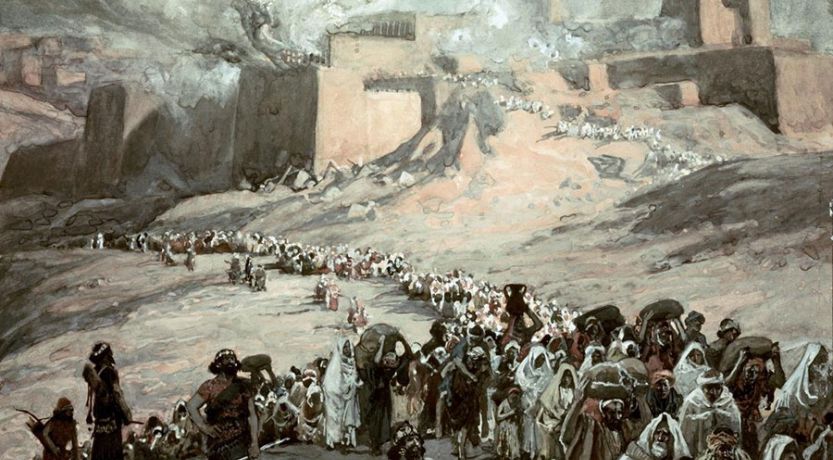
In today’s chapter, Daniel provides bookend dates of the story he’s about to pen. It starts in the “third year of Jehoiakim king of Judah” and ends the first year of King Cyrus. A little study shows this to be 605-539 B.C. In other words, Daniel was an educated young man from nobility in Israel’s southern kingdom of Judah. His hometown is destroyed in a long Babylonian siege in which Daniel watched people starve to death and, according to the prophet Jeremiah, reduced to cannibalism to survive.

Out of this horrific event, Daniel is taken captive by his enemy. He is torn from his family, his people, and his hometown which has been reduced to rubble. He ends up in the capital city of his enemy, Babylon, and finds himself subject to indentured servitude to his people’s enemy number one: King Nebuchadnezzar. Daniel’s own name is taken from him and he is given a new name. He is forced for three years to learn everything about the history, culture, and literature of his enemy.

A young man of God forced to live in captivity and exile and to serve his enemies for about 65 years. Welcome to the story of Daniel, whom many people only know from brightly illustrated children’s books in the dusty Sunday School memory bins of their brains.

But the real story is far deeper and more complex than that, as Daniel tries to tell me as a reader in his opening Chorus. It is the story of a young man who finds a way to survive. He courageously maintains and lives out his faith in the midst of the unbelievably difficult circumstances that make up nearly his entire life.

In the quiet this morning I find myself mulling over the common misperception I observe followers of Jesus often have, and that I confess I find myself unconsciously falling into from time to time. It’s partially driven, I believe, by the American Dream and the Protestant work ethic. If we believe, work hard, and live good lives then life should be a breeze of material blessing and pain-free existence. But as I journey through God’s Message I find that this has never been the message. Daniel fires an explosive shot across the bow of that notion from the very beginning of his story.

Trauma, suffering, starving, captivity, bondage, indentured servitude, and life-long exile in the land of his enemies serving a mad king.

I find God’s purpose in my pain. That’s the message Daniel foreshadows in the Chorus of his book, and the one I’ve been reminded of over and over again on my life journey.


Holy Sh*t

holyshitYes, everything else is worthless when compared with the infinite value of knowing Christ Jesus my Lord. For his sake I have discarded everything else, counting it all as garbage, so that I could gain Christ. Philippians 3:8 (NLT)

One of the books on my summer reading list is a fascinating treatise entitled Holy Sh*t, A Brief History of Swearing, by Melissa Mohr. I am intrigued by the subject matter on a number of levels. At least part of my motivation when I picked up the book sprang out of my role as President of our local community theatre. Most popular plays and musicals contain at least some swear words. Our organization regularly engages in conversation weighing the options of presenting a script as written (knowing that we will offend some of our audience members) or changing the script to eliminate some or all of the offensive words (knowing that in doing so we are breaking the law and our contractual obligations to the playwright and publisher). When people hear certain words they get offended. Then, they write letters. It’s my job to respond.

What most modern Americans do not realize is that the Bible is full of language that most people would consider harsh or obscene. After studying it for over thirty years, I’ve always understood this. In her book, Mohr does a great job of laying it out in a literary, social and historical context. The Old Testament was originally written in Hebrew and the New Testament was originally written in Greek. The authors sometimes used words, phrases and euphemisms which, literally translated, would offend most religious people today. The verse above (Philippians 3:8) from today’s chapter is a great example. Paul was trying to make a strong point. All of the things that he once thought worth-while (e.g. being extremely religious, keeping all of the Jewish laws and customs, zealously persecuting anyone who didn’t agree with his religious view, and etc.) he now considers worth-less. But, Paul didn’t write it that way in his letter.

When Paul wrote that all of his former religiosity was “worthless” he used the Greek word that is transliterated in English: skubalon. It is the only place in the New Testament this Greek word is used. Literally translated in today’s language it means “shit.” When translators write this verse in English they choose to use a more acceptable English word such as “rubbish” or “worthless” so as not to offend. But make no mistake about it, Paul considered all of the religious trappings of his life prior to meeting Jesus as nothing more than a pile of shit.  And, he wasn’t afraid to say so.

Today, I’m thinking about words, phrases and euphemisms. They are little metaphors. A sound we make or symbols we write which represent something else without using “like” or “as.” One of the little known, rarely taught aspects of God’s Message is that it often uses words and word pictures that are offensive to those with fragile social sensibilities. Truth offends, and Paul clearly understood that sometimes Truth must be spoken in words that communicate its harsh realities.