Tag Archives: John 8

Seeing and Believing

Seeing and Believing (CaD Jhn 9) Wayfarer

Jesus said, “For judgment I have come into this world, so that the blind will see and those who see will become blind.”
John 9:39 (NIV)

A few weeks ago there was a congressional hearing regarding prejudice, specifically anti-semitism, on college campuses. The Presidents of three elite universities were asked simple, direct questions. Their responses were evasive, murky, and unclear. Two of the three resigned in subsequent weeks.

These events came to mind today as I read today’s chapter. This is the third chapter in a row in which John gives witness to the rising conflict between the religious leaders in Jerusalem and Jesus. The religious leaders were elite, educated, and wealthy. They occupied the highest rung of their society. Jesus was a sharp contrast. Jesus had no formal or elite education in the established educational system. Jesus was not wealthy, and He depended on the generosity of others to fund His traveling ministry. Jesus lived and operated in the rural, backwater regions of the country.

John carefully chose the healing of a blind man as one of the seven miracles, or “signs” as he chooses to call them, as it fits perfectly with the narrative on multiple levels. In the previous chapter, Jesus refers to Himself as “the Light of the World” multiple times. As if to literally prove His point, today’s chapter begins with Jesus healing a man who had been blind since birth. Out of the darkness of his blindness, the man can see for the first time in his life.

This event led to three hearings before the elite, educated, powerful religious leaders. The first was with the former blind man himself who recounted the event of his healing. There is division among the religious leaders. Some are entrenched in their fundamentalist belief that the fact Jesus performed this miracle on the Sabbath (the religious “day of rest”) negates the “godliness” of the miracle. Others argue that the very act of giving sight to a man born blind can only come from God.

Then, something fascinating happens. These educated elites ask the formerly blind beggar his opinion, but they aren’t happy when the man proclaims Jesus a prophet. Some of the religious leaders are so adamant in their disbelief of Jesus that they choose to believe that the blind man is lying about being blind since birth.

Hearing number two is with the blind man’s parents. John records that they are “afraid” of the religious leaders and the power these elites have to excommunicate them from the synagogue and socially ostracize them. This is another clear indicator of toxic fundamentalism. The elite few at the top of the food chain use power and fear to control the masses. In this instance, the parents testify that their son was born blind, but when it comes to his healing and his testimony about Jesus, the parents know the narrative their overseers want to hear. They deftly plead the fifth and deflect to their adult son.

The blind man is called back before the leaders for the second time. It’s classic. The dumb, poor beggar responds to the repeated questions with wisdom and reason. He makes the leaders look foolish in the mental gymnastics they are exercising to justify their unbelief. The result is what one might expect from humiliated fundamentalist elites. They insulted him, threatened him, and threw him out.

John then records that Jesus introduces himself to the formerly blind man. The man proclaims his personal belief that Jesus was the Son of Man, and he worships Jesus. Jesus then proclaims that He came “so that the blind will see and those who see will become blind.”

A couple of thoughts in the quiet this morning. First, I love the progression of the formerly blind man’s faith. He begins not knowing who Jesus was or who healed him. He then calls Jesus a man, then progresses to calling Jesus a prophet. Finally, he meets Jesus personally and places his faith in Jesus as the Messiah and worships Him. Healing the man’s physical blindness led to the healing of his spiritual blindness. Jesus not only opened the man’s physical eyes, but his spiritual eyes as well. Which leads me to my second thought.

Along my spiritual journey, I have encountered religious, label-wearing Christians who I observed to be spiritually blind. I have also encountered individuals who claim no faith label but I observe that they clearly see the heart and Spirit of Jesus’ teaching. This is a constant reminder to me that every person is having their own conversations with Life and that God’s Spirit is perpetually at work to open the eyes of our spirits to see the Light of the World. Today’s chapter is a reminder that staunch, educated religious people can be spiritually blind while humble, uneducated and irreligious individuals can have spiritual sight that is 20/20.

A friend once asked me about my increasingly poor hearing. I told him that if my impaired physical hearing contributes to being able to hear spiritual things with greater clarity, I will always choose the latter.

If you know anyone who might be encouraged by today’s post, please share.

Showdown

Showdown (CaD Jhn 8) Wayfarer

“You belong to your father, the devil, and you want to carry out your father’s desires. He was a murderer from the beginning, not holding to the truth, for there is no truth in him. When he lies, he speaks his native language, for he is a liar and the father of lies.”
John 8:44 (NIV)

A few weeks ago I watched an HBO Documentary entitled Let Us Prey. It tells the stories of three women who grew up in a fundamentalist Baptist denomination and were sexually abused by men in authority within the church. Echoing the same scandal within the Roman Catholic church, the church hushed up, shuffled perpetrators to other locations, and stonewalled attempts to hold those involved criminally responsible. It is difficult to watch.

Along my spiritual journey, I have observed that any human religious institution can become a perpetrator of evil.

This is precisely the heart of today’s chapter. John established from the beginning of his account that there was a conflict between Jesus and the institutional leaders of the Jewish religious council. Today’s chapter is set in the council’s backyard, the Temple courts at the Feast of Tabernacles. Today’s chapter is a continuation of the previous chapter. The conflict between Jesus and the religious leaders comes to a head and becomes a public showdown.

At the center of Jesus’ argument is truth and lies. While I mentioned it in yesterday’s chapter, it is in the showdown with the religious leaders that Jesus famously says, “If you hold to my teaching, you are really my disciples. Then you will know the truth, and the truth will set you free.” Jesus then contrasts the truth and freedom He offers with the actions and motivations of the religious leaders. The religious leaders are trying to have Jesus killed, they are trying to hold on to their earthly power and the wealth, status, and control it affords them. Jesus then points to the evil one and makes a case that it is the evil one that the religious leaders are following.

Across the Great Story, the evil one is always anti-God. God is for life so the evil one rejoices in death. God is for truth so the evil one uses lies and deceptions. In Jesus, God shows that His way is one of love, truth, humility, selflessness, service, and sacrifice. As the “Prince of this world” the evil one and the kingdoms of this world are about hatred, lies, pride, selfishness, power, and control. Jesus simply points out that the religious council needs only to see their own actions and attitudes toward Him to see who they are really following.

As a disciple of Jesus, I can’t help but think about current events through the lens of Jesus’ own words, teachings, and example. I find it fascinating the extent to which truth is ignored today to perpetuate false realities. Women, with whom God said there would be special enmity from the evil one, are once again being subjugated. This time it is from those who are biological males simply claiming to be women. From a spiritual perspective, I observe this to be simply a new form of the same old misogyny that the evil one has perpetuated from the beginning.

Of course, I can’t point the finger without three fingers pointing back at me. In the quiet this morning, I am equally reminded by Jesus’ showdown with the religious leaders of His people that any religious system can be corrupted, even the ones with which I am involved. This reminds me of Jesus’ admonition to His followers: “Be as shrewd as serpents and as gentle as doves.” This is not only true as I walk in this world but also in the human institutions that wear the label of my own faith.

If you know anyone who might be encouraged by today’s post, please share.

Showdown!

Showdown! (CaD John 8) Wayfarer

When Jesus spoke again to the people, he said, “I am the light of the world. Whoever follows me will never walk in darkness, but will have the light of life.”
John 8:12 (NIV)

“Very truly I tell you,” Jesus answered, “before Abraham was born, I am!”
John 8:58 (NIV)

When we left yesterday’s chapter of John’s biography of Jesus, Jesus was teaching and performing miracles at the Temple in Jerusalem during a national religious festival called the Feast of the Tabernacles. Jerusalem and the Temple were teeming with religious pilgrims in town for the festival. Jesus, His teaching, and His miracles are making a huge impression, and there are a myriads of opinions among the people about who Jesus is.

In today’s chapter, John shifts focus from the crowds and their popular opinions to the two leading players in the story: Jesus and the Jewish religious leaders. Today’s chapter is a showdown that has been building between Jesus and the religious institutional establishment, and it’s an important one in the story. Once again, identity is the theme of this showdown: “Who am I?” and “Who are you?”

I find this chapter to be a critical text in what it means to me to be a follower of Jesus. Jesus is an upstart and a maverick. Like Clint Eastwood in his spaghetti westerns, He seemingly shows up out of nowhere to challenge the institutional religious authority. I’ve learned along my life journey that institutions of every kind are about authority, hierarchy, and control. Institutions can be healthy human systems or very dysfunctional human systems, but in either case institutions balk at direct challenges that come from outside the system.

As this question of “who is Jesus” gets bandied about, there are two parties who have never wavered in their opinion. Jesus has claimed to be the Son of God who has come from the Father in heaven to bring God’s Kingdom to earth and salvation to anyone who believes, receives, follows, and obeys. The institutional religious authorities have pegged Jesus as a threat to their prestige and authority, an unknown firebrand who is wildly popular with the unruly poor masses, and a disruptor of their lucrative religious racket.

In this showdown, Jesus steadfastly proclaims and maintains His eternal nature (I came from my Father in heaven to do His will, and I am returning there when my mission is completed) and His condemnation of the religious leaders who have transformed the plan God gave through Moses into an institution that oppresses the poor and needy in order to feed the egos, bank accounts, and authority of the religious ruling class.

In this showdown, the religious leaders proclaim and maintain their authority. These authorities are all essentially lawyers, and they default to multiple legal arguments to condemn Jesus:

  • Objection: You don’t have two witnesses. (vs. 13)
  • Objection: You keep talking about your Father, but you can’t produce Him. (vs. 19)
  • Examination: They directly ask Jesus to say who He is in order to get it on record so as to build a legal case against His claim. (vs. 25)
  • Point-of-order: We’re descendants of Abraham and have never been slaves, so how are you going to “set us free.” (vs. 33)
  • Point-of-order: We are Abraham’s children, God’s chosen institutional authorities, and you are not. (vss 39, 41)
  • Verdict: You, Jesus, are a half-breed, racially inferior, and heretical Samaritan scum, and you’re demon possessed.

What’s fascinating is that Jesus bookends this public showdown with two fascinating claims:

Jesus starts by saying that He is the “Light of the World” which directly connects to John’s assertion in chapter one, that Jesus is the eternal agent of creation and when God said, “Let there be light” it was Jesus flipping the switch.

He ends the showdown by countering the religious leader’s authoritative claim to being Abraham’s children by stating “before Abraham was, I am.” That’s critically important because these lawyers all know that in Exodus chapter 3 God revealed Himself to Moses as “I Am.” In fact, they considered “I Am” as “He who must not be named” and it was strictly forbidden to utter the name “I Am.” Jesus ends the showdown with a bang by firing the claim to be the eternal “I Am” who existed before Abraham. He is essentially proclaiming Himself God, which is why His opponents “picked up stones to stone Him.”

In the quiet this morning I find myself confronted, once again, by John’s story. In relating this debate about Jesus’ identity, I can’t help but see the contrast of Jesus’ personal, relational connection to individuals outside the system and the authoritative, human, religious institution of the Jewish authorities.

I hear Jesus saying, “This is, and always has been, about a personal, eternal relationship into which each and every one is invited. These people have taken it and made it into just another kingdom of this world, and all the kingdoms of this world are ultimately powered by the prince of this world.”

Here are the questions my soul is asking this morning:

  • What kingdom(s) am I building on this earth journey?
  • Is my faith personal or institutional? How do I, and others, know the difference?
  • How can I be more like Jesus, and less like a card carrying member of an institution?

If you know anyone who might be encouraged by today’s post, please share.

The Great Debate

Jesus said to them, “Very truly, I tell you, before Abraham was, I am.”
John 8:58 (NRSV)

In yesterday’s post, I got to thinking about the events John describes in the context of our own contemporary presidential election in the United States. I’d like to extend the metaphor today because you can’t truly understand the context of the events in today’s chapter without understanding that there is an on-going political debate taking place. The issues being debated are the very two questions with which I ended yesterday’s post:

  1. Who is Jesus?
  2. What do we do with Him?

It’s also important to understand that the party officials, the Jewish religious leaders, were all lawyers. They acted much like Supreme Court justices interpreting our Constitution, only they were legal experts interpreting the Law of Moses (all the religious rules and regulations in the Books of Exodus, Leviticus, et al). These lawyers were also in political, social, and economic control of the Jewish people under Roman occupation, and of the Temple. These legal, religious, political officials were threatened by Jesus for a number of reasons.

First, Jesus was highly critical of these political, religious lawyers (in today’s debate Jesus calls them children of the Devil). Second, Jesus’ teaching and actions were a tectonic paradigm shift that cut against the grain of the ruling party’s conservative, narrow interpretation of what God desires and expects of His followers. This threatened their thought control over the populace. Finally (and getting to the real crux of the matter), Jesus was also extremely popular and it was creating social unrest that threatened these lawyers political and social control. Their power, authority, and economic cash cow was threatened (think of it like one of our political parties who might lose their control over Congress).

And so, as Jesus is in the Temple teaching, these legal/political/religious party officials send waves of lawyers to debate Jesus on a variety of issues. Their goal is to trap Jesus into saying something that would give them authority, according to their almighty law, to arrest and kill the young troublemaker from Nazareth.

First, they send a woman caught in adultery who, by law, should be stoned to death for her crime. The legal team, however, seemed to forget that the law calls for both the woman and her adulterous lover to be condemned. Jesus, however, refuses to debate the jots and tittles of the legal issues. He simply highlights the accusers own sin and hypocrisy, publicly shaming them into abandoning their blood fury.

The next legal team questions  the claims Jesus has been making about Himself on the grounds that the law requires two witnesses. Jesus counters that God, the Father, is His second witness. He adds that if the lawyers would get their heads out of the law and sought to  know the Father (author of the law), they would understand this.

Finally, the lawyers ask Jesus point-blank who He is. Jesus once again offers cryptic answers to the direct question, stating that they will know for sure “when you have lifted up the Son of Man” (a prophetic foreshadowing of Jesus’ own crucifixion).

The audience is impressed with Jesus’ dismantling of the lawyers’ arguments. The debate is going Jesus’ way, and many of the Jews in the audience decide to switch their party affiliation and join Jesus’ camp.

The debate now shifts and Jesus goes on the offensive. Like all good politicians, the ruling legal officials liked to align themselves with the beloved, historical pillars of the party. They were known for calling themselves “children of Abraham” and draping the mantel of Abraham’s legacy around their shoulders. Jesus questions their hypocrisy, asking why they have been in their smoke filled back rooms plotting to kill Him.

The debate quickly spirals into back and forth name-calling (sound familiar?). The lawyers hold fast to their “Children of Abraham” branding. Jesus counters by accusing them of being murderers. The lawyers raise their own Abraham claim and double down, claiming that God is their father. Jesus counters that the devil is, in fact, their father because, like the devil, the evidence proves they are all liars and murderers. The lawyers, now really pissed off, counter by calling Jesus a demon and then throw in a racial epithet by throwing out rumors (from the internet, no doubt) that Jesus is a actually a half-breed Samaritan.

Jesus then shifts the debate once more, this time claiming that He personally knows their beloved Abraham (to wit: “I knew Abraham. Abraham is a friend of mine. You, sir, are no child of Abraham.”), and that Abraham rejoiced to see Jesus’ take up His campaign. The legal team scoffs. This is ludicrous and insane. Abraham lived over a thousands years ago. How could Jesus actually know Abraham?

Jesus ends the debate with the most headline grabbing, jaw-dropping, topic trending statement of all. Jesus says, “Before Abraham was, I am.” Only, in the Hebrew language Jesus used the word that is transliterated into English: “Yaweh.” Yahweh is the name God gave to Moses on the mountain when Moses asked who He was (See Exodus chapter 3). Yaweh was the unutterable, sacred, holy name of God. To the Jews, Yaweh was forever to be considered “He-who-must-not-be-named.” In saying “Yaweh” Jesus both directly claimed that He was God and gave his political opponents their legal grounds to pounce. And, pounce they did. The lawyers suddenly became executioners. They immediately picked up the stones (perhaps the dropped stones intended for the adulterous woman) to carry out swift justice.

Today, I am reminded that I am reading the testimony of a member of Jesus’ own inner circle, John, who was a first-hand original source witness of this debate. I am struck by the fact that Jesus seemed to foreknow the way these events were going to play out, and ultimately contributed to their outcome. I am, once again, reminded that Jesus claimed to be God. If Jesus wasn’t lying, and if He wasn’t crazy, then I’m left to accept that He was exactly who He claimed to be. And, I’m left to make up my own mind about the second issue of the debate: What am I going to do with Him?


chapter a day banner 2015

Context and Color

If a man is caught lying with the wife of another man, both of them shall die, the man who lay with the woman as well as the woman. So you shall purge the evil from Israel.
Deuteronomy 22:22 (NRSV)

The ancient books of law are not always an easy, inspirational read. I like it, however, when I come across something that provides a layer of context and color to other stories in God’s Message. Today is a good example. The law of the ancient Hebrews was  that when a man and woman committed adultery they were both guilty and were to be punished by being stoned to death.

In John’s biography of Jesus there is the story of a woman caught in adultery. The religious leaders brought the woman before Jesus, stones in hand, asking Jesus to render judgment whether they should stone her to death. But, according to the law we read into today’s chapter, both the man and woman were to be stoned. So, where was the man?

The context helps provide evidence of why Jesus was so angry with the religious leaders of that day who liked to use the letter of the law when it worked to their own advantage, while they conveniently ignored the parts that weren’t. Jesus deftly handles the situation by telling the religious leaders that whichever one of them is without sin could cast the first stone. The religious leaders split and Jesus forgave the woman and sent her on her way.

Today, I’m thinking about my own heart and life. Who do I most resemble in the story? The religious hypocrite using God’s Message for my own advantage? The disgraced sinner doomed to die? Or am I like Jesus, extending grace and mercy to the condemned? As I sit here in the morning quiet I must admit that I am a mixture of all three. Today, I want to be more the latter and less the former.

chapter a day banner 2015

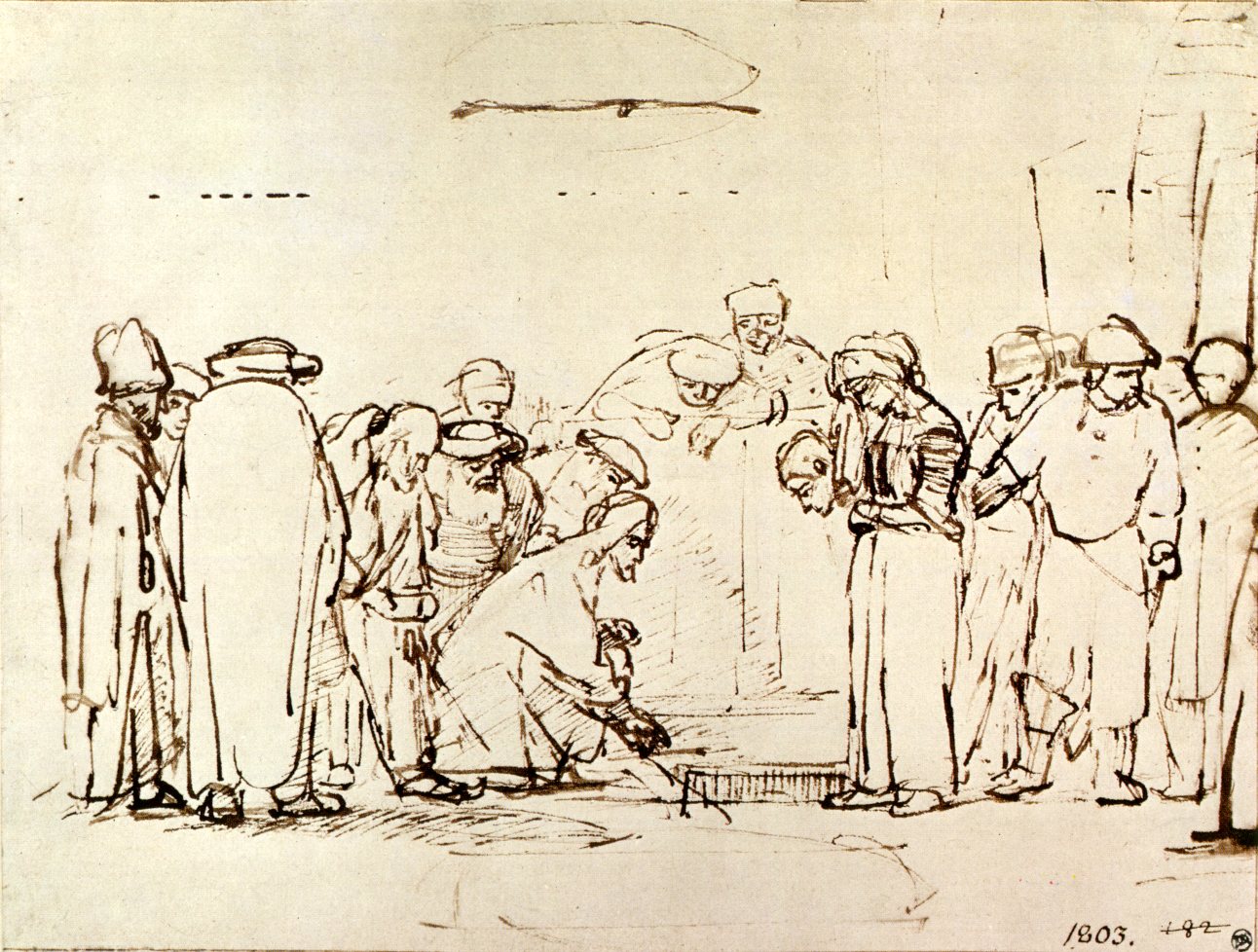
featured image by Rembrandt van Rijn (wikipedia)

Chapter-a-Day John 8

Jesus said to the people who believed in him, “You are truly my disciples if you remain faithful to my teachings. And you will know the truth, and the truth will set you free.” John 8:31-32 (NLT)

A few weeks ago, Wendy and I attended an induction ceremony at Grandview College. Our daughter, Taylor, was inducted into the Alpha Chi Honor Society. It was interesting to listen and to learn about the various honor societies. The motto of the Alpha Chi fraternity was  the second part of Jesus’ quote from today’s chapter: “You shall know the truth, and the truth will set you free.”

Along the journey, I’ve never ceased to be amazed at the way we pick and choose what pieces of God’s Message we want to hold on to, and those we so conveniently choose to ignore. “You shall know the truth and the truth shall set you free” is such a powerful quote, but it’s really the consequential end of an “if then” statement. What Jesus said was that the knowledge of truth and subsequent freedom is the result to following Him, and remaining faithful to His teaching. In a few chapters, Jesus will make the claim that He is the Truth. You can’t have the result without the source.

Today, I’m thinking about the ways that I conveniently ignore truths out of a desire to escape uncomfortable spiritual requirements. I’m asking God for a little forgiveness along with the strength and grace to embrace Truth and all that it requires of me.