Tag Archives: Climax

Not Without Struggle

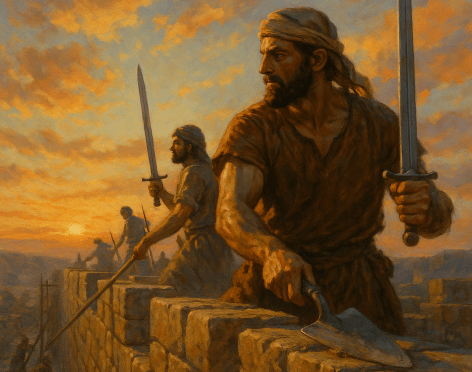
Meanwhile, the people in Judah said, “The strength of the laborers is giving out, and there is so much rubble that we cannot rebuild the wall.”
Nehemiah 4:10 (NIV)

It’s October, which means post season baseball. Alas, our beloved Cubs made it to October this year but they didn’t have what they needed to get past the Division Series. C’est la vie.

Of course, the World Series will now and forever bring back memories of 2016, the year the Cubs broke their 108 year World Series drought and all of the legendary curses. For the most part, I remember that final out and the joy of that moment. A few weeks ago I watched the documentary of the World Series that year and spent some time remembering the Cubs’ journey through the entire post season.

It brought back a memory of lying in bed after the Cubs lost one of the play off games. I had descended into one of my brooding puddles of pessimism. Wendy, ever my life guard when I’m at risk for drowning in that puddle, quietly reminded me that great stories always have moments when things look darkest. It’s in overcoming the struggles that great stories are made. As I recounted all of the struggles of that post season and the World Series saga, I was reminded of just how many there were.

That came to mind this morning as I read today’s chapter. Nehemiah’s project of rebuilding Jerusalem’s walls is in full swing. Today’s chapter is all about the struggle from without and within. They are surrounded by enemies who don’t want Jerusalem rebuilt. Those enemies join forces and plot to attack and stop the project. They are insulted, jeered, and mocked. There is a constant threat of attack both night and day. At the same time, the people are getting worn out from the constant labor required. The excitement has worn off and the long slog is taking its toll on everyone. As I read the chapter I could feel the fear, the weariness, the discouragement.

If I were standing in Nehemiah’s sandals, I would be descending into. a brooding puddle of pessimism. But Nehemiah was the right man for the job. The first thing he always did was pray. He then forged a plan for continuing the work while defending the project both night and day. He created a system of alarm and a plan of action should the city be attacked. He continued to prayed constantly and he repeatedly encouraged everyone to trust God to both defend them and provide what was needed to see the project through.

I mentioned in yesterday’s post/podcast that every human endeavor of which I’ve been a part has encountered some kind of challenge, obstacle, and/or opposition. I sometimes wonder why I’m ever surprised by this. We are part of the Great Story, and Wendy’s observation holds true. There is no great story without conflict and struggle. It’s what makes the climactic final chapter so powerful.

I find myself thinking through the challenges and struggles I’m currently facing at work and in life. Nehemiah’s example feels a simple and apt reminder. Pray, plan, work the plan, and keep reminding myself of God’s eternal promises.

Time to get back to it. Have a great day, friend.

If you know anyone who might be encouraged by today’s post, please share.

Promotional graphic for Tom Vander Well's Wayfarer blog and podcast, featuring icons of various podcast platforms with a photo of Tom Vander Well.
These chapter-a-day blog posts are also available via podcast on all major podcast platforms including Apple, Google, and Spotify! Simply go to your podcast platform and search for “Wayfarer Tom Vander Well.” If it’s not on your platform, please let me know!
An orange icon featuring an open book symbol, representing a Bible or scripture resource.

The Spectrum of Belief

The Spectrum of Belief (CaD Jhn 12) Wayfarer

Even after Jesus had performed so many signs in their presence, they still would not believe in him.
John 12:37 (NIV)

We are just over halfway through John’s account of Jesus’ story. John now shifts the narrative to focus on the final days of Jesus’ earthly journey. Almost half of John’s account is the events leading to Jesus’ crucifixion and His subsequent resurrection.

In today’s chapter, John shares about the wake of Jesus raising Lazarus from the dead. Word spreads about the miracle. Lazarus and his sisters hold a feast to honor Jesus. Crowds are arriving for the Passover festival and the buzz is all about Jesus who raised a man named Lazarus from the dead. Everyone wants to meet both of them. It is on the wave of this #trending event that Jesus enters Jerusalem with crowds waving palm branches and proclaiming Him king.

As I sat back and looked at the structure of the chapter, it became clear to me that John prepares his readers for the final, climactic chapters by providing a survey of where people were on the spectrum of belief in Jesus.

It begins with Lazarus and his sisters, who have every reason to put their faith in Jesus. In particular, however, it is Mary who acts with humility and foresight in pouring perfume on Jesus’ feet and wiping them with her own hair. Jesus explains that she is preparing Jesus for His own burial. Mary not only believes, but she may be the only one who seems to understand what is about to happen to Jesus.

Next, John makes sure to mention Judas, his indignation at Mary wasting perfume that cost a year’s wages to give Jesus a foot bath. The money could have been sold and given to the poor, though John is sure to mention that what Judas really meant was it could be sold and put into the ministry’s money purse where he would have access to it. He will, instead, find another way to make 30 pieces of silver. Even among Jesus’ disciples was one who was on the unbelieving end of the spectrum.

Next are the crowds of Jews who have been recurring characters in John’s account. In the wake of Lazarus’ return from the grave, they are clamoring to get close to both Jesus and Lazarus. Of course, John has already made clear in the aftermath of the miracle of the Filet-o’-Fish Feast that the crowds are fickle. They’re all in on believing when it’s about free food or an entertaining spectacle, but they will move to the unbelieving side of the spectrum and chanting “Crucify Him!” in just a few days.

Then there are the religious leaders known as the Pharisees. They and the Chief Priests are hell-bent on killing Jesus, and now they add Lazarus to the hit list. How ironic that they want to kill the man who was just raised from the dead. These are the people on the extreme end of the unbelief side of the spectrum.

John then mentions Jesus’ disciples, himself included, and confesses that while they believed Jesus, they really didn’t understand what Jesus was doing or saying until after all of the events he’s recounting actually happened. So add to the spectrum those who believed, but didn’t really understand what it was that they were believing.

John also introduces us to a group of Greeks who were in town for the Passover festival. These were non-Jewish (a.k.a. Gentile) adherents to the Jewish faith but who weren’t fully circumcised converts. What’s fascinating about John adding this group to the mix is that by the time John wrote this account, the biggest controversy among the rapidly growing Jesus Movement was whether the large number of Greek Gentiles who were becoming believers must become Jewish converts before they could be considered good Christians. In response to this group of Greeks who want to meet Jesus, Jesus says “And I, when I am lifted up from the earth, I will draw all people to myself.” John’s first-century readers would have found these Greeks on the belief side of the spectrum to be very important to the mix, and a foreshadowing of the conflict within the Jesus Movement years later.

John then makes sure to mention that, despite all of Jesus’ signs and miracles, there were many unbelievers entrenched on the unbelief side of the spectrum. He seems to acknowledge those who would refuse to believe no matter what Jesus did or said.

John then mentions the Religious Leaders who secretly were on the believing side of the spectrum but who would not publicly acknowledge this. They fear the institutional union leadership who would have them kicked out (and maybe added to the hit list) if anyone were to find out they were believers.

In the quiet this morning, I can’t help but hear John’s unspoken question in the subtext. He’s given me all these different people and groups at various places on the spectrum from disbelief to belief. “So, Tom, where are you on the spectrum? With which person or group do you identify?

Of course, that’s the important question. I have to believe that it’s the motivation for John writing this primary source account in the first place. I find it fascinating that John places this belief spectrum right before the final events of the story. It’s as if John is taking my spiritual temperature leading into the climax. As a life-long disciple, I find it worthwhile to ponder this question anew, especially in this season of Lent when believers all over the world are introspectively walking through the climax of the story together.

I enter another day of this earthly journey with Jesus’ words from today’s chapter ringing in my ears: “For I did not come to judge the world but to save the world.”

If you know anyone who might be encouraged by today’s post, please share.

Both/And Family

Both/And Family (CaD Gen 42) Wayfarer

Now Joseph was the governor of the land, the person who sold grain to all its people. So when Joseph’s brothers arrived, they bowed down to him with their faces to the ground.
Genesis 42:6 (NIV)

There was a period of time in my twenties and early thirties when I did a deep dive into my family history. I investigated both my father’s and mother’s family lines. I talked to my parents, grandparents, great aunts, and great uncles. I asked many questions about relatives I knew nothing about. I heard many fascinating stories, and I learned a great deal. I was led to the conclusion that family is messy. My family, like almost every family, always put our good foot forward for public perception. In both my paternal and maternal families going back several generations, I found plenty of skeletons hidden in the closets.

Divorce
Broken relationships and members refusing to speak to one another
Deceit
Suicide (more than one)
Depression
Alcoholics (more than one)
Illegitimate children
Children sold into servitude
Secret marriages
Sexual harassment
Attempted sexual assault
Public scandal
Lawsuits
Court hearings
Prison sentences…

I also found multiple examples of…

Deep love
Intense devotion
Genuine faith
Sacrificial generosity
Honorable character
Faithfulness to duty
Unquenchable hope
Inner strength

One of the lessons my family history adventure taught me is that family is not either/or “good” or “bad,” but rather it is both/and good things and bad things. Yes, I am a product of a loving family. Yes, my family has failings and dysfunctions like every other family system. I endeavor to do my best to be a healthy cog in my family system. I’d like to think I’ve succeeded in some ways. I must confess I’ve tragically failed in others.

I thought about these things as I read today’s chapter. The dramatic story of Joseph is drawing to its climax. Everything begins to “work together” for Joseph. Israel and his sons are starving in Caanan because of the severe famine that was predicted by Joseph in interpreting Pharaoh’s dream. The same brothers who almost killed Joseph and sold him into slavery because Joseph told them of a dream in which they bowed down to him, now arrive in Egypt to buy food and they bow down to him. The dream is fulfilled just as Joseph described thirteen years earlier.

I thought it fascinating that Israel would not allow Benjamin to travel with the brothers. With Joseph presumed dead, Benjamin was the only son that Israel had left who was born of Rachel, his first love. It would seem that when Israel thought Joseph was dead, he replaced his “favorite” with the only other son of Rachel in the tribe. Joseph, longing to see Benjamin, uses his brother’s ignorance of his true identity to force them to bring Benjamin back to Egypt. Israel balks. Having lost Joseph, he fears that the same will happen to Benjamin.

In the quiet this morning, I found myself thinking about the very human family drama of Israel and his many sons, including the lost son Joseph. Yes, it’s a tragic story fraught with flawed characters, tragic choices, and dreadful circumstances. And, it’s also a beautiful story of redemption, salvation, and God weaving these flawed human beings into a larger story, the Great Story, of God’s redemption of all things.

This gives me hope for my own family story which, when I really dug in to look at it objectively, I found to have its own flawed characters, tragic choices, and dreadful circumstances. Along my journey, I’ve discovered that God has redemptive purposes for me/us as well. On this eve of Thanksgiving, I am grateful for that.

If you know anyone who might be encouraged by today’s post, please share.

Miraculous and Monotonous

This is what the Lord says to me:
    “I will remain quiet and will look on from my dwelling place.
like shimmering heat in the sunshine,
    like a cloud of dew in the heat of harvest.”
Isaiah 18:4 (NIV)

Our local gathering of Jesus followers recently went through a book called Walls Fall Down by Dudley Rutherford. The subtitle of the book is “7 Steps from the Battle of Jericho to Overcome Any Challenge.” For those not well versed in their ancient Hebrew history, the battle of Jericho was an unusual event in which the Hebrews marched around the walled city of Jericho, blew their trumpets, gave a shout, and “the walls came a tumblin’ down.”

I had the opportunity to share a couple of the messages from the series. One of the reminders that I gave listeners is that the miraculous events of Jericho happened once. It is an amazing story and there are many worthwhile lessons one can gather from it. Nevertheless, the truth is that it happened just once. Israel didn’t take their Tower of Power horn section on a tour of every city in the land. The other cities of the land would have to be defeated the old-fashioned way.

Along my journey I have witnessed and experienced some amazing things. There have been climactic moments in which God intervened in everyday life in very cool ways. There have been even more moments in which I desperately would have loved for God to intervene, to supernaturally remove the obstacles before me, yet God remained just as the prophet Isaiah described in today’s chapter: quiet, and looking on. I was required to do the heavy lifting, to exercise faith, to learn the hard lessons, to suffer through the hardship.

Some blame God for not making things easier. Some try to package the miraculous into repeatable human formulas and promise that God will topple every wall. Some walk away in anger and resentment at the fact that God toppled walls for some one else, but not for them.

This is part of the journey, and it’s part of the lesson we are required to learn from it as we progress spiritually. Sometimes God acts in amazing ways and climactic events. Often, we are left to the daily slog of faith and the grind of pressing on one step at a time. They are equal parts of the journey and they each have their eternal purposes.

Excuse me while I lace up the hiking boots. It seems I have a long, uninspiring trek ahead of me today. You never know, though. Miraculous things might happen at any moment. Anything can happen.

The Cubs might even win the World Series! 🙂

chapter a day banner 2015

Featured image: six steps via Flickr

Foreshadowing and Climax

Megiddo Valley of Armageddon

You will come from your place in the far north, you and many nations with you, all of them riding on horses, a great horde, a mighty army. You will advance against my people Israel like a cloud that covers the land. Ezekiel 38:15-16a (NIV)

The prophetic messages of Ezekiel in today’s and tomorrow’s chapter are part of a curious and mysterious niche of theological study known as eschatology, the study of prophecy and the end times. The vision and message in today’s chapter calls out a leader named “Gog” of the land of “Magog” from the “far north” who will gather a multi-national coalition of armies to march on Israel in a massive battle.

Most scholars agree that these chapters parallel the vision of John (Revelation 16) who names the location of this gathering of kings for a final great battle: Armageddon. The valley of Armageddon near the ancient town of Megiddo is in northern Israel which is now the site of an on-going archaeological study and a tourist center. I had an opportunity to visit several years ago and that’s the valley of Armageddon behind me in the picture above.

As fascinating as these prophetic matters are to ponder and discuss, I have come to a few conclusions about them along my journey. First, I have known many people who become so obsessed with these prophesies (it can be like solving a massive, unsolvable puzzle) that they get lost in it. I don’t quite see the point of getting so distracted by trying to understand these things that we ignore more important and current matters.

Second, in any story the idea of foreshadowing is to hint at what is to come in the climactic chapters without giving it away. As author of the Great Story being told in history, I think God intended these foreshadowing prophesies to give us a hint of climactic events to come but never intended us to actually understand all of these matters with certainty. No author wants us to know the details of the climax until we actually get to that point of the story.

Finally, I have come to believe that these foreshadowing prophetic messages are there to remind me that there is a bigger story being told in this life. When encountering the daily headlines and the ebb and flow of international events, I take solace in faith that things are being played out toward a prescribed chapter. We are not yet to that point of the story. And, I’m okay with that.

A Case for Delayed Gratification

English: King Solomon in Old Age (1Kings 4:29-...I am my lover’s,
    and he claims me as his own.
Come, my love, let us go out to the fields
    and spend the night among the wildflowers.
Let us get up early and go to the vineyards
    to see if the grapevines have budded,
if the blossoms have opened,
    and if the pomegranates have bloomed.
    There I will give you my love.
There the mandrakes give off their fragrance,
    and the finest fruits are at our door,
new delights as well as old,
    which I have saved for you, my lover.
Song of Solomon 7:10-13 (NLT)

In today’s chapter, young King Solomon offers another flattering and erotic shower of compliments on the young woman he is courting. Earlier in the song he complimented her from head to foot. This time he moves from feet to head and you can feel the pent up sexual tension as the images and euphemisms gain a stronger sexual tone. Solomon is hot after this young woman.

The woman picks up the song and we find that she has finally been claimed by Solomon. She will become his wife. Solomon’s words and romantic verses have obviously had the desired effect because no sooner has she been claimed as his bride than she suggests that they proceed to a fertile, outdoor love fest. The chapter ends with the young woman declaring that she has saved herself for him, and for this moment.

There is something beautiful in the build up to this moment. I found it ironic that today is chapter seven. Seven, in biblical numerology, is the number of completion and here in the seventh chapter the completion of the long courtship, the claiming of the bride, and the bride’s invitation to consummate their love. We live in a generation of mobile phones, fast food, ATMs, overnight delivery, video streaming, music streaming, and more information available at your fingertips than has existed in all the libraries in all the world combined. We have been seduced by gratification of our temporal desires 24/7/365. This spills over into our sexual lives in the form of porn, sexting, hooking up, and the death of courtship as we have known it for centuries. My daughter linked this article in a comment to my post last week. I replied that it makes me want to get all the millennial young men in a room and have an intervention.

Do not hear what I am not saying. I do not intend for this to be the rant of an old man against technology and the younger generations. Rather, in contrast to where our culture seems to be heading, I hear in Song of Solomon the wisdom, art, and beauty of love that takes time, effort, and creativity to develop. I am reminded that delayed gratification makes the climactic sensual feast deeper, more meaningful and ultimately more pleasurable.