Tag Archives: Eschatology

The Mystery

Message in the Mystery (CaD Ezk 43) Wayfarer

The glory of the Lord entered the temple through the gate facing east. Then the Spirit lifted me up and brought me into the inner court, and the glory of the Lord filled the temple.
Ezekiel 43 (NIV)

I love a good mystery. It’s always been one of my favorite genres of novels. Wendy and I love a good British mystery drama more than just about any other thing on television. Life is full of mystery, and from Genesis to Revelation the Great Story has plenty of its own mysteries and we’ve been reading about one of them the past few days as Ezekiel is given a vision and very detailed blueprints and instructions for its construction. But it’s never been made.

In today’s chapter, the vision and tour of the Temple is complete and Ezekiel sees the glory of the Lord arrive from the east through the East gate. This is significant because back in chapter 10, Ezekiel was shown a vision of God’s glory departing from Solomon’s Temple in Jerusalem. So it would appear that Zeke is seeing a vision of the Temple that will replace Solomon’s Temple which had been reduced to rubble by the Babylonians.

But when the Hebrews returned to Jerusalem after the fall of the Babylonian Empire at the hands of the Persians, they faced the monumental task of rebuilding the walls of Jerusalem as well as rebuilding a Temple. Resources were few and the Second Temple began as a fairly modest structure. It would later be expanded and refurbished by Herod, but it was never built as Ezekiel described.

So why would God give Zeke this vision and instructions for a Temple that has never been built? It’s a mystery, and there are many theories across both the Jewish and Christian spectrums of thought.

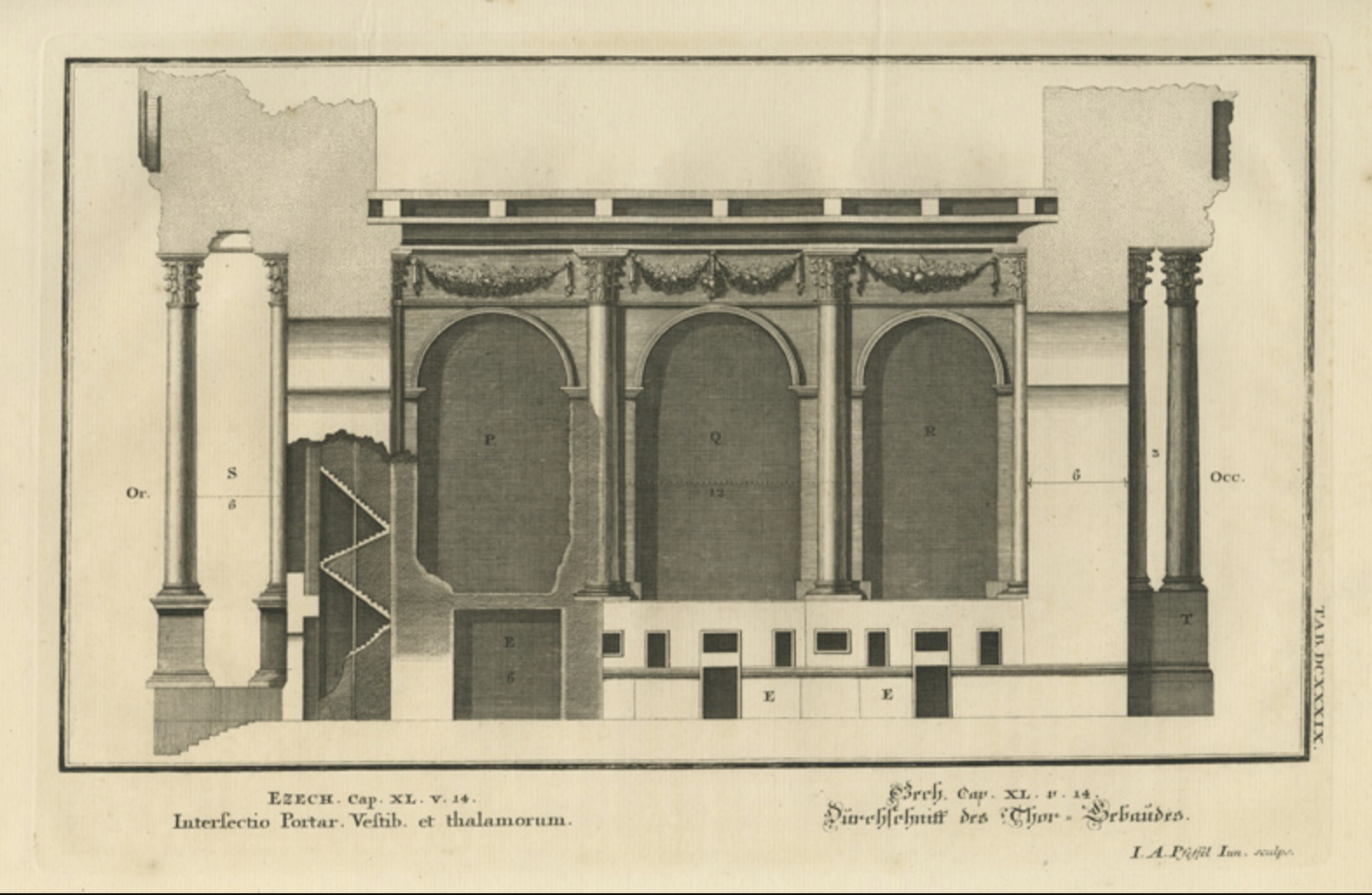
Many Jews believe that Ezekiel’s Temple is the Third Temple that will be built in Jerusalem one day. The pesky problem there is that right now the Muslims control the Temple Mount where it should be constructed and the Al Aqsa mosque that stands there is a holy site for Muslims. If you’ve been watching the news lately you’ll be reminded that there’s not a lot of goodwill between the Muslims and the Jews, so I don’t think that’s going to happen any time soon. Nevertheless, a lot of work has been done (and money raised) to prepare for the Third Temple’s construction one day. You can find architectural design images online showing what it’s projected to look like.

For Christians, many believe that Zeke’s Temple will be built during the end times. Others believe that Zeke’s Temple was the plan but the Jewish people forfeited the opportunity for its construction by their disobedience and it will never be built. Still, others see it as a precursor vision to the same vision John sees of a New Jerusalem in the final two chapters of Revelation when there is a new heaven and a new earth.

So which is it? It’s a mystery. I can choose one of the theories that makes the most sense with my understanding of the prophecies of the end times and John’s Revelation but even that mystery is interpreted in a host of different ways.

Richard Rohr in his book The Divine Dance says that mystery isn’t something we can’t understand but something we can endlessly understand. There are messages for us in the mystery itself. As I’ve peeled back some of the layers of this envisioned Temple over the past few days I think that it’s fascinating how there is a thread that weaves itself through the entire story.

For me, one of the biggest spiritual lessons for me in Ezekiel’s vision is the hope. Ezekiel and his contemporary, Jeremiah, witnessed and experienced one of the darkest periods of history for the Hebrew people. They literally lost everything, and were taken into exile, their nation and their Temple (one of the fabled seven wonders of the ancient world). And what does one need most when you’re down and out and without hope? You need a vision that gives you hope for what could be. In this darkest of times, God is giving Zeke and his fellow Hebrews that vision.

It was in a letter to Zeke and his fellow Hebrews, suffering in the darkness of their despair in Babylon that God through Jeremiah said:

“For I know the plans I have for you,” declares the Lord, “plans to prosper you and not to harm you, plans to give you hope and a future.

Those words weren’t given to bright, affluent high school graduates looking forward to their Freshman year in college. You’d think so given the number of cards and trinkets that have those words printed on them every May. And, while the promise is true for those bright high school graduates, it’s helpful to understand that those words were originally given to a people who had lost everything, had experienced terrible suffering we can’t even imagine, and were living in a foreign land in a hopeless situation. In the pit of their hopeless despair, God gives them a vision and hope.

As another person who suffered terribly, Corrie Ten Boom loved to say, “There is no pit so deep that God’s love and grace aren’t deeper still.”

I don’t know for certain if or when Ezekiel’s envisioned Temple will ever be constructed, but that is the message I find in the mystery.

If you know anyone who might be encouraged by today’s post, please share.

Two Points from the Prophetic

Exile Required (CaD Mi 5) Wayfarer

“But now many nations are gathered against you. They say, “Let her be defiled, let our eyes gloat over Zion!” But they do not know the thoughts of the Lord; they do not understand his plan, that he has gathered them like sheaves to the threshing floor.”
Micah 4:11-12 (NIV)

One of the positive spiritual by-products of this chapter-a-day journey for me is humility. This is especially true when it comes to the words of the ancient prophets which are often layered with meaning.

In today’s chapter, Micah’s words address what was in his day (vss 9-13), but this is also eerily layered in describing what is happening today (vss 11-12, see above), and then he provides a vision of yet what will be (vss. 1-8).

I sat in the quiet this morning and meditated on these 13 verses in relation to all that I’ve studied, listened to, read, and learned with regard to prophecy and eschatology (a.k.a. the study of the “end times”) for over 40 years. Without getting far deeper into the weeds than is my intention with these chapter-a-day posts/podcasts, let me just say that Micah’s message offers some challenging prophetic puzzles in light of the different major schools of thought.

Knowing, however, that I don’t really want to wade into the deep weeds, I was left mulling over another relevant question: What is a modern, everyday person supposed to get out of a passage like this, if all I want to do is find a thought for my day that I can hold onto and that will help me to live today in a way that God desires?

And this brings me back to two simple thoughts.

First, how fascinating that ancient Micah quite aptly describes what happened on October 7.

“But now many nations are gathered against you. They say, “Let her be defiled, let our eyes gloat over Zion!”

I find his next line even more apt in consideration of the sum of Micah’s prophetic puzzles.

But they do not know the thoughts of the Lord; they do not understand his plan.”

And, this brings me back to humility. I have, on multiple occasions, had the experience of teaching about prophecy and the “end times.” In fact, even in the past few months, I’ve had a chance to wade back in and teach on pieces of it as part of a larger team. When teaching about this genre, I typically encourage people to be wary of those who proudly proclaim they can tell you with certainty and precise detail exactly what will happen in the future based on prophetic writing like Revelation. I am constantly reminded that in Jesus’ day, there were entire schools of scholarly and well-educated thought proudly proclaiming with certainty and precise detail what the Messiah would be and do.

They were all wrong.

I try, therefore, to humbly avoid repeating that error of human hubris.

But while I don’t know with certainty and precise detail there are some big-picture things that, by faith, I do know. In John’s Revelation, Jesus tells him,“I am the Alpha and the Omega, who is, and who was, and who is to come.” As I find amidst Micah’s prophetic puzzles an accurate assessment of what was, and what is, and a vision of what is to come, I am led to not worry so much about the “what” and “when” but the “Who.”

And this brings me to my second simple nugget for my day. In our bizarro times of head-scratching and uncertainty, I take spiritual solace in all of the ways that the prophetic has been accurate about things that were and are. It leads me to trust that those things that Great Story says about what will be, are equally true and can be trusted even if I don’t know or understand the precise details about how it will all play out.


If you know anyone who might be encouraged by today’s post, please share.

It’ll Pan Out in the End

The Lord will be king over the whole earth. On that day there will be one Lord, and his name the only name.

Then the survivors from all the nations that have attacked Jerusalem will go up year after year to worship the King, the Lord Almighty, and to celebrate the Festival of Tabernacles.
Zechariah 14:9, 16 (NIV)

One can’t journey through the totality of God’s Message without running into prophetic messages of the end of things as we know them, though it is important to note that the idea of there being an “end” is a misnomer because God consistently speaks of “new” beginnings. “Old things pass away, new things come” aptly describes one of God’s core message to us throughout the Great Story.

Even in creation of all that we know, the process of death and life is ever-present. Science tells us that the totality of this expanding, living universe is made up of energy that takes on different forms and phases. When solid matter dies and decays it is converted to a different kind of energy that, in turn, feeds other systems. We bury or burn a dead body, it decays, biodegrades or is consumed and the ecosystem uses the converted energy to feed the system in other ways.

The book of Revelation, which we often think of as describing “the end” because it reveals a chaotic time of pain and suffering. But the book actually ends with comfort, peace, joy, and  new life in a new beginning:

Then I saw “a new heaven and a new earth,” for the first heaven and the first earth had passed away, and there was no longer any sea.
Revelation 21:1 (NIV)

Today’s final chapter of Zechariah follows the exact same pattern. There is a period of intense conflict and suffering followed by a new reality under a sovereign God who calls everyone to celebrate the Feast of Tabernacles. The Jewish Feast of Tabernacles was an annual harvest feast. Think about it, harvest is that time of year when all that has been sown, cultivated, watered, tended, and pruned is finally harvested. In other words, as plants reach the end of their life-cycle we chop it down and gather it so that it, in turn, will feed everyone (its solid matter changed to a different kind of energy in our digestive systems) and perpetuate life.

Along my life journey I have studied many different theories on the mysterious prophetic texts of the Bible. One thing that I’ve come to learn about prophetic imagery is that it is easy to find in all the mysterious images and metaphors all kinds of things that spark endless theories and debates, which often turn into feuds, which separate people into various opposing camps. Reading today’s chapter I can understand how the Jewish scholars in Jesus’ day were looking for a Messiah to show up on the scene, wipe out the evil Romans, and usher them into global power. It’s what Zac seems to be describing in today’s chapter. However, the Messiah described in the previous chapters is gentle, riding on a donkey, suffering betrayal and death.

What a mysterious contradiction.

This morning in the quiet I’m mulling over some basic beliefs and world views about where our world is headed. Some contend that humanity is essentially good and, despite our penchant for focusing on all that is bad and negative, our world and humanity is slowly getting better and better and moving in designed progression towards the joy, peace, goodness and life described in the final chapter of Revelation among other visions of utopia. Others believe that humanity is essentially flawed and things are only going to get worse and worse until in the final depth of darkness and doom God will show up and save the day. I find it fascinating to observe that friends who occupy both schools of thought are given to doomsday thinking and dire doomsday proclamations depending on the circumstances they see around themselves and their belief (though not knowledge) of where it is leading.

As I make my way through this life journey I find myself increasingly and humbly relinquishing any sense of surety with regard to prophetic versions of the end times. I think of one Christian scholar who was confronted with an either-or question about the Book of Revelation regarding three major theories of the return of Christ. He was asked whether he believed in the pre-tribulation rapture, mid-tribulation rapture, or post-tribulation rapture. Realizing that the question was intended to pigeon-hole him for the questioner’s judgement, the scholar refused to be trapped into the either-or debate and responded, “I’m a pan-tribulationist. I believe it’s all going to pan out in the end.”

I don’t know what’s going to happen tomorrow or in that murky, vague period we see in the future and have dubbed the “end times.” I’m not sure even my speculation profits me or anyone else very much. I do know that we live in an intricately ordered  system that is perpetually converting things from one type of energy to another type of energy to perpetuate life. I know that the Bible describes a beginning, tells stories filled with beginnings and endings that lead to new beginnings, and then ends with mysterious visions of a large-scale ending and new beginning. I believe that Jesus was God incarnate who, interestingly enough, came to suffer, die, and then rose from the dead to usher in a whole new beginning of things. I see in Jesus’ teaching and resurrection the exact same paradigm revealed in creation, in today’s chapter, and in the Great Story as a whole.  I believe that Jesus is “the way, the truth, and the life” just as He claimed to be, and that’s why I follow.

And so, I will continue to follow Jesus and grow my faith. I will cultivate in my life and relationships the love, grace, and forgiveness that Jesus exemplified and to which He call me. I trust that this earthly journey will lead me to a time of natural harvest from my earthly body and existence. My body will be converted to different kind of energy for the time-being and my spirit (which science can’t produce, quantify, examine, or reproduce) will then be ushered into new beginnings of an eternal nature just as Jesus described. What will that all look like exactly?

I’d be happy to chat with you over coffee or a pint. We can talk about what the Bible says and what scholars and artists have speculated over time. We can talk about people who have seen things in near-death experiences. I’ll be happy to share with you what I’ve come to believe in my studying and reading and contemplation.

Just know that at the end of our conversation, after I have told you what I think about prophecies and end times and heaven and resurrected bodies and eternity, I will shrug my shoulders and tell you, “It will all pan out in the end…right before the next beginning.


Apocalypse, World View and Work

So you also must be ready, because the Son of Man will come at an hour when you do not expect him.

“Who then is the faithful and wise servant, whom the master has put in charge of the servants in his household to give them their food at the proper time?
Matthew 24:44-45 (NIV)

Whether we know it or not, each one of us approach life with a certain ingrained perspective. It’s called a world view and we each have one. Our world view determines how we perceive and react to events and circumstances around us. If something happens that doesn’t fit neatly into our world view, it can be rather disconcerting.

I thought a lot about world view this past November when Donald Trump unexpectedly won the Presidency. It was an event that most of us never could have imagined happening. We know that anyone can run for President, but we’ve come to expect from history that the winner is always going to be a member of the political establishment.

The election results definitely shook things up, and with it came all sorts of apocalyptic thinking. I still feel it simmering beneath the surface of news articles, posts, and current events. Along my life journey I’ve noticed this pattern in human behavior. If we’re rattled hard enough we go into doomsday mode.

As I sat in my hotel room on election night at 1:00 a.m. swapping text messages with Wendy and Taylor I got to thinking about world views. Among followers of Jesus the prevailing world view has been a predominantly medieval one in which things are going to get worse and worse and worse and worse until the very end when Jesus returns in a eucatastrophic moment.

J.R.R. Tolkien was a teacher of medieval literature and his epics reflect this world view. Saruman is a great example of how Tolkien viewed modern man felling the innocence of the trees to fuel his machines of war. (Interesting to think how serving in WWI and living through WWII may have affected his world view. ) Darkness grows and spreads until the forces of good stand on the field of battle outnumbered and hopeless. Then at the darkest moment something happens to miraculously bring about unexpected victory. That’s what he called eucatastrophe.

There is another world view among followers of Jesus, however, that holds that things are actually getting better [cue: The Beatles’ It’s Getting Better All the Time]. It’s the “glass is actually half-full” world view. This world view holds that despite the headlines and 24 hour news channels skewing our perspective by bombarding us with the latest tragedies from around the globe, the situation world-wide is actually better today than at any point in human history. There’s less disease, life spans are the longest they’ve ever been, things are safer than they’ve ever been globally, and food production is the highest it’s ever been around the globe. Poverty world-wide is lower than its ever been in history and what we would call “poor” in today’s world is far different (and better) than our definition just a generation or two ago.

In today’s chapter Jesus gives his followers some generalities about what’s to come in the future. It reads like the medieval world view with wars, famines, false messiahs, and Jesus returning when no one is expecting it. Even in the description Jesus admits that He does not know the exact timing of events.

These things are fascinating to think about, and many people dedicate much of their lives to studying eschatology and all the various theories of the end times. Google it and you’ll find all sorts of charts, graphs, opinions, and theories about what’s to come.

I found it interesting that Jesus concludes His apocalyptic overview with a parable of a servant in charge of feeding his master’s servants while the master is away. When the master returns the only question was whether or not the servant was found doing what he was supposed to do. Jesus’ message is clear: Don’t worry about these ordained events that I cannot control. Worry about being faithful to do each day those things I am called to do. Actively love God. Actively love others. The rest will take care of itself.

On election night our daughter asked me to text her something wise. I don’t know how wise my message was, but I gave her my perspective at that moment. Donald Trump may be President, but the next morning I was going to get up, go to work, and do the things I do everyday. Just like I did when Obama was President, and Bush 43, and Clinton, and Bush 41. Life goes on. My job is to focus my time and attention on my spheres of influence and doing the things I’m called to do to the best of my ability.

Now, if you’ll excuse me, I have some work to do 😉

I Don’t Want to Ruin the Surprise

“As the new heavens and the new earth that I make will endure before me,” declares the Lord, “so will your name and descendants endure. From one New Moon to another and from one Sabbath to another, all mankind will come and bow down before me,” says the Lord. “And they will go out and look on the dead bodies of those who rebelled against me; the worms that eat them will not die, the fire that burns them will not be quenched, and they will be loathsome to all mankind.”
Isaiah 66:22-24 (NIV)

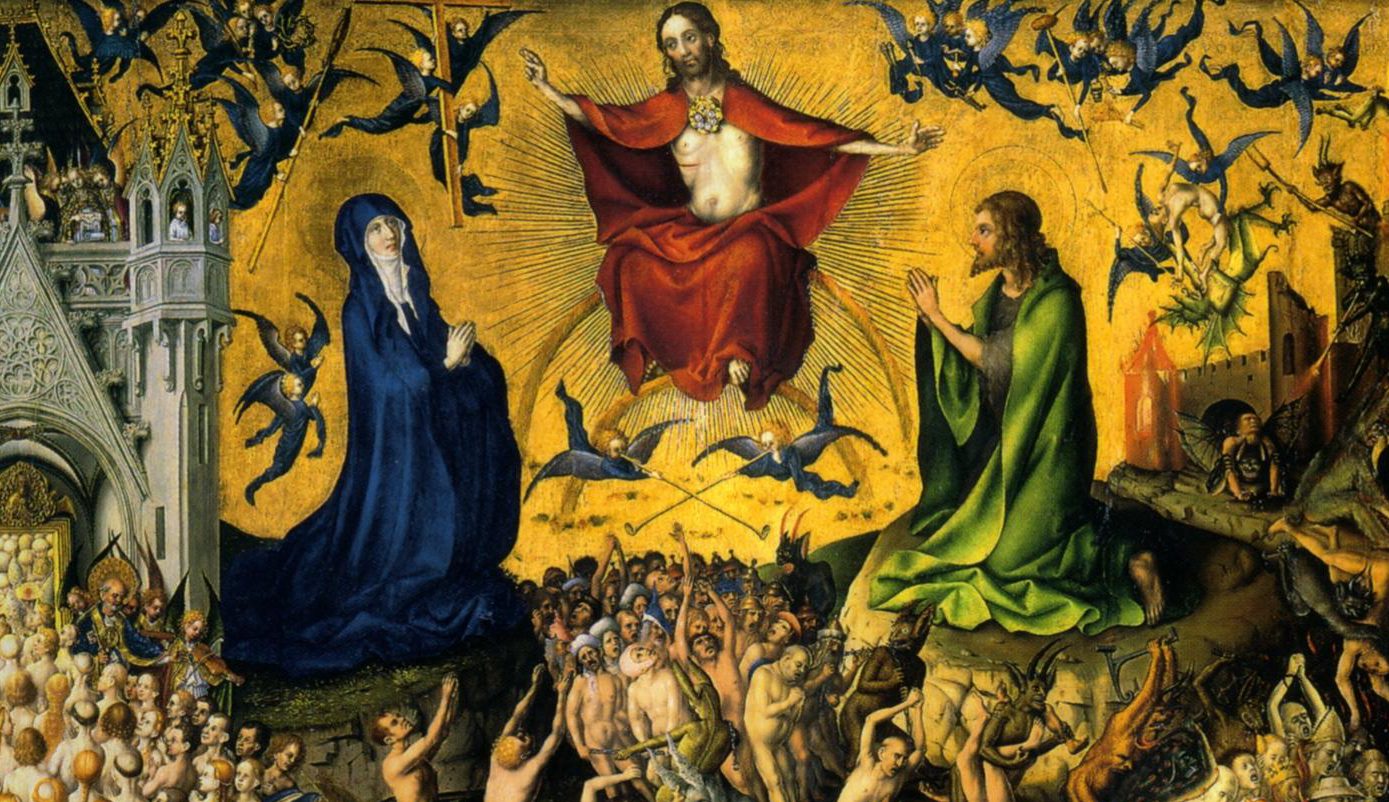
Today we end our long journey through Isaiah’s prophetic tome. Granted, it’s a long slog at 66 chapters. Yikes! We started in late September last year. Isaiah’s work ends with a vision of the end times. It’s what theologians call eschatology: the study of the end times and the final destiny of humankind. Once again, there are clear connections between Isaiah’s vision in today’s chapter and that of John in Revelation.

The study of eschatology has never been an exact science.  Intelligent, knowledgable, and sincere scholars have forever argued this theory and that theory regarding how all things are going to end. I was raised in the conservative protestant evangelical tradition to believe that Jesus would someday call all believers on earth to be “raptured” to heaven, triggering a seven-year tribulation of hell on earth, followed by the return of Jesus to earth, the imprisonment of Satan, and a 1,000 year reign of Christ, followed by a final battle and judgment in which the saved go to heaven and the unsaved go to hell.

There are countless other versions of the end times in which the same Biblical texts are interpreted a myriad of different ways. There are versions in which there is no rapture, or the rapture will happen half-way into the tribulation, or the rapture will happen after the seven years of tribulation. There are versions in which there is no 1,000 year reign, or perhaps the 1,000 year reign has all already happened, or perhaps it’s happening all right now, or perhaps it will never happen literally, or perhaps it will happen but with no real eternal damnation, or perhaps… you get the picture.

When I was younger I studied it all more fervently, presented my own interpretation more dogmatically, and took it all more seriously. The longer I’ve continued in my journey following Jesus the less important it has become to me. Please don’t read what I’m not writing. I will forever continue my journey into God’s Message and pursue Christ. I have just noticed along my journey that we who claim to follow Jesus have historically been quick to place too much importance on theological litmus tests at the expense of the only two things that Jesus Himself said were truly important.

This morning I’m thinking about Wendy. My wife hates when surprises are ruined. She will blissfully ignore hints, turn a blind eye, and put things out of her mind if she thinks that it might ruin what is intended to be an eventual surprise. When Jesus was asked about His return He deferred knowledge and said, basically, “it’s a surprise.” I think I’ve adopted Wendy’s attitude as my theological bent toward eschatology. It was obviously meant to be a surprise.

So, taking a cue from Wendy, I think I’ll let the whole end-time thing be the surprise Jesus intended. Today, I’ll just keep focused doing the two things Jesus said were important for me to do:

  • Love Him.
  • Love others (even Amillenialists)

chapter a day banner 2015

The Challenge in the Way We See the World

The earth will be completely laid waste
    and totally plundered.
The Lord has spoken this word.
Isaiah 24:3 (NIV)

Over the past week in the United States we have seen a clash of peoples with very different world views; People who see the world very differently. The presidential election has brought those stark differences into the spotlight, along with our continued struggle to to love those with whom we disagree and to let discourse rule over discord.

I don’t hear people talking much about world views any more. I had an entire class on it in college in which we defined many of the more popular world views, discussed them at length, and weighed their differences. My impression is that higher education has changed a lot in the past 20 years. At the liberal arts college I attended we were taught that the loss of an election to those who saw the world differently was reason for fascination, personal challenge and understanding rather than fear and loathing.

World view is the primary way we see the world. World view is the lens of our core religious, political, and socio-economic views. Our world view is the filter through which we see the world and process news and events. It is a very human thing to assume that our world view is right and others world views are wrong; to struggle with those who don’t share our own personal view of the world.

There is, however, value in understanding how I view the world and to have it challenged. This is where discourse is a worthwhile friend.

Today’s chapter highlights a piece of world view that has been challenged in recent years. I had a discussion about this with Wendy and one of my daughters this past week in light of the surprising results of our election. Many followers of Jesus hold to what is essentially a medieval world view as it relates to our view of the future. This world view holds that things are going to get progressively worse and worse until there is apocalypse, and then Jesus will return and redeem everything in a eucatastrophic climax to the Great Story.

There is another world view I’ve been reading from some modern day mystics which takes an opposite view. God is progressively redeeming things. Things are getting better all the time, though we can’t really see it. Despite our fears, worries and a media bent on showing us all that is sensationally wrong with the world things are actually getting better as God’s resurrection power spreads in an ever-expanding universe.

So which is it? Apocalypse and eucatastrophe or evolving redemption? Isaiah’s prophetic words today certainly lends itself to the former. The world laid waste in desolation, but in the end the Lord is reigning in Jerusalem.

This morning I’m mulling over these things in my  mind. I’m pondering how I see the world and weighing what I read in God’s Message. I’m watching the news of the day and trying to see them both in context of my personal world view while understanding how those same events are perceived by those who see the world differently than I.

chapter a day banner 2015

Foreshadowing and Climax

Megiddo Valley of Armageddon

You will come from your place in the far north, you and many nations with you, all of them riding on horses, a great horde, a mighty army. You will advance against my people Israel like a cloud that covers the land. Ezekiel 38:15-16a (NIV)

The prophetic messages of Ezekiel in today’s and tomorrow’s chapter are part of a curious and mysterious niche of theological study known as eschatology, the study of prophecy and the end times. The vision and message in today’s chapter calls out a leader named “Gog” of the land of “Magog” from the “far north” who will gather a multi-national coalition of armies to march on Israel in a massive battle.

Most scholars agree that these chapters parallel the vision of John (Revelation 16) who names the location of this gathering of kings for a final great battle: Armageddon. The valley of Armageddon near the ancient town of Megiddo is in northern Israel which is now the site of an on-going archaeological study and a tourist center. I had an opportunity to visit several years ago and that’s the valley of Armageddon behind me in the picture above.

As fascinating as these prophetic matters are to ponder and discuss, I have come to a few conclusions about them along my journey. First, I have known many people who become so obsessed with these prophesies (it can be like solving a massive, unsolvable puzzle) that they get lost in it. I don’t quite see the point of getting so distracted by trying to understand these things that we ignore more important and current matters.

Second, in any story the idea of foreshadowing is to hint at what is to come in the climactic chapters without giving it away. As author of the Great Story being told in history, I think God intended these foreshadowing prophesies to give us a hint of climactic events to come but never intended us to actually understand all of these matters with certainty. No author wants us to know the details of the climax until we actually get to that point of the story.

Finally, I have come to believe that these foreshadowing prophetic messages are there to remind me that there is a bigger story being told in this life. When encountering the daily headlines and the ebb and flow of international events, I take solace in faith that things are being played out toward a prescribed chapter. We are not yet to that point of the story. And, I’m okay with that.