Tag Archives: Sower

Of Prophets and Plants

[Jesus] told [His disciples], “The secret of the kingdom of God has been given to you. But to those on the outside everything is said in parables so that,

“‘they may be ever seeing but never perceiving,
    and ever hearing but never understanding;
otherwise they might turn and be forgiven!’”

Mark 4:11-12 (NIV)

One of the most important themes in the Great Story up through the start of Jesus’ ministry is the heart relationship between God and the Hebrew people. God made a covenant with His people but they time and time again broke their end of it. For roughly four hundred years God’s prophets were center stage warning God’s people to repent and turn their hearts back to Him. They warned God’s people of the consequences of not doing so. The people continually refused to listen. They lost their Kingdom and were taken into exile. They eventually returned from exile and rebuilt their lives, clinging to God’s promised Messiah.

One of the things that is often lost on casual readers of Jesus’ teaching is His relationship to the ancient Hebrew prophets. In Matthew 5:17 Jesus said, “Do not think that I have come to abolish the Law or the Prophets; I have not come to abolish them but to fulfill them.” If Jesus came to abolish the prophets, then I can justify ignoring the ancient prophets. Since He said He came to fulfill them, then I think I’d better understand the prophets and their message.

In today’s chapter, Mark records Jesus’ famous parable of the Sower who scatters his seed and it falls on different types of soil. The eventual fruitfulness of the seeds was determined by the quality of the soil. When His disciples asked Jesus to explain the parable and why He spoke in them, Jesus quotes the prophet Isaiah:

Then I heard the voice of the Lord saying, “Whom shall I send? And who will go for us?”
And I said, “Here am I. Send me!”
He said, “Go and tell this people:
“‘Be ever hearing, but never understanding;
    be ever seeing, but never perceiving.’
Make the heart of this people calloused;
    make their ears dull
    and close their eyes.
Otherwise they might see with their eyes,
    hear with their ears,
    understand with their hearts,
and turn and be healed.”

Isaiah 6:8-10

The relationship between God and His people had always been like a rocky marriage. Some, like the prophets, had their hearts were in the right place. They were sincere in their faith, and devout in their covenant. But most were hard-hearted and calloused towards the things of God. Jesus claims that He is the fulfillment of the prophets, God’s Messiah who has come to reveal God’s Kingdom and fulfill the promise made through Abraham that through His people would come a blessing and salvation for all people. The irony is that God’s people, the Hebrew people, will continue to be just as they always have been. Some will see it, but many won’t.

The parable of the Sower and Jesus’ quote from Isaiah are linked. Jesus’ own people, especially the institutional religious establishment have rock-hard hearts. Jesus’ words will have no effect, any more than Isaiah’s words did to the royal and religious institutional establishments of his day.

And, of course, that is the whole point of Jesus’ parable for me as a reader. What’s the quality of soil in my heart, mind, and life? Do the spiritual seeds of this chapter-a-day journey germinate? Take root? Grow? Bear fruit in my thoughts, words, and actions during the day? If so, then the fruit of the Spirit will be increasingly evident with my wife, my family, my colleagues, my clients, my friends, and my community. They will experience in me love, joy, peace, patience, kindness, gentleness, faithfulness, goodness, and self-control.

May it ever be.

If you know anyone who might be encouraged by today’s post, please share.

Listen Carefully

Listen Carefully (CaD Lk 8) Wayfarer

Therefore consider carefully how you listen.
Luke 8:18a (NIV)

Along my life journey, there are so many people I have met and with whom I have shared the journey for a particular season of life. Over forty years I have spent stretches of my journey amidst at least eleven different local gatherings of Jesus’ followers across two states. In each case, I had some opportunity to use the gifts I’ve been given in some kind of spiritual leadership.

I woke up this morning and the lake. My father and I made a quick trip down yesterday to winterize things and button the place up for the winter. As I sat in the quiet this morning, watching the sun come up over the cove, I let my mind linger in the memory banks. I thought of each of those gatherings. Faces and names came to me that I had not thought about in so very long. There are so many lives and stories.

There were so many individuals that I have no idea where their journeys led them or what has become of them.

A beautiful, intelligent, and personable young woman whom I visited in the suicide watch section of a mental health clinic. The death in her eyes concealed so many secrets.

A young man with so much happening inside of him, and he didn’t know what to do with all of his anger. He had flaming red hair to match that anger and he struggled as the only child with a single mother and absent father.

The rough, rebellious, foul-mouthed, drug-using offspring of a fundamentalist family system. Man, I loved him. His rough exterior, which put so many people off, hid a heart of gold. Come to think of it, I imagine Simon Peter was a lot like him.

The beautiful trophy wife of a wealthy, prominent attorney. No amount of expensive clothing and cosmetics could hide the loneliness and pain that had her dying inside. Her exterior was so put together for someone so spiritually desperate.

Then there are those whose stories I’ve known or learned about along the way.

The prank-pulling, immature dude who was not serious about anything ended up getting his act together, succeeding in business, and being a great husband and father to his kids.

A different beautiful, intelligent, and personable young woman whom I watched walk through her suicide attempt, struggle with her inner demons, and find her way.

Several individuals came out of the closet, (some to me personally) and found very different roads leading to very different places.

Multiple seemingly wise individuals made very different tragic and foolish decisions that led to painful consequences affecting so many others, which also led to very different places.

In today’s chapter, Luke presents a series of episodes from Jesus’ ministry, when the crowds were huge and He was riding a wave of popularity. The chapter begins with a parable Jesus told about a sower who scatters his seed. The seed falls in different places on different types of soil which leads to very different results. Jesus tells His disciples that the parable is about how God’s Word lands with different individuals which leads to very different results.

As I meditated on the chapter, I thought about all the different individuals mentioned in the chapter:

The wife of Herod’s house manager who became a member of Jesus’ entourage and a financial supporter of His ministry.

The man possessed by many demons, who after being delivered by Jesus, asks to join His entourage. In this case, Jesus tells him to stay home and tell his story to the people in his community.

The angry pig farmer whose pigs (and livelihood) the evicted demons entered and killed.

Jesus’ own biological family members trying to get in touch with him (and who, at the moment, think he’s crazy).

The little girl who dies and whose spirit leaves her body, only to be called back by Jesus. What did she experience while she was absent her body?

So many individuals encounter Jesus, hear Him, touch Him, and witness His interactions with others. So many different lives. So many different experiences. So many different outcomes.

Each person has their journey. Each person has their story. Each person ends up in different places with different outcomes.

I found it fascinating that after the parable of the sower, Jesus tells His followers: “consider how carefully you listen.” With each story choices are being made about listening, receiving, and responding. With each choice, different directions lead to different places. My story, my journey, and my trajectory in life that led to intersections with all of these different individuals I mentioned are rooted in how carefully I listened, how receptive my heart had been, and how I chose to respond. It led me to each of those people.

Indeed, that process continues today and each day of this earthly journey.

Lord, help me listen well, be receptive, and respond appropriately to Your Word and Spirit.

If you know anyone who might be encouraged by today’s post, please share.

Sow What?

Sow What? (CaD Mk 4) Wayfarer

Again [Jesus] said, “What shall we say the kingdom of God is like, or what parable shall we use to describe it? It is like a mustard seed, which is the smallest of all seeds on earth. Yet when planted, it grows and becomes the largest of all garden plants, with such big branches that the birds can perch in its shade.”
Mark 4:30-32 (NIV)

It is spring in Iowa, arguably the best place to grow things in the world. Growing up, our state used the tag line: “A place to grow.” I always found this a great tag line full of metaphorical layers. I’m sad it got buried under slogans like “You make me smile!” and “We do amazing things with corn.”

Spring brings my perennial desire to plant something and make it grow. I have to confess that when it comes to being a child of Iowa I’m a bit of a prodigal. Growing things has never come naturally to me. I’ve done okay with my rosebushes, but I think it’s because they do well on their own despite me. Last spring we planted some herbs on the patio. I even got to use them to make fresh seasoning a few times before they died.

It’s a beautiful thing about the cycles of life, isn’t it? It is perennial. Hope springs eternal with Easter. Every spring the Cubs have a chance to win the World Series and I have a chance to successfully grow something. It doesn’t matter that the odds are 1:108. There’s still a chance, and each spring the hope is intoxicating.

Last year, Wendy and I bought actual herb plants. Undeterred by their premature death, I decided that this year we’re going to grow them from seeds. If I’m going to commit serial herbicide, I might as well make it more difficult. So, we got three grow-kits with pots, dirt, and seeds.

What struck me as I planted the seeds was how minuscule they were. Seriously, I felt like I was sprinkling dust particles in the dirt! I followed the instructions for watering and a week or so later Wendy and I went to the lake for a long weekend. When we got back, there were actual plants growing in two of the three pots. What did I do wrong with the third plant? I’m telling you: I can kill a plant before it even sprouts! When I contacted the grow-kit company I was told that sometimes you can get “bad seed.” I’m not sure what that means, but it felt like a pardon from the Governor. I sanded out a couple of notches off the handle of my garden trowel.

I thought about my little herb garden as I read today’s chapter. Jesus uses planting seeds as a word picture of God’s Kingdom. The seed can be as small as a speck of dust, but it can sprout and grow into something huge. Which is why earlier in the chapter Jesus told another story about a person who was sowing seed as they journeyed along. The seed was sown everywhere, which got me mulling this over.

Jesus told His followers that the seed is the Word. In the Great Story, I learned that Jesus is the living Word and also incarnate Love. So, one way I sow the Word along my life journey is by sowing love that is joyful, peaceful, patient, kind, gentle, faithful, good, and self-controlled. In doing this, I’m scattering that hopeful possibility of spring that the seed might happen to fall upon a soul that it good soil for that seed to germinate and grow into something exponentially huge in relation to that little seed sown in a gentle word, a gesture of forgiveness, a random act of kindness, or a timely hug.

Of course, the Great Story also talks about bad seed that can equally be sown. The seeds of hatred, anger, malice, chaos, violence, rage, jealousy, envy, selfishness, dissension, and division. Bad seeds don’t grow much of anything.

In the quiet this morning, I find myself once again looking within and without. What am I sowing in my thoughts, words, actions, reactions, posts, tweets, replies, and comments? I look outward at the things I see in the media, on social media, and the people I “follow.” What is being sown? Good seed? Bad seed?

I don’t want to be judgmental, but I do want to be wise.

I can’t control others, but I can control myself.

I am embarking on yet another day. Day number 20,088 of my earthly journey.

It’s spring in Iowa. A place to grow.

What am I going to sow today?

If you know anyone who might be encouraged by today’s post, please share.

The Pursuit

Whoever pursues righteousness and love
    finds life, prosperity and honor.

Proverbs 21:21 (NIV)

A recently released study showed that the number of church-going Christians in the United States has dropped significantly in the past twenty years. As usual, I have heard a number of media outlets fanning the flames of fear, anxiety, and panic at the news. I’m not getting my undies in a bunch over it. There are some fascinating questions to be asked, contemplated, and discussed regarding the details in the data. Fear leads to all sorts of silly, reactive behavior.

When I was young and starting out on my faith journey, many institutional churches had a keen interest in morality and political power. There was, I know, a genuine motivation in being followers of Jesus. I experienced it first hand in my own life and in the sincere mentors I wrote about yesterday who taught me spiritual disciplines. There was also, however, a drive for size, numbers, and political influence within media-driven pastors and leaders. I myself witnessed and was often a part of a push to get people to pray the sinner’s prayer and walk an aisle to accept Jesus. While that launched many faith journeys, my own included, there were many who simply believed that they had received the heavenly stamp of approval. They had their spiritual “fire insurance” policy that would keep them out of hell, and their ticket was punched for heaven. This was often not the start of a faith journey towards becoming more like Jesus, but a transactional religious rite.

Jesus addressed this in His parable of the sower. The seed falls on all sorts of soil. Some show signs of life and growth, but never grows to maturity or produces a healthy, abundant crop.

My own observation is that there have been many who were part of institutional denominations and churches for reasons that were far different than a personal spiritual journey to follow Jesus. It could have been familial, cultural, and/or social expectation in a time when the institutional church was part of the fabric of our society. There has been a huge shift in the past twenty years. Denominations are imploding. The institutions are falling apart. In addition, being a follower of Jesus involves regular fellowship with other believers and worship. Membership and participation in an institutional church provide the opportunity for those things. At the same time, I have known many regular church members and attenders who neither worship nor participate in any real spiritual relationship with others. In addition, an institutional church is not the only place that the disciplines of worship and fellowship can be found.

This brings me back to the proverb from today’s chapter that I pasted above. It cuts right to the heart of the matter and makes me ask: “What am I pursuing?” If it’s simply a religious rite or a transactional moment that gives me some sense of eternal security, then it’s a very different thing than me being a follower of Jesus. What I have discovered is that being a follower of Jesus is a faith journey because it is a never-ending pursuit and a seeking after becoming the person Jesus calls me to be. As the proverb states, it’s not a pursuit of religion and heaven, but of righteousness and love.

Jesus said:

But seek first his kingdom and his righteousness, and all these things [life’s basic necessities] will be given to you as well.

Matthew 6:33 (NIV)

So, in the quiet this morning I find myself asking the very simple question: “What am I pursuing?” Then there is a follow-up question that is difficult, but necessary: “What do I want to say I am pursuing, and what do my daily words, actions, relationships, purchases, time spent, and energy expended reveal to be my life’s pursuits?

Righteousness and love.

Sometimes, I have to recalibrate and remember what the goal is. Otherwise, I get distracted pursuing so many other things.

The Sower and the Seeds

From Peter, an apostle of Jesus the Anointed One, to the chosen ones who have been scattered abroad like “seed” into the nations living as refugees…
1 Peter 1:1 (TPT)

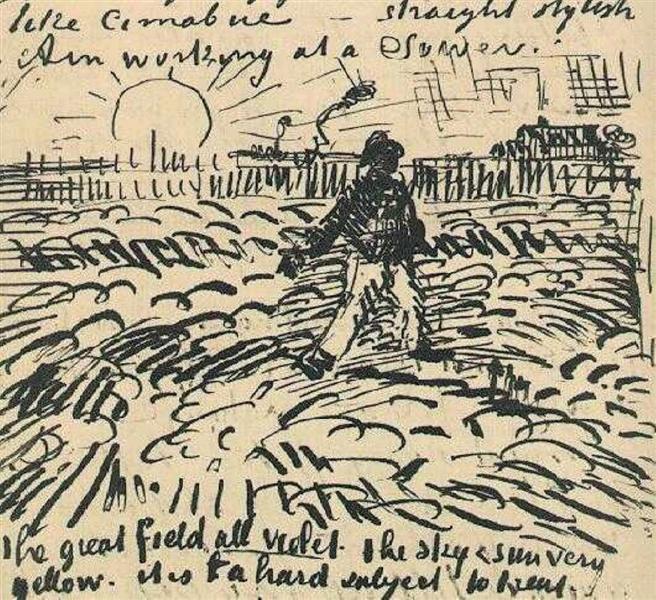
I’ve always had an appreciation for Vincent Van Gogh. The tragic Dutch artist who failed at almost everything in his life, including his desire and failed attempt to become a pastor. The story of his descent into madness is well known, along with his most famous works of a Starry Night, sunflowers, and his haunting self-portraits.

I find that most people are unaware that one of Van Gogh’s favorite themes was that of a sower sowing his seed. He sketched the sower from different perspectives and painted multiple works depicting the lone sower, his arm outstretched and the seed scattered on the field.

This morning I’m jumping from the ancient prophet Zechariah to a letter Peter wrote around 30 years after Jesus’ death, resurrection, and ascension. In recent months, I’ve been blogging through texts that surround the Babylonian exile 400-500 years before Jesus. But that wasn’t the only exile recorded in God’s Message. Peter wrote his letter to followers of Jesus who had fled persecution from both Jews and Romans in Jerusalem. As I’ve mentioned in previous posts, exile is a consistent theme in the Great Story.

At that point in time, thousands upon thousands of people had become followers of Jesus and were creating social upheaval by the way they were living out their faith. They were caring for people who were marginalized, sick, and needy. When followers of Jesus gathered in homes to worship and share a meal, everyone was welcome as equals. Men and women, Jews and non-Jews, and even slaves and their masters were treated the same at Christ’s table. This was a radical shift that threatened established social mores in both Roman and Jewish culture. So, the establishment came after them with a vengeance.

Peter begins his letter to the Christian exiles by immediately claiming for them a purpose in their exile. He gives the word picture of being the “seed” of Christ scattered by the Great Sower to various nations. They were to take root where they landed, dig deep, and bear the fruit of the Spirit so that the people around them might come to faith in Christ. God’s instructions through the prophet Jeremiah to the Babylonian exiles could just as easily apply to them:

This is what the Lord Almighty, the God of Israel, says to all those I carried into exile from Jerusalem to Babylon: “Build houses and settle down; plant gardens and eat what they produce. Marry and have sons and daughters; find wives for your sons and give your daughters in marriage, so that they too may have sons and daughters. Increase in number there; do not decrease. Also, seek the peace and prosperity of the city to which I have carried you into exile. Pray to the Lord for it, because if it prospers, you too will prosper.”

Jeremiah 29:4-7 (NIV)

And, in the quiet this morning I realize that it can also apply to me wherever my journey leads me. There is a purpose for me wherever that may be. I am the seed of Christ. I am to dig deep, create roots, draw living water from the depths, grow, mature, and bear the fruit of love, joy, peace, perseverance, patience, kindness, goodness, faithfulness, gentleness, and self-control.

I can’t help but think of Van Gogh, the failed minister who found himself in several exilic circumstances that inspired his paintings. I’ve read his letters, and I find that scholars tend to diminish or ignore the role of faith in Vincent’s life and work, despite his many struggles. Then I think of that sower who shows up again and again in his work. I can’t help but wonder if when he repeatedly sketched and painted the sower, if he thought about his works being the seed of God’s creativity he was scattering in order to reflect the light which he saw so differently than everyone else, and so beautifully portrayed. I find it tragic that he never lived to see the fruit of his those artistic seeds. Yet, I recognize that for those living in exile, that is sometimes the reality of the journey.

Seed in the Chaff

“I will scatter you like chaff
    driven by the desert wind.
This is your lot,
    the portion I have decreed for you,”
Jeremiah 13:24-25a (NIV)

The community where Wendy and I live, and our local gathering of Jesus’ followers, is experiencing a season of acute grief. This past week a young man, the youngest son of our senior pastor and his wife, passed away unexpectedly. He should have been experiencing the prime of his life. It is unnerving when tragedy strikes like this. There are so many unanswerable questions.

In Sunday morning’s message the teacher gave us a word picture of a man who initiated a controlled burn of his lawn. The teacher watched as the fire spread across the grass turning the lawn into a field of scorched and blackened death. Confused, the teacher stopped and spoke to the man. “I don’t understand,” he said. “You’re killing your lawn.

Oh no,” said the man. “The seed’s already in the ground. Come back in a few months and you will see how lush and green it is with new life.”

I couldn’t help but think of that parable as I read Jeremiah’s prophetic poem this morning. He foresaw that God’s people would experience unspeakable tragedy. They would be conquered. Their city and their Temple would be destroyed. They would be “scattered like chaff driven by the desert wind.” This was their lot in life.

Why me? Why him? Why us? Why now?

So many unanswerable questions.

Then in the quiet this morning I pictured and watched the chaff driven and scattered by the wind. What Jeremiah did not see in his vision is that there is seed mixed in with the chaff. Jeremiah does not see Daniel raised to a position of unbelievable authority and honor within the Babylonian palace. Jeremiah does not see Shadrach, Meshach and Abednego standing with God in the flames of the fiery furnace without getting one hair of their head singed. Jeremiah does not see the repentance of Nebuchadnezzar, doesn’t read the handwriting on Beltshazzar’s wall, does not hear the beautiful lyrics of the psalmists’ lament from exile, and does not see the incredible ministry and visions the prophet Ezekiel will have in that land. Jeremiah does not see the return of the remnant under Nehemiah or the miraculous work of his people rebuilding the Temple and the walls of the city. The prophet’s does not foresee Jesus entering the walls of rebuilt Jerusalem, God’s Son sacrificed for sin once for all, and then resurrected to new and eternal Life.

We all experience tragedy along our our life journeys; We all will have times when we are shaken to the core of our souls. In such times our eyes become intensely focused on our lot in life and we ask unanswerable questions. In the moment, Jeremiah just sees himself, his people, and their lot in life; Their lot in life that cannot be changed any more than a leopard can change his spots. He stands and looks out and all he can see is dry chaff scattered on the scorching desert wind.

Look more closely.

There’s seed in that chaff.

The Sower is not finished with the Story.