Tag Archives: Holy

Journey’s End

And Moses the servant of the Lord died there in Moab, as the Lord had said.
Deuteronomy 34:5 (NIV)

I mentioned in one of my posts last week that the third anniversary of my mom’s passing is approaching. The dark and cold of winter bring back sense memory of it for me. It is a moment I will forever hold dear; sitting there at her bed with my dad and sister as she slipped into eternity.

Death is a holy moment.

There is a genuine sobriety of spirit one experiences when, in an instant, there is one less life in the room.

Death is also an intimate moment.

My mother gave me the gift of life. To be with her as she stepped through the veil was meaningful in ways I can’t express.

Today’s short and final chapter of Deuteronomy tells the story of Moses. It is more than a simple retelling. Like the moment of death itself, it is holy. It is intimate.

Jewish tradition sees something in the text that is easily missed in the English translation.

al-pî YHWH

Word for word:

  • ʿal – “upon / by”
  •  – “mouth”
  • YHWH – “the LORD”

So the literal rendering is unmistakable: “by the mouth of the LORD.”

The phrase in its usual and common context modifies a command. Priests act “by the mouth of the Lord.” Commands are give “by the mouth of Moses.”

But, Deuteronomy 34:5 is not your usual and common context. We’re not dealing with a command, but the death of God’s man. The chapter is careful to point out that Moses was not frail at the end. He had strong sight and plenty of vigor. He was not failing. He was simply finished with his earthly task.

Moses dies “by the mouth of the LORD.”

As God breathed life into Adam, He similarly receives Moses’ life.

A divine kiss.

Intimate.

Holy.

Then the text continues to amaze as God Himself buries Moses in an unmarked grave just short of the Promised Land to which he led the people but will not enter himself.

No shrine. No spectacle. No packed national assembly. It’s just God and His man Moses. Received with a kiss. God digs the grave. God prepares the body. God buries Moses. Alone.

In the quiet this morning, I find myself meditating on what I can learn from Moses in the end.

I will never see the full fruit of my work. I may not watch the final act of the story I helped God author. I may not get credit, closure, or an ovation. Yet, I can still finish this earthly journey fulfilled.

Moses teaches me to let go of outcomes without resentment. He encourages me to bless the next generation without envy. He whispers assurance that I can trust God with the ending I don’t get to choreograph.

God asks me to steward, not complete.

And then—I get to climb the mountain anyway.
To look.
To bless.
To let go.

God will meet me there. He’ll take care of everything.

If you know anyone who might be encouraged by today’s post, please share.

Promotional graphic for Tom Vander Well's Wayfarer blog and podcast, featuring icons of various podcast platforms with a photo of Tom Vander Well.
These chapter-a-day blog posts are also available via podcast on all major podcast platforms including Apple, Google, and Spotify! Simply go to your podcast platform and search for “Wayfarer Tom Vander Well.” If it’s not on your platform, please let me know!
An orange button featuring an open book icon with a white outline.

Across the Divide

Across the Divide (CaD Lev 8) Wayfarer

“You must stay at the entrance to the tent of meeting day and night for seven days and do what the Lord requires, so you will not die; for that is what I have been commanded.”
Leviticus 8:35 (NIV)

Throughout the Great Story, there is a clear separation established between the kingdoms of this world and our earthly realities, and the Kingdom of God which exists in a different realm, a heavenly realm, a realm of Spirit. Dotted through the Great Story are experiences in which the divide between these two realms is breached. Angelic visits are a great example. Individuals like Isaiah, Ezekiel, and John being given a glimpse of God’s throne room are another. Typically, when humans experience these breaches of the spiritual divide, the human being is reported to be scared to death.

In his exploration of Near Death Experiences (NDEs) in the book Imagine Heaven, John Burke reports what people who have physically died, experienced the other side, and were sent back describe of their experiences. He found that most described it as more real than anything in this earthly existence. Those who’ve experienced say that this earthly life is a shadow world compared to that world.

As I have considered these accounts and descriptions, I have begun, I believe, to understand holiness in a deeper way. Holiness always seemed to me to be defined as some kind of super-powered moral perfection, but the further I get in my spiritual journey, the more I realize that’s not it. The divine reality of God’s presence on the other side of the divide is overwhelming and indescribable Light, Love, Life color, beauty, wholeness, knowledge, and infinity. That’s holy.

What we experience daily on this earthly journey in a realm of sin and death is not holy. Throughout the Great Story, God is trying to reveal the glory of His Kingdom to me, allow me to choose into that Kingdom by faith, and to live my earthly life in this world of sin and death according to the principles of a Kingdom that is not of this world.

Today’s chapter is a major transformation for Aaron and his sons. Yesterday, they were just normal Hebrew dudes like every other Hebrew dude. After the events of today’s chapter and a week of camping out at the entrance to God’s tent temple, they are priests. They have a uniform, a detailed instruction manual, and they’ve been ceremonially cleansed and purified for the role of being priests for the Hebrew people with all the responsibilities that go along with it. Welcome to a whole new reality.

As I meditated on the chapter in the quiet this morning. I pondered what God is doing with these ancient Hebrews in the toddler stages of human development in history. Just the other day our granddaughter Sylvie was with us. She’s at the stage in which she’s having to learn that there are things of Papa and Yaya’s that are special. They aren’t toys to be mindlessly and carelessly played with or discarded. God is doing the same thing with the Hebrews. He’s giving them an earthly sense of a spiritual Life and death realities of God’s Kingdom. The heavenly and the earthly. The holy and the ordinary. The sacred and the profane. These are things they can hardly fathom in the same way Sylvie can hardly fathom why that fragile family heirloom she just grabbed off the table is holy in Papa and Yaya’s kingdom.

In the quiet this morning, I find myself reflecting back on the kids and grandkids visit for a few hours on Sunday. There were colorful light saber fights, playing make believe, running in circles, wrestling on the bed, video games, intense energy, laughter, love, cuddles, sharing challenges, celebration of goodness, food, drink, and did I mention love? Yes, there was a lot of love. It was holy. At least it was a taste, a hint of that ultimate reality on the other side of the divide. How might I reflect and infuse my day with a little of that holiness for those around me?

If you know anyone who might be encouraged by today’s post, please share.

These chapter-a-day blog posts are also available via podcast on all major podcast platforms including Apple, Google, and Spotify! Simply go to your podcast platform and search for “Wayfarer Tom Vander Well.” If it’s not on your platform, please let me know!

Time to Drive

Time to Drive (CaD Ezk 44) Wayfarer

This is what the Sovereign Lord says: No foreigner uncircumcised in heart and flesh is to enter my sanctuary, not even the foreigners who live among the Israelites.
Ezekiel 44:9 (NIV)

I was driving with our daughter Taylor in the car. It was a gorgeous, quiet day late in the afternoon. She was around eleven or twelve years old at the time. About a block from our house was this giant parking lot that sat completely empty. I pulled into the parking lot and Taylor was wondering what was going on. I told her we were switching seats and that I was going to give her an opportunity to drive the car.

Taylor was completely freaked out by this, and that first driving lesson didn’t last very long, but she did it. She learned the basics of an accelerator and brake pedal, about shifting the car into gear, and she performed some basic turns with the steering wheel.

I not only had the joy of taking her completely by surprise, but I was also wanting to plant a seed in her soul. She was on the cusp of a new phase in life when she will find herself capable and responsible for things that were once forbidden to her. And while she was still a few years from having legal permission to drive a car, the truth is that she was already far more capable than she even knew – she’d never even thought about it.

In today’s chapter, Ezekiel’s vision continues and he is reminded of all the rules of the priests in the Temple that were established back in the book of Leviticus. In a previous post, I talked about God being a God who makes distinctions. And in today’s chapter, we are reminded that in that day there were distinctions between priests and non-priests, even between Jews and non-Jews. By the time Jesus appeared on the scene, the distinction had morphed into outright prejudice and religiously sanctioned racism.

But humanity grows and matures the way my daughter does. There was a time when the distinction was made “You are not to drive. Only daddy or mommy drives. That’s your seat. This one is mine.” But there comes a time when the distinction is removed. Jesus came to remove the distinctions and do something completely new.

Paul, who was himself a Jewish religious and legal scholar who became a disciple and apostle of Jesus, explained the removal of the distinction Ezekiel shares in today’s chapter between Jewish Levitical priests and “uncircumcised foreigners” to the believers in Ephesus:

(I know this is a long passage, but imagine yourself being one of the “uncircumcised foreigners” who was never allowed into the Temple and had been treated like a second-class citizen your whole life reading this for the first time.)

 The Messiah has made things up between us so that we’re now together on this, both non-Jewish outsiders and Jewish insiders. He tore down the wall we used to keep each other at a distance. He repealed the law code that had become so clogged with fine print and footnotes that it hindered more than it helped. Then he started over. Instead of continuing with two groups of people separated by centuries of animosity and suspicion, he created a new kind of human being, a fresh start for everybody.

Christ brought us together through his death on the cross. The Cross got us to embrace, and that was the end of the hostility. Christ came and preached peace to you outsiders and peace to us insiders. He treated us as equals, and so made us equals. Through him we both share the same Spirit and have equal access to the Father.

That’s plain enough, isn’t it? You’re no longer wandering exiles. This kingdom of faith is now your home country. You’re no longer strangers or outsiders. You belong here, with as much right to the name Christian as anyone. God is building a home. He’s using us all—irrespective of how we got here—in what he is building. He used the apostles and prophets for the foundation. Now he’s using you, fitting you in brick by brick, stone by stone, with Christ Jesus as the cornerstone that holds all the parts together. We see it taking shape day after day—a holy temple built by God, all of us built into it, a temple in which God is quite at home.
Ephesians 2:14-22 (MSG) emphases added

Jesus came to usher in a new age of humanity in which the Temple is no longer a bricks-and-mortar building but a flesh-and-blood organism. Everyone who is in Christ is a brick of the living, breathing Temple, and everyone who is in Christ is a priest of that Temple. We’re all included, we’re all a part of it.

In the quiet this morning, I am grieving the fact that for two thousand years the Institutional church has largely succeeded in putting the old distinctions back in place in which professional clergy are the only holy priests and the people in the pews are the unholy commoners. But that’s not what Jesus taught or intended. You and I, my friend, are a brick in the Temple and we’re Priests in this world to show others by our lives, our words, and our example the love and way of Jesus.

Jesus came to tell all of us “Get over here in the drivers seat, my child. It’s time to learn to drive.”

If you know anyone who might be encouraged by today’s post, please share.

Distinctions

Distinctions (CaD Ezk 41) Wayfarer

Then he measured the temple; it was a hundred cubits long, and the temple courtyard and the building with its walls were also a hundred cubits long. The width of the temple courtyard on the east, including the front of the temple, was a hundred cubits. Then he measured the length of the building facing the courtyard at the rear of the temple, including its galleries on each side; it was a hundred cubits.
Ezekiel 41:13-15 (NIV)

For the recently freed Hebrew slaves, everything about life had changed. All they knew about the God of their ancestors Abraham, Isaac, and Jacob was what Moses had told them. But they’d witnessed what God could do in the ten plagues that had been inflicted on Pharaoh and Egypt. They’d seen God part the waters of the Red Sea so they could cross and then bring the same waters crashing down on the Egyptian army.

But they still know relatively little about God. But in Exodus 19, they are about to learn a whole lot more. Moses goes up on a mountain by himself. From below they watch as lightning strikes, then smoke starts billowing, and the whole mountain trembles. When Moses descends, he not only has the Ten Commandments, but he has the blueprints and instruction manual for a Temple, a priesthood, rituals, and sacrifices that prescribe an entirely new way of living with God and with one another in community.

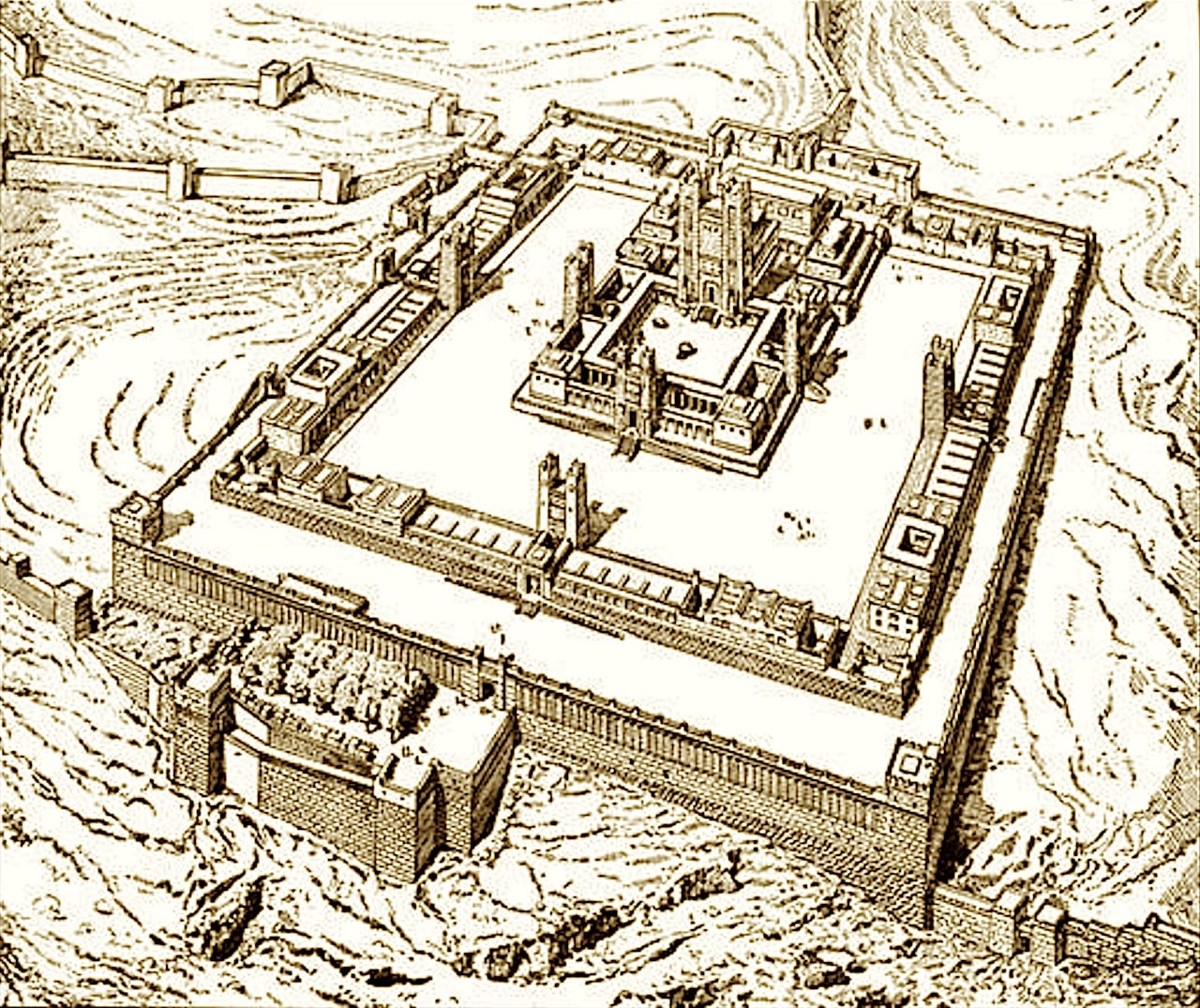
One of the things that became quickly clear to the ancient Hebrews when God, through Moses, gave them instructions for a temple and its rituals is that God made distinctions. Again, this parallels the Creation poem in Genesis 1 and 2 where God made a distinction between “this” and “that” parts of creation. There are consistent structural designs from the tent tabernacle, to Solomon’s Temple, and to the Temple Ezekiel sees in his vision. With each, there were distinctions of space. There were spaces between the common and the sacred, the space that was everyday people, and the “most holy” space where God’s presence resided.

The Most Holy Place, sometimes called the “Holy of Holies” was a perfect square. The only person who could enter was the high priest.

Fast forward to Jesus, some 400 years after Ezekiel. In Luke 9, Jesus takes his three inner-circle disciples and goes up a mountain. Suddenly, Jesus is transformed into blinding, bright light. There is lightning and then there’s smoke everywhere and then Moses shows up in his glorified, heavenly body along with Elijah. Does this sound familiar?! Jesus would descend that mountain and consequently usher a completely new blueprint and new distinctions that build on the old.

Jesus subsequently told His disciples that the Temple would soon be reduced to rubble, and 40 years later it was. After His death and resurrection, Jesus sent His Holy Spirit. This is an important new distinction. God’s presence was in Jesus’ people. The human soul became the “Most Holy Place” where God’s Spirit dwells and the body is its Temple.

But wait, we’re not done. The night before Jesus’ was executed, He told His followers, “I’m going to prepare a place for you.” When John is given a vision in Revelation this place is revealed as a new Jerusalem. Just like with Ezekiel, John had to watch as it was measured and wouldn’t you know it, this heavenly city is perfectly square just like the Most Holy Place. The distinctions from beginning to end have been transformed and flipped inside out. What began as a small (about 15 feet square) Sacred Space with the distinction that only God’s Presence is holy enough to be there, becomes at the end of the Great Story a “Most Holy Place” that is 1200 miles square where all of God’s people dwell together with God because, through the sacrificial death and resurrection of Jesus, they have been made holy, as well.

In the quiet this morning, I am reminded that the tremendously precise and ordered details that Ezekiel describes are a part of how God metaphorically reveals Himself to us. He is a God of detail and distinctions who transforms chaos into order, death into life, and the common into that which is holy. Paul wrote to the believers in Corinth that if anyone is joined with Christ, that person is a new creation, old things pass away and new things come. In other words, I am a microcosm of the very thing that God is doing throughout the entire Great Story, transforming that which wasn’t holy into that which is eternally holy.

I am in process, and as my local gathering of Jesus’ followers continues to remind everyone, this journey is about progress, not perfection.

And so, I progress into another day of the journey.

If you know anyone who might be encouraged by today’s post, please share.

The Holy and the Profane

The Holy and the Profane (CaD Ezk 36) Wayfarer

“I had concern for my holy name, which the people of Israel profaned among the nations where they had gone.”
Ezekiel 36:21 (NIV)

Growing up, my mother had a set of fine china and a “silver service” of tableware that was actually silver and had to be polished. The entire set was kept in a special box. It only came out on very special occasions. You knew that when mom broke out the fine china a very special meal was about to take place. It was an event.

Imagine, if you will, a Twilight Zone-esque scenario in which I needed to feed our dog, Tuffy. So, I broke open the box of my mom’s fine china and grabbed one of the large plates along with one of her silver serving spoons. I popped open a can of that nasty-looking brown stuff you feed dogs and I dug that gunk out of the can with mom’s silver spoon onto the fine china plate and then threw it on the floor for the dog. Just as I do this my Mom walks in and sees what I’ve just done. How do you think she would have reacted? You are correct, I would very quickly have been living outside in the kennel with Tuffy. Fortunately, I knew better than to feed the dog with mom’s fine china.

Along life’s road, I had heard the word “profanity” many, many times. Usually, it had to do with “bad words” that I wasn’t supposed to use. I was in college before I learned that “profanity” means to “empty something of its meaning.” I’ll never forget watching Professor McFadzean miming the action of dumping something upside down and spilling its contents on the floor. You take something meaningful and treat it as if it’s meaningless.

Taking mom’s fine china and feeding Tuffy with it is the act of profaning it. It has a very special meaning for my mother. It’s exclusive, meant only for rare occasions to serve the finest food for the most worthwhile moments in life. Feeding the dog with it empties it of that meaning. It profanes it.

Back in Exodus, when God revealed Himself to Moses from the burning bush, God told Moses His name: “Yahweh” which means “I Am.” God told His people that this name was holy. It was special. It was sacred. Therefore, they never uttered it. It was too holy to even speak it.

In today’s chapter, God through Ezekiel proclaims that one day He is going to bring all of His people back from exile to the land of Israel. Jerusalem would be rebuilt. God’s people and the land would once again prosper with life. But then God repeatedly tells them that the Hebrew exiles have profaned His name among the nations where they are living in exile. They took something holy and sacred and metaphorically threw it on the ground and stomped on it. He goes on to tell them that when He brings the exiles home and restores the land He is doing it for the sake of His Holy name. In other words, it’s not because God’s people earned it or deserved it. It’s because God is a holy God, love incarnate and full of grace.

In the quiet this morning, I find my mind going down two trails of thought. The first is very simple and straightforward as it relates to what I’ve known to be profanity my entire life. I find it fascinating that in our culture the name of Jesus Christ is used as common swear words. We don’t do that with Buddha, Mohammed, or Krishna. But people routinely take the name that “is above all names” and the name at which demons flee and at which scripture says “every knee will bow and every tongue confess.” We take that name and use it as an empty, meaningless, momentary exclamation of everyday anger. That’s profane to the core.

The other trail my mind went down is to think about what Jesus did for all of us. What God is proclaiming to His people in exile is very much a foreshadowing of what He will do through Jesus. Not restoring and redeeming land and a city, but restoring and redeeming our hearts and souls through the death and resurrection of Jesus. Not because we deserve it or somehow earned it, but because He is Love and full of grace.

And that is holy.

If you know anyone who might be encouraged by today’s post, please share.

Wells and Walls

Wells and Walls (CaD Acts 7) Wayfarer

“You stiff-necked people! Your hearts and ears are still uncircumcised. You are just like your ancestors: You always resist the Holy Spirit!”
Acts 7:51 (NIV)

Of late, I’ve been reading a series of posts by a fascinating Orthodox believer and mystic in Ireland. I’d never heard of this before, but there are a great number of “holy wells” scattered across Ireland and he’s been seeking them out and documenting the adventure. There are all sorts of legends and stories that surround each well and many of them are located in extremely remote locations. Finding some of them sounds like a bit of a pilgrimage in and of itself. No matter how hard they are to find, I’m always surprised at the photos showing many people had been there and left tokens of their visit. Many obviously still believe that these wells are “thin places” where the veil between the physical realm and the spiritual realm is more permeable.

I find the “holy well” phenomenon intriguing, and it’s obviously rooted in the history of 1500 years ago when wells, and fresh water, were more critical for survival. With Jesus’ claim to be “living water springing up to eternal life,” it makes sense how a well could take on layers of metaphorical and spiritual significance. It’s unlike anything I’ve experienced here in America, though our modern history only goes back a couple of hundred years and was arguably rooted in more “enlightened” times.

Along my life journey, it has always been church buildings that I have observed people treating like sacred spaces. I can remember being taught this as a child, literally as if the building was holy and had some special divine indwelling. While I fully understand that a building dedicated to the gathering of believers in worship can take on all sorts of significance for people, the very idea of a church building goes against the core of what Jesus taught.

In today’s chapter, a young believer named Stephen is brought before the same religious rulers who conspired to have Jesus killed. The charges against him included him “speaking against this holy place” (meaning the Temple in Jerusalem) as Stephen quoted Jesus saying He would “destroy this Temple and rebuild it in three days.” For the Jews, the Temple was sacred, so when Stephen argues that “God does not dwell in houses made with human hands” he was taken out and stoned to death.

One of the things that I love most about Jesus was that He moved God’s presence out of buildings with walls made with human hands to the table where “two or three are gathered” over a good meal and conversation. God is there because God indwells the believers at the table, and there’s a shared presence in the gathering together. My body is the temple. God’s Spirit is in me and goes everywhere I go. To ignore this and believe that God resides in a sacred church building down the street where I visit Him on Sunday means I don’t get Jesus’ teaching at all. In fact, it makes me no different than the stiff-necked religious rulers throwing stones at Stephen.

So, in the quiet this morning I am reminded once again that God is in me, and my body is the temple. This means that the divine is a part of every piece of my day, even the mundane and ordinary bits. It means that when Wendy and I gather for coffee and our usual blueberry and spinach smoothies in just a few minutes there is something holy taking place if we will simply take time to recognize it. And, I don’t have to go hunting in remote locations to find a holy well, though that does seem like a really fun adventure.

If you know anyone who might be encouraged by today’s post, please share.

What Indiana Jones Taught Me About Holiness

What Indiana Jones Taught Me About Holiness (CaD 1 Sam 6) Wayfarer

But God struck down some of the inhabitants of Beth Shemesh, putting seventy of them to death because they looked into the ark of the Lord. The people mourned because of the heavy blow the Lord had dealt them.
1 Samuel 6:19

Raiders of the Lost Ark is one of those movies I associate with my youth. It premiered in my Freshman year of high school and it became one of the biggest blockbusters of that era. It was also during this same era that the advent of the Video Cassette Recorders (VCR) allowed for renting and buying a movie to be watched over and over again at home. I have no idea how many times I’ve seen Raiders of the Lost Ark, but it’s a lot.

There is a great scene towards the climactic end of the movie in which the villain archaeologist, Belloq, dresses like a Hebrew high priest to open the Ark of the Covenant and peer inside. He is surrounded by Nazis filming and witnessing the event while Indy and Marian are tied up a short distance away. There’s a moment at the end of Raiders of the Lost Ark that is a brilliant piece of writing and filmmaking. It takes the audience on a roller coast ride of emotions from disappointment to wonder to horror and it ends with awe.

One of the things that I always loved about Raiders of the Lost Ark is that it is rooted in events from the Great Story like the events in today’s chapter. “Didn’t you guys ever go to Sunday School?” Indy asks the government officials who come to him asking about the Ark.

The Philistines, despite moving the Ark around to different towns had experienced an ongoing outbreak of a plague of “tumors” since they took the Ark captive at the battle of Ebenezer. Scholars over the years have proposed that either both bubonic plague or bacillary dysentery could be the culprits as they could easily have been carried by rodents on ships from other regions. The Philistines were coastal people heavily involved in sea trade.

The Philistines return the Ark with a guilt offering to the Hebrews at the border town of Beth Shemesh which happened to be one of the Levitical towns, one of the towns scattered through all the Hebrew tribes where Levites would be living among them. According to the Law of Moses, only Levites would be allowed to handle or move the Ark.

While the Ark is in Beth Shemesh, curiosity gets the better of some of the residents who take the opportunity to peek inside. The chapter says they died, though the specifics are not recorded so we have no idea whether Hollywood pyrotechnics were involved.

This string of Ark stories is fascinating because of the attitudes of the human beings in each scene. Last week I observed that the corrupt priests and Hebrews treated the Ark like a good luck charm, and God remained silent, allowing them to be defeated, the ark taken captive. Then the Philistines treated the Ark as the trophy of a defeated God. The result was the destruction of their idol and an outbreak of plague. In today’s chapter, the residents of Beth Shemesh treat the Ark as an object of trivial curiosity and meet with similarly disastrous ends.

At the end of today’s chapter, the residents of Beth Shemesh observe, “Who can stand in the presence of the LORD, this holy God?” The Hebrew word for holy is qādôš and its meaning is a fascinating subject of study. When Moses stood before the burning bush God told him to take off his sandals because he was standing on holy ground. The Ark was to be kept in the “Most Holy Place” in the Tabernacle and only the High Priest was to enter its presence once a year because it was holy. Holiness is often thought of in our culture as simple moral purity, but it’s so much more than that. I love that the makers of Raiders of the Lost Ark seem to have captured it. Even Indy, who must have learned something in Sunday School, knows to close his eyes and tell Marian to do the same. They can’t look. It’s holy. They, like we the audience, get to the end of the scene with an overwhelming sense of awe and wonder. That’s qādôš.

In a bit of synchronicity this morning, the devotional that Wendy and I read at breakfast each morning spoke of Rudoph Otto’s description of “holy.” It sounds like spells from Harry Potter’s world. He says that that which is “holy” is a paradoxical experience of the opposites mysterium tremendum (scary mystery) and mysterium fascinosum (alluring, fascinating, seductive mystery). Otto argued that if you don’t have both you don’t have the true or full experience of the Holy.

The problem with both the Hebrews and the Philistines in the opening chapters of 1 Samuel is that they arguably had neither as it related to God and the Ark of the Covenant. At best, they had the latter and not the former.

In the quiet this morning, I enter another day and another work week as a follower of Jesus endeavoring to think and speak and act with regard for the fullness of His mysterium tremendum and mysterium faschinosum.

Note: A new message from 7/31/22 was added to the Messages page. CLICK HERE

If you know anyone who might be encouraged by today’s post, please share.

Holy Moment

Holy Moment (CaD Psalm 145.2) Wayfarer

[Note: I know I did Psalm 145 yesterday, but it became obvious to me this morning that I needed to spend some more time in it. So, consider this a blogging BOGO from me to you! :-)]

The eyes of all look to you,
    and you give them their food at the proper time.

Psalm 145:15 (NIV)

He was weeping over the phone. Across the miles, on the other end of the connection, I knew that this moment was qadosh, a holy moment. It was holy, not because of any kind of religious piety or righteous achievement, but because of the depth of its suffering.

Along my life journey I’ve observed that religion has done a number on our concept of holiness. The institutional church has, as it always does, warped holiness into some kind of religious merit badge, a litmus test of morality, a trophy for those religious over-achievers at the top of the Sunday School class. In doing so, religion profanes the fullness of holiness.

Holiness is woven into creation unbound by church membership or religious ritual. Holiness is an encounter with the divine in the human experience. Holiness is not limited to the transcendental, spiritual glory of Jesus’ transfiguration. The emotional, physical, mental, and spiritual agony of his unjust, illegal, blood-drenched execution was a holy moment, as well.

That’s how I recognized the holy moment as my friend wept from the darkness of his own personal pit. He was joining the ranks of many who have gone before him. He was the woman kneeling naked and ashamed in front of the Son of God as her adultery lay publicly exposed. He was the prodigal covered in pig shit and eating the slop of his own choices. He was the wanton woman knelt down before Jesus as her tears wash the feet of the One she fully expects to condemn him like everyone else is in his life seems to be doing. He was me, 20 years ago, as I wept alone in the darkness of a warehouse apartment crying out over the shattered pieces of my life.

I knew this was a holy moment because I had been there myself. This was a holy moment because every human and religious pretense had been stripped away. He was, in that moment, spiritually naked and empty. He had reached a point when he could no longer play the game. This was his breaking point before the One who redeems, recreates, and uses broken things; The Potter who takes the lump of collapsed clay spinning on His wheel and begins to make something new. Whether my friend recognized it, or not, this was the waypoint on his journey that is the inflection point when old things begin to recede in the rearview mirror, and he will find a light on the horizon leading him in a new direction.

Today’s chapter, Psalm 145, begins the last five songs in this 150 song anthology of ancient Hebrew song lyrics. The editors end their compilation with five songs of praise. Today’s is a beautiful description of God’s goodness and I could have picked out any number of verses to chew on, but it was the phrase “you give them their food at the proper time” that resonated deep in my soul.

Remember that God’s base language is metaphor, and metaphors are layered with meaning. Make no mistake, food is food, as in the miraculous Manna that God provided the Hebrew tribes on their wilderness wanderings and the loaves and fish Jesus turned into an all-you-can-eat, filet-o-fish-o-rama. It’s also that which is necessary for spiritual survival and sustenance, as Jesus reminded the Enemy after fasting for forty days: “You can’t just eat physical bread. You need the spiritual bread of the Word.”

From there the metaphor expands to even more layers of meaning:

“In the beginning was the Word…”

“I am the Bread of Life…”

“He took a loaf and broke it, saying, ‘This is my body, broken for you.'”

“I am the living bread that came down from heaven. Whoever eats this bread will live forever. This bread is my flesh, which I will give for the life of the world.”

Along my spiritual journey, I’ve experienced God’s provision of “food” at the “proper time” on both the physical and spiritual level. I remember being married with two small children, my first mortgage, no job, and no idea what was going to happen next. There have been moments when clients unexpectedly pulled the plug on projects, and I wasn’t sure how we would pay the bills. Then there was that lonely night in the dark warehouse apartment when every religious facade I had mistaken for being an actual spiritual resource had been revealed to be impotent, and my soul was starving for a scrap of real spiritual nourishment.

I had religiously participated in the ritual of Communion countless times in my life, yet that moment was the first time I truly tasted the Bread of Life. It was a holy moment. It was qadosh.

In the quiet this morning, I’m praying for my friend who was on the other end of that call. He’s got a long, long road ahead of him. I did my best to assure him that if he relies on the Bread of Life to sustain him, and he doggedly presses on, one-day-at-a-time, towards that Light on the horizon, he will find himself in amazing places. He may find himself in a deep place, but grace is deeper still. He may despair in the moment at the waste he’d made of his life, but God may transform it into wisdom.

I’ve been there.

In the moment all he could see was the unholy ruins of his life.

Little did he know, it was the holy start of a new creation.

He who was seated on the throne said, “I am making everything new!” Then he said, “Write this down, for these words are trustworthy and true.”
Revelation 21:5 (NIV)


As always, if you know anyone who might be encouraged with today’s post, please feel free to share.


Holy Moments in the Dark

Holy Moments in Dark Places (CaD Ps 106) Wayfarer

Save us, Lord our God,
    and gather us from the nations,
that we may give thanks to your holy name
    and glory in your praise.

Psalm 106:47 (NIV)

Yesterday, Wendy and I found ourselves discussing the concept of holiness as we enjoyed our weekly date at the local pub for pizza and a pint. It kind of picked up on what I discussed in my blog post a few weeks ago. In my experience, the concept of being “holy” has largely been reduced by the institutional church to mean “morally pure.” In my spiritual journey, I’ve come to understand that it means so much more than that.

Our conversation sprung out a friend sharing with us about a loved one who finds themselves in one of life’s dark valleys. Wendy and I both identified with the story because both of our journeys include stretches in dark places of our own choices and consequences. Much like our friend’s loved one, the respective dark valleys on life’s road were not characterized by any kind of moral purity.

Go to any twelve-step meeting and you’ll hear people tell their own stories about dark valleys on life’s road. You’ll also hear them share that sometimes one must hit rock-bottom before they spiritually wake up to the consequences of their actions and their need to change.

In Jesus’ famous story of the Prodigal Son, the younger brother finds himself far from home, broke, alone, and literally wading in pig shit. In that rock-bottom moment Jesus shared:

“That brought him to his senses. He said, ‘All those farmhands working for my father sit down to three meals a day, and here I am starving to death. I’m going back to my father. I’ll say to him, Father, I’ve sinned against God, I’ve sinned before you; I don’t deserve to be called your son. Take me on as a hired hand.’ He got right up and went home to his father.

Wendy and I discussed that this very moment, in the midst of the dark valley, at rock-bottom, and knee-deep in pig shit, was a holy moment. That’s the way the spiritual journey often works. Holiness is not confined to the definition of moral purity found at the mountain-top of righteousness. Holiness can also be found in the spiritual awakening that often happens not at the summit of morality but in the muck of a shattered life.

Today’s chapter, Psalm 106, is the final song in Book IV of the anthology of Hebrew song lyrics we know as the Psalms. It is another summary review of the history of the Hebrews. As the song comes to its conclusion, the songwriter pens:

Save us, Lord our God,
    and gather us from the nations

This would indicate that this song was likely written from a place of exile when the Hebrew tribes had been scattered across the Assyrian and Babylonian empires. What’s different in this re-telling of the history compared to the one I just read last week is the heart of repentance. The songwriter finds himself far from home, broken, living amidst his enemies and he recognizes that this dark valley was part of the consequence of his peoples own poor choices. Like the Prodigal, like Wendy and me, the songwriter is having his own holy moment of spiritual awakening. He’s owning his part (and the part of his people) in landing himself in this dark valley. He’s making the spiritual turn.

In the quiet this morning I find myself thinking about my own journey which includes holy moments that occurred both on spiritual mountain tops and sinful, dark valleys. King David wrote in another song (we haven’t gotten to it yet) that there’s nowhere that he could flee from God’s presence. Even in my lowest, darkest moments, God was not absent. It was there He helped awaken my spirit to my need to change the spiritual trajectory of my life.

It was a holy moment.

That’s Qadosh

That's Qadosh (CaD Ps 99) Wayfarer

Exalt the Lord our God and worship at his holy mountain, for the Lord our God is holy.
Psalm 99:9 (NIV)

While being in quarantine has frustrated my extroverted need for interpersonal interaction over the past ten days, I have also been mindful each day to appreciate the opportunity it has afforded Wendy and me to spend lots of time with our grandson, Milo, who normally resides across the pond in Scotland. Yesterday, my exercise monitor informed me that I’d set a new personal record for exercise in one day. If you’re having a hard time getting into that New Year’s workout routine, I suggest finding someone to loan you their three-year-old for a few days.

One of the more endearing developments during our extended time together has been Milo’s desire to go to sleep at night in Papa and Yaya’s bed. Last night, Wendy and I climbed onto the bed with Milo between us. We read three books together, then turned out the light. We sang softly in the darkness. Wendy reached over Milo and held my hand as we lay and sang with Milo nestled between us. Even with my hearing impairment, I could hear Milo’s deep breaths as he drifted to sleep. We then whispered a prayer over him before slipping out of the room.

That, my friend, was a special moment. I wanted to just stay in that moment forever. If only I could bottle it up and hold onto it. I immediately knew that it was a memory I will remember and cherish always.

Today’s chapter, Psalm 99, continues in this section of ancient Hebrew praise songs. They were likely used for liturgical purposes to call the Hebrews to worship in the temple. The lyricist of Psalm 99 layered this call to praise with metaphorical meaning that casual readers in English would never pick up.

Remember in yesterday’s post/podcast I shared that “everything is connected?” The Hebrews found spiritual connections with numbers. Each number had meaning. Seven was a number that meant “completeness.” Three was a number spiritually connected to the divine. There are three stanzas, each with four verses (4+3=7). Seven times the songwriter uses the Hebrew name of God, Yahweh. Seven times he uses Hebrew independent personal pronouns. Three times he refers to God as “holy” (Hebrew: qadosh).

I confess that “holy” is a word, and a spiritual concept, that I failed to fully understand, or flat out got wrong, for most of my journey. The concept of holiness as communicated by the institutional churches I’ve been involved in my whole life made holiness out to be simple moral purity in the utmost sense. The equation was “no sin” plus “going to church” equaled “holiness” (x + y = z). Which meant that holiness, unless you were Mother Theresa, was pretty much unattainable.

I have come to understand, however, that qadosh has a much larger meaning. There are moments in life in which everyone in the room knows there is something meaningful, something special, something larger that is happening in the moment.

Our daughter, Taylor, has an audiotape of the moment she entered the world in the delivery room. You hear her squeaky cries. You hear Dr. Shaw announce it‘s a girl. You hear me talking to her on the warming table. That moment is qadosh.

Last October I stood with our daughter, Madison, in a courtyard. We watched the congregation stand and turn toward us. The beautiful bride, whom I taught to walk, I now walked down the aisle to “give her away” to the man she loves. People smiled and wept. That moment was qadosh.

I sat in the dark room of the nursing home as my grandmother’s life ebbed away with each strained breath. Through the wee hours I kept watch over her. I held her hand. I sang her favorite hymn. I read the final chapter of the Great Story to her and I realized in the moment that it was like reading a travel brochure for the trip she was about to take. That moment was qadosh.

Last night as Wendy and I held hands and hovered over our peaceful, sleeping grandson lying in our bed. We sang. We prayed blessings over him. It was a holy moment. That’s qadosh.

Throughout the Great Story, when God made a special appearance (theologians call that a theophany) the person to whom God appears is mesmerized, speechless, dumbfounded, or overwhelmed. To be in the presence of God, described by lyricist of Psalm 99 as the royal King of Kings. That moment is qadosh.

When the psalmist calls me to worship, he’s not religiously demanding that I dutifully “go to church” in an effort to attain some pinnacle of moral purity. In fact, when I meditate on the fullness of all the qadosh moments I’ve recalled, then all my old notions of what it means to be “holy” are silly in their triteness. The psalmist is calling me into the mysterious, beautiful, meaningful moment of qadosh.