Tag Archives: Repentence

Putting the Mission to Work

John answered, “Anyone who has two shirts should share with the one who has none, and anyone who has food should do the same.”
Luke 3:11 (NIV)

In over thirty-years of my career with Intelligentics, I have been incredibly blessed. I do, however, have a small number of painful memories. Most of the agony traces back to mistakes we discovered involving client data — mistakes that were consequential. In each case, our company’s modus operandi was to do what our mission states:

“…by applying the principles of God’s Word to our lives and work, we become examples of servant leadership and integrity…”

Go to the client.
Honestly confess.
Agree to make it right.
Refund what they paid for the project.

I am happy to report that I can easily count on one hand the number of times we were required to do this. It was never fun, and the amount of money we refunded was not small.

Today’s chapter is all about setting and preparation. Luke lays out the historical setting for Jesus making his entrance in ministry. He lists seven actual names of people at the top of the org charts of the kingdoms of empire, commerce, and religion — individuals who will conspire to have Jesus executed in just three years. Luke then introduces Jesus’ cousin John, a herald in the wilderness preparing the way for the Messiah.

As I meditated on John’s words, I found it fascinating that Luke specifically notes that tax collectors and soldiers went to hear John’s message. These were both despised groups of people. Tax Collectors were despised because they were seen as working for the enemy (Rome) and they profited by extorting their own people. Soldiers were despised as occupiers, and those who leveraged their power to oppress innocent people.

When they asked John what they should do, John gave specific answers.

“Don’t collect more than you have to.”
“Don’t extort money and don’t accuse people falsely—be content with your pay.”

John didn’t tell them to get a different job. He told them to act differently in the job they already had.

When I was a young man, I was convinced that I would spend my life in vocational ministry. God had other plans. I’ve spent my career helping clients measure and improve their customers experience. Along the way, God taught me that my job gave me the opportunity to work with all sorts of people, from all walks of life, whom I would otherwise never meet. He revealed to me the opportunity I’d been given to teach people principles that would not only improve the quality of their work, but the quality of their lives and relationships.

And, I would also be given the opportunity to exemplify what I say I believe…

Honestly confessing a mistake.
Making it right.
Refunding money.

John’s message was the warm-up act for Jesus — but their messages dove-tailed perfectly. John called all people, saints and sinners alike — to take a spiritual heart check. Then turn a changed heart into tangible, specific acts of goodness in every day life.

Repentance, according to John, wasn’t a feeling. It was visible. It showed up in the way people treated others, handled money, and used their authority.

On this Monday morning, entering another work week, that’s a good reminder. It’s one thing for my company to have a mission statement. It’s another thing for me to actually do business like I believe it.

If you know anyone who might be encouraged by today’s post, please share.

Promotional graphic for Tom Vander Well's Wayfarer blog and podcast, featuring icons of various podcast platforms with a photo of Tom Vander Well.
These chapter-a-day blog posts are also available via podcast on all major podcast platforms including Apple, Google, and Spotify! Simply go to your podcast platform and search for “Wayfarer Tom Vander Well.” If it’s not on your platform, please let me know!
An orange button with an open book icon in white, representing a reading or educational theme.

Stupid Decisions

Stupid Decisions (CaD Ezk 18) Wayfarer

Rid yourselves of all the offenses you have committed, and get a new heart and a new spirit. Why will you die, people of Israel? For I take no pleasure in the death of anyone, declares the Sovereign Lord. Repent and live!
Ezekiel 18:31-32 (NIV)

Wendy and I have several good friends who are currently residing in that stretch of life’s journey when one has the responsibility to parent teenagers. No one seems to be having any fun.

The thing about the teen years is that kids begin to get a taste of freedom and of free will, but they’re still about ten years from having fully developed brains. They make really stupid decisions. And, because they are old enough to get into serious trouble, those stupid decisions run the risk of quickly becoming tragic.

As I listen to some of the stories, it brings back memories of both Taylor and Madison. The girls were good kids and I’m happy to say they made far more good decisions that stupid decisions. But make no mistake, they both made stupid decisions. We caught a few of them. Certain stupid decisions are stupid because they’re so stupid that getting found out is a certainty. I’m certain there were stupid decisions that they got away with. Parents are stupid too, to believe that somehow our children won’t make the same stupid decisions we made when we were their age.

Stupid teenager decisions are a great example of what we call sin. We know it’s wrong, but we do it anyway. We do it for any number of reasons.

In the Great Story, sin is the major spiritual problem. It enters the Story in the third chapter of Genesis. Adam knew that he wasn’t supposed to eat the fruit of one tree. But, dang it, it looked so beautiful and juicy and he was really craving a taste of sweet succulent fruit at that moment.

Stupid decision.

Stupid decisions have consequences.

The consequence of Adam and Eve’s stupid decision, God says, is death. Not right away, but eventually. The human body will break down, wear out, and return to the dust of the earth from which it was formed. Ashes to ashes. Dust to dust.

As Paul wrote to Jesus’ followers in Rome:

sin entered the world through one man, and death through sin, and in this way death came to all people, because all sinned

The message God continues to relay to humans throughout the rest of the Great Story is that He is for life. He wants me to be for life. He wants me to experience life.

At the same time, God does not like death any more than the. parent of a teenager likes to get a call from the Police because they have a teenager in custody.

In today’s chapter, Ezekiel relays what, at the heart of it, this very simple message. In fact, it’s as simple as they come. If you make stupid decisions and live a life of selfishness, pride, stealing, cheating others, living in immorality, and never looking out for anyone but numero uno then death is the just consequence for squandering the opportunity life affords.

But that’s not what God wants. He takes no pleasure in it. It’s a tragic consequence of endless stupid decisions.

God wants life, and He even makes a way for it. Ezekiel proclaims it beautifully in today’s chapter:

Rid yourselves of all the offenses you have committed, and get a new heart and a new spirit. Why will you die, people of Israel? For I take no pleasure in the death of anyone, declares the Sovereign Lord. Repent and live!

In other words, turn around. Make different choices. Follow God. He’s offering a new heart and a new spirit. A fresh start.

Paul put it this way to the believers in Rome:

For if, by the trespass of the one man, death reigned through that one man, how much more will those who receive God’s abundant provision of grace and of the gift of righteousness reign in life through the one man, Jesus Christ!

Just as death to all came through one sin, so God would arrange for life for all to come through one death. Life…death…new life.

I will tell you, that the new life began for me when I made one good decision to take the first step:

I admitted I was powerless over my stupid decisions — that my life had become unmanageable.

This day I call the heavens and the earth as witnesses against you that I have set before you life and death, blessings and curses. Now choose life, so that you and your children may live and that you may love the Lord your God, listen to his voice, and hold fast to him.
Deuteronomy 30:19-20 (NIV)

If you know anyone who might be encouraged by today’s post, please share.

Holy Moments in the Dark

Holy Moments in Dark Places (CaD Ps 106) Wayfarer

Save us, Lord our God,
    and gather us from the nations,
that we may give thanks to your holy name
    and glory in your praise.

Psalm 106:47 (NIV)

Yesterday, Wendy and I found ourselves discussing the concept of holiness as we enjoyed our weekly date at the local pub for pizza and a pint. It kind of picked up on what I discussed in my blog post a few weeks ago. In my experience, the concept of being “holy” has largely been reduced by the institutional church to mean “morally pure.” In my spiritual journey, I’ve come to understand that it means so much more than that.

Our conversation sprung out a friend sharing with us about a loved one who finds themselves in one of life’s dark valleys. Wendy and I both identified with the story because both of our journeys include stretches in dark places of our own choices and consequences. Much like our friend’s loved one, the respective dark valleys on life’s road were not characterized by any kind of moral purity.

Go to any twelve-step meeting and you’ll hear people tell their own stories about dark valleys on life’s road. You’ll also hear them share that sometimes one must hit rock-bottom before they spiritually wake up to the consequences of their actions and their need to change.

In Jesus’ famous story of the Prodigal Son, the younger brother finds himself far from home, broke, alone, and literally wading in pig shit. In that rock-bottom moment Jesus shared:

“That brought him to his senses. He said, ‘All those farmhands working for my father sit down to three meals a day, and here I am starving to death. I’m going back to my father. I’ll say to him, Father, I’ve sinned against God, I’ve sinned before you; I don’t deserve to be called your son. Take me on as a hired hand.’ He got right up and went home to his father.

Wendy and I discussed that this very moment, in the midst of the dark valley, at rock-bottom, and knee-deep in pig shit, was a holy moment. That’s the way the spiritual journey often works. Holiness is not confined to the definition of moral purity found at the mountain-top of righteousness. Holiness can also be found in the spiritual awakening that often happens not at the summit of morality but in the muck of a shattered life.

Today’s chapter, Psalm 106, is the final song in Book IV of the anthology of Hebrew song lyrics we know as the Psalms. It is another summary review of the history of the Hebrews. As the song comes to its conclusion, the songwriter pens:

Save us, Lord our God,
    and gather us from the nations

This would indicate that this song was likely written from a place of exile when the Hebrew tribes had been scattered across the Assyrian and Babylonian empires. What’s different in this re-telling of the history compared to the one I just read last week is the heart of repentance. The songwriter finds himself far from home, broken, living amidst his enemies and he recognizes that this dark valley was part of the consequence of his peoples own poor choices. Like the Prodigal, like Wendy and me, the songwriter is having his own holy moment of spiritual awakening. He’s owning his part (and the part of his people) in landing himself in this dark valley. He’s making the spiritual turn.

In the quiet this morning I find myself thinking about my own journey which includes holy moments that occurred both on spiritual mountain tops and sinful, dark valleys. King David wrote in another song (we haven’t gotten to it yet) that there’s nowhere that he could flee from God’s presence. Even in my lowest, darkest moments, God was not absent. It was there He helped awaken my spirit to my need to change the spiritual trajectory of my life.

It was a holy moment.

Inflection Points

Then Nehemiah the governor, Ezra the priest and teacher of the Law, and the Levites who were instructing the people said to them all, “This day is holy to the Lord your God. Do not mourn or weep.” For all the people had been weeping as they listened to the words of the Law. Nehemiah said, “Go and enjoy choice food and sweet drinks, and send some to those who have nothing prepared. This day is holy to our Lord. Do not grieve, for the joy of the Lord is your strength.” The Levites calmed all the people, saying, “Be still, for this is a holy day. Do not grieve.” Then all the people went away to eat and drink, to send portions of food and to celebrate with great joy, because they now understood the words that had been made known to them. Nehemiah 8:9-12

Along life’s journey I’ve grown increasingly fascinated with words. Words, in and of themselves, are creative expression. At the root level they are metaphors. A series of squiggles on a page that correspond to a series of vowels and consonants which mean something to any who can read or understand the language. Words come in and out of fashion. Words you never heard before suddenly become “buzzwords.”

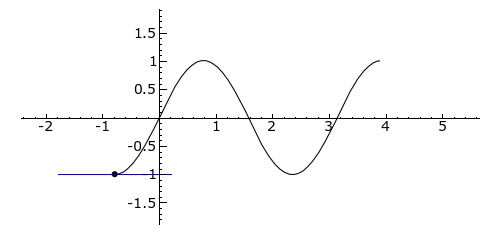
Over the past couple of years, I’ve heard the words “inflection point” used a lot in business. It’s become a bit of a buzzword in some circles. It’s a great little term from the world of calculus. It describes the point at which a curve moves from being concave (downward) to convex (upward), or vice versa. Businesses have adopted the term to describe the point at which a trend (in sales, for example) stops rising and starts declining, or vice versa. The inflection point is the point of change. It’s a change of direction.

I think the term “inflection point” has strong spiritual connotations, as well. God’s Message repeatedly calls people to make a sudden change of direction. Turn from darkness towards the Light. Turn from evil ways and embrace that which is good. Turn away from hatred and pursue Love. Turn from sin and pursue God. Spiritual journeys are all about inflection points.

In today’s chapter, the walls of Jerusalem have been rebuilt. The gates are back in place. As a way of celebrating, Ezra brings out the scrolls with the law of Moses. It’s likely that the words of the law of Moses had not been widely read or heard publicly since Jerusalem and Solomon’s temple had been destroyed some 150 years earlier. Many who lived in Jerusalem may never have heard it. Perhaps no one in their families had heard it since the days of their great-great grandparents.

The reading of God’s story and the law of Moses becomes a spiritual inflection point. The people realize how far they have spiritually wandered away from God’s path. They weep. They grieve. Their hearts turn towards God.

I love the response of the Levites to the people. “Don’t grieve. Feast. This is a moment of joy!” I can’t help but think of the prodigal son returning to his father in humility and shame, and the father’s contrasting expression of joy. That’s the way spiritual inflection points work. They are a moment when grief and turn to joy.

This morning I’m thinking about all of the different metaphorical ways the term “inflection point” applies to life. I’m thinking about the inflection points I’ve experienced, both positively and negatively. Fiscal inflection points, relational inflection points, vocational inflection points, and spiritual inflection points. I’m meditating on the inflection points that still need to occur in my spiritual journey. Followers of Jesus often talk about their conversion as the inflection point of their life. While I certainly look back on that moment as monumental, I’ve found that following Jesus is a never ending series of inflection points. I don’t mature or progress unless I experience them.

Inflection point. Good words.

Chapter-a-Day Luke 5

Jesus and Saint Peter, Gospel of Matthew 4.18-20
Image via Wikipedia

Simon Peter, when he saw [the miracle], fell to his knees before Jesus. “Master, leave. I’m a sinner and can’t handle this holiness. Leave me to myself.” Luke 5:8 (MSG)

Wendy and I were talking last week on our drive home from the lake. We were listening to the radio and a guy mentioned that he considered himself such bad person that God couldn’t possibly love or forgive him.

“I think that’s pride,” Wendy said. As I thought about it, I had to agree with her. There is an insidious side to pride. “I’m so terrible that God couldn’t possibly forgive me” is really just the dark side of “I’m so great God will surely accept me.”

We then talked about our own experiences with shame and guilt. On our conversational journey we came to discover that we had similar experiences. We each experienced periods of life when we pushed God away, but it wasn’t about feeling too guilty or too much shame. Our reticence to accept God’s forgiveness came out of the knowledge that to accept God’s gift of grace and forgiveness would incur a debt of gratitude and a call to walk away from the illicit behaviors to which we clung (and enjoyed).

Sometimes we push God away because, like Peter, we just want to be left alone. We don’t want to change.

Thankfully, God is tenacious in pursuit.

Enhanced by Zemanta

Chapter-a-day 2 Kings 24

Generations. 

In God's opinion he also was an evil king, no different from his father

. 2 Kings 24:9 (MSG)

It's funny to watch certain behavioral traits pass down through generations. If you grew up in my family and found yourself in the bathroom when everyone else was at the table ready to eat, you were labeled "Uncle Garrett" because some old guy a few generations before had a habit of always being on the pot at meal time. When a person in my wife's family behaves in an authoritatively stubborn way, they are said to have inherited the Vander Hart gene.

Sometimes these behavioral patterns that flow through families are silly and the source of lots of ribbing and laughter. Sometimes they are simply annoying and you roll your eyes when they surface. Other times, however, they can be spiritually unhealthy and destructive. One of the themes that sticks out like a sore thumb in our journey through the Book of Kings is the perpetuation of sin and evil across generations. Time after time I read a verse like the one above from today's chapter. "Chip off the ol' block" is not always a good thing.

Today, I'm reminded that I am responsible for my own behavior and following God may require me to take a clearly different path than the well-worn trail that was blazed by earlier generations in my family. Following in Jesus' footsteps is a journey that leads us to change in ways that force to be more like Him, and less like those on the path behind us.

Creative Commons photo courtesy of Flickr and collylogic

Chapter-a-Day 1 Kings 15

Cleaning house is making room for new things. Asa conducted himself well before God, reviving the ways of his ancestor David. He cleaned house: He got rid of the sacred prostitutes and threw out all the idols his predecessors had made. Asa spared nothing and no one; he went so far as to remove Queen Maacah from her position because she had built a shockingly obscene memorial to the whore goddess Asherah. Asa tore it down and burned it up in the Kidron Valley. 1 Kings 15:11-13 (MSG)

There is something about "cleaning house" that brings a fresh start. Cleaning house means purging old and worthless things that take up room, demand time attention and distract me from more important things. I might "rearrange house" so that there is a sense that things are fresh and new, but it is not the same thing as cleaning house. The old and worthless things are still there. They may be tucked away for the moment, out of sight, so I can fool myself to believing that things are clean. But, nothing has really changed.

"Cleaning house" requires uncomfortable decisions. I'm sure Asa's decision to remove grandma from power had tremendous ramifications in his life, his household, in his family, and in his community. She had been holding "position" within the family, the royal household, and therefore, the government, for multiple generations. The removal of something or someone that holds an old, secure position within any kind of system tends to throw that system into conflict and confusion for a while. That's why we avoid it.

"Cleaning house" is a requisite part of the process for anyone who wants to follow Jesus. You don't get far in the journey if you keep accumulating and never purge. A journey requires mobility and you can't move if you're loaded down. "Old things pass away, new things come," God's message tells us. But, there's no room for new things in our backpack if it's still full of our old stuff.

Creative Commons photo courtesy of Flickr and questioneverything