Tag Archives: Inflection Point

“Yet This I Call to Mind”

"Yet This I Call to Mind" (CaD Lam 3) Wayfarer

Yet this I call to mind
    and therefore I have hope:
Because of the Lord’s great love we are not consumed,
    for his compassions never fail.
They are new every morning;
    great is your faithfulness.
I say to myself, “The Lord is my portion;
    therefore I will wait for him.”

Lamentations 3:21-24 (NIV)

Jeremiah shows all the signs of being an Enneagram Type Four. The constant brooding. The wallowing in melancholy. The ability to wax eloquent and hyperbolic on his suffering and affliction. Of course, Jeremiah has far more reason than I to brood. When, in today’s poetic chapter, he states “I called on your name, Lord, from the depths of the pit” it wasn’t just hyperbole. In Jeremiah 38, his enemies literally threw the prophet into an empty well and left him to die in the muddy slime at the bottom.

And I think I’ve seen some bad days.

One of the things lost on most readers of Lamentations is the intricate way in which it is written. Each chapter is its own separate Hebrew poem. Each poem (chapter) is a Hebrew acrostic, meaning that every verse begins with a different letter in the Hebrew alphabet. Today’s chapter is the middle poem, and those who joined me for last year’s journey through the book of Psalms might remember that in Hebrew poetry, the very middle verse or stanza or poem tends to contain the central theme. The way that Jeremiah structured this cycle of poems, the first verse of today’s chapter is the central verse of the book:

I am the man who has seen affliction
    by the rod of the Lord’s wrath.

[cue: I Am a Man of Constant Sorrows by the Soggy Bottom Boys]

Yesterday, I wrote about the very human need to grieve, and the permission that God gives throughout the Great Story to do so. I believe it is healthy on all levels to process and express sorrow and grief, and God gives consistent permission to do so. Jesus even sweat blood as He expressed His despair at the suffering He was about to face on the final day of his earthly journey. Singing the blues is good for the soul.

Along the journey, however, I’ve also learned that there’s a point at which the healthy expression of my sorrow becomes an unhealthy victim status. Jeremiah didn’t die in the pit. Jesus didn’t stay in the grave. Choosing to mire myself in despair and refuse hope is to deny the very core of my faith.

Jeremiah quite obviously was a student of David’s lyrics in the Psalms. He follows David’s example both in shamelessly singing the blues, but also in finding the inflection point at which a ray of light shines in the darkness. There’s always that moment when the free-fall ends and the road begins to ascend. It’s the moment of eucatastrophe when the winds shift, the lighthouse appears on the horizon, and the seeds of hope bear fruit in the midst of despair. Jeremiah, writing from the depths of death, starvation, and devastation more extreme than David ever faces, makes the turn to hope more eloquently than David ever did:

Yet this I call to mind
    and therefore I have hope:
Because of the Lord’s great love we are not consumed,
    for his compassions never fail.
They are new every morning;
    great is your faithfulness.
I say to myself, “The Lord is my portion;
    therefore I will wait for him.”

That’s the moment I seek in every dark valley of my journey. The moment that comes after I’ve cried a river of tears, screamed like King Lear and his fool into the winds of misfortune, written endless pages of guttural lament, and feasted on every angry growl of my blues collection. The moment when I lay spent from the rage and my soul can finally hear the whisper:

“Yet this I call to mind…”

Wait for it.

If you know anyone who might be encouraged by today’s post, please share.

The Inflection Point

The Inflection Point (CaD Mk 8) Wayfarer

[Jesus] then began to teach them that the Son of Man must suffer many things and be rejected by the elders, the chief priests and the teachers of the law, and that he must be killed and after three days rise again. He spoke plainly about this, and Peter took him aside and began to rebuke him.

But when Jesus turned and looked at his disciples, he rebuked Peter. “Get behind me, Satan!” he said. “You do not have in mind the concerns of God, but merely human concerns.”

Mark 8:31-33 (NIV)

Inflection point has become a buzzword in business during my career. And, it’s often misunderstood. The inflection point is the point on a line where the line changes its sign. It’s when the curve of that line reveals a shift of direction. When it ultimately shifts direction, that’s called the “turning point.” The turning point happens later. The inflection point is the subtle shift that precedes the turning point. If you see the inflection point, you can predict the turning point.

When the moving line turns red, that’s the inflection point.

In today’s chapter, the narrative of Mark’s version of Jesus’ story hits an inflection point. The majority of the first eight chapters is an endless stream of miracles, wonders, and exorcisms seasoned with Jesus parables and teachings. It has been all about Jesus interacting with people’s lives in this world. He’s feeding hungry people, healing sick people, delivering possessed people, and teaching people spiritual principles of God’s kingdom in contrast to the human religious system controlling most of their lives.

Out of the blue, Jesus tells his followers quite plainly that He will be rejected by the religious power-brokers in Jerusalem, He will be killed, and then in three days He will rise from the dead. We’re just half-way through Mark’s biography of Jesus and Jesus let’s fly with the greatest spoiler of all time without once issuing his listeners a Spoiler Alert.

This event is a narrative inflection point. From this point forward, Mark’s version of events will drive towards the very events Jesus predicts.

What really resonated in my heart and mind this morning was Peter’s reaction. Upon hearing Jesus explain the end game of His mission on earth, Peter pulls the master aside and “rebukes” Him. In the quiet, I imagined what Peter’s rebuke might have been…

“You can’t die! We’re just getting started!”

“The twelve of us have left everything to follow you assuming this was a long-term gig! How are we going to retire if you leave us in the lurch?”

“Jesus, dude, you’ve got what it takes to ride this wave all the way to the throne. With your powers and the people behind you, there’s nothing that can stop you from ruling the world!”

“Look! Your parables and stories are confusing, but they’re great. People love them. The miracles and the free fish sandwiches, that’s what the people want. If you go off-message and start tweeting about your death like some crazy-man, it’s over. You’ll lose your momentum. These people will stop following you. Then where will we be?”

He’ll be right where the powerful men atop the human religious racket can arrest Him, usher Him through their kangaroo court, and leverage their local power to convince Rome to execute this threat to all that they care about.

He’ll be right where He just predicted He’d end up.

It struck me this morning that this is more than just an inflection point in the storyline. This is also a spiritual inflection point in Jesus’ teaching.

I am so focused on this life. I am so concerned with my immediate circumstances. Virtually every moment of my day is concentrated on my place in this world. My time, energy, and resources are spent trying to make this earthly life last as long as possible (even if it ends up being no Life at all). I do all that I can not to think about death, talk about death, or consider the undeniable truth that my body is going to die.

“You’re right, Tom,” Jesus says through the text of today’s chapter. “Thanks for being honest. Because that is what needs to change. That is the inflection point…

“Anyone who intends to come with me has to let me lead. You’re not in the driver’s seat; I am. Don’t run from suffering; embrace it. Follow me and I’ll show you how. Self-help is no help at all. Self-sacrifice is the way, my way, to saving yourself, your true self. What good would it do to get everything you want and lose you, the real you? What could you ever trade your soul for?”
Mark 8:34-37 (MSG)

If I follow Jesus at this inflection point, then down the road a whole bunch of turning points in my words, decisions, actions, and relationships will reveal themselves. Consider Peter. It’s at Cornelius’ house in Acts 10 that the turning point is revealed.

In the quiet this morning, I find myself contemplating this spiritual inflection point at which Jesus asks me to consider God’s eternal Kingdom more real than this physical life, more important than the things of this world, more valuable than anything this life could afford.

This is also a point of tension. It doesn’t mean that I ignore this life, coast through this journey, live as if nothing on earth matters. It does! It matters enough for Jesus to come and do exactly as He predicted. The spiritual inflection point gets down to the motives at the core of my being.

What is it I want?

What is it I’m living for?

What does my head answer? What does my heart answer?

If there is ultimately no evidence of a turning point on my calendar, on my credit card statement, and on my task list, then the truth is that I missed the inflection point.

If you know anyone who might be encouraged by today’s post, please share.

Holy Moment

Holy Moment (CaD Psalm 145.2) Wayfarer

[Note: I know I did Psalm 145 yesterday, but it became obvious to me this morning that I needed to spend some more time in it. So, consider this a blogging BOGO from me to you! :-)]

The eyes of all look to you,
    and you give them their food at the proper time.

Psalm 145:15 (NIV)

He was weeping over the phone. Across the miles, on the other end of the connection, I knew that this moment was qadosh, a holy moment. It was holy, not because of any kind of religious piety or righteous achievement, but because of the depth of its suffering.

Along my life journey I’ve observed that religion has done a number on our concept of holiness. The institutional church has, as it always does, warped holiness into some kind of religious merit badge, a litmus test of morality, a trophy for those religious over-achievers at the top of the Sunday School class. In doing so, religion profanes the fullness of holiness.

Holiness is woven into creation unbound by church membership or religious ritual. Holiness is an encounter with the divine in the human experience. Holiness is not limited to the transcendental, spiritual glory of Jesus’ transfiguration. The emotional, physical, mental, and spiritual agony of his unjust, illegal, blood-drenched execution was a holy moment, as well.

That’s how I recognized the holy moment as my friend wept from the darkness of his own personal pit. He was joining the ranks of many who have gone before him. He was the woman kneeling naked and ashamed in front of the Son of God as her adultery lay publicly exposed. He was the prodigal covered in pig shit and eating the slop of his own choices. He was the wanton woman knelt down before Jesus as her tears wash the feet of the One she fully expects to condemn him like everyone else is in his life seems to be doing. He was me, 20 years ago, as I wept alone in the darkness of a warehouse apartment crying out over the shattered pieces of my life.

I knew this was a holy moment because I had been there myself. This was a holy moment because every human and religious pretense had been stripped away. He was, in that moment, spiritually naked and empty. He had reached a point when he could no longer play the game. This was his breaking point before the One who redeems, recreates, and uses broken things; The Potter who takes the lump of collapsed clay spinning on His wheel and begins to make something new. Whether my friend recognized it, or not, this was the waypoint on his journey that is the inflection point when old things begin to recede in the rearview mirror, and he will find a light on the horizon leading him in a new direction.

Today’s chapter, Psalm 145, begins the last five songs in this 150 song anthology of ancient Hebrew song lyrics. The editors end their compilation with five songs of praise. Today’s is a beautiful description of God’s goodness and I could have picked out any number of verses to chew on, but it was the phrase “you give them their food at the proper time” that resonated deep in my soul.

Remember that God’s base language is metaphor, and metaphors are layered with meaning. Make no mistake, food is food, as in the miraculous Manna that God provided the Hebrew tribes on their wilderness wanderings and the loaves and fish Jesus turned into an all-you-can-eat, filet-o-fish-o-rama. It’s also that which is necessary for spiritual survival and sustenance, as Jesus reminded the Enemy after fasting for forty days: “You can’t just eat physical bread. You need the spiritual bread of the Word.”

From there the metaphor expands to even more layers of meaning:

“In the beginning was the Word…”

“I am the Bread of Life…”

“He took a loaf and broke it, saying, ‘This is my body, broken for you.'”

“I am the living bread that came down from heaven. Whoever eats this bread will live forever. This bread is my flesh, which I will give for the life of the world.”

Along my spiritual journey, I’ve experienced God’s provision of “food” at the “proper time” on both the physical and spiritual level. I remember being married with two small children, my first mortgage, no job, and no idea what was going to happen next. There have been moments when clients unexpectedly pulled the plug on projects, and I wasn’t sure how we would pay the bills. Then there was that lonely night in the dark warehouse apartment when every religious facade I had mistaken for being an actual spiritual resource had been revealed to be impotent, and my soul was starving for a scrap of real spiritual nourishment.

I had religiously participated in the ritual of Communion countless times in my life, yet that moment was the first time I truly tasted the Bread of Life. It was a holy moment. It was qadosh.

In the quiet this morning, I’m praying for my friend who was on the other end of that call. He’s got a long, long road ahead of him. I did my best to assure him that if he relies on the Bread of Life to sustain him, and he doggedly presses on, one-day-at-a-time, towards that Light on the horizon, he will find himself in amazing places. He may find himself in a deep place, but grace is deeper still. He may despair in the moment at the waste he’d made of his life, but God may transform it into wisdom.

I’ve been there.

In the moment all he could see was the unholy ruins of his life.

Little did he know, it was the holy start of a new creation.

He who was seated on the throne said, “I am making everything new!” Then he said, “Write this down, for these words are trustworthy and true.”
Revelation 21:5 (NIV)


As always, if you know anyone who might be encouraged with today’s post, please feel free to share.


Truth About Trouble

As soon as it was night, the believers sent Paul and Silas away to Berea.
Acts 17:10 (NIV)

Trouble in the water, trouble in the air
Go all the way to the other side of the world, you’ll find trouble there
Revolution even ain’t no solution for trouble

Trouble
Trouble, trouble, trouble
Nothin’ but trouble

-Bob Dylan, Trouble, 1989 (Shot of Love)

These are the lyrics from the song that flitted into my brain as I read today’s chapter. That’s the way my right-brain works. It connects events I’m experiencing or what I’m reading with an appropriate theme song from memory. I know. Weird.

The book of Acts is the story of how the Jesus movement explosively expanded in the decades following Jesus’ crucifixion and resurrection. Whenever a company, organization, or movement expands rapidly there are certain inflection points at which a major shift occurs in perception and reaction towards that expansion. We saw one a few chapters back when the Jesus Movement broke through the borders of its Jewish roots.

In today’s chapter, we’re following Paul, Silas, and Timothy on a journey through Greece. As always, the goal of their journey is to proclaim the Message of Jesus to those who’ve probably never heard it. They have a standard game-plan which is to start in the local Jewish synagogue where Paul uses his steel-trap knowledge of the Law and Prophets to explain to the Jews that the Messiah is not who they think He is. He’s not some human conqueror who would show up with an army to wipe out Rome and set up an earthly Kingdom. Rather, Paul argued, the prophets describe a suffering servant who would be sacrificed for humanity, then raised from the dead to declare victory over death, not Rome.

While Paul’s preaching had gotten him in trouble before, in today’s chapter we see that trouble begins following him. Locals aren’t content to simply drive Paul and his posse from the city, now his detractors are following him, and bringing trouble with them. Trouble in Thessalonica drives Paul to Berea, but Jews from Thessalonica arrive to stir up trouble for Paul in Berea, which drives Paul to Athens.

What strikes me in the circumstances is how trouble, rather than thwarting God’s plan, actually advances it. How long would Paul have stayed in the Thessalonica if everything had been peaceful? How long would it have taken him to move on to Berea? And, would Paul have even made the long journey Athens had it not been for trouble?

Along this Life journey I’ve encountered periods of trouble when daily existence is accompanied by emotional stress, sleeplessness, anxiety, unwarranted fear, and the like. It’s easy for me to obsess about the troubles I’m experiencing. It’s also easy for me to feel that only doom and gloom will be the outcome. Today’s chapter is a good reminder for me to stop obsessing about the trouble, and start looking for where God might be using the trouble to propel and advance His purposes for me.

The very next track after Trouble on Bob Dylan’s Shot of Love LP is Every Grain of Sand which contains this lyric:

In the fury of the moment I can see the Master’s hand
In every leaf that trembles, in every grain of sand

Sometimes trouble propels me toward the place the Master’s hand is guiding me if I’m willing to open my eyes to see it.

Have a great day, my friend.

Inflection Points

Then Nehemiah the governor, Ezra the priest and teacher of the Law, and the Levites who were instructing the people said to them all, “This day is holy to the Lord your God. Do not mourn or weep.” For all the people had been weeping as they listened to the words of the Law. Nehemiah said, “Go and enjoy choice food and sweet drinks, and send some to those who have nothing prepared. This day is holy to our Lord. Do not grieve, for the joy of the Lord is your strength.” The Levites calmed all the people, saying, “Be still, for this is a holy day. Do not grieve.” Then all the people went away to eat and drink, to send portions of food and to celebrate with great joy, because they now understood the words that had been made known to them. Nehemiah 8:9-12

Along life’s journey I’ve grown increasingly fascinated with words. Words, in and of themselves, are creative expression. At the root level they are metaphors. A series of squiggles on a page that correspond to a series of vowels and consonants which mean something to any who can read or understand the language. Words come in and out of fashion. Words you never heard before suddenly become “buzzwords.”

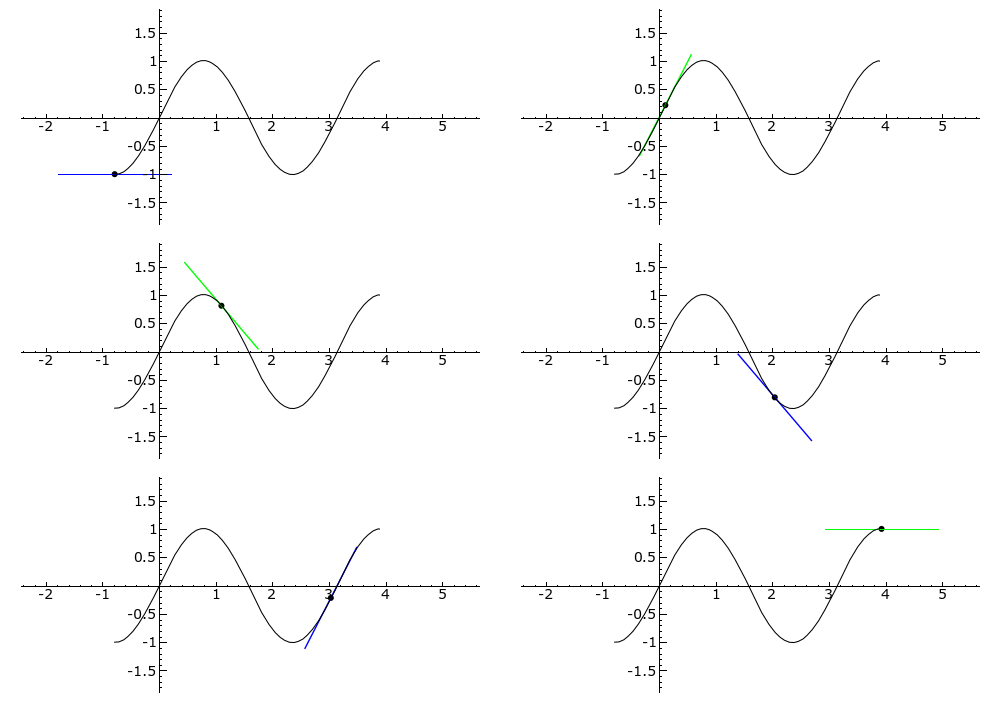
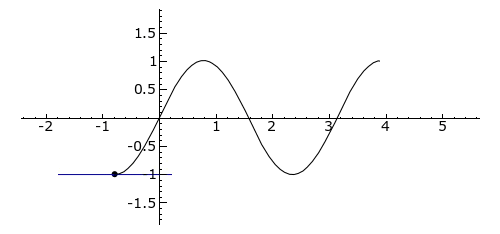
Over the past couple of years, I’ve heard the words “inflection point” used a lot in business. It’s become a bit of a buzzword in some circles. It’s a great little term from the world of calculus. It describes the point at which a curve moves from being concave (downward) to convex (upward), or vice versa. Businesses have adopted the term to describe the point at which a trend (in sales, for example) stops rising and starts declining, or vice versa. The inflection point is the point of change. It’s a change of direction.

I think the term “inflection point” has strong spiritual connotations, as well. God’s Message repeatedly calls people to make a sudden change of direction. Turn from darkness towards the Light. Turn from evil ways and embrace that which is good. Turn away from hatred and pursue Love. Turn from sin and pursue God. Spiritual journeys are all about inflection points.

In today’s chapter, the walls of Jerusalem have been rebuilt. The gates are back in place. As a way of celebrating, Ezra brings out the scrolls with the law of Moses. It’s likely that the words of the law of Moses had not been widely read or heard publicly since Jerusalem and Solomon’s temple had been destroyed some 150 years earlier. Many who lived in Jerusalem may never have heard it. Perhaps no one in their families had heard it since the days of their great-great grandparents.

The reading of God’s story and the law of Moses becomes a spiritual inflection point. The people realize how far they have spiritually wandered away from God’s path. They weep. They grieve. Their hearts turn towards God.

I love the response of the Levites to the people. “Don’t grieve. Feast. This is a moment of joy!” I can’t help but think of the prodigal son returning to his father in humility and shame, and the father’s contrasting expression of joy. That’s the way spiritual inflection points work. They are a moment when grief and turn to joy.

This morning I’m thinking about all of the different metaphorical ways the term “inflection point” applies to life. I’m thinking about the inflection points I’ve experienced, both positively and negatively. Fiscal inflection points, relational inflection points, vocational inflection points, and spiritual inflection points. I’m meditating on the inflection points that still need to occur in my spiritual journey. Followers of Jesus often talk about their conversion as the inflection point of their life. While I certainly look back on that moment as monumental, I’ve found that following Jesus is a never ending series of inflection points. I don’t mature or progress unless I experience them.

Inflection point. Good words.