Tag Archives: Apostles

Paul & the Prisoners of Rome

Paul & the Prisoners of Rome (CaD 1 Cor 4) Wayfarer

We work hard with our own hands. When we are cursed, we bless; when we are persecuted, we endure it; when we are slandered, we answer kindly. We have become the scum of the earth, the garbage of the world—right up to this moment.
1 Corinthians 4:12-13 (NIV)

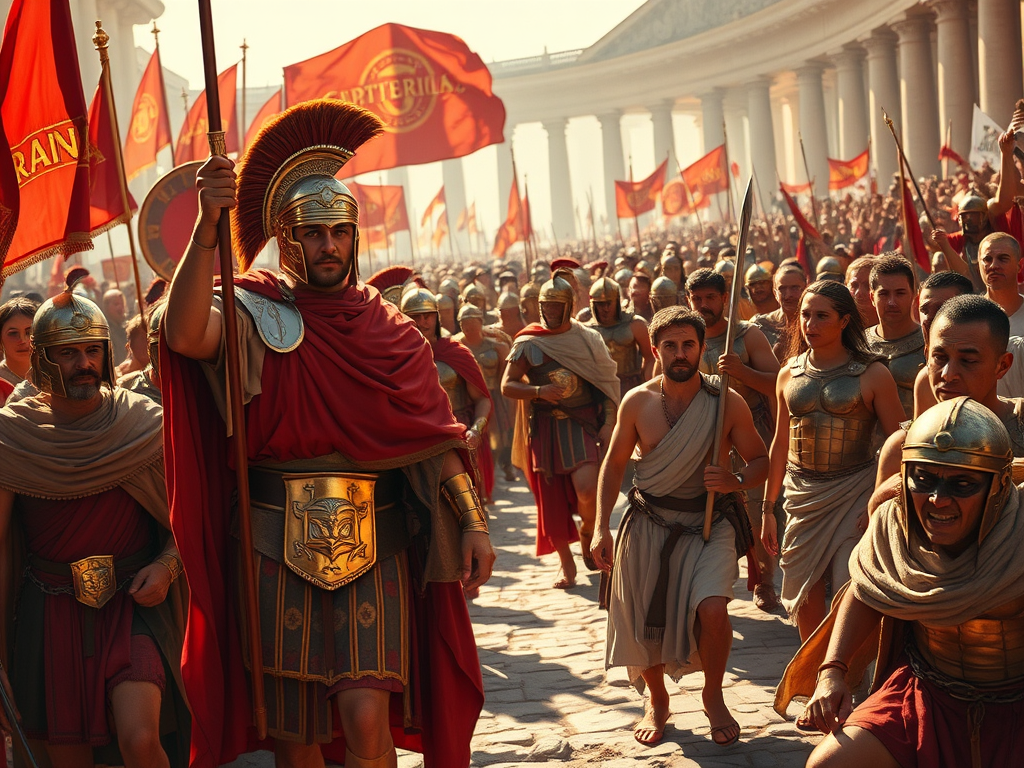
In ancient Rome, successful military conquests and campaigns ended with a triumphant homecoming parade. It was spectacle on a grand scale and the crowds loved it. The victorious general would lead his legion through the streets with their banners flying while the masses lined the streets and cheered.

Of course, every parade has to end, and in this case, at the end of the Roman victory parade were the prisoners of war, chained, beaten, and condemned. What a sharp contrast to the glorious, polished and pompous army who had just inspired and energized the adoring crowd. The prisoners provided the Roman masses with the opportunity to gloat in Roman greatness and bask in schadenfreude at their worthless enemies. The prisoners could be mocked, jeered, and pelted with whatever rocks or refuse was available along the street. In many cases, they’d already suffered abuse at the hands of their captors. They’d been ill-treated and marched for hundreds of miles against their will.

Ultimately, these prisoners would be marched to the Roman arena where, to the delight of the Roman crowds, they would face a horrific death. Among the most popular with the Roman masses was watching people getting ravaged and eaten by packs of wild beasts who had been starved in preparation for the occasion. But that wasn’t enough. The Romans would build contraptions that gave prisoners a false hope of being able to climb and escape from the beasts, but they were rigged to fall apart or fail, giving the crowds a little extra entertainment.

In yesterday’s post, I wrote about our human penchant for turning leaders into celebrities. In today’s chapter, Paul turns that entire notion on its head. He compares himself, and his fellow apostles to one of Roman prisoners being drug through the streets at the end of the parade. And, it wasn’t total hyperbole. When you study the persecution, punishment, and injustice that Paul and his fellow apostles endured, it’s both astounding and gut-wrenching.

Which makes his attitude even more amazing to me. “When we are cursed, we bless; when we are persecuted, we endure it; when we are slandered, we answer kindly.” Which, is not only what Jesus taught, but what Jesus exemplified as He was bound, beaten, mocked, and unjustly executed in a horrific way.

The struggle, of course, is to even connect with these realities here in my 21st century reality. I live in the most affluent country in the world in arguably the greatest time to be alive in human history. So, what am I supposed to take away from Paul’s reality and example?

First, I’m taking perspective with me into this day. I can list every single trouble, worry, or anxiety I might be feeling and then consider a Roman prisoner-of-war’s reality, Paul’s reality, and Jesus’ reality. Talk about a reality check. What am I complaining about?

Second, even in my own rather comfortable realities, I can think of specific instances of people being unkind towards me, unjustly accusing me of things, and using their power or influence against me. What’s my response?

Anger, vengeance, retribution, playing the victim card?

Or, like Paul, do I bless, endure, and answer kindly?

That, is a reminder I need every day.

If you know anyone who might be encouraged by today’s post, please share.

These chapter-a-day blog posts are also available via podcast on all major podcast platforms including Apple, Google, and Spotify! Simply go to your podcast platform and search for “Wayfarer Tom Vander Well.” If it’s not on your platform, please let me know!

Growing Things Change

Growing Things Change (CaD Acts 6) Wayfarer

In those days when the number of disciples was increasing, the Hellenistic Jews among them complained against the Hebraic Jews because their widows were being overlooked in the daily distribution of food.

Opposition arose, however, from members of the Synagogue of the Freedmen (as it was called)—Jews of Cyrene and Alexandria as well as the provinces of Cilicia and Asia—who began to argue with Stephen.
Acts 6:1,9 (NIV)

I saw a funny meme the other day of a father holding his three-month-old baby. The baby had doubled in weight in the three months since birth. At this rate of growth, the father calculated, the kid would weigh trillions of pounds by the time it was ten years old.

Healthy things grow…
Growing things change…
Change challenges me…
Challenge leads me to trust God…
Trusting God leads to obedience…
Obedience leads to health…
Healthy things grow…

A friend shared this with me many years ago, and I know that I have referenced it at least once before (After blogging for 17 years, I’m bound to repeat a few things!). I have always loved this little mantra because I have experienced it to be true in my life, and I have observed it to be true in both others and in healthy and growing human systems.

The early Jesus Movement was an organic, growing human system. In the first six chapters of Acts, Luke references the growing number of believers five times. At the beginning of the book, Luke records the number of believers right after Jesus’ ascension as about 120. In chapter 4, Luke numbers the believers at 5,000. He’s mentioned rapid growth twice since mentioning the 5,000.

Growing things change…

Having been a leader in a number of different systems and organizations along my life journey, I can only imagine the changes required by the Apostles to accommodate the rapid pace of growth. It was not only a change in numbers, but in geography too. Many of the first believers on the day of Pentecost in the second chapter were from all over the known world. In today’s chapter, Stephen is sharing Jesus’ teaching with a synagogue outside the Temple. The cozy little group of early believers sharing all things in common wouldn’t have been cozy for long.

Change challenges me…

Luke records the first challenges faced by the growing Movement in today’s chapter. There is a challenge from within in the form of anger between ethnic factions within the Movement. There were also challenges from without in the form of false accusations made against them to the Temple rulers who had already persecuted the Apostles.

Challenge leads me to trust God…

Luke also records in today’s chapter that the Apostles appointed more men to help with the daily duties the Movement had established for caring for the daily needs of its members. The needs of the system are expanding, and with it the system has to distribute responsibilities to more members of the system. This, in itself, requires trust not only in the members taking on the responsibilities but also in God to provide for and enable a rapidly growing organism.

In the quiet this morning, my meditation on the changes in the early Jesus Movement has me thinking about change in general. Life never stops changing. I’m facing some life changes right now, in fact. This means there will always be challenges. How I handle the change is, I believe, a barometer of my spiritual health. I can follow the path of trust and obedience to greater levels of spiritual health and growth, or I can follow the path of anger, resentment, complaint, and depression which becomes an unhealthy cycle for me and everyone around me.

Lord, help me trust and obey that I might spiritually grow with every challenge.

If you know anyone who might be encouraged by today’s post, please share.

The Unknown Disciples

The Unknown Disciples (CaD Acts 1) Wayfarer

“Therefore it is necessary to choose one of the men who have been with us the whole time the Lord Jesus was living among us, beginning from John’s baptism to the time when Jesus was taken up from us. For one of these must become a witness with us of his resurrection.”
Acts 1:21-22 (NIV)

Over the centuries, followers of Jesus in many different varieties have adopted certain texts that are regularly used in corporate gatherings. One of them is known as the Apostle’s Creed, which is a statement of core beliefs. Among the stated beliefs is that of “the holy catholic Church.” For those of the Protestant persuasion, this statement prompts a lot of head-scratching. “Wait a minute. We’re not Catholic!?”

The word catholic is an adjective meaning “broad or wide-ranging in tastes, interests, or the like; having sympathies with all; broad-minded; liberal.” The Apostles Creed isn’t referring to the institution of the Roman Catholic Church, but rather it is referring to all believers around the globe of every persuasion.

Along my journey, it has been my observation that most believers don’t give this specific belief statement much thought. We tend to think in terms of our particular silo like loyal fans of a particular sports team. We stay in our lane, attend our team’s gatherings, and largely don’t think much about the other teams in our league, let alone in other leagues around the world. Yet, the Great Story ends with a picture of eternity in which there are people of “every tribe and language and people and nation.”

Today we begin our chapter-a-day trek through the Acts of the Apostles or just Acts. It is the history of the early Jesus Movement from Jesus’. resurrection through the first, roughly, thirty years. It is written by Dr. Luke, the same man who investigated and wrote an account of Jesus’ story that we know by his name, Luke. A physician by vocation, Luke became a follower of Jesus whose investigation into the Jesus story led him to become an associate of the Apostles. He eventually traveled with the Apostle Paul, writing some of Acts of the Apostles as an eyewitness account of what happened.

What struck me in Luke’s opening chapter was his mention of just how many followers were around during Jesus’ resurrection and in the earliest days of the Movement. I tend to think just in terms of the eleven disciples (the Twelve, minus Judas) and the Marys who were at the tomb. Luke describes about a hundred and twenty people who were regularly meeting together with Jesus’ disciples after the resurrection. When it came time to fill Judas’ open position in the Twelve, the stipulation was that it had to be a person who had been a follower and member of Jesus’ entourage from His baptism all the way through to His resurrection. There were enough of them that two were appointed who then drew straws.

I contemplated these 120 unnamed, largely forgotten believers. Many of them had been just as faithful in following Jesus throughout His ministry as the Twelve had been. It wasn’t just the Twelve and a few women who interacted with the risen Jesus. In his letter to the believers in Corinth, Paul states the total number of people who witnessed the risen Jesus was around 500 over the 40 days between His resurrection and ascension. Paul even states that most of them were still alive if the Corinthians wanted to corroborate his statement.

In the quiet this morning, I meditated on the fact that relatively few individuals got mentioned and top billing in the history of the Jesus Movement. There was a whole host of unknown, unmentioned followers who had their own personal Jesus story. They were a crucial part of participating in and carrying out Jesus’ mission. It is not unlike the realization of what it means when I say the Apostles Creed and state that I believe in the “holy, catholic Church.” I’m stating that I believe there are fellow believers of different persuasions around the world, but do I really think about them in more than a mental acknowledgment that they exist?

For the past several years, Wendy and I have regularly prayed for a group of orphans being raised in an orphanage on the other side of the world. We have photos and names of each one of the orphans in a little photo album. We pray for them each by name as part of our daily prayers. We support the work that is providing for them. It’s amazing how, over time, our prayers have led to genuine care and concern for them. It’s a small thing, but it’s a tangible way to put action to our belief statement. If I really believe what I say I believe, I want to be both mindful and active in supporting all of the unknown and (to me) anonymous disciples around the world.

If you know anyone who might be encouraged by today’s post, please share.

The Maverick

I want you to know, brothers and sisters, that the gospel I preached is not of human origin. I did not receive it from any man, nor was I taught it; rather, I received it by revelation from Jesus Christ.
Galatians 1:11-12 (NIV)

Note to my regular readers: Our local gathering of Jesus’ followers is  spending most of an entire year (Sep ’18 through Jul ’19) studying the book of Acts (which we just finished blogging through yesterday). In conjunction with this study, I’ve decided to blog our way through all of Paul’s letters in chronological order. The exact chronology is a matter of scholarly debate, so I will be making a few educated guesses myself. We begin with Paul’s letter to the believers in the Asia Minor region of Galatia.

I’ve always had a bit of maverick in me. Maverick is a relatively contemporary word rooted historically in a south Texas lawyer by that name back in the 19th century. Given a herd of cattle as payment of the debt, Maverick the lawyer had no need for the livestock. He left the cattle unbranded and let them roam free. The name soon became synonymous with an “unbranded” individual who likes to blaze their own trails and go their own way.

Being a maverick is one way I find myself really identifying with Paul. I see it all over the place in the opening to his letter to the believers in the region of Galatia in Asia Minor where he’d traveled and established local gatherings of believers on his first mission to the region (Acts 13-14). He begins his letter to the believers there establishing his individual authority apart from the Twelve and James, the brother of Jesus, in Jerusalem.

First, Paul reminds his readers that he received the Message from the risen Christ, not from another human being. The “Apostles” to early believers were those followers of Jesus to whom the risen Christ appeared and commissioned. Paul repeatedly placed himself in this category by stating that the risen Jesus appeared to him on the road to Damascus (Acts 9) and commissioned him to share the Message. The fact that his was a singularly unique appearance and calling made Paul a maverick. While the Twelve eventually embraced Paul and his calling, they also let him do his own thing.

Paul next makes it clear to the believers in Galatia that, after the dramatic events on the road to Damascus, that he didn’t go directly to Jerusalem and present himself to the Twelve. He went off, by himself, to Arabia and then returned to Damascus. The subtext of this claim is that Paul, once again the maverick, did his own thing and went his own way apart from the Twelve.

He goes on to explain that it was three years later before he traveled to Jerusalem and met with Peter and James. The Greek word Paul uses makes it clear that he was met with hospitality. Still, he specifies that it was only Peter and James. He didn’t meet the other eleven apostles.

This morning I’m reminded of the huge paradigm change Jesus introduced to those early believers. For well over a thousand years the Jewish paradigm introduced through Moses had been that “ministry” (I refer to the priestly sacrifices and duties of the tabernacle/temple) had been confined to certain people. Only descendants of Aaron could be priests. Only descendants of Levi could work in the temple. “Ministry” was restricted to the privileged few.

Among the early believers of Jesus everyone (including women, foreigners, youth, slaves, rich, poor, etc.) who believed and received the Holy Spirit received a spiritual gift to use in ministering to everyone else. Everyone was a part of the ministry.

This made way for a maverick like Paul. The Twelve and James were doing the thing Jesus called them to do down in Jerusalem and wherever. Paul had his own calling from Jesus. He blazed his own trail. If the ministry of the temple was confined, the ministry of the Message of Jesus was liberated and unlimited.

Which leads back to me. Somewhere along the line the institutional church decided to once again define and confine “ministry” to a privileged and approved few. But that was never the paradigm. Since the day of Pentecost, Holy Spirit has never been confined. The ministry of Jesus’ love through the gifts of the Spirit is the privilege and calling of every believer, even me. Which, I must admit, stirs my own maverick heart.


Chapter-a-Day Jeremiah 16

Uri at the sea of galilee
Image by yanivba via Flickr

“Now, watch for what comes next: I’m going to assemble a bunch of fishermen.” God’s Decree! “They’ll go fishing for my people and pull them in for judgment.” Jeremiah 16:16 (MSG)

For centuries, those who follow Jesus have followed a yearly calendar that, across the seasons, celebrates Jesus’ birth, ministry, death, resurrection, and ascension. The traditional calendar marks this coming Sunday as remembering Jesus calling his first followers. In a little synchronicity with today’s prophetic chapter in Jeremiah, they happened to be fishermen:

As Jesus was walking beside the Sea of Galilee, he saw two brothers, Simon called Peter and his brother Andrew. They were casting a net into the lake, for they were fishermen. “Come, follow me,” Jesus said, “and I will send you out to fish for people.” At once they left their nets and followed him. Matthew 4:18-19 (NIV)

I grew up fishing, and I know a lot of passionate, amateur anglers. The thing about true fishermen is that they are both patient and tenacious about going after their catch. Isn’t it cool that when Jesus could have chosen academics and students of religion to be his followers, he instead went after rough and hardened blue collar fishermen? He could inspire them with the knowledge they needed, what Jesus was really looking for were followers with the heart and soul required for the tasks that lay ahead.

“Jesus would never want me,” people have told me as they weigh the emotional, relational and spiritual baggage of their own wayward journies.

Yes, actually. Yes, he would.

Enhanced by Zemanta