Tag Archives: Catholic

The Unknown Disciples

The Unknown Disciples (CaD Acts 1) Wayfarer

“Therefore it is necessary to choose one of the men who have been with us the whole time the Lord Jesus was living among us, beginning from John’s baptism to the time when Jesus was taken up from us. For one of these must become a witness with us of his resurrection.”
Acts 1:21-22 (NIV)

Over the centuries, followers of Jesus in many different varieties have adopted certain texts that are regularly used in corporate gatherings. One of them is known as the Apostle’s Creed, which is a statement of core beliefs. Among the stated beliefs is that of “the holy catholic Church.” For those of the Protestant persuasion, this statement prompts a lot of head-scratching. “Wait a minute. We’re not Catholic!?”

The word catholic is an adjective meaning “broad or wide-ranging in tastes, interests, or the like; having sympathies with all; broad-minded; liberal.” The Apostles Creed isn’t referring to the institution of the Roman Catholic Church, but rather it is referring to all believers around the globe of every persuasion.

Along my journey, it has been my observation that most believers don’t give this specific belief statement much thought. We tend to think in terms of our particular silo like loyal fans of a particular sports team. We stay in our lane, attend our team’s gatherings, and largely don’t think much about the other teams in our league, let alone in other leagues around the world. Yet, the Great Story ends with a picture of eternity in which there are people of “every tribe and language and people and nation.”

Today we begin our chapter-a-day trek through the Acts of the Apostles or just Acts. It is the history of the early Jesus Movement from Jesus’. resurrection through the first, roughly, thirty years. It is written by Dr. Luke, the same man who investigated and wrote an account of Jesus’ story that we know by his name, Luke. A physician by vocation, Luke became a follower of Jesus whose investigation into the Jesus story led him to become an associate of the Apostles. He eventually traveled with the Apostle Paul, writing some of Acts of the Apostles as an eyewitness account of what happened.

What struck me in Luke’s opening chapter was his mention of just how many followers were around during Jesus’ resurrection and in the earliest days of the Movement. I tend to think just in terms of the eleven disciples (the Twelve, minus Judas) and the Marys who were at the tomb. Luke describes about a hundred and twenty people who were regularly meeting together with Jesus’ disciples after the resurrection. When it came time to fill Judas’ open position in the Twelve, the stipulation was that it had to be a person who had been a follower and member of Jesus’ entourage from His baptism all the way through to His resurrection. There were enough of them that two were appointed who then drew straws.

I contemplated these 120 unnamed, largely forgotten believers. Many of them had been just as faithful in following Jesus throughout His ministry as the Twelve had been. It wasn’t just the Twelve and a few women who interacted with the risen Jesus. In his letter to the believers in Corinth, Paul states the total number of people who witnessed the risen Jesus was around 500 over the 40 days between His resurrection and ascension. Paul even states that most of them were still alive if the Corinthians wanted to corroborate his statement.

In the quiet this morning, I meditated on the fact that relatively few individuals got mentioned and top billing in the history of the Jesus Movement. There was a whole host of unknown, unmentioned followers who had their own personal Jesus story. They were a crucial part of participating in and carrying out Jesus’ mission. It is not unlike the realization of what it means when I say the Apostles Creed and state that I believe in the “holy, catholic Church.” I’m stating that I believe there are fellow believers of different persuasions around the world, but do I really think about them in more than a mental acknowledgment that they exist?

For the past several years, Wendy and I have regularly prayed for a group of orphans being raised in an orphanage on the other side of the world. We have photos and names of each one of the orphans in a little photo album. We pray for them each by name as part of our daily prayers. We support the work that is providing for them. It’s amazing how, over time, our prayers have led to genuine care and concern for them. It’s a small thing, but it’s a tangible way to put action to our belief statement. If I really believe what I say I believe, I want to be both mindful and active in supporting all of the unknown and (to me) anonymous disciples around the world.

If you know anyone who might be encouraged by today’s post, please share.

Popes & High Priests

Popes & High Priests (CaD Lk 20) Wayfarer

One day as Jesus was teaching the people in the temple courts and proclaiming the good news, the chief priests and the teachers of the law, together with the elders, came up to him. “Tell us by what authority you are doing these things,” they said. “Who gave you this authority?”
Luke 20:1-2 (NIV)

I’ve been fascinated of late reading about the intrigue at the Vatican. The Pope recently defrocked one of the powerful Vatican Cardinals of the Roman Catholic church and accused him of embezzlement. He also met with an American Cardinal and stripped him of his apartment and privileges. Just weeks ago, the Pope fired the entire leadership team of the church’s worldwide charity arm because of a toxic work environment. Sounds like the Pope has his hands full.

I’m not Roman Catholic, but as an amateur historian, I’ve always been fascinated with it. Think about it. The Roman Church is a nation. In fact, it is technically still an empire. The 177 million acres of land it owns around the globe is second only to the British Empire. The Vatican Bank has over 8 billion dollars in assets.

Today’s chapter got me thinking about the Roman Church. Herod’s Temple in Jerusalem was not unlike the Vatican for Roman Catholics. The Hebrew religious system was vast, politically powerful, and rich. Millions visited the temple each year from all over the known world to offer sacrifices and offerings. The temple had its own currency which drove the need for the money changers Jesus famously drove out. The sacrificial system was big business. And, just like the Pope and Cardinals, the temple system had a High Priest and Sanhedrin.

Throughout Jesus’ ministry, He has operated outside of this system. Other than making a few dutiful pilgrimages to Jerusalem in His three years of ministry, His operations were far north of Jerusalem in the region of Galilee. Jesus has no earthly authority. He has no standing. He doesn’t hold a title, sit on any committees, or wear a funny hat. And while His ministry certainly gained popularity for performing miracles no one had ever seen, He was also popular for not being what the corporate religious system of His day had become.

There are three main characters at this point in the story of Jesus’ final week. There’s Jesus, the leadership of the Hebrew political and religious system, and the crowds. Twice in today’s chapter, Luke states that the power brokers of the temple and Hebrew religious system were afraid of the crowds. Their public approval ratings weren’t high, and Jesus’ constant criticism of them was a threat to them. If Jesus incited a riot it would unleash the wrath of Rome to quell the mob and keep the peace. That would cramp both their political power and their flow of revenue. When religion becomes big business, it becomes just another kingdom of this world with all the corruption and intrigue that comes with it. Just ask the Pope.

In the quiet this morning, I find myself attracted to the way Jesus’ model of living, teaching, and loving stands in such stark contrast to the corporate religious system that killed Him to protect itself. It was small, personal, and reflected the very things He taught. That’s what attracts me just as it attracted the crowds of everyday people who followed him. As a disciple of Jesus, I have this increasing desire to mold my own faith, life, and ministry in the same model. I want to carry out His mission in small and personal ways. The further I have progressed in my spiritual journey, the more comfortable I’ve become working outside of corporate religious systems.

I enter today with a heart’s desire to love the people I will interact with today well, and a heart full of gratitude that I’m not the Pope.

If you know anyone who might be encouraged by today’s post, please share.

Truth & Wackiness

Truth & Wackiness (CaD Col 2) Wayfarer

Therefore do not let anyone judge you by what you eat or drink, or with regard to a religious festival, a New Moon celebration or a Sabbath day.
Colossians 2:16 (NIV)

I have been something of a denominational nomad during my faith journey. The ancient Apostle’s Creed says “I believe in the holy catholic church” which confuses a lot of modern believers. They get it confused with the Roman Catholic tradition. The word “catholic” means “broad, universal, comprehensive.” In other words, the “church” is not contained by one denomination or tradition. I’ve always embraced this belief. Thus, rather than play for one team, I’ve been a bit of a free agent. I feel at home in many different denominational traditions, even though I may not agree 100% with the jots and tittles of their particular doctrinal statements.

Along my spiritual journey, I’ve encountered a number of individuals and groups that hold what I consider to be wacky beliefs. There are the Pentecostals who equate “speaking in tongues” with spiritual elitism (“You don’t have to speak in tongues, but why go Greyhound when you could fly first class?”). I’ve never had to work hard to find all kind of legalism that still exists around the Sabbath (“You can go outside and play catch, but don’t you dare play an actual game!”). I have a friend whose parent refused to attend their wedding unless they were baptized three times. Silly.

I find it fascinating that Christianity began as a spiritual movement. Jesus did not fret too much about structure. Twelve marginally capable men and a handful of dutifully faithful women were directed with little detail to spread Jesus’ love and teaching to the ends of the earth. Peter was given a leadership role, but no real job description. It wasn’t an organization as much as it was an organism.

As the Jesus movement spread, the reality is that there were a number of wacky beliefs that emerged in various locations. Paul’s letter to the followers of Jesus in Colossae was specifically written to address some of these. Paul doesn’t name any specifics. It’s likely that it wasn’t a single, organized false teaching but rather a loose number of strange things different individuals were spouting. What Paul does make clear to the believers in Colossae is that they were to hold fast to the simplicity of Jesus’ core teaching:

So then, just as you received Christ Jesus as Lord, continue to live your lives in him, rooted and built up in him, strengthened in the faith as you were taught, and overflowing with thankfulness.

In the quiet this morning, I am prepping for a message I have to deliver on Sunday from the book of Revelation. Talk about a book that spawns a wide range of thoughts and beliefs (and, yes, some of them are wacky). I find John’s Revelation is a lot like what Paul was communicating to the believers in Colossae. One can get spiritually distracted by all sorts of things. For the Colossians it was dietary restrictions, Sabbath regulations, and New Moon festivals. In John’s vision it’s beasts and horsemen and plagues. As I get to the core of it, however, the vision is about one thing: Jesus Christ is Lord. Paul was telling the Colossians to ignore the wackiness stay focused on that.

I’ve always found that to be a good plan.

I’ll stick with that.

If you know anyone who might be encouraged by today’s post, please share.

Non-Essential Liberty

Be careful, however, that the exercise of your rights does not become a stumbling block to the weak.
1 Corinthians 8:9 (NIV)

The local gathering of Jesus’ followers to which Wendy and I belong has been growing steadily in the years since I began regularly joining for worship and serving in the community. What has been interesting is that the growth is largely coming from other local and regional churches and gatherings who have been slowly fading and even shutting down. The result is that among our community of believers we have a growing, yet increasingly diverse, population who bring with them a host of different traditions, beliefs, customs, and worship practices.

What I’ve observed among the leadership and staff of our community is that the attitude has not been a black and white “This is our way and we don’t do it your way” type of attitude. Rather, I’ve observed an open attitude asking “What can we learn from the richness of all these other traditions?” The result has been a fascinating and unique experience. A traditionally “mainline” church operating in the gifts of the Holy Spirit typically found in gatherings labeled “Charismatic” or “Pentecostal.” A contemporary-style worship service that incorporates pieces of ancient liturgy and generally follows the ancient church calendar. A gathering that most casual observers would label “modern evangelical” and yet during the week many in our community pray the ancient, Divine Hours. During Lent you’ll find members of our community journeying through the Stations of the Cross. The whole thing has been less “either, or” and more “both, and.”

As I read today’s chapter this morning it struck me that Paul wrote to a fledgling gathering of believers in Corinth who were experiencing their own melting pot of diverse backgrounds and belief systems. The Christian faith came out of a typically rigid, black-and-white religious system of Judaism. Yet in Corinth there would have been believers who had come from pagan backgrounds and  knew nothing of Judaic traditions or beliefs. There would have been intellectual Greeks who were mostly steeped in philosophy and had little practical understanding of any religion. The result was a clash among the local gathering of Corinthian believers. Good Jews were horrified at the notion that the meat on their table may have been once sacrificed in a pagan temple. The former pagans and those who weren’t raised in the Jewish tradition couldn’t quite understand why, on Earth, it was that big of a deal.

Paul’s wisdom was the adoption of a “both, and” spirit rooted in Jesus’ law of love. Those who rolled their eyes at fellow believers from Jewish tradition (who couldn’t handle the idea of meat sacrificed to idols) were to respect their brothers and sisters who were. If the Abrahams are coming over for dinner do the hospitable thing and keep it kosher. Those of Jewish tradition were to respect that not everyone was raised in their life-long, black-and-white religious traditions. It’s not the same for them. Take off the Jr. Holy Spirit badge. Let it go. Take one for the team. Love one another in the diversity of our consciences and convictions.

I believe St. Augustine nicely summed up what Paul was getting at a few centuries later: “In essentials unity. In non-essentials liberty. In all things charity (i.e. love).” Whether or not you care that your rib-eye had been butchered in the Temple of Apollo is a matter of individual conscience. It’s a non-essential. Love and respect those believers in your midst who come from different backgrounds and may not believe the same way you do.

This morning I’m grateful for the diverse group of believers with whom Wendy and I regularly worship. From the “frozen chosen” believers from mainline backgrounds to the former Roman Catholics and all the different forms of baggage they carry to the Charismatics who spiritually bring in da noise and da funk. I admittedly don’t always understand, nor fully appreciate where they’re all coming from. We just shrug our shoulders, keep an open mind and spirit, and love, love, love, love, love. When it comes to stuff like this I always want to live, learn, love, and operate in “non-essential liberty.”

Worship Like You’re Drunk at 9 a.m.

“These people are not drunk, as you suppose. It’s only nine in the morning!”
Acts 2:15 (NIV)

I grew up in a very traditional church paradigm for a midwest American Protestant. I, and my family, were expected to dress in our “Sunday best.” Every part of the church routine was carefully planned and orchestrated. The service had a certain pageantry to it. You kept quiet. You sat up straight in the unpadded wooden pew. You stood when you were told to stand. You sang the verses you were told to sing when you were told to sing them. You sat quietly and listened. It was all very proper.

In the nearly forty years I’ve been a follower of Jesus I have worshipped in a veritable plethora of environments across cultures and denominations. Catholic and Protestant, mainline and charismatic, traditional and non-traditional, I’ve had a lot of different experiences. I’ve worshipped in a poor mountain village on Mindanao in the Philippines where chickens scurried around the dirt floor and a dog wandered in to flop to sleep under the rickety table that served as an altar where I was preaching. I’ve worshiped in silence with Quakers and in the raucous call and response of an African-American congregation. I’ve worshipped at St. Patrick’s in Dublin, the National Synagogue in Jerusalem, and with a handful of Arab believers in Nazareth.

I’ve always held an expansive view of worship. There are always things I can learn from different cultures and traditions. I have, however, made a few observations along the way.

I believe that between the Reformation and the Enlightenment, Protestants by-and-large disembodied worship. The Reformation did away with physical gestures like genuflection and kneeling. The Enlightenment convinced us that our brains were the center of the worship experience, embellished by a couple of instances of standing, singing, and maybe a recitation.

Please don’t hear what I’m not saying. I don’t think the worship paradigm in which I was raised was wrong, but perhaps I’d describe it as purposefully limited. In my perpetual journey through God’s Message I find that the call to praise and worship is always physically active with repeated encouragements to shout, lift hands, dance, sing, clap, play instruments, lift banners and the like. I have yet to come across an exhortation in the Bible asking me to praise God with my hands in my pockets, to praise God with mumbling, or to rejoice in passive sitting.

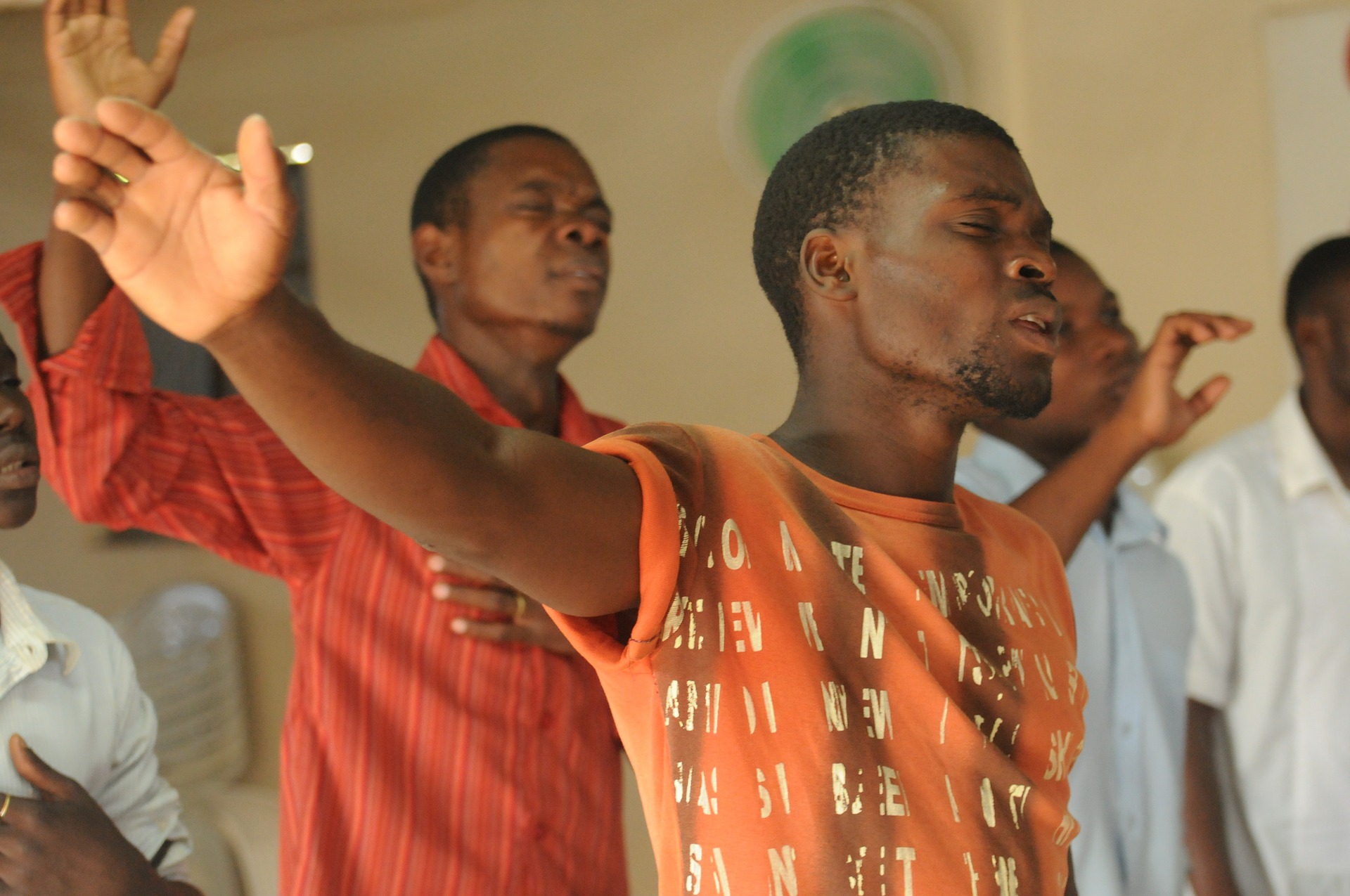
I’ve also observed, both in scriptural descriptions and in my own experiences, that when Holy Spirit pours out on a group of people at worship things can get a little weird. In today’s chapter, casual observers thought Peter and the boys were drunk at 9:00 in the morning. When King David was worshipping in the Spirit his wife became pissed off at how publicly “undignified” he was acting.

This morning I’m enjoying dusting off some old memories of diverse worship experiences in which I’ve participated. I’m also reminded by the events of Pentecost in today’s chapter that I can’t think of one description of Holy Spirit outpouring that is described as a quiet affair of public propriety. When the religious leaders chastised Jesus’ followers for their raucous outpouring of praise, Jesus replied, “If they were silenced then the rocks would cry out.”

The further I get in my journey, the less I care about what anyone else thinks. I’ll take an outpouring of Holy Spirit anytime. I’ll worship like I’m drunk at 9:00 in the morning.


“There are No Wrong Notes.”

Jazz musician Miles Davis.
Jazz musician Miles Davis. (Photo credit: Wikipedia)

Shout to the Lord, all the earth;
    break out in praise and sing for joy!
 Sing your praise to the Lord with the harp,
    with the harp and melodious song,
with trumpets and the sound of the ram’s horn.
    Make a joyful symphony before the Lord, the King!
Psalm 98:4-6 (NLT)

I’ve experienced a lot of different styles of worship throughout my journey. I grew up as kid growing up in a liturgical Methodist church. I dressed up in choir robes and entered the sanctuary in a long processional with the pastor and the adult choir. I sang choral music accompanied by a pipe organ or piano. The evangelical church I went to after that had slick, professional, popular sounding music. My Quaker friends were a quiet group, allowing plenty of silence to “center” ourselves. Whenever I get to attend a Catholic mass I’m totally blown away by the metaphorical depth and meaning of the ritual. The Presbyterians I worshiped with reminded me of my childhood experiences in a good way. I’ve attended worship services with my Pentecostal friends that, in comparison, felt like a three ring circus.

When reading the psalms you can never completely divorce yourself from the fact that this is a volume of lyrics meant for ancient worship. Along the journey I’m constantly running into people caught up in what is “right” or “wrong” about the way this group or that group expresses themselves in worship. Maybe I’m in the minority, but I’m reminded this morning of a quote by the great jazz trumpeter, Miles Davis: “There are no wrong notes.”

My many and varied experiences have taught me that there’s benefit to the smorgasbord of worship styles you’ll encounter across the panacea of churches and groups. You may prefer this or that from the options laid out for you, but taking a bite from something you’ve never had before just might surprise you in a good way.

As I read the above lyric this morning I thought of all of my experiences in churches where “worship” was synonymous with words like: quiet, silent, and respectful. Dude, if you’re following the prescription for worship laid out in Psalm 98 it is NOT going to be quiet and peaceful. Shouting, trumpets and a ram’s horn?

Seriously. It’s gonna get loud. I’m just saying.

Chapter-a-Day Acts 11

from Shayan via Flickr

And since God gave these Gentiles the same gift he gave us when we believed in the Lord Jesus Christ, who was I to stand in God’s way?” Acts 11:17 (NLT)

We can scarce understand what momentous paradigm shift Peter and the early believers experienced in the events chronicled in the past few chapters. It was deep, profound social unrest. The walls the Jews had built up between themselves and the non-Jews (Gentiles) through the centuries were tall and thick and seemingly impenetrable. As Jews, the 12 apostles of Jesus were comfortable keeping Jesus’ work and teaching within the clearly defined boundaries of the Jewish law and culture. As had happened so many times in the three years of Jesus’ public ministry, God had other plans; Plans that would obliterate their own personal agendas.

Peter walking into Cornelius’ house and ministering to him and his family is not unlike a southern Ku Klux Klan member in 1930s America walking into an African American’s home for a meal. It’s like an Irish Catholic walking into a Protestant’s home in Northern Ireland and embracing them. It was radical and it was sure to reverberate through the young Christian community with conflict, dissent, and boisterous protest. And, it was clearly the work of God.

As the arguments rose in crescendo, Peter asked the crucial question: “Who was I to stand in God’s way?”

Throughout my life journey I’ve witnessed God doing the inexplicable, and I have stood in the center of the resulting maelstrom of vehement disbelief, anger, and dissent. I have run into individuals and groups who want to dictate what God will do, when He will do it, and how He will go about doing it. They want God to fit nicely inside the box of their own design and cultural or denominational comfort zone. I have watched people stretch and twist God’s own Word to defend and justify their prejudiced views. Like Peter, I have even been guilty of it myself.

Increasingly I find myself desperately desiring that God’s will, not mine, be done. The only boundaries I desire to place on God are those that God Himself has ordained and set in place. I want God to have free reign in my heart, my life, my home, and my community. God forbid that I should ever stand in the way of what He is doing, but grant that I may free fall into it.