Tag Archives: 1 Peter 4

Fiery Ordeals

Dear friends, do not be surprised at the fiery ordeal that has come on you to test you, as though something strange were happening to you.
1 Peter 4:12 (NIV)

Wendy and I have been reading a growing number of articles in the morning that chronicle individuals who have been singled-out and persecuted for failing to march lock-step with the prevailing dogma of whatever group is in control. In one article we read this week, a woman and her husband moved their entire family from one part of the country to another because of the way they’d been blackballed by entire social groups to which they’d been blissfully a part of for decades.

This is not a one-sided phenomenon. It’s happening on both sides of the political spectrum. It’s happening in politics, religion, business, and academia. What I am observing — and at times personally experiencing — in our current social landscape is a return of social ostracism as a form of punishment.

None of this is new. It is as old as human empire itself. If Peter were to pay us a visit, he would say, “Welcome to the club.”

In the Roman Empire of Peter’s day, social standing was everything. It was an adult version of high school on steroids. If you accepted Roman culture and went with the flow every little thing was going to be alright. If you failed to participate, if you hinted at not accepting the prevailing Roman rites, religions, and cultural norms – you would quickly find yourself on the outs in all sorts of ways.

It is exactly what Peter’s audience was experiencing. When a person, or an entire household became followers of Jesus, they no longer joined the drunken, sexually permissive festival culture. They stopped participating in sacrifices to local gods. They refused to honor the imperial cult (e.g. the Emperor is a god). They withdrew from trade guild feasts that involved offerings to idols.

Believers were therefore seen as suspicious, held in contempt. Colleagues unfollowed them on Roman LinkedIn. Their membership at Roman Rotary was revoked. The neighborhood moms’ club made it obvious they were not welcome.

Not only that, but suddenly believers were held with suspicion and became the subject of outrageous rumors in their neighborhood and social circles. They were labeled atheists (because they rejected visible gods). They were accused of cannibalism (the sacrament of Communion misunderstood). They were suspected of sedition (refusal to call Caesar “Lord”).

It gets even more intimate. If a member of a Roman household became a believer, the ostracism and suffering began in the home. A wife, a child, a servant, or a slave who became a believer in a socially entrenched Roman household could expect domestic violence, expulsion from the household, loss of inheritance, and social severing.

This is the situation that Peter is addressing in his letter. When Peter writes of a “fiery ordeal,” he is not reaching for poetic flourish. Fire is already licking at the edges of their world.

On the surface, Peter is speaking directly to the social suffering I’ve just described.

He is also prophetic. Because in a short time the city of Rome will experience a tragic and catastrophic fire. Emperor Nero will scapegoat and blame the fire on Christians.

The types of suffering Peter’s audience are experiencing is only going to get worse. Rome will unleash a brutal campaign against the Jesus Movement. Believers will be tossed into arenas to be torn apart by wild animals for Roman entertainment. Christians will be impaled alive, covered in pitch, and become living torches at the Emperor’s garden parties. They will be rounded up and executed in mass crucifixions.

It is likely that Peter himself was crucified in the “fiery” persecution he prophetically foreshadows in today’s chapter.

I find my heart focused on two things as I meditate on these things in the quiet this morning.

The first focus is placing the current realities I experience and read about in proper historical context. The rising pressures, sufferings, and persecutions that Peter’s audience was experiencing was personally more devastating. The physical threat far greater. One of the reasons that I love history is that it provides a necessary contextual mirror. If I think I have truly experienced suffering, I need to slip my feet into the sandals of a first-century Roman slave who informs his owner that he is now a follower of Jesus and will no longer swear that the Emperor is a god and bow down in loyalty to him.

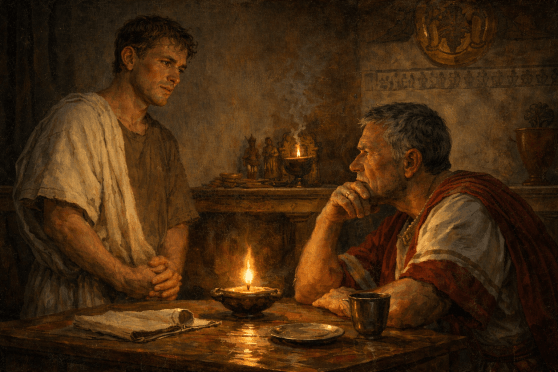
Imagine the quiet in that room. The oil lamp flickering. The master staring. The slave’s voice steady but trembling.

The second focus of my meditations is that context alone does not alleviate the sting of what some have experienced and suffered of late. Peter’s counsel still lands:

  • Don’t be surprised.
  • Don’t retaliate.
  • Don’t be ashamed.
  • Entrust myself to Jesus who is faithful, and who suffered for me.

As I head into the weekend, I find myself deeply grateful for the relatively safe, free, and peaceful life I enjoy each day. It is more safe, free, and peaceful than the vast majority of human beings experienced in all of human history.

I am also mindful of Peter’s prophetic foreshadowing. There’s no guarantee things on this earth will get better. The Great Story, and Jesus Himself, made clear that things will get worse in the final chapters.

But we’re not there yet. And so, I will enjoy my weekend with gratitude — and open with hands.

If you know anyone who might be encouraged by today’s post, please share.

Promotional graphic for Tom Vander Well's Wayfarer blog and podcast, featuring icons of various podcast platforms with a photo of Tom Vander Well.
These chapter-a-day blog posts are also available via podcast on all major podcast platforms including Apple, Google, and Spotify! Simply go to your podcast platform and search for “Wayfarer Tom Vander Well.” If it’s not on your platform, please let me know!
An orange icon featuring an open book outline.

The Mystery of Uncertainty

Since we are approaching the end of all things, be intentional, purposeful, and self-controlled so that you can be given to prayer.
1 Peter 4:7 (TPT)

Wendy and I had the joy of hosting a houseful of her family this past weekend. It was fun to have Wendy’s grandmother over and to surround her with loved ones she doesn’t get to see very often. Grandma is in her nineties and still living independently here in town.

I remember my own grandfather who lived well into his nineties. I have observed that there’s a particular reality that people go through at that age. There’s a loneliness that sets in when most everyone they knew as contemporaries are gone. With it, there is a questioning of why they are still on this Earth.

As I was among my local gathering of Jesus’ followers yesterday morning I happened to note those who have gone through the agony of having children die.

Those who wonder why they are still here, and those who wonder why that had to bury a child before their young lives even got started. Welcome to the mystery.

In today’s chapter, Peter tells the followers of Jesus scattered and living in exile that the end of all things was near. This was something that the early believers wholeheartedly believed. Despite the fact that Jesus Himself said that no one knew when He would return, the early believers assumed it could be any minute, and urged Jesus’ followers to live as if it could be any minute.

Along my life journey, I have observed that believers of almost every generation I’ve lived with have been convinced that Jesus’ return and the end of all things were near. As an amateur historian, I’ve learned that believers throughout history have been convinced of the same.

Theologians call it “the imminent return of Christ.” In other words, it could happen at any moment, and I do believe that. I also believe that Jesus was right when He told His followers that the exact time of the end times would remain a mystery. That means that it is also very possible that those of my generation will be like Peter and those of every subsequent generation who was convinced they would live and die believing they’d see the events of John’s Revelation take place in person.

In the same way, I have also observed that this earthly journey is both fragile and mysterious. While the average person expects to live to the average age, every day the journey ends for individuals far sooner than anyone expected. This is also part of the mystery.

In the quiet this morning, I find myself coming to one spiritual conclusion from these mysteries of the unknown future: Let the uncertainty of tomorrow inform the way I approach today.

As Jesus put it:

“Give your entire attention to what God is doing right now, and don’t get worked up about what may or may not happen tomorrow. God will help you deal with whatever hard things come up when the time comes.”

And so, I enter another day. Have a good one, my friend.

Called Still Deeper

Above all, love each other deeply, because love covers over a multitude of sins. 1 Peter 4:8 (NIV)

I have a confession to make this morning. I’ve been aggravated recently with a particular relational scar. It’s a past injury. Call it near ancient history. I forgave. We moved on and our paths led different places in life. It’s easy to forget past injuries when you don’t really have to continue in relationship with the person you’ve forgiven. Now,  years later I look to the horizon and our paths appear to once again be converging.

My scar itches.

I was struck this morning by Peter’s command, not just to love but to love deeply. And the reason for the call to this deep love is forgiveness. Forgiveness is a tough one, and Jesus certainly addressed it head on. Peter knew this only too well, because it was his question that prompted Jesus to address the matter:

At that point Peter got up the nerve to ask, “Master, how many times do I forgive a brother or sister who hurts me? Seven?”

Jesus replied, “Seven! Hardly. Try seventy times seven.

“The kingdom of God is like a king who decided to square accounts with his servants. As he got under way, one servant was brought before him who had run up a debt of a hundred thousand dollars. He couldn’t pay up, so the king ordered the man, along with his wife, children, and goods, to be auctioned off at the slave market.

“The poor wretch threw himself at the king’s feet and begged, ‘Give me a chance and I’ll pay it all back.’ Touched by his plea, the king let him off, erasing the debt.

“The servant was no sooner out of the room when he came upon one of his fellow servants who owed him ten dollars. He seized him by the throat and demanded, ‘Pay up. Now!’

“The poor wretch threw himself down and begged, ‘Give me a chance and I’ll pay it all back.’ But he wouldn’t do it. He had him arrested and put in jail until the debt was paid. When the other servants saw this going on, they were outraged and brought a detailed report to the king.

“The king summoned the man and said, ‘You evil servant! I forgave your entire debt when you begged me for mercy. Shouldn’t you be compelled to be merciful to your fellow servant who asked for mercy?’ The king was furious and put the screws to the man until he paid back his entire debt. And that’s exactly what my Father in heaven is going to do to each one of you who doesn’t forgive unconditionally anyone who asks for mercy.”

Ironic that Peter would ask about forgiveness when it would be he who three times denied that he even knew Jesus, who heard the rooster crow, who looked into the eyes of his Lord at that very moment and experienced the need of seventy-times-seven forgiveness. Peter knows all about deep love and forgiveness.

Some other words of Jesus come to mind this morning as I ponder:

“You’re familiar with the old written law, ‘Love your friend,’ and its unwritten companion, ‘Hate your enemy.’ I’m challenging that. I’m telling you to love your enemies. Let them bring out the best in you, not the worst. When someone gives you a hard time, respond with the energies of prayer, for then you are working out of your true selves, your God-created selves. This is what God does. He gives his best—the sun to warm and the rain to nourish—to everyone, regardless: the good and bad, the nice and nasty. If all you do is love the lovable, do you expect a bonus? Anybody can do that. If you simply say hello to those who greet you, do you expect a medal? Any run-of-the-mill sinner does that.

“In a word, what I’m saying is, Grow up. You’re kingdom subjects. Now live like it. Live out your God-created identity. Live generously and graciously toward others, the way God lives toward you.”

I sit in the quiet this morning with my itchy scar, and I’m reminded that Jesus command to love others was never just about loving those who are easy for me to love and those with whom I don’t have to be in relationship. Jesus calls me to follow deeper on the path of love. To follow Jesus is to push into the deep waters of Love that He waded into when He forgave my heaping helpings of weakness, foolishness, and failings. That was the whole point of His parable of the indebted servant. I have been forgiven for so much, how can I not forgive another for so much less even if I have to keep forgiving in exponential measure.

I’m seeing myself in Jesus parable this morning. If my love is not deep enough to salve itchy old relational scars of an already forgiven issue in the past then it is, plain and simple, not deep enough.

Today, I’m pushing deeper.

Chapter-a-Day 1 Peter 4

Called & Gifted Workshop
Called & Gifted Workshop (Photo credit: bobosh_t)

God has given each of you a gift from his great variety of spiritual gifts. Use them well to serve one another. Do you have the gift of speaking? Then speak as though God himself were speaking through you. Do you have the gift of helping others? Do it with all the strength and energy that God supplies. Then everything you do will bring glory to God through Jesus Christ. All glory and power to him forever and ever! Amen. 1 Peter 4:10-11 (NLT)

Many years ago I was serving on staff at a local church. A couple in the church had an adult son and his family who had moved back in with them. The son had gone to seminary and had become a pastor. His first church experience was abysmal. The church released him from his service and he could not find another church who wanted to hire him. So, he and the family moved in with mom and dad.

I spent some time with the unemployed young pastor. The church, in an effort to be an encouragement to him, allowed him to fill the pulpit a few Sundays. It quickly became clear to everyone that there was a problem. The young man had an incredible gift for knowledge. He was a tremendous theologian and thinker. He was able to reason through and grasp some of the most complex theological concepts. The problem was, he was socially awkward around people and when he preached it was utterly painful to listen to him. He was convinced, however, that he was going to be a pastor whether he had the personal skill set to do it well or not.

Along the journey I’ve noticed a common trend in fellow believers: We desire to be (or believe we are) gifted in ways we are not. A administrative pastor with no gift for preaching insists on subjecting his flock to his poor communication skills. A gifted musician and worship leader insists on preaching an awkward, rambling mini-sermon between each song. While their music ushers in a movement of the Spirit, their attempts at teaching between songs brings the movement of the Spirit to a screeching halt. A person with all sorts of desire and musical ability still can’t sing on key and insists on subjecting the church’s ears to their pitch imperfect strains.

Perhaps it is because our areas of giftedness seem so, well, natural. “I’m not special. I’ve always been good at that. That’s boring. What I’d really like to be is….” I’ve come to recognize this as a subtle form of envy. I really want to preach like he does, sing like she does, have a position of leadership like him, or have her knack for hospitality. It begs the question: Do I really want to glorify God, or am I seeking after what I feel would glorify myself?

The organized church tends to be very focused at helping people discover their spiritual gifts. We have tests and workshops and study guides and books that cover the subject in every way imaginable. What we are not very good at is confronting people who are chasing after ways that they are not gifted and helping direct their focus within the boundaries of their giftedness.

Today, I’m thinking about the young man with the gift of knowledge and theology. I wonder if he continued to chase after what the ways he was not gifted, or if he ever found the path to utilize the gifts God gave him. I hope it is the latter. We are all on our own journey. I pray we each find the road to utilizing the spiritual gifts God gave us.