Tag Archives: Envy

Systemic Dysfunction

[Levite community leaders] came as a group to oppose Moses and Aaron and said to them, “You have gone too far! The whole community is holy, every one of them, and the Lord is with them. Why then do you set yourselves above the Lord’s assembly?”
Numbers 16:3 (NIV)

Albert Einstein once said, “Great spirits have always encountered violent opposition from mediocre minds.”

Along my life journey, I’ve observed a few things that have been true in both business and churches.

  1. Individuals have different gifts and callings that, when deployed appropriately, benefit the entire system and help it function in a healthy way.
  2. Individuals sometimes desire to be, or firmly believe that they are, gifted or called in ways that they simply are not. These individuals will often attack those who have these gifts, roles, or the power structure of the system in order to make their desires or beliefs be true. This detrimentally undermines the entire system.
  3. Individuals are sometimes placed by leadership to positions and roles that are incongruent with their gifts and callings. Other times circumstances force people into roles for which they are not suited. In either situation, the system will experience strain and will not function at peak health or productivity.

In the books of Exodus and Leviticus God establishes a system in which His fledgling Hebrew community of former slaves is to function. The system establishes order for healthy spiritual, physical, relational, and community function. All the Hebrew people have to do is to obey the rules and contentedly function within the system as it has been established.

However, not everyone is willing to do so.

Two of Aaron’s sons impertinently made light of their priestly duties. Most of the spies, plagued by fear and doubt, lied and exaggerated to enflame the people against entering the Promised Land.

In today’s chapter, a group of Levite leaders rebel against Moses and Aaron. Their motivations and complaints are layered, but what is clear is that they are envious of Moses and Aaron’s leadership, they are discontent with their roles as Levites and want the positions of priests and prophets to which Moses, Aaron, and Aaron’s sons have been called. Their discontent is fueled by the hardships they’ve experienced as well as listening to (and participating in) perpetual grumbling and complaints. Ironically, they also criticize Moses and Aaron for not simply delivering the Promised Land that they themselves refused to enter out of their own fear and doubts. Their envy, jealousy, discontent, and critical spirits have blinded themselves to their own destructive thoughts and behaviors.

God’s solution appears to be purging the system of the dysfunctional and destructive parts. I find it telling that Moses and Aaron humbly plead and act on behalf of the misguided crazymakers in the system. Moses’ attitude and actions are downright Christlike.

In the quiet this morning, I can’t help but think about the businesses, organizations, and churches in which I’ve encountered the very same dysfunctions, envies, jealousies, critical spirits, and self-seeking demands that Moses and Aaron encountered in today’s chapter. These dysfunctions are still with us today because all human systems, just like the Hebrews in the wilderness, continue to function in a fallen world utilizing human beings given to their own sinful pride and self-centered appetites.

Which leaves me with a choice to make. Will I operate, lead, and exemplify the humility and grace Moses demonstrates – and the fruit of God’s Spirit to which Jesus calls me to respond to all people in every situation? Or, will I fall into the trap of human envy, discontent, selfish ambition, and the critical spirit to which they inevitably lead?

A good question to ponder on a Monday morning heading into a new work week. I know what I choose. You?

If you know anyone who might be encouraged by today’s post, please share.

Promotional graphic for Tom Vander Well's Wayfarer blog and podcast, featuring icons of various podcast platforms with a photo of Tom Vander Well.
These chapter-a-day blog posts are also available via podcast on all major podcast platforms including Apple, Google, and Spotify! Simply go to your podcast platform and search for “Wayfarer Tom Vander Well.” If it’s not on your platform, please let me know!
Logo of Bible Gateway featuring an open book icon with text below.

Best of ’24: #5 A Confession

A Confession (CaD Rom 9) Wayfarer

Therefore God has mercy on whom he wants to have mercy, and he hardens whom he wants to harden.
Romans 9:18 (NIV)

A decade or so ago, I found myself in the check-out line in a department store feeling this quiet, internal, seething anger. The source of this anger? Chip and Joanna Gaines. They were everywhere. Wendy and every one of her friends were talking about them. People I know were making pilgrimages to Waco, Texas. Their “collections” were suddenly in every store. There in the checkout line, Joanna was staring at me from the covert of Cosmopolitan. So, what do we do when we get angry these days? We vent on social media!

“I love Chip and Joanna,” I tweeted, “but I’m tired of seeing their faces a million times a day!”

The next day my tweet received a reply from Chip Gaines, himself.

“I know,” he tweeted back, “I told Joanna the other day that even I’m tired of us!”

It wasn’t long after this that I noticed myself feeling that same quiet, internal, seething anger. This time it was an online author and “influencer” who was trending and I started hearing this person’s name come up in conversation all the time. I remember Wendy and her friends talking in our kitchen one day and everyone was talking about what this influencer recently said about this or that topic. I was suddenly filled with anger. I wanted to throw up. I had to leave the room my insides were seething so intensely.

The problem was, I knew that these angry reactions inside of me weren’t healthy. Anger like this always points to something deeper in the Spirit that is askew. I began to dig into what it was that was going on inside of my heart. The answer ended up being simple once I realized it. Suddenly, it dawned on me that I’ve had this anger, these feelings of irritation and animosity, toward certain individuals my entire life. And they were almost all individuals I didn’t know at all!

Here I was a 50-year-old man who had been a disciple of Jesus for almost 40 years and it had taken me that long to realize that I have a problem with envy. The commonality between all of the individuals who produced this latent animosity within me is that they were people who suddenly became famous and everyone was talking about them and being influenced by them. Why them? Why not me? I feel shame in confessing it because it feels so petty. It’s true, however. I have to own it. Over the past several years I’ve had to consciously deal with this very real sin to which I had been blind my entire life.

As I have processed and worked on my envy, I have run headlong into what, in human terms, is an uncomfortable reality: God’s sovereignty.

Jesus told a parable about the owner of a vineyard. Throughout the day the owner finds workers, negotiates a price for their labor for the day, and sends them to work in his vineyard. At the end of the day, the workers who worked all day find out that they’re getting paid the same as the guy who was hired for the final two hours of the day. They are pissed. The owner of the vineyard responds,

‘Friend, I haven’t been unfair. We agreed on the wage of a dollar, didn’t we? So take it and go. I decided to give to the one who came last the same as you. Can’t I do what I want with my own money? Are you going to get stingy because I am generous?’
Matthew 20:13-15 (MSG)

In today’s chapter, Paul addresses the truth of God’s sovereignty. God blessed Jacob, but not his older twin brother Esau. The prodigal wastes all of his father’s money on partying and prostitutes and is given a homecoming party, while the older brother goes seemingly uncelebrated for his faithfulness and obedience. God, in His sovereign purposes, raises one person to prominence while another works in obscurity.

On one hand, I can dismiss these human inequities as simply “life isn’t fair” (and it’s not), but Paul is adding to this another layer of truth that Jesus was addressing in His parable. God is sovereign, and His knowledge and purposes are infinite, while mine are finite. This is where a disciple of Jesus finds the requirement of faith and surrender.

If God is good, and I believe He is. If God has a good purpose for me and my life, and I believe He does. Then I can rest in living the life God has generously and sovereignly purposed for me, this life I am now living, and this path I am now walking. I can also surrender any desire that my path should be like the one anyone else is walking.

In the quiet this morning, I’m thinking about our kitchen. On the counter, right next to the stove, Wendy has placed the Magnolia Cook Book in such a way that Joanna Gaines stares at me every day in my own house. It’s good. It no longer triggers me. It’s a daily reminder for me to pray for Chip and Joanna and all that God is doing in and through their lives. God has been generous to them, and they have a tremendous amount of positive impact in our world. I’m also quite certain that they face struggles and stresses because of that generosity which I wouldn’t want in a million years. In dealing with my envy problem, I’ve embraced that sometimes God’s generosity is in saving us from the things our heart’s desire, but which would lead to tragedies we could never foresee.

If you know anyone who might be encouraged by today’s post, please share.

These chapter-a-day blog posts are also available via podcast on all major podcast platforms including Apple, Google, and Spotify! Simply go to your podcast platform and search for “Wayfarer Tom Vander Well.” If it’s not on your platform, please let me know!

Big Brother Mentality

Big Brother Mentality (CaD Rom 11) Wayfarer

And if by grace, then it cannot be based on works; if it were, grace would no longer be grace.
Romans 11:6 (NIV)

Last week, I gave a message to our local gathering of Jesus’ followers. I kicked off the message by stating that I’ve long had the idea for a book about the things that Christians always get wrong. In that message, I talked about God’s presence. My entire life I’ve listened to people pray for God to “be present” or to “Come to us.” If we really believe what we say we believe, that is the most illogical thing to pray for. If you want to know why, I encourage you to listen to the message because that’s not the subject of today’s post.

One of the other chapters of my proposed book is the subject of today’s post. Along my life journey, I’ve observed that while Christians say we believe that salvation is “by grace through faith,” we still act as if there’s a bit of meritocracy mixed in. I like to think of this kind of thinking as “Grace Plus.” “Yes salvation is by grace through faith, plus if you were really “saved” you wouldn’t [fill in the blank with a behavior that, in your mind, a real Christian wouldn’t exhibit].

In today’s chapter, Paul addresses an implied question in his letter’s argument about salvation being for both the non-Jewish Gentiles as well as the Jewish people: “Has God rejected His people?” I am always amazed at how given we human beings are to binary, either-or, thinking. The Jewish people of Paul’s day were so proud of being “God’s chosen people” that they wanted to maintain exclusivity. Rather than perceiving the inclusion of Gentiles as followers of Jesus as God’s merciful generosity flowing from its Jewish roots, they concluded that God’s love of Gentiles must mean rejection of Israel. This attitude, by the way, is the same as the older brother in the parable of Prodigal Son. Like the father in that parable, Paul explains that God loving the “prodigal” Gentiles and celebrating their homecoming into salvation does not negate His love and purposes for “big brother” Israel. It is not an “either-or” but a “yes-and.”

The “Big Brother” thinking that Paul is addressing with his Jewish brothers and sisters is a form of the same problem that exists with those I observe with “Grace Plus” thinking. It’s a form of self-righteousness that mentally assents to God’s love as gracious and merciful, but at the heart of it still clings to the notion that our good works have some merit in making us more worthy than the dirty sinner.

In the quiet this morning, I find myself thinking of the fruits of the Spirit that Paul lists in his letter to the believers in Galatia. I thought through Big Brother’s reaction to his father’s grace and mercy toward the sinful little brother:

“The older brother became angry and refused to go in. So his father went out and pleaded with him. But he answered his father, ‘Look! All these years I’ve been slaving for you and never disobeyed your orders. Yet you never gave me even a young goat so I could celebrate with my friends. But when this son of yours who has squandered your property with prostitutes comes home, you kill the fattened calf for him!’

Then I tried to determine which of the Fruits of the Spirit he displayed in his reaction:

  • Love
  • Joy
  • Peace
  • Patience
  • Kindness
  • Goodness
  • Faithfulness
  • Gentleness
  • Self-Control

How about the Prodigal’s father? Yeah, Pops was exemplifying them all.

As a child of God, I want to have my Father’s heart which is gracious, merciful, generous, and truly loving. This means, however, that I have to surrender all of my meritocratic notions. God’s generous and gracious love for others does not diminish His love for me, it just means there’s more love to go around than I ever thought possible.

If you know anyone who might be encouraged by today’s post, please share.

A Confession

A Confession (CaD Rom 9) Wayfarer

Therefore God has mercy on whom he wants to have mercy, and he hardens whom he wants to harden.
Romans 9:18 (NIV)

A decade or so ago, I found myself in the check-out line in a department store feeling this quiet, internal, seething anger. The source of this anger? Chip and Joanna Gaines. They were everywhere. Wendy and every one of her friends were talking about them. People I know were making pilgrimages to Waco, Texas. Their “collections” were suddenly in every store. There in the checkout line, Joanna was staring at me from the covert of Cosmopolitan. So, what do we do when we get angry these days? We vent on social media!

“I love Chip and Joanna,” I tweeted, “but I’m tired of seeing their faces a million times a day!”

The next day my tweet received a reply from Chip Gaines, himself.

“I know,” he tweeted back, “I told Joanna the other day that even I’m tired of us!”

It wasn’t long after this that I noticed myself feeling that same quiet, internal, seething anger. This time it was an online author and “influencer” who was trending and I started hearing this person’s name come up in conversation all the time. I remember Wendy and her friends talking in our kitchen one day and everyone was talking about what this influencer recently said about this or that topic. I was suddenly filled with anger. I wanted to throw up. I had to leave the room my insides were seething so intensely.

The problem was, I knew that these angry reactions inside of me weren’t healthy. Anger like this always points to something deeper in the Spirit that is askew. I began to dig into what it was that was going on inside of my heart. The answer ended up being simple once I realized it. Suddenly, it dawned on me that I’ve had this anger, these feelings of irritation and animosity, toward certain individuals my entire life. And they were almost all individuals I didn’t know at all!

Here I was a 50-year-old man who had been a disciple of Jesus for almost 40 years and it had taken me that long to realize that I have a problem with envy. The commonality between all of the individuals who produced this latent animosity within me is that they were people who suddenly became famous and everyone was talking about them and being influenced by them. Why them? Why not me? I feel shame in confessing it because it feels so petty. It’s true, however. I have to own it. Over the past several years I’ve had to consciously deal with this very real sin to which I had been blind my entire life.

As I have processed and worked on my envy, I have run headlong into what, in human terms, is an uncomfortable reality: God’s sovereignty.

Jesus told a parable about the owner of a vineyard. Throughout the day the owner finds workers, negotiates a price for their labor for the day, and sends them to work in his vineyard. At the end of the day, the workers who worked all day find out that they’re getting paid the same as the guy who was hired for the final two hours of the day. They are pissed. The owner of the vineyard responds,

‘Friend, I haven’t been unfair. We agreed on the wage of a dollar, didn’t we? So take it and go. I decided to give to the one who came last the same as you. Can’t I do what I want with my own money? Are you going to get stingy because I am generous?’
Matthew 20:13-15 (MSG)

In today’s chapter, Paul addresses the truth of God’s sovereignty. God blessed Jacob, but not his older twin brother Esau. The prodigal wastes all of his father’s money on partying and prostitutes and is given a homecoming party, while the older brother goes seemingly uncelebrated for his faithfulness and obedience. God, in His sovereign purposes, raises one person to prominence while another works in obscurity.

On one hand, I can dismiss these human inequities as simply “life isn’t fair” (and it’s not), but Paul is adding to this another layer of truth that Jesus was addressing in His parable. God is sovereign, and His knowledge and purposes are infinite, while mine are finite. This is where a disciple of Jesus finds the requirement of faith and surrender.

If God is good, and I believe He is. If God has a good purpose for me and my life, and I believe He does. Then I can rest in living the life God has generously and sovereignly purposed for me, this life I am now living, and this path I am now walking. I can also surrender any desire that my path should be like the one anyone else is walking.

In the quiet this morning, I’m thinking about our kitchen. On the counter, right next to the stove, Wendy has placed the Magnolia Cook Book in such a way that Joanna Gaines stares at me every day in my own house. It’s good. It no longer triggers me. It’s a daily reminder for me to pray for Chip and Joanna and all that God is doing in and through their lives. God has been generous to them, and they have a tremendous amount of positive impact in our world. I’m also quite certain that they face struggles and stresses because of that generosity which I wouldn’t want in a million years. In dealing with my envy problem, I’ve embraced that sometimes God’s generosity is in saving us from the things our heart’s desire, but which would lead to tragedies we could never foresee.

If you know anyone who might be encouraged by today’s post, please share.

Silent and Deadly

Silent and Deadly (CaD Gal 5) Wayfarer

Let us not become conceited, provoking and envying each other.
Galatians 5:26 (NIV)

There are mornings on this chapter-a-day journey when I experience synchronicity. Something in the chapter dovetails perfectly with something else that I’ve read, seen, or considered in the recent past. It happened this morning with regard to a commencement address published in the Free Press by Robert Parham, an Assistant Professor at the University of Virginia’s McIntire School of Commerce. Entitled, “To the Class of 2024: You are All Diseased,” it is well worth the few minutes it will take to read it in its entirety.

The following section, in particular, caught my attention:

You live in the wealthiest country in the history of the world, yet you feel economic anxiety. The late Charlie Munger summarized it succinctly: “The world is not driven by greed. It’s driven by envy.” And in this era of instantaneous communication networks and social media, envy has been put into hyperdrive.

But envy has also been transformed and rebranded. Once a deadly sin, it became a virtue. We call it “fairness” (or sometimes “equity”) now and concentrate our attention on all the ways the world is “unfair.” Mostly the ways that lead to others in our peer group having more than us.

The world is unfair. Deeply so. It’s just that you’re the lucky ones. You won the birth lottery.

In today’s chapter, envy makes the list of “works of the flesh” that stand in opposition to the “fruits of the Spirit” that should be increasingly evident in the lives of every follower of Jesus. Envy makes the list along with things like sexual immorality, orgies, witchcraft, and drunkenness. Along my life journey, I’ve observed that it’s much easier for the institutional church to hone in on the ugly, scandalous, and often public sins like being an addict, sexually immoral, or a member of the local Wiccan coven. Envy is a “pretty” sin that gets both overlooked and ignored. I don’t remember one lesson or sermon in 40 years that took a good look at how destructive envy can be to both our spiritual health and our very lives.

If you’ve had your head buried in the sand somewhere, it should be noted that we are living in a culture with epidemic mental health issues in children and young adults. Drug overdoses, suicides, anxiety, and depression have increased to epidemic proportions. Researcher Jonathan Haidt traces this epidemic back to the introduction of the iPhone with a front-facing camera and an app called Instagram. Suddenly, everyone is taking selfies and publicly sharing their lives with the masses hoping to get “likes,” comparing themselves to others, and wanting to become “influencers.” It’s all driven by envy. We don’t compare ourselves to the billions of human beings who would love to live in our affluent sneakers. We compare ourselves to those few who have more than us: more likes, more fame, more followers, more money, more fashionable clothes, more prestige, more influence, prettier homes, cuter kids, etc.

I think we’re overdue in giving envy the attention it deserves. It is destroying the spiritual and mental health of an entire generation. The institutional church is silent on the subject.

I confess to you that one of the reasons that this topic resonates so deeply within me is because I have always struggled with envy. I didn’t even realize it until I started to really dig into my own flaws and weaknesses as an adult. One of the things I recognized in myself was the fact that I would feel intense antipathy, even hatred, towards certain people. In most cases, it was people I didn’t even know personally. As I confessed this and began digging into why I had these intensely negative feelings towards people I didn’t even know (and were probably really nice people), I realized that underneath it was envy. I wanted to experience the fame, influence, popularity, and prosperity these individuals had experienced. It was silly. It was nonsense. I feel awkward even admitting it, but it’s the truth. I had to repent of my attitude and address the envy that had crept into my heart and brain, silently influencing me for years without me recognizing it.

In the quiet this morning, I find myself grateful for the abundant blessings I enjoy every moment of every day without even thinking about it or stopping to recognize how good I have it. I am reminded of the unhealthy ways envy affected my life without me even recognizing it. I am motivated to continue to reduce the influence that the “works of the flesh” had in my life and increase the “fruits of the Spirit” in my motivations, my thoughts, my words, and my actions.

If you know anyone who might be encouraged by today’s post, please share.

“What’s it to You?”

"What's it to You?" (CaD John 21) Wayfarer

When Peter saw [John], he asked [Jesus], “Lord, what about him?”
John 21:21 (NIV)

I grew up fishing with my dad, though I never acquired his love for it. I am too impatient, and was especially so when I was a kid. As a young man, both my body and imagination were too active to sit in a boat for hours waiting for fish to bite. Nevertheless, I do have great memories of doing so.

There is one day in particular that stands out. I was around eleven and Dad and I were fishing on the Canadian side of the boundary waters. We fished a couple of coves on an island we’d never fished before. Oh man, the fish were definitely biting that day. It was unlike anything I’d experienced fishing. It felt like every cast of my Johnson’s Sprite pulled in a fish. In a couple of hours we had our limit, including two or three of the largest fish we’d ever landed. And, we’d thrown a lot of them back. I’ll never forget that day.

I think of that day whenever I read about one of the miraculous catches Jesus facilitated, as in the one in today’s chapter. Jesus told the disciples to go to Galilee and wait for Him there. So they did. And, they waited, and waited, and waited, until Peter couldn’t handle waiting and decided to go fishing. All night they fished, and didn’t catch so much as a minnow. Then the dude on the shore frying up some breakfast yells out to try the right side of the boat. “Voilà!” Suddenly there’s 153 lunkers in the net and the net is too heavy to pull into the boat! I remember that shot of adrenaline and the rush of dopamine flooding through my brain that day dad and I had our big catch.

The boys know in the moment that it’s Jesus on shore cooking breakfast. Peter abandons the boys with the net, dives in, and swims to shore (Did he, perhaps, think for a faction of a second of trying to walk to Jesus on the water?).

John chooses to end his biography with one of the most interesting conversations recorded in the Great Story. Jesus asks Peter to go for a walk, and John follows. Three times Jesus asks Peter, “Do you love me?” and three times he commissions Peter to “Feed my sheep.” Peter probably didn’t even understand what Jesus was doing in that moment.

Three affirmations cover the three denials Peter uttered the night of Jesus’ arrest. “Leave your shame behind, Rocky. The Good Shepherd is heading home. You’re the shepherd in charge now.” Jesus then tells Peter to plan on a rough end to his earthly journey. He will be forcefully taken where he doesn’t want to go. He will be stretched out. As the appointed shepherd, they will crucify him, too.

Then Peter does something so human. He looks over at John and asks Jesus, “What about him?”

Along my life journey, I’ve observed that we humans have a thing with equity and fairness. I love the idyllic fantasies of everything working out the same for everyone. I so easily fall down the rabbit-hole of envy and jealousy cleverly disguised as political and social righteousness. I so easily grieve when looking over at the grass that appears so much greener on another person’s lot in life.

As a follower of Jesus, I’ve had to submit to the reality that my notions of equity and fairness are not part of the Kingdom economy. That’s why Jesus responds to Peter, “What’s it to you if I have different plans for John? We’re not talking about him, we’re talking about you, Peter. You each have a part to play in this Great Story but the roles are different, your lives and experiences will be different, and your deaths will be different. Peter, you’ll die about thirty years before him. The Romans are going to crucify you. John will live to old age, be exiled to an island, and pen the visions given to him of the final chapters of the Great Story. What’s it to you?”

One of the most important lessons I’ve learned as a follower of Jesus is that my focus is to be on God’s Kingdom, even on this earthly journey. Not checking-out and biding my time, but rather bringing a Kingdom perspective and mission to all that I am, think, say, and do. Jesus said to “set my heart on things above,” which means my earthly perspective has to change.

Like Peter, I have a journey to walk and a mission to accomplish, but I’ve had to let go of the notion that everyone’s journey looks like mine, or that my mission is going to look exactly like someone else’s. My father was beautifully and wonderfully made to be a gifted accountant, artisan, and patient fisherman. I’m not anything like that, so what’s it to me if dad’s journey looks different than mine, or mine looks different than his?

The good news, Jesus promised, is an equitable eternal homecoming where there is no more sorrow, or pain, or envy, or jealousy. Until then, like Peter, I’m called to contentedly walk my own journey and allow others to walk theirs, even if it appears to me that their journey is better, or easier, or more fun, or [place your favorite envy descriptor here]. I have come to believe that when I look back from eternity, I will see how wrong our human perceptions were with regard to what a “good” life looked like on this world, and also believe my eyes will be opened see all the “good” I experienced but never really saw or appreciated.

If you know anyone who might be encouraged by today’s post, please share.

My Core Weakness

My Core Weakness (CaD Jer 45) Wayfarer

“Should you then seek great things for yourself? Do not seek them. For I will bring disaster on all people, declares the Lord, but wherever you go I will let you escape with your life.’”
Jeremiah 45:5 (NIV)

One of the things I’ve experienced as an Enneagram coach is that it’s is common for people, upon reviewing their Enneagram Type, to say, “I don’t want that to be my Type!” In fact, there have been people I’ve encountered who insisted on mistyping themselves, whether consciously or unconsciously, because they were uncomfortable with embracing their true selves. This is, I have discovered, sometimes part of the self-discovery journey for people.

Every Enneagram Type has its core fear, core weakness, core desire, and core longing. These may manifest themselves differently in different individuals. As an Enneagram Four, my core desire is to be “special and unique” while my core weakness is the sin of envy. It’s easy for me to feel that others have something special or unique that I lack. Without realizing it, I sometimes feel an intense antagonism toward people I don’t even know that’s rooted in my envy. It’s taken a long time for me to recognize that in myself and address it.

Coming in at only five verses, Jeremiah 45 is one of the shorter chapters in the Great Story, though there are a handful that are even shorter. When the messages of Jeremiah were compiled into what we now know as the book of Jeremiah they were compiled thematically. The final chapters of the book are a kind of appendix. Today’s chapter is a fascinating, personal message that God gave Jeremiah for his friend and faithful scribe Baruch.

I saw shades of myself as I read Baruch’s lament in the quiet this morning. Baruch’s brother occupied an important position in the administration of King Zedekiah. Baruch was Jeremiah’s scribe, writing down the prophets dictated messages and then rewriting them all over again when the king burned the original copies in his anger. Let’s face it, the doom-and-gloom of Jeremiah’s prophetic works are bit repetitive and depressing. Add to that the fact that all of the anger, hatred, and animosity of Jeremiah trickled down to Baruch. When Jeremiah was banned from speaking in public, it was Baruch who got the job of proclaiming the words no one wanted to hear. Baruch sometimes got blamed when an accuser was afraid to confront the prophet himself.

“Why am I stuck doing this my whole life?” I can hear Baruch muttering to himself. “Why didn’t I get a cushy, high-profile job in the King’s administration like my brother?”

Jeremiah hears the muttering of his friend and scribe. God tells Jerry to tell Barry: “Don’t seek great things for yourself. Believe me, your brother’s story is not going to end well, but I will protect you and your life as the scribe of my anointed prophet.”

We don’t know what happened to Baruch’s brother Seraiah, though it was likely either captivity or death. Baruch, on the other hand, was still alive with Jeremiah in Egypt after the fall of Jerusalem.

In the quiet this morning, I confess that it’s always been easy for me to feel a certain level of discontent with my life. I was called specifically to do what I’m doing, and I trust that with all my being. Nevertheless, whenever I go through a tough stretch of the journey, my core desires and core weakness make it hard for me to stay in my lane without some dramatic and pessimistic brooding, and Wendy can tell you that I excel in this.

But that’s where God’s words to Baruch really resonate with me in all my “Fourness.” I can focus on obediently and faithfully fulfilling that to which I’ve been called, or I can waste a lot of time pining away in envy for what others have been called to do. The reality is that I have been and continue to be extremely blessed, and when I focus on that blessing, and the Source of that blessing, then I find contentment is soon to follow.

If you know anyone who might be encouraged by today’s post, please share.

Unmanageable

Unmanageable (CaD 1 Sam 28) Wayfarer

Samuel said, “Why do you consult me, now that the Lord has departed from you and become your enemy? The Lord has done what he predicted through me. The Lord has torn the kingdom out of your hands and given it to one of your neighbors—to David. Because you did not obey the Lord or carry out his fierce wrath against the Amalekites, the Lord has done this to you today.
1 Samuel 28:16-18

“Insanity is doing the same thing over and over again and expecting a different result” is a quote that has been misattributed to Albert Einstein for many years. Etymologists find no evidence of Einstein ever saying the words. It was fascinating for me to learn that the earliest documented uses of the quote are from the Twelve Step group Al-anon, particularly with regard to the second step: “We came to believe that a Power greater than ourselves could restore us to sanity.”

In yesterday’s chapter, I made the case that David’s flight to live among his enemies was prompted by the realization that Saul would never give up trying to kill him. Why? Because multiple times Saul had spoken words of repentance and sworn oaths to do so, and every time he goes right back to doing what he’s sworn he won’t do. It’s just like the insanity of addiction.

If you go to a Twelve Step meeting, you’ll hear stories of lives that have become unmanageable. Individuals speak of addictive insanity that has brought them to the brink of death and lives that have completely self-destructed. That’s where I observe Saul being in today’s chapter, only Saul’s problem is not alcoholism or drug addiction. Saul is addicted to his own pride, greed, and envy.

When the Philistines line up for battle with Saul and his army, Saul becomes afraid. He seeks some word or sign from God of what will happen, but God is silent. Samuel is dead. The high-priest, Abiathar, has joined up with David. Saul has no prophet in his service. In desperation, Saul hires a medium to conjure up the spirit of Samuel even though he knows that such an act is against God’s law. It’s just like when Saul crossed the line and offered sacrifices that only a priest was allowed to make. His fear drives him to cross the line and do what he knows he shouldn’t do, just like he’s always done expecting a different outcome.

Samuel’s spirit does appear and reiterates the very thing he had told Saul before. Saul’s repeated disobedience and his refusal to admit that his own actions have led his life to become unmanageable and to submit to God, who could restore his sanity, his own actions and choices have sealed his fate. He will die in the upcoming battle, and David will succeed him as king just as had been prophesied.

In the quiet this morning, I find myself looking back on my own life journey and the times my life had become unmanageable because of my foolish choices. It’s easy to read Saul’s story and shake my head in judgment, except I can’t. There’s another famous quote that I can make my own: “There, but for the grace of God, goes Tom Vander Well.” Saul is a tragic figure. The best thing about tragedies, even the real ones I hear in a Twelve Step meeting, is that they can help inform my own life and my own choices.

I don’t want to be a Saul. I would rather be a David.

The determining factor is what I choose to do with my own decisions, actions, and words today.

If you know anyone who might be encouraged by today’s post, please share.

The Underdog & the Unprepared

The Underdog & The Unprepared (CaD 1 Sam 22) Wayfarer

“Then David said to Abiathar, “That day, when Doeg the Edomite was there, I knew he would be sure to tell Saul. I am responsible for the death of your whole family. Stay with me; don’t be afraid. The man who wants to kill you is trying to kill me too. You will be safe with me.”
1 Samuel 22:22-23 (NIV)

I’ve always cheered for the underdog. I’m sure that this is wrapped up in my temperament. Throughout my life’s journey, the teams I ended up adopting are teams that never (or rarely) win the big one, the perennial losers, and the “less than” team in big rivalries. Perhaps this penchant for the underdog is the reason that one of my favorite classic tales has always been Robin Hood. I love the lone upstart who cares for the common man and takes on the prejudicial system. There’s a hint of Christ-likeness in the character and the story.

This came to mind this morning as I pondered today’s chapter. The saga of King Saul and to-be King David is, throughout, a story of contrasts. King Saul is on the throne. He has all of the authority and power. He is, however, a horrible leader. Today’s chapter hints at the fact that King Saul has stuffed his administration with friends and cronies from his own tribe, the little tribe of Benjamin. This could not have played well with the other 11 tribes. Instead of being concerned with the welfare of the nation, Saul is slowly descending into a personal, mad obsession to kill young David, who is anointed by God to become his successor.

Saul is an object lesson in a trifecta of deadly sins: pride, envy, and wrath.

David, in contrast, has all the gifts of a strong leader in the making. His courage, humility, and military prowess have made him popular with the people. David, however, has no nobility, social standing, or systemic power. Rather, he’s got a price on his head. The king is myopically focused on killing him. He flees into the wilderness.

David is an object lesson in the forging of a great leader through injustice, suffering, and sore trials.

In the wilderness, hiding first in a cave and then in a forest, today’s chapter states, “All those who were in distress or in debt or discontented gathered around him, and he became their commander. About four hundred men were with him.”

A rag-tag bunch of mercenaries, misfits, and malcontents who have no social standing becomes David’s merry band of followers hiding in the forest. Sound like anyone?

Meanwhile, the mad-king has the high-priest who gave David consecrated bread in yesterday’s chapter killed along with his entire family and the entire population of the town where they resided. One son of the High Priest, Abiathar, escapes to David in the forest to tell David what has happened.

What does David do?

He takes personal responsibility for the slaughter: “That day, when Doeg the Edomite was there, I knew he would be sure to tell Saul. I am responsible for the death of your whole family.”

He treats the young priest Abiathar with kindness, extends to him peace, and shows him loving hospitality: “Stay with me; don’t be afraid. The man who wants to kill you is trying to kill me too. You will be safe with me.”

Looks like Robin just got his Friar Tuck. 😉

Some people are thrust into leadership unprepared, like Saul. Without the requisite character qualities for learning quickly on the job, the position becomes a trap that brings out the worst in a person.

Some people become leaders through experience and trial, like David. All references to Robin and his merry band aside, David is not having fun. It is during this period of hiding that David wrote the lyrics to Psalm 142:

Listen to my cry,
    for I am in desperate need;
rescue me from those who pursue me,
    for they are too strong for me.
Set me free from my prison,
    that I may praise your name.
Then the righteous will gather about me
    because of your goodness to me.

As I ponder these contrasting individuals, my underdog spirit whispers: “Forge me, Lord, into the person you want me to be. Amen.”

If you know anyone who might be encouraged by today’s post, please share.

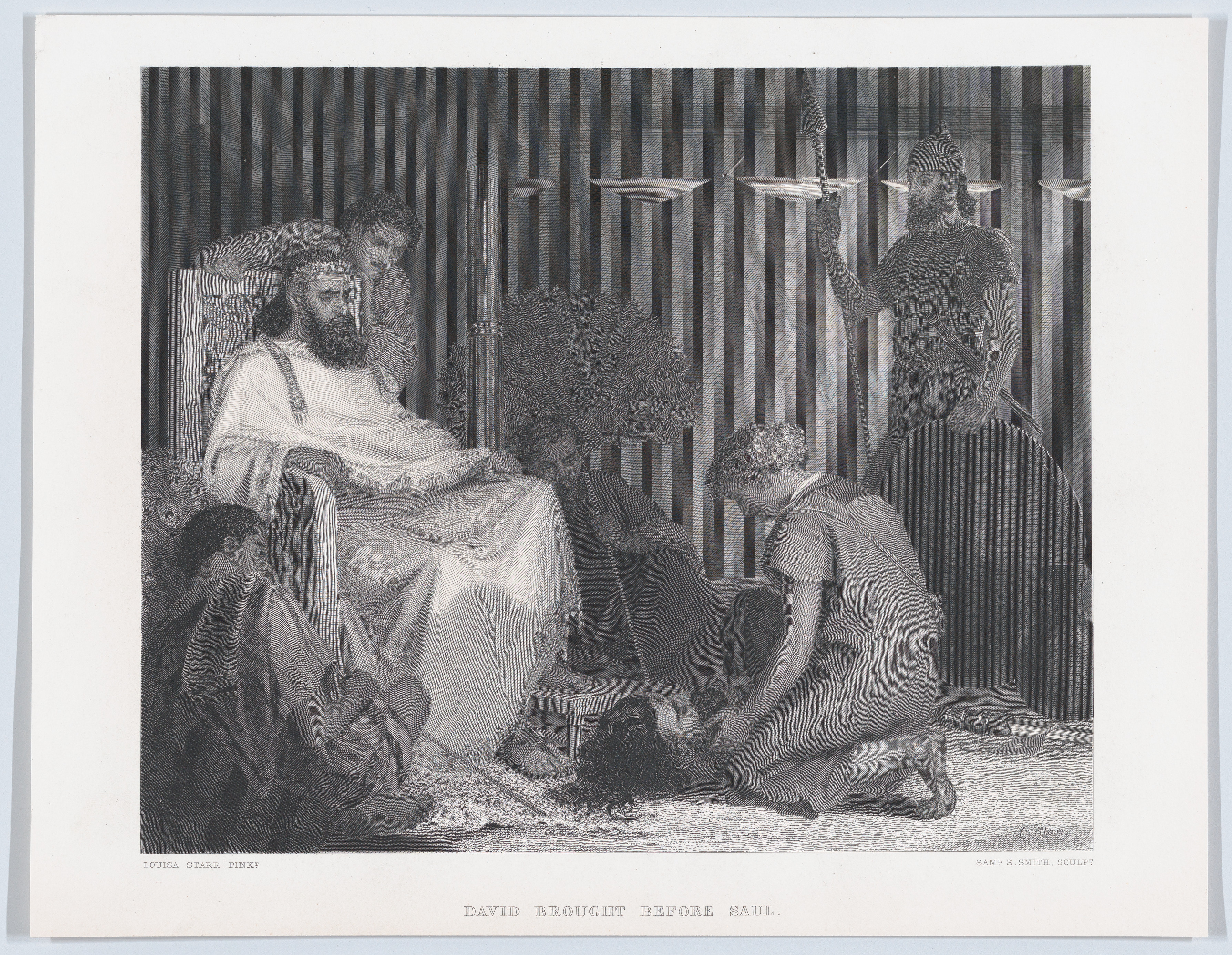
The Tragedy of Saul

The Tragedy of Saul (CaD 1 Sam 18) Wayfarer

When Saul realized that the Lord was with David and that his daughter Michal loved David, Saul became still more afraid of him, and he remained his enemy the rest of his days.
1 Samuel 18:28-29 (NIV)

The history of theatre traces its roots back to ancient Greece. The stories that the Greeks adapted for the stage were typically comedies or tragedies. Even Shakespeare’s plays are categorized as comedy, tragedy, or history. The iconic comedy and tragedy masks continue to symbolize the theatre to this day.

In all of the Great Story, Saul may arguably be the most tragic figure. Given the opportunity of a lifetime, his ego, pride, and envy lead him on an ongoing, downward spiral as he becomes obsessed with his anointed rival, David.

In today’s chapter, the author of 1 Samuel documents the stark contrast between David and Saul. David is humble and successful in everything he does. He’s a successful warrior, musician, leader, and lover. Five times in today’s chapter the author reminds us of David’s success and God’s favor towards him. Six times in today’s chapter, the author documents Saul’s anger, jealousy, envy, and rage.

To make matters worse, Saul appears to heed The Godfather’s advice: “Keep your friends close, and your enemies closer.” He intertwines his life with David to the extent that he can’t escape. David is always there. David is his minstrel. David is one of his best military officers. David is his son’s best friend. Jonathan treats David like a brother. David is the husband of his daughter. Michal is in love with the guy. Every decision Saul makes assures his self-destruction, while every decision David makes solidifies his success to Saul’s envious chagrin.

Along my life journey, I’ve observed individuals whose lives appear to be an echo of Saul’s. Their lives are one ongoing series of tragedies, the fruit of their own foolishness and cyclical poor choices. I’ve also observed those whose lives appear to be charmed like David. They succeed at everything they do and appear blessed in every way. In contrast, they appear to make routinely wise choices and enjoy a general sense of favor.

In the quiet this morning, there were two things that struck me as I meditated on the contrasting characters of Saul and David. First, I’ve learned along my spiritual journey that I have a nasty envious streak. Not surprisingly, it is the core weakness of an Enneagram Type Four (that’s me). It took me years to see the fulness of it in myself. I’m still in process of learning how to address it in a healthy way. So, I have to confess that I identify with Saul more than I care to admit.

The second thing that struck me is simply the cyclical and systemic pattern of Saul’s decline and David’s rise. The text states that God’s favor was with David and not with Saul, so there’s a spiritual component to it, but there is also the fact that Saul continuously made poor choices that ensured his failure, while David continuously acted with humility and made wise decisions. This leads me to consider my own choices – the choices I made yesterday, and the choices I will make today. Where am I making poor choices? Where am I making wise choices? How can I make fewer of the former and more of the latter?

David wasn’t perfect, by any means, but I’d prefer that my story look more like his than Saul’s.

If you know anyone who might be encouraged by today’s post, please share.