Tag Archives: Cross

A Simple Step

Then he said, “Jesus, remember me when you come into your kingdom.”
Luke 23:42 (NIV)

The call came from the hospital — which was odd.

A nurse who worked in the Intensive Care Unit had a patient asking to see me — immediately.

I didn’t know the older gentleman particularly well. I’d had no more than two conversations with him and his wife. Pleasantries. Casual stories. Nothing serious. I hadn’t spoken with them for a couple of years. I hadn’t even been aware that they’d moved out of their life-long residence into a small apartment across from the hospital.

I barely knew them.

As soon as I walked into the ICU and took one look — I knew.

The man was lying on his death bed.

I greeted him warmly — giving him a smile. Fear was in his eyes.

I wasted no time.

“You’re going to die. You know that, don’t you?”

He nodded.

“Are you afraid about what’s going to happen when you die?”

Another nod.

I briefly shared Jesus’ promises of eternal life for anyone who believes — and asked if he’d like me to lead him in a prayer of belief.

A third nod.

By the time we were done with the short prayer, tears were streaming down his face.

“You have to tell my wife,” he said. “Tell her I prayed to receive Jesus in my heart. Tell her she needs to pray, too.”

I agreed that I would.

“Now!” He insisted. “Go right now! Our apartment is across the street. Go there. Don’t wait.”

I walked across the street to the apartment number he gave me.

I shared exactly what had happened. I asked her if she wanted to pray like her husband had. She said she did. I led her in a similar short prayer of faith, and then I left.

The man died that evening.

His wife was discovered dead in their apartment the following morning.

I didn’t really didn’t know their story. I presume, given their ages, that they knew about Jesus. As death drew near they realized something unsettling — They knew about Jesus, but they didn’t know Him.

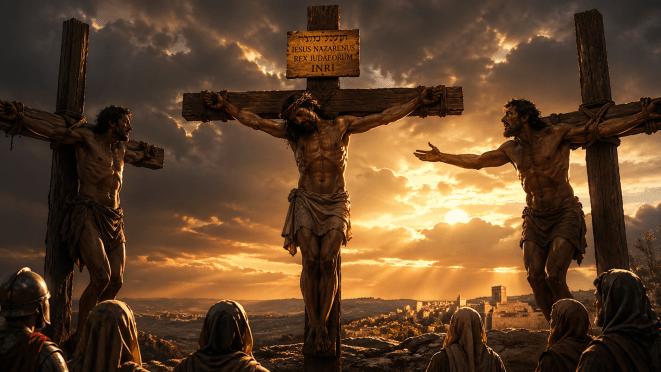
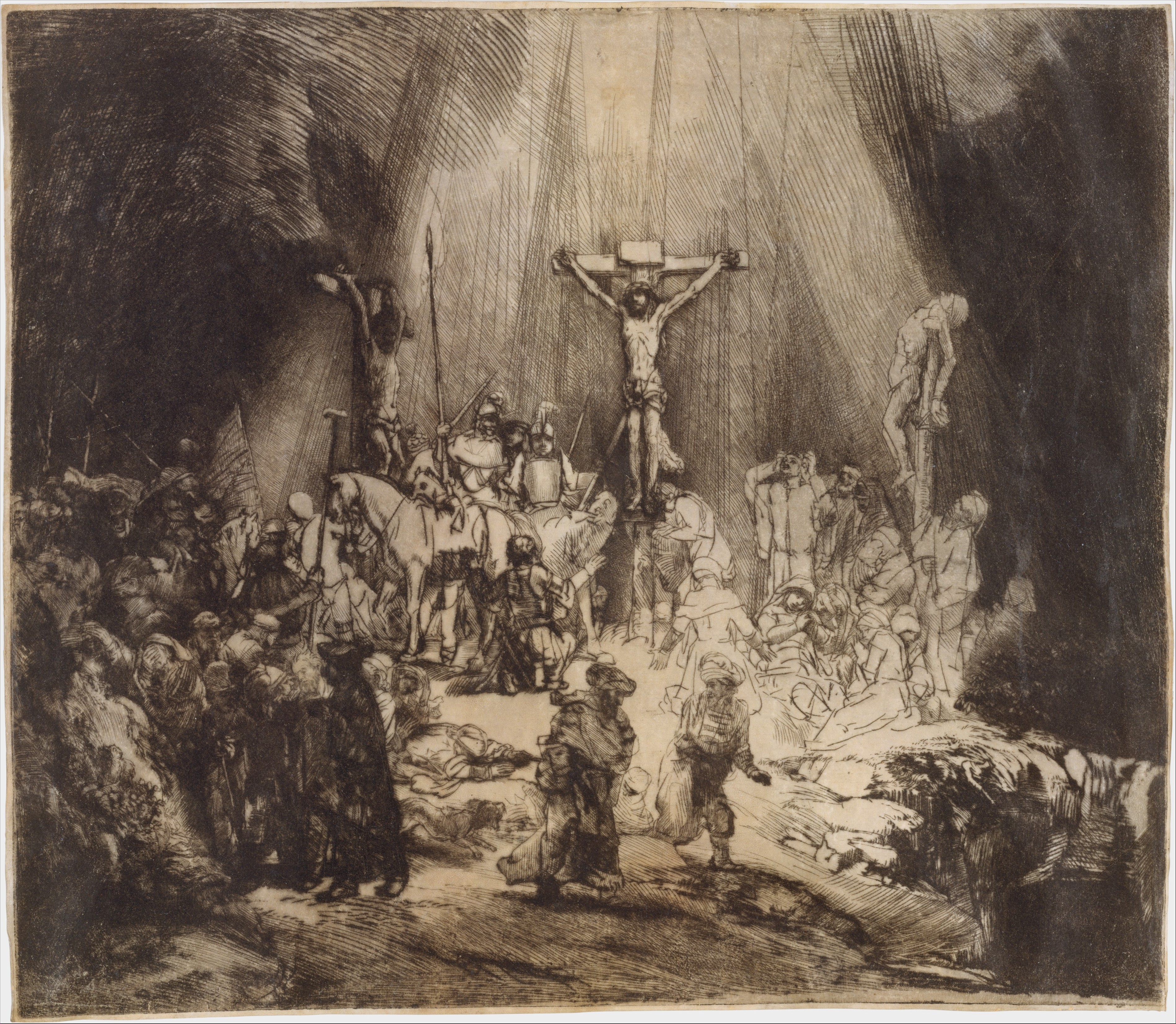
In today’s chapter, Jesus is crucified.

It was the most brutal, humiliating form of execution.

Some victims of crucifixion suffered for days before dying.

Hanging there between heaven and earth affords time for conversation.

Luke describes the conversation between Jesus and the two thieves crucified on either side of Him. As I read the episode this morning, it felt like one of Jesus’ parables come to life.

“Once, there were two thieves crucified for their crimes…”

One had gone all-in to the angry bitterness in his heart.

The other asked Jesus, “Remember me when you come into your Kingdom.”

I spent some time meditating this morning on this simple request.

Somewhere — somehow — he knew enough to ask.

He’d watched Jesus being railroaded by the system.

He saw the simple truth of what was happening.

“I deserve this — but not Him.”

His simple request was an example of Jesus’ proverbial mustard seed of faith.

Small.
Barely there.
But alive.

“I’m guilty for what I’ve done.”
“I deserve to die.”
“But Him? He’s going to His eternal Kingdom.”
“Jesus? Think of me.”

And, in the quiet this morning, it made me think of that call from the hospital. A man and woman who knew about Jesus their entire lives.

Until death came knocking.

Faith is a simple step.

But it’s a step every person has to make for themselves — or not.

Once, there were two thieves
Nailed to the cross for their crimes.
One died as he’d lived.
The other… took a single step.

If you know anyone who might be encouraged by today’s post, please share.

Promotional graphic for Tom Vander Well's Wayfarer blog and podcast, featuring icons of various podcast platforms with a photo of Tom Vander Well.
These chapter-a-day blog posts are also available via podcast on all major podcast platforms including Apple, Google, and Spotify! Simply go to your podcast platform and search for “Wayfarer Tom Vander Well.” If it’s not on your platform, please let me know!
An orange square icon featuring a white open book graphic.

The Need for Struggle

The Need for Struggle (CaD Rom 5) Wayfarer

Not only so, but we also glory in our sufferings, because we know that suffering produces perseverance; perseverance, character; and character, hope.
Romans 5:3-4 (NIV)

Here in the Midwest, there has been a tremendous amount of rain this summer. Entire towns in northwest Iowa are underwater. We know individuals and businesses who have been significantly impacted.

A week ago Wendy and I were preparing to have our entire family with us for two days to celebrate the 4th of July. The day before everyone was scheduled to arrive we had a rainstorm that poured several inches of rain in a short period. Our sump pump couldn’t keep up. Our basement flooded. Suddenly we found ourselves in crisis mode as we scrambled to move things around and find a way to stem the tide. At one point, Wendy looked at me with tears running down her cheeks.

“This is not how I wanted this day to go,” she said.

Indeed.

At the same time, Wendy and I have been walking with multiple families who are in seasons of acute suffering. Not just the momentary pain of a flooded basement kind of suffering. We’re talking about the severe, agonizing circumstances that can rip lives and families apart type of suffering. The circumstances are uniquely different with each of these friends but the life struggles are equally difficult. It’s hard to witness. And, it puts a wet basement into perspective.

Along my life journey, I have observed that our culture struggles with suffering. It’s almost as if we believe no one should ever experience difficulty. We spend a lot of time, energy, and resources trying to avoid or alleviate suffering. There are plenty of televangelists who will promise you that God will provide a life of wealth and blessing if you simply send them a few bucks, and then a few more, and then a few more. And, to my point, many people do.

Wendy and I recently read an article by an expert who addressed the reality that we have a generation of young adults who have been overprotected by parents and a culture obsessed with safety. Now these kids can’t cope with the struggles of everyday adult life.

In today’s chapter, Paul tells the believers in Rome to “glory” in their suffering. This is not an isolated teaching. James wrote the same thing, as did Peter. The goal of being a disciple of Jesus is to follow His example. Jesus Himself said that following Him requires me to carry a cross. The cross was invented to make a person suffer an excruciating death. The bottom line is that spiritual maturity is forged through painful struggle. If there is no pain, there will be no spiritual progress.

In the quiet this morning I’m continuing to pray for our friends in their season of suffering. I’m going to once again reach out to encourage them. One of the things I’ve learned in my own seasons of suffering is that I don’t have to be alone. I have great friends. When I’m suffering, I need those friends the most. When they are suffering, they need me, even if it’s simply making them aware I am present. There are important aspects of maturity that one learns in this life only through struggle. It’s good to have good companions on the journey.

By the way, our basement is back to normal. Our family’s visit was wonderful. In the grand scheme of things, it was a rather minor event. It did teach us, however, that there are some things we need to do to avoid it happening again.

If you know anyone who might be encouraged by today’s post, please share.

Success and Prosperity

Success and Prosperity (CaD 1 Chr 14) Wayfarer

So David’s fame spread throughout every land, and the Lord made all the nations fear him.
1 Chronicles 14:17 (NIV)

When I was a teenager, I spent two years being spiritually mentored. The first thing my mentor had me do was memorize Joshua 1:8, the words Moses gave to his successor, Joshua:

Keep this Book of the Law always on your lips; meditate on it day and night, so that you may be careful to do everything written in it. Then you will be prosperous and successful.

It was the beginning of my fascination with the Great Story and a commitment to reading it, studying it, and applying its principles and lessons to my life. You might say it was the seed that took root and eventually led to these chapter-a-day posts.

Of course, there’s also that promise the verse gives of prosperity and success if one lives according to the Book. Which, I have meditated on long and hard over the years. The promise has been a source of both tension and wisdom.

Today’s chapter is fascinating both for its content and its placement in the Chronicler’s updated history of the Kingdom of ancient Israel. One of the things I’ve learned in my decades of studying the Great Story is that the Hebrews were very deliberate in the structure of their writing. Today’s chapter is a great example.

In the previous chapter, the Chronicler reveals the priority King David placed on his faith in the God of Abraham, Isaac, Jacob, and Moses. He leads a procession bringing the Ark of the Covenant to Jerusalem where a temple will eventually be built for it. However, the Ark is not yet brought into the city. The Ark is left at the house of a man named Obed-Edom for three months. The Chronicler is sure to mention that while the Ark was in Obed-Edom’s home he and his household were blessed.

In the next chapter, the Ark is brought into the city of Jerusalem and David makes it a major event.

So, what happens in the three-month interlude?

The Chronicler tells of God blessing David in every way.

A foreign King makes a treaty with David and builds a palace for him. This shows David’s growing prominence in the region, as well as the respect and fear neighboring Kingdoms have for the powerful David. (verses 1-2)

David is blessed with more wives and children. (verses 3-6)

David, who the Chronicler is sure to mention always inquires of God before engaging in battle, is given major military victories over the Kingdom’s biggest rival. Not only this but when David and his men capture the idols of the Philistines, he dutifully burns them in accordance with the law of Moses. A detail marking David’s obedience to God that Samuel failed to mention. (verses 8-16)

With his structured account of David’s commitment to God and David’s blessed life and reign, the Chronicler is making the same connection that Moses was making with Joshua in the verse that I memorized all those years ago. Make God your priority, live according to His Book, and you will be prosperous and successful. One might say that this is the pre-Christian version of a prosperity gospel. The Chronicler is lifting up David as the example for his people to follow.

In the quiet this morning, I feel the nagging tension that comes with the fact that I regularly observe people making God into a good luck charm and a shortcut to worldly wealth and prosperity. It’s easy to do with the simplistic equation that is given. In my wrestling with this tension over the past 40-plus years, I have made a few conclusions.

First, I believe the promise is genuine. Making God and God’s Word the center of my life has led to success and prosperity for me. But, those words are layered with all sorts of meaning that I don’t believe are intended. God’s ways are not our ways, the prophet Isaiah reminds me. His thoughts are not my thoughts. Prosperity and success in God’s Kingdom does not look like it does for the Kingdoms of this World and people who are focused on this life and worldly things. Exhibit A is God’s own Son who revealed that success at the Kingdom of God level is taking up one’s cross and laying down one’s life for their friend. Prosperity in God’s Kingdom is ultimately an eternal concept, not a temporal one.

Second, living according to God’s Word has benefitted me in so many ways. I have avoided a lot of foolish mistakes because I followed God’s wisdom. I have diminished stress and anxiety with the antidote of faith and hope. I have found joy and contentment in enjoying the blessings I’ve been given rather than the envy and stress of chasing after the blessings of others.

Finally, I have learned that God’s view of “success” and “prosperity” comes at the expense of trials, struggles, tribulations, obstacles, and suffering. The Chronicler is holding up a specific piece of David’s story and an example for his people to respect and follow. However, he does so at the cost of providing context that is essential for wisdom and understanding. Before David was king he was an outcast and branded as an outlaw. David spent years on the run, living as an exile in the desert. The anointing and promise given to little boy David that he would be king would not come to fruition for decades in which his everyday life was a constant struggle for survival.

So, in the quiet this morning I once again find myself back at a place of understanding. Yes, there is success and prosperity in surrendering to Jesus and living my life according to His Word. No, that doesn’t look like success and prosperity as the world defines it, though it may look that way at certain times for certain individuals like King David. It does not, however, change a couple of basic principles that the Great Story gives as necessary context. First, spiritual blessings and maturity in this life are rooted in struggle. Second, this world is not my home. True prosperity is found in eternity.

If you know anyone who might be encouraged by today’s post, please share.

A Bit Part

A Bit Part (CaD LK 23) Wayfarer

Then [the criminal crucified next to Jesus] said, “Jesus, remember me when you come into your kingdom.”
Luke 23:42 (NIV)

When I was young and involved in theatre, like most people I always wanted the starring roles. I’ve been blessed to have gotten lead roles in a number of great shows. As I studied theatre and began to direct shows myself, I was always struck by individuals at auditions who made it clear that if they didn’t get the lead role, they didn’t want to be in the show. As time went on, I found this sentiment increasingly sad.

The more time I spent on stage, the more I began to realize the joy of playing a “bit” part. It requires less time learning lines, which provides more time for playing with the lines, developing the character, and experimenting with the role. I’ve always loved the process of character development. Even with small roles of only a few lines I will do an entire character study and develop a full back story for the character in order to bring that character to life for the audience. There’s a ton of fun to be had in crafting a bit character who “steals the show.” I think the best role, by far, in Hamilton is King George. He’s only on stage for a few brief moments, but he’s stolen the show every time I’ve seen it.

As I read through the Great Story, I find that my theatre experiences lead me to contemplate those who have bit parts in the narrative. In today’s chapter, Jesus is tried, sentenced, crucified, dies, and is buried. There are a host of bit players in the event. There’s the terrorist and murderer who is pardoned instead of Jesus, who had done nothing wrong. There’s the foreigner traveling to Jerusalem who is forced to carry Jesus’ cross. Luke twice references the women who had traveled with Jesus all the way from Galilee and had the courage to witness the crucifixion while most all the male disciples were hiding in fear. And, there’s Joseph, a member of the ruling council who conspired to have Jesus killed now asking for the body of Jesus and placing it in his own tomb.

All of these bit characters have a story to tell, and I can only imagine how compelling those stories might be as they unpacked the events that led them to be there at that moment on that day. I wonder how the events of that day may have changed their lives.

Of all these bit characters, it was the thief crucified next to Jesus who commanded my attention as I meditated on the chapter in the quiet this morning. First, I found it fascinating that he knew enough about Jesus to be convinced of Jesus’ innocence, and he seemed to know what Jesus taught. Was he among the curious crowds who gathered to listen to Jesus in the Temple earlier in the week? Was he convicted of his own blaring mistakes and poor life choices as he listened?

I also found it fascinating that the thief knew Jesus’ teaching enough to acknowledge that Jesus was a King with a Kingdom. Did he overhear Jesus’ conversation with Pilate when Jesus said, “My kingdom is not of this world”? At what point did the thief decide that Jesus was exactly who He said He was?

Finally, I love that the thief owns his own sins and the painful consequences he is experiencing. Shakespeare’s tragic thieving character, Bardolph, comes to mind when he says to Prince Harry, “When thou art King, don’t hang a thief!” The thief on the cross has no such hopes of escaping with a royal pardon. With the eyes of his spirit, the condemned man sees with perfect clarity what is happening at this moment. He and the angry criminal hanging on the other side of Jesus are getting what they deserve. They committed their crimes and they are paying for it. With the same clarity, he sees that Jesus is an innocent man suffering like a lamb being slaughtered.

At that moment, the nameless thief has one request: “Remember me.”

There is something I find so purely humble and gut-wrenching honest in this ask. He accepts his fate and embraces the certainty that he deserves the eternal punishment to which he knows he is headed. I’m reminded of Jesus’ parable of the rich man and the poor beggar Lazarus. The rich man languishes in Hades and looks across the spiritual chasm to see Lazarus in heaven. This is the reality the thief fully expects. He will be in eternal anguish as across the great spiritual divide Jesus takes up His throne in His eternal Kingdom. He accepts this fate.

“Please. Just think of me. That’s all I ask.”

How magnificent, how beautiful, that in this grand, climactic, spiritual moment in the history of all creation, one undeserved, poor thief finds a mustard seed of faith and the grace that flows freely from it.

When, as an actor, I make an entrance to play a bit character on stage, I am that person in that moment. In the quiet this morning, I find myself similarly hanging on my cross next to Jesus. I know my sins. I know what I deserve. I know that Jesus does not deserve what I deserve. In the quiet, it is my soul whispering, “Remember me.”

If you know anyone who might be encouraged by today’s post, please share.

Choosing Humility

Choosing Humility (CaD Lk 14) Wayfarer

“But when you are invited, take the lowest place, so that when your host comes, he will say to you, ‘Friend, move up to a better place.’ Then you will be honored in the presence of all the other guests. For all those who exalt themselves will be humbled, and those who humble themselves will be exalted.”
Luke 14:10-11 (NIV)

Before getting into today’s chapter, a quick update from the Vander Well homefront. As faithful readers know, I love my morning quiet time, and it’s out of that morning quiet that these chapter-a-day posts spring. Just a few nights ago, our daughter and her family moved back to the States from the U.K.. As in, they moved moved…into our house…for the indeterminate future. Ya-Ya and I are so very excited about this. After our grandkids lived an ocean away for five years, we are over the moon to have them just an arm-length away from a cuddle or a hug. However, the empty nest will be a three-generation household for a while with grandchildren whose bodies are still on UK time, where midnight to us is 6:00 a.m. to their wee brains. So, my morning quiet the past few days has turned into playtime and doing the Macarena.

So, please know that my chapter-a-day posts may be published sporadically for at least a few weeks until the holidays are over and life settles into a routine for the household. And, they may be a little more sporadic after that. It’s semi-controlled chaos for the near future. Thank you for your patience and understanding.

Speaking of hospitality. In today’s chapter, Jesus is a dinner guest at the home of a “prominent” local Pharisee. Jesus is still drawing crowds that number in the thousands and so the Pharisee’s dinner attracts a lot of locally prominent people. I find it fascinating that one host found Jesus to be a rude and impudent guest, but the invitations kept coming with different results.

At this particular dinner, Jesus watches as guests clamored and connived for the “seats of honor” at their host’s table. Jesus used the moment to teach a lesson. Basically, if you take a place of honor for yourself and your host tells you to move to the foot of the table because someone more important deserves the seat of honor, your desire to be seen as the most prominent person in the room will turn into the exact opposite. You’ll be embarrassed in front of everyone as you slink to the only open seat as far from the seat of honor as possible. If, however, you are content to take that seat at the foot of the table and your host says, “No, my friend, come sit at my right hand at the head of the table,” then everyone at the dinner will notice as you are escorted to a place of honor.

What fascinated me this morning, is that later in the chapter Jesus seems to extend this same lesson about humility when He turns to the crowds and says, “Whoever does not carry their cross and follow me cannot be my disciple.” This very well-known statement of Jesus loses the power of its meaning when Jesus said it to the crowds.

The Romans who were in control of the country were able to rule their empire for centuries, in part, because they found the most cruel and heinous ways of suppressing dissent, crime, and rebellion. Romans would tie a person to the back of two different chariots and then drive them in opposite directions until the person was quite literally pulled apart. Other victims of Rome would have molten metal poured into their mouths. One of Rome’s more creative means of torture and executions was to tie a person into a huge sack with a snake, a monkey, a dog, and a rooster and then throw the whole sack into the river. The animals would tear the person apart in their terror as they all drowned. According to the ancient philosopher, Seneca, however, it was crucifixion that was the worst torture of all.

“Is there really such a thing as a person who would prefer wasting away in pain on a cross – rather than dying quickly? Would anyone be willing to choose to be fastened to that cursed tree, especially after the beating that left him deathly weak, deformed, swelling with vicious welts on shoulders and chest, and struggling to draw every last breath?”
Seneca, Moral Letters, 101

In separate writings, Seneca described how each crucifixion could vary depending on the executioner, with different ways to sadistically amp up the pain and suffering of the victim.

“I see right in front of me different kinds of crosses made by different people. Some hang their victims upside down. Some impale them through the private parts. Others stretch out their arms onto forked poles.I see ropes, whips, and tools of torture crafted for specific limbs and joints.
Seneca, Dialogue, To Marcia on Consolation, 6.20

In Jesus’ day, crucifixion was a very common and public spectacle. Romans typically had people crucified on the road just outside a town or city. As Jesus and His followers made their way to Jerusalem, town-by-town, they would pass crucified individuals tortured and hanging on crosses that they were humiliated and forced to carry themselves to the place of their execution. I think it very reasonable that Jesus may have been making his way walking out of town with His disciples, entourage, and crowds when they came upon the sight of a criminal carrying his cross under Roman guard. I can imagine this sight caused Jesus to turn to the crowds and say: “And whoever does not carry their cross and follow me cannot be my disciple.”

There is a connection between this moment and His teaching at the Pharisee’s dinner party. Jesus said that humbly accepting the lowest position, even at the risk of social humility was what His followers should do. He then doubles down on this teaching by pointing to a bloody victim of torture, in complete agony, dragging the cross on which he will be killed, and says, “this is what you must do to be my disciple.”

In the few seconds of quiet I had this morning between the unrelenting barrage of a six-year-old’s questions and dancing the Macarena, I found myself thinking about my own willingness to choose humility. In a world that is all about popularity, likes, followers, status, and influence, how do I willingly choose into the lowest rung, the foot of the table, or carrying a cross today? On this day and the upcoming weekend of semi-controlled chaos, holiday festivities, family gatherings, friend gatherings, and hoop-la, how can I tangibly choose the attitude and consequential behaviors Jesus desires of me?

Have a very Merry Christmas, my friend. Thank you for reading, and following, and listening. I am grateful for you. If you don’t see a daily post in the weeks ahead, just know I’m probably doing the Macarena with my grandkids.

If you know anyone who might be encouraged by today’s post, please share.

Jesus and the Religious Rule Keepers

Then he said to them, “The Sabbath was made for man, not man for the Sabbath.
Mark 2:27 (NIV)

As a child, I did a lot of walking and playing outdoors with the kids in my neighborhood. The neighborhood around the 3100 block of Madison Avenue was pretty much a virtual playground for us. I still remember who lived in most of the houses on our block and several of the houses on the blocks around us. We knew all of the “shortcuts” between garages, through fences, and how to quickly both get to other places and to disappear in need. We also knew the quickest routes, by foot or bike, to the woods, creeks, and green spaces that surrounded our neighborhood.

As we would play tag, hide-and-seek, or walk to the woods, I can remember nonchalantly playing with whatever plant I happened to walk over or past. Dandelions could be turned into a woven bracelet, and their dead blooms could be blown to the wind as a natural form of confetti. The leaves from corn plants in people’s backyard gardens could be held tightly between your thumbs like a diaphragm and made to make the most unusual noises when you blew through the hole between your thumbs. Of course, apples, cherries, and other fruit could be picked as you walked by for a quick snack. If you could spot one, a four-leaf clover was always a must-grab for luck in our next game of Freeze Tag, T.V. Tag, or Kick-the-Can.

What struck me in today’s chapter was the fact that, as Jesus and his followers were walking, “they began to pick some heads of grain.” Of course, they did. They were no different than me and my neighborhood friends as we walked through a neighbor’s yard. If you’re on a walk and you walk through a field your hands naturally reach out and caress the heads of grain to feel the softness across your hand. Your hand unconsciously closes around one and your fingers rub the grain loose from the head. You let the chaff fall from your palm or blow it like the natural confetti of a dandelion. You pop a grain into your mouth without thinking much of it. I learned as a child that interacting with creation as you walk through it is as natural as breathing.

How silly, then, that the religious people of Jesus’ day thought the natural act of picking heads of grain to be breaking “the Sabbath.” The “Sabbath” day was simply a day of rest each week. It follows God’s example in the creation poem in Genesis. God creates the universe in six days and then takes a day off. God later told His people in the Ten Commandments: “Do just like I did. Work six days, but make sure you take a day off, a sabbath.” The rule was meant to help perpetuate a healthy life. I need sleep each day. I need a day off each week. I need a few weeks of vacation each year. It’s part of the healthy physical rhythm that promotes mental and spiritual health, as well.

Along my life journey, one of the things I’ve observed is that religion likes to translate spiritual principles into strict, prescriptive rules of behavior. I remember one Bible college a friend of mine considered attending desired that their students stay sexually pure, so the rule was that if a member of the opposite sex is sitting in a chair and vacates it you must allow time for the chair to cool from that person’s body heat before you sit in it. I wish I was making that up. Without the rule, I would have never even thought about residual female body heat on a classroom chair. The legalistic rule intended to keep me “pure” actually ends up creating the illicit thoughts it was intended to prevent. The religious rules intended to ensure that I keep the spiritual principle actually become more perverse than the sin it’s trying to keep away from. It’s a perfect illustration of what Paul told the followers of Jesus in Rome in his letter to them:

The law code started out as an excellent piece of work. What happened, though, was that sin found a way to pervert the command into a temptation, making a piece of “forbidden fruit” out of it. The law code, instead of being used to guide me, was used to seduce me.

Read Romans 7:8-12 (MSG)

So, let me come back to today’s chapter. Jesus and the disciples walking through a field casually picking off a head of grain. The legalistic, religious rule keepers confront Jesus and point to the behavioral rules they’ve manufactured to give clarity to the earlier code of conduct which was born out of the one rule God gave them in the Ten Commandments in order to adhere to a spiritual principle of making sure you get some rest and stay healthy.

Jesus, in reply to the religious rule enforcers, simply points out an exception to the rule that those same legalistic rule enforcers chose to ignore (e.g. “You’re condemning me for doing the same that King David and his men did, but I don’t hear you condemning him.”) Jesus then cuts to the heart of the matter: the Sabbath was made as a principle of rest to help give you have a good life and keeping your heart, mind, and body healthy.

In the quiet this morning I find myself thinking of all the ways I once adhered to religious legalism. I confess, there was so much about what Jesus was teaching and getting at that I didn’t get at all. But, that was my journey. I had to walk through those stretches in order to learn, fail, struggle, persevere, grow, and mature in my own heart and mind. As the old hymn says: I was blind, but now I see. I have come to perceive that I, as a religious person, can be more spiritually blind than the “sinner” I believe that I am trying to save.

In this season of Lent, as I walk towards the annual memorial of Jesus’ death and celebration of His resurrection, I can’t help but think of the confessed thief hanging on the cross next to Jesus. The confessed sinner went with Jesus to paradise while the religious rule-keepers, who condemned and had Jesus executed, stood there hurling insults and condemnation at Him. They were blind, as I once was. Even Jesus said in those moments as he looked down at his executioners and the good religious rule-keepers condemning him: “Father, forgive them. They have no idea what they’re doing.”

I’m left thinking that this wayfaring stranger would rather hang on a cross, a confessed sinner next to Jesus, than religiously stand in condemnation of others for their breaking of the rules that were addendums to the previous code of conduct, which were additions to the one ancient rule, which was originally intended as a principle to spiritually guide people to Life.

I think I’ll go for a walk today. No dandelions out yet to blow to the wind, but I can pick a few leaves, and just maybe a four-leaf clover.

Anyone up for a game of kick-the-can?

Chapter-a-Day Leviticus 9

Moses and Aaron entered the Tent of Meeting. When they came out they blessed the people and the Glory of God appeared to all the people. Fire blazed out from God and consumed the Whole-Burnt-Offering and the fat pieces on the Altar. When all the people saw it happen they cheered loudly and then fell down, bowing in reverence. Leviticus 9:23-24 (MSG)

The sacrifices resulted in God’s glory and God’s presence, which resulted in worship. There was an order to the process. Sin separates man from a holy God. When sacrifice for sin was made, and the price for sin was paid, then the separation between God and man was lifted and the way was made for God’s glory and presence. The people, awed by God’s glory and presence, bow in reverence and worship.

Fast forward 2500 years. Jesus made the sacrifice for sin and conquered sin’s consequence, which is death and the grave. The result was a glorified Christ appearing to his followers and God’s presence in the form of the indwelling Holy Spirit in the hearts of all believers. The result is our grateful worship.

sin>separation>sacrifice>presence>glory>worship

Once again I find that the systematic set of sacrifices and offerings was a foreshadow of God’s ultimate plan. All of the laws, rules, and sacrifices set out in Leviticus serve to remind the human race what an impossible state we were in. Trying to attain perfection in the keeping of every law and the offering of every prescribed sacrifice was a heavy burden. No one could do it perfectly, and that was the point. We don’t earn forgiveness and salvation by systematically and sacrificially doing good things. We are graciously given forgiveness and salvation by what God did for us on the cross.