Tag Archives: U2

Book Review: Surrender

It’s fascinating how music becomes part of one’s life journey. I’ve always been amazed out a song can conjure up a specific moment in time. U2 came to fame during my college years and their music became intertwined with so many memories of my journey into adulthood.

There are three distinct and indelible memories I associate with U2.

SCENE 1
Fred Thompson’s car. It was my freshman year of college. He introduced me to this Irish band who, he said, is going to be the next big thing. It was the War album. Fred was a senior and told me he was an aficionado of a well-played guitar. The Edge, he told me, was unlike anything anyone had ever heard before. He made me listen. In my memory, Fred will always be a musical prophet. The next year came The Joshua Tree and U2 became the biggest rock group on the planet.

SCENE 2
I had a great college friend who was rabid about both rock music and conservative politics. Initially high on U2’s early albums, he quickly soured on them when The Unforgettable Fire and then Rattle and Hum failed to march lock-step in line with his political world-view. I endured several ranting diatribes about U2’s heretical liberalism. Interestingly, I also fell out of favor with my friend. I personally found that the questions U2 were asking in their music to be more intensely personal and spiritually honest than a rock group making dogmatic diatribes.

SCENE 3
I was just out of college and working as a youth leader at a small town Baptist church in Iowa. The movie Rattle and Hum was playing in Des Moines and I scheduled a trip to Des Moines for any kids who wanted to go see it on the big screen. I had to endure a grilling from strict parents who were afraid of me taking their impressionable teens to a “rock and roll” movie. I was surprising successful, in retrospect, and I think U2 made some young fans that day.

For the record, I listened to the audiobook of Bono’s autobiography, Surrender based on a recommendation of a good friend. Bono narrates the book himself and adds sound effects and music clips to make it a larger more of a multi-media experience than your basic audiobook. He also does voice impersonations of people and it’s hilarious. Bono reads the book so conversationally that it made if feel as if he was simply telling me his story over a pint. I recommend it.

I found Surrender to be a humble and transparent telling of Bono’s story (and U2’s story). He doesn’t shy away from confessing the tragic flaws of his stubbornness, his passions, and his ego. At the same time, I appreciated him peeling back the curtain on his rabid, faith-fueled compulsion to make a difference in this world. I felt no soap-box virtue signaling. He just shares his heart, and I found myself continually shaking my head with respect. Bono has continuously channeled his wealth and privilege into a tireless effort to make a difference for the poorest and most marginalized people in the world. I confess that I was unaware of just how much Bono has accomplished on the world’s political stage and the personal sacrifices he’s made to do so.

For me, the most pleasantly enjoyable part of the book was the fact that Bono has seemingly met and befriended the most strange and broadly diverse group of people imaginable. I thoroughly loved listening as he regaled with anecdotes about Bob Dylan, Kris Kristofferson, Prince, Desmond Tutu, Bill Clinton, Bill Gates, Warren Buffet, Johnny and June Carter-Cash, and others.

Then, of course, there is the overarching story of U2. Four teen lads from Dublin who have somehow managed to survive stardom, push the envelope, remain together, and continue making chart-topping music despite their stark differences in personality, their individual tragedies, and the outside pressures that become the doom of most rock-and-roll bands. Surrender is certainly Bono’s take, but I couldn’t help but sense that he was speaking for the group in the same way he’s always been the voice of U2.

Surrender is probably not going to appeal as much to those who are unfamiliar with Bono or with U2. Even then, I would recommend it as the rare story of a rock-and-roll superstar who has doggedly endeavored to be faithful to his family, his faith, and his band mates while audaciously trying to make a difference in this world.

Surrender

Surrender (CaD Jer 21) Wayfarer

Whoever stays in this city will die by the sword, famine or plague. But whoever goes out and surrenders to the Babylonians who are besieging you will live; they will escape with their lives.
Jeremiah 21:9 (NIV)

I have been listening to the audiobook Surrender, the autobiography of the rock band U2’s lead singer, Bono. If you’re interested, I’d recommend listening to the audiobook rather than reading it. Bono reads it himself complete with song snippets and sound effects. There’s something even more personal about listening to him tell me his stories.

Bono’s life journey has been pretty amazing, and not just because of being a rock star. He is also a follower of Jesus, and it’s obvious that his faith has compelled him to use his status to do big things and make the world a better place just like Paul used his Roman citizenship to appeal to Caesar so as to share his faith story in successive trials before increasingly more powerful political figures of his day. Bono’s journey has, likewise, brought him into conversations of the most powerful political figures on earth. He even got Pope John Paul II to try on his blue sunglasses.

As I listen, and I’m almost finished, my mind keeps going back to the title of his book, Surrender. It’s really the thread of the whole story. It would be easy to read his story as the simple charmed life of a rock star, but underneath the story line is his faith-fueled motivation rooted in a young teenager’s passionate surrender to Jesus. The passion appears to have never waned despite his critics, many of them self-proclaimed Christians wearing their bright and shiny Junior Holy Spirit badges.

I thought about this as I read this morning’s chapter and meditated on the prophet Jeremiah, who had an unwavering faith-fueled passion of his own. In yesterday’s chapter he said:

Whenever I speak, I cry out
    proclaiming violence and destruction.
So the word of the Lord has brought me
    insult and reproach all day long.
But if I say, “I will not mention his word
    or speak anymore in his name,”
his word is in my heart like a fire,
    a fire shut up in my bones.
I am weary of holding it in;
    indeed, I cannot.

In today’s chapter, King Zedekiah sends a messenger pleading for Jerry to seek God’s mercy and deliverance. What’s crazy about this is that King Z was personally responsible for the Babylonian army knocking at the gates of Jerusalem. It was King Z who broke his allegiance with Babylon and made an alliance with Babylon’s enemy: Egypt. King Z and his administration have done nothing but mock and try to violently silence Jerry’s prophetic messages. Now that the fecal matter is striking the electric, rotary oscillator with great velocity, King Z suddenly wants to make an alliance with Jerry. It seems Z will make an alliance with anyone who might benefit him in the moment.

I found Jeremiah’s response fascinating. At the very beginning of God’s relationship with the Hebrew people, He said, “I’m setting before you life and death. Choose life.” (Deut 30:19). In this moment of terror as the Babylonians threaten to destroy Jerusalem, God through Jerry tells them that the same choice is yet before them: life and death. If they want death, they can stay in the city and hold out against the Babylonian siege. If they want life, all they have to do is surrender.

In the quiet this morning, I’m reminded that this faith journey is one of perpetual surrender.

Then [Jesus] told them what they could expect for themselves: “Anyone who intends to come with me has to let me lead. You’re not in the driver’s seat—I am. Don’t run from suffering; embrace it. Follow me and I’ll show you how. Self-help is no help at all. Self-sacrifice is the way, my way, to finding yourself, your true self. What good would it do to get everything you want and lose you, the real you? Luke 9:23 (MSG)

Or, as Bono sings it:

It’s in the street gettin’ under my feet
It’s in the air, it’s everywhere I look for you
It’s in the things that I do and say
And if I wanna live I gotta die to myself someday
Surrender, Surrender.

If you know anyone who might be encouraged by today’s post, please share.

Prescience

Prescience (CaD 1 Ki 8) Wayfarer

“When they sin against you—for there is no one who does not sin—and you become angry with them and give them over to their enemies, who take them captive to their own lands, far away or near…”
1 Kings 8:46 (NIV)

Prescience noun (Prē-sh[ē]en[t]s): foreknowledge of events
a. Divine omniscience
b. Human anticipation of the course of events

A few years ago I was gifted the book The Fourth Turning. It was written in 1997. In it, the authors William Strauss and Neil Howe document what they suggest to be a generational pattern in history. In general, they submit that human generations have a “seasonal” pattern and historical human events follow that seasonal pattern just as things die each winter and spring back to life in the spring. Writing over twenty years ago, and based on the generational pattern they’d identified, they correctly predicted that around the year 2020 there would be a catastrophic, global event. They even suggested a pandemic fit the bill as a potential catastrophe. Fascinating.

Their book was eerily prescient.

In today’s chapter, King Solomon calls the entire nation and all the leaders of the twelve tribes to dedicate the Temple he’d built in Jerusalem. On his knees before the altar, Solomon prays a rather long prayer of dedication. In the midst of that prayer, he prays for a future generation of his people who sin against God and are taken captive into the land of their enemies.

It was a prescient utterance.

Approximately 400 years after the events of today’s chapter, Solomon’s people will be warned again and again by the prophets to turn their hearts back to God. When they refuse, the city of Jerusalem and the very Temple Solomon is dedicating will be destroyed by the Babylonians. Solomon’s people will be taken captive and carried off into exile. Next to the Exodus out of Egypt, it is the defining event of the Hebrew people. The entire story is foreshadowed in detail within Solomon’s prayer.

Another 400 years after the final exiles return to Jerusalem and rebuild the Temple, Jesus and His disciples find themselves leaving the Temple just days before Jesus would be crucified. Jesus tells His followers that every stone of the Temple would be thrown down and destroyed. In 70 A.D., just 40 years (or one generation) after He made this statement, the Romans did exactly that.

Jesus’ statement was prescient.

Along my spiritual journey as a disciple of Jesus, I have come to believe what I once heard U2’s Bono utter in an interview: “I think things are already written.” He belongs to a long line of people who made the same observation using different words. Looking back on my own life journey, I see certain events and relationships that I have no doubt were meant to be. Even if I didn’t have the prescience to see them on the road ahead of me, it is obviously clear in 20-20 hindsight.

As a person of faith, this gives me both comfort and hope as I enter each day, each week on this life journey. I am uncertain of what this day holds. I am uncertain what this week holds. I am, however, certain of who holds both this day and this week. Things are already written. There is a Great Story being told by the Author of Life. My role is to surrender, to follow, and to keep pressing on.

Lace ’em up.

If you know anyone who might be encouraged by today’s post, please share.

Stuck in a Moment

Stuck in a Moment (CaD Gen 33) Wayfarer

But Esau ran to meet Jacob and embraced him; he threw his arms around his neck and kissed him. And they wept.
Genesis 33:4 (NIV)

Many years ago I found myself back in the stomping grounds of my youth. It was late at night and I ran into an old friend. I approached to say hello and discovered he had a drink or two too many. I was shocked to find that I was greeted with anger that felt like it was seething to the point of rage. He looked like he was ready to punch me, and the air was filled with violent tension. I quickly backed away and left.

I never forgot that moment.

Ten or so years later I ran into my friend again. Needless to say, my apprehension was high when I saw him. All I could think about was the tension from ten years before. I played it cool and chose not to initiate conversation. Imagine my surprise when my friend walked up to me with a smile, greeted me warmly with a big hug, and initiated a friendly catch-up conversation. It was as if the episode a decade before had ever happened.

That moment came to mind this morning as I read today’s chapter and the reunion between twin brothers, Jacob and Esau. In this case, it had been 20 years since Jacob fled into exile to escape his brother’s rage. The last thing Jacob remembered was the aftermath of stealing Esau’s blessing and birthright. Esau was spewing anger and vengeance. In yesterday’s chapter, Jacob hears that Esau is on his way with 400 men, and he is clearly anticipating Esau to greet him with the same anger and vengeance he remembered from their last meeting. He carefully devises a plan in anticipation of a violent outcome.

Imagine Jacob’s shock when Esau runs ahead of his 400 men to embrace him, kiss him, and weep at their reunion.

Along my life journey, one of the things I’ve learned about myself is that I have a very active mind, imagination, and inner world. It comes with being an Enneagram Type Four. This is a good thing in all sorts of creative ways. I discovered it to be quite helpful as an actor, allowing me to easily suspend disbelief and live fully in the world of a play behind the fourth wall. At the same time, my active mind can also become a hindrance.

They say, “Time heals all wounds.” Sometimes it’s true, but not if my brain replays that uncomfortable, tense moment with my friend over, and over, and over again. And, I did just that. I couldn’t let it go. It was like relational PTSD. All I had to do was think about it and I was right back in that moment, feeling all of the shock, apprehension, and fear all over again. It makes it hard for me to let things go. Sometimes, I’m unable to emotionally or relationally move forward from a moment. As U2 sings it:

And you are such a fool
To worry like you do
I know it’s tough
And you can never get enough
Of what you don’t really need now
My, oh my
You’ve got to get yourself together
You’ve got stuck in a moment
And you can’t get out of it

In the quiet this morning, I wondered if Jacob was wired the same way. Paul summed up his letter to Jesus’ followers in Philippi by telling them:

whatever is true, whatever is noble, whatever is right, whatever is pure, whatever is lovely, whatever is admirable—if anything is excellent or praiseworthy—think about such things.

I’ve discovered that doing this often requires me to find the “stop” button in my brain from continuing to repeat whatever mental playlist I have on a continuous loop. I have to force myself to consciously choose a different playlist that fits Paul’s description.

I’ve found that the path of spiritual growth requires me to recognize unhealthy and unproductive ways within myself, and find the self-discipline to address them. In some cases, this is easy. In other cases, it’s an entire spiritual journey all its own.

If you know anyone who might be encouraged by today’s post, please share.

“All People”

"All People" (CaD John 12) Wayfarer

Now there were some Greeks among those who went up to worship at the festival. They came to Philip, who was from Bethsaida in Galilee, with a request. “Sir,” they said, “we would like to see Jesus.”
John 12:20-21 (NIV)

And I, when I am lifted up from the earth, will draw all people to myself.”
John 12:35 (NIV)

I recently read an interview with a social scientist in the Wall Street Journal who has spent his academic career studying the blending of people groups within a culture. With the current cultural conversation around prejudice and racism, he raised some interesting facts that no one is talking about. Leading up-to World War two, ethnic groups in America kept to themselves. Italian, Irish, Dutch, German, and the like congregated together in neighborhoods and/or small towns. Prejudice and conflict between ethnicities was strong. Even in my small town of Pella, Iowa there once was a time when a neighborhood on the south side, known as “South Pella” was predominantly Irish amidst our town of Dutch immigrants.

Then after the war, in which different ethnicities fought together side-by-side and gained respect for one another, people began to intermarry. Ethnic prejudice is relatively non-existent today compared to what it was. The “melting pot” blended ethnicities. Now, the scholar says, the number of bi-racial couples has been rising steadily for decades. Some 20% of our population no longer fit into the categories of White, Black, Hispanic, or Native American because they are the offspring of bi-racial couples for which we have no applicable choices on the census form. With each subsequent generation the number of mixed race individuals will grow. Races, he believes, will melt together just as ethnicities have done. It’s already happening, though no one is talking about it.

A modern reader can scarcely understand how racial, gender, and religious prejudice were a way of life in Jesus day. One of the things that made Jesus a “radical” in the eyes of the religious leaders was His intentional crossing of every social boundary. Jesus crossed both ethnic and gender lines when he spoke to the Samaritan woman. He then taught and performed miracles in Samaria at a time when good Jews typically went out of their way to travel around Samaria because the hatred between Jews and Samaritans ran so deep. Jesus’ ministry among the Samaritans threatened the orthodox ethnic prejudice that was part of the culture of the day. Jesus healed a Roman Centurion’s son when Roman were the hated, occupying enemy. Jesus touched lepers. Jesus partied with tax collectors and unrighteous sinners that any good, religious Jew would self-righteously avoid.

In today’s chapter, John slips in an interesting fact. It’s the last week of Jesus’ earthly life, a group of Greeks ask Jesus for an audience. Greeks were another racial group that good Jews avoided since they regarded them as dirty and inferior. Jesus, however, welcomed them, though John does not share any of the conversation He had with them. The fact that Jesus welcomed them is important to John’s first century readers because the number one conflict in the early Jesus Movement was the long-standing prejudice between Jews and non-Jewish Greek “gentiles.” John was addressing those who might say, “Jesus never hung out with Greek gentiles, so why should we?”

John is also connecting the welcoming of the Greeks to something Jesus says later in the chapter: “And I, when I am lifted up from the earth, will draw all people to myself.” In drawing “all people,” Jesus boldly sets forth His mission to bring love, salvation, and redemption to anyone who believes regardless of DNA, gender, skin color, ethnicity, social status, economic status, family of origin, tragic mistakes or messed up life.

The Greek word that John uses for “lifted up” is hypsoō which has multiple definitions. It means literally “lifted up” (as on the cross) and also means “exalted” (as in resurrected and glorified). How fascinating that “exaltation” comes through suffering, just as Jesus said in today’s chapter: “Anyone who loves their life will lose it, while anyone who hates their life in this world will keep it for eternal life.”

In the quiet this morning, I’m feeling both inspired and challenged. I’m inspired by Jesus’ example, and His mission. John would also write the book of Revelation in which he is given a glimpse of eternity. He describes people “of every tribe and people and language and nation” gathered together to “exalt” the glorified Christ.

Or, as U2 describe it:

I believe in the Kingdom come,
when all the colors bleed into One.

At the same time, I am challenged to reclaim Jesus’ example of crossing any and every social boundary, excluding no one in channeling God’s love, and to exhort fellow believers in my circles of influence to do the same…until, together, all colors cross into a new reality and bleed into One.

If you know anyone who might be encouraged by today’s post, please share.

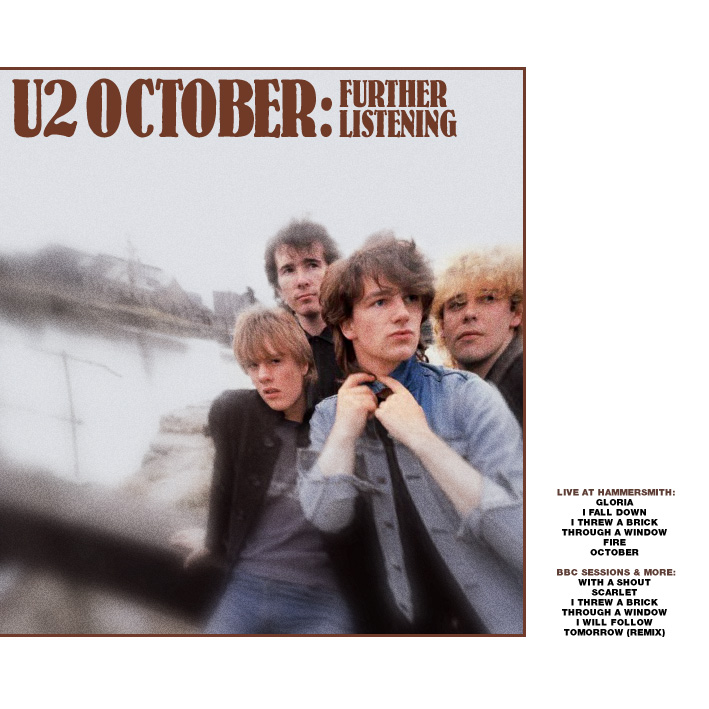
October

“I am against you,”
    declares the Lord Almighty.
“I will burn up your chariots in smoke,
    and the sword will devour your young lions.
    I will leave you no prey on the earth.
The voices of your messengers
    will no longer be heard.”
Nahum 2:13 (NIV)

U2 rose to fame during my college years. The iconic band that now fills stadiums and cuts deals with Apple to release their CDs was just an avant garde group of punks from Ireland when I first heard of them. One of the early songs that was extremely popular on my campus is now largely forgotten in their repertoire. It is quite simple and short:

October
And the trees are stripped bare
Of all they wear
What do I care

October
And kingdoms rise
And kingdoms fall
But you go on…and on…

I thought about that song this morning as I mused on Nahum’s prophesied fall of the Assyrian empire. The Assyrian empire (a.k.a. the Neo-Assyrian empire) was one of three empirical legacies of the Assyrians. It was their final empire which lasted just 300 years, roughly from 910-612 B.C. It is ranked 119 out of 214 historic world empires on Wikipedia’s charts.

Nahum was a prophet of doom for the Assyrians. Though they had risen to heights of regional power they were now to be silenced once and for all. And, Nahum’s prediction came true when an alliance of their vassals rose up to destroy the capitol city of Nineveh a few years later.

Kingdoms rise and kingdoms fall. But You go on…

As a lover of history, I often think about the ebb and flow of human kingdoms and empires. As the Great Story plays out from the beginning of Genesis to the end of Revelation, there is a constant rise and fall of kingdoms and empires. Hundreds of them. How many of them thought that they were it. How many claimed to be the greatest? How many claimed that they would never fall? How many rulers claimed divinity or divine right?

Kingdoms rise and kingdoms fall. But You go on…

This morning, I’m humbled. I am suspicious of any claims of divine right, invincibility, or superiority whether that come from an ISIS propaganda video or a presidential candidate’s propaganda ad. There is a larger story being told, and the kingdoms of this world are all merely playing their part.

Kingdoms rise and kingdoms fall. But You go on.

Chapter-a-Day Psalm 40

I waited patiently for the Lord to help me,
    and he turned to me and heard my cry.
He lifted me out of the pit of despair,
    out of the mud and the mire.
He set my feet on solid ground
    and steadied me as I walked along.
He has given me a new song to sing,
    a hymn of praise to our God.
Psalm 40:1-3 (NLT)

Those who traverse the faith journey have a story to tell. The journey is a story in progress. It is a Pilgrim’s Progress. I started here. I followed Jesus. Now I am here. I have changed. I have progressed. That was old. This is new. That is now dead to me, while this is now alive in me.

While stuck in the Dallas Fort Worth airport this past Saturday I struck up a conversation with a man sitting next to me. He was from Nigeria and was studying for his master’s degree at North Texas University. He was a poet and a filmmaker. When I asked him about his filmmaking he said unashamedly that he decided to make films because it is the best vehicle to share the good news about Jesus. “When people asked Jesus a question,” he said, “Jesus did not respond with a chapter and verse or a sermon. He told a story.”

I thought of my friend this morning as I read the opening lines of psalm 40 and as I heard U2’s song going through my head. Everyone on the journey of faith has a story to tell.

So, what’s your story?