Tag Archives: Head

The Story We Tell With Our Lives

Hear, O Israel: The Lord our God, the Lord is one. Love the Lord your God with all your heart and with all your soul and with all your strength
Deuteronomy 6:4-5 (NIV)

As my family’s unofficial historian and pastor, I’ve become a repository for old family bibles.

“What should we going to do with great-grandma’s bible? Anyone want it?”

Nah! Give it to Tom.”

Yes, I will take it. The first thing I will do is look to see what it contains besides the pages and the printed text. When a Bible is well-used it collects things. Ephemera of all kinds gets stuffed in the pages. It’s fascinating what people choose to keep. Handwritten notes are often found scribbled in the margins. It can be a window into an ancestor’s head and heart.

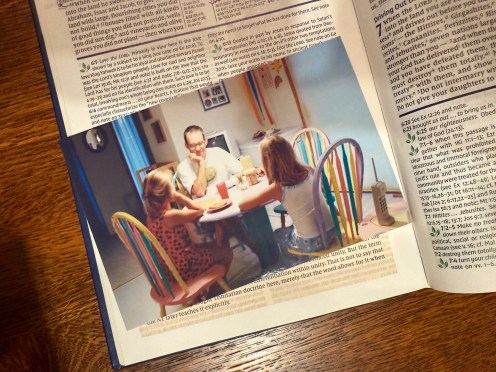
In my Bible there is a photograph. I don’t even remember putting it there. I think it randomly surfaced and I just shoved it inside the cover of my bible because it was convenient in the moment. It’s still there years later. The photograph is of my daughters and me at the breakfast table. They are about eight or nine years old and are eating their breakfast. I’m sitting there right where they found me when they got up, bible open. I’ve been doing this early morning meditation thing for a long time.

Today, our grandson Milo celebrates his eighth birthday. A generation has come and gone since that photograph in my bible was taken. When Milo comes to visit, his room is across the hall from my home office. Like me when I was his age, Milo is a morning person. So, amidst my quiet time I will hear the pocket door to my office slowly slide open and Milo will slide up on Papa’s lap. Just like my daughters used to do.

I could sit in today’s chapter for a long, long time. It is Moses at his most intimate and loving as a patriarch of his people. Remember, Deuteronomy is Moses’ final deathbed message. Today’s chapter is a loving father and grandfather’s heart fully open and on display.

Moses begins with what is known as the Shema in Jewish tradition. Shema means “hear” in Hebrew. This verse is recited morning and evening. It’s sung, whispered, shouted, taught to children as soon as they can speak. It’s what Jesus referenced as the greatest commandment. Love God with all your heart, soul, (Jesus added mind) and strength. God is one – not just a monotheism – but the unifying center of reality. Nothing exists outside of His oneness.

Moses begins with the Shema — the heartbeat of Israel. Then, like every wise elder, he moves from proclamation to formation – from hearing to teaching. Moses tells every Hebrew to share their family’s story with every child: Slavery, God’s deliverance, the miracles, the mess in the wilderness, God’s faithful provision, and the gracious promise and prosperity of the Promised Land.

“Tell them the Story,” Moses urges his children, “So they can trust the Story.”

Later in his message, Moses urges his children to action: Do what is right and good in the Lord’s sight, so that it may go well with you…”

James echoes this same sentiment in his letter to Jesus’ followers:

“Do not merely listen to the word, and so deceive yourselves. Do what it says.”
James 1:22 (NIV)

As I meditated on these things in the quiet this morning, I found myself focused on two intertwined thoughts.

First, the Hebrew word for “heart” intimates far more than just emotion. It is the wholeness of my inner self. It is the union of mind, will, and desire. To love God with my “heart” is to let Him sit enthroned on my decision-making center.

Second, I recognized that there is a flow to what Moses commands. The words can’t get from the ear to heart or hand – nor can they can’t be shared with the mouth – without passing through the mind. Perhaps that’s why our Lord added “mind” to the Shema.

Ear —> Head —> Heart —> Mouth/Hands/Feet

Along my life journey, I’ve observed individuals for whom the word has completely by-passed the heart. They hear the word. It enters the brain as plain text, rules, and religious commands. The hands might obey in legalistic fashion. The mouth regurgitates the text in heartless, rote, religious obedience.

But there’s no heart in it.

The words aren’t just laws, commands, and decrees. When channeled through grateful and believing hearts they’re paths to life, abundance, and longevity in all that God is providing in the future to which He is leading.

Here in the quiet, I find myself staring back at the photo of me at the table with my young daughters, my bible open to whatever chapter I was meditating on in the quiet that morning. I find myself looking forward to the next few weeks and the next time Milo slides open the pocket door of my office and staggers in on my lap, my bible open to whatever chapter of Deuteronomy we’ll be on that day. I look forward to sharing the Story in whatever way flows in our conversation.

My mornings in the quiet, this chapter-a-day trek, isn’t religious obedience. It’s my heartbeat. It’s my spirit breathing. It’s nourishment for my soul that fuels my day. It’s my personal embodiment of the heart of the Shema.

And so, I will tuck the photo back in my bible along with the other ephemera that I’ve mindlessly collected over the years. Perhaps one day a great-grandchild or great-great grandchild will inherit it. Perhaps it will whisper to a future generation about the pattern God established through Moses:

Hear the Story. Trust the Story. Tell the Story.

If you know anyone who might be encouraged by today’s post, please share.

Promotional graphic for Tom Vander Well's Wayfarer blog and podcast, featuring icons of various podcast platforms with a photo of Tom Vander Well.
These chapter-a-day blog posts are also available via podcast on all major podcast platforms including Apple, Google, and Spotify! Simply go to your podcast platform and search for “Wayfarer Tom Vander Well.” If it’s not on your platform, please let me know!
An open Bible with a photograph tucked inside, depicting a nostalgic moment of a parent and children at a breakfast table.

Stuck in a Moment

Stuck in a Moment (CaD Gen 33) Wayfarer

But Esau ran to meet Jacob and embraced him; he threw his arms around his neck and kissed him. And they wept.
Genesis 33:4 (NIV)

Many years ago I found myself back in the stomping grounds of my youth. It was late at night and I ran into an old friend. I approached to say hello and discovered he had a drink or two too many. I was shocked to find that I was greeted with anger that felt like it was seething to the point of rage. He looked like he was ready to punch me, and the air was filled with violent tension. I quickly backed away and left.

I never forgot that moment.

Ten or so years later I ran into my friend again. Needless to say, my apprehension was high when I saw him. All I could think about was the tension from ten years before. I played it cool and chose not to initiate conversation. Imagine my surprise when my friend walked up to me with a smile, greeted me warmly with a big hug, and initiated a friendly catch-up conversation. It was as if the episode a decade before had ever happened.

That moment came to mind this morning as I read today’s chapter and the reunion between twin brothers, Jacob and Esau. In this case, it had been 20 years since Jacob fled into exile to escape his brother’s rage. The last thing Jacob remembered was the aftermath of stealing Esau’s blessing and birthright. Esau was spewing anger and vengeance. In yesterday’s chapter, Jacob hears that Esau is on his way with 400 men, and he is clearly anticipating Esau to greet him with the same anger and vengeance he remembered from their last meeting. He carefully devises a plan in anticipation of a violent outcome.

Imagine Jacob’s shock when Esau runs ahead of his 400 men to embrace him, kiss him, and weep at their reunion.

Along my life journey, one of the things I’ve learned about myself is that I have a very active mind, imagination, and inner world. It comes with being an Enneagram Type Four. This is a good thing in all sorts of creative ways. I discovered it to be quite helpful as an actor, allowing me to easily suspend disbelief and live fully in the world of a play behind the fourth wall. At the same time, my active mind can also become a hindrance.

They say, “Time heals all wounds.” Sometimes it’s true, but not if my brain replays that uncomfortable, tense moment with my friend over, and over, and over again. And, I did just that. I couldn’t let it go. It was like relational PTSD. All I had to do was think about it and I was right back in that moment, feeling all of the shock, apprehension, and fear all over again. It makes it hard for me to let things go. Sometimes, I’m unable to emotionally or relationally move forward from a moment. As U2 sings it:

And you are such a fool
To worry like you do
I know it’s tough
And you can never get enough
Of what you don’t really need now
My, oh my
You’ve got to get yourself together
You’ve got stuck in a moment
And you can’t get out of it

In the quiet this morning, I wondered if Jacob was wired the same way. Paul summed up his letter to Jesus’ followers in Philippi by telling them:

whatever is true, whatever is noble, whatever is right, whatever is pure, whatever is lovely, whatever is admirable—if anything is excellent or praiseworthy—think about such things.

I’ve discovered that doing this often requires me to find the “stop” button in my brain from continuing to repeat whatever mental playlist I have on a continuous loop. I have to force myself to consciously choose a different playlist that fits Paul’s description.

I’ve found that the path of spiritual growth requires me to recognize unhealthy and unproductive ways within myself, and find the self-discipline to address them. In some cases, this is easy. In other cases, it’s an entire spiritual journey all its own.

If you know anyone who might be encouraged by today’s post, please share.

Dealing Swiftly with Troublemakers

Joab_and_the_wise_womanNow a troublemaker named Sheba son of Bikri, a Benjamite, happened to be there. He sounded the trumpet and shouted,

“We have no share in David,
    no part in Jesse’s son!
Every man to his tent, Israel!”

2 Samuel 20:1 (NIV)

One troublemaker is all it takes to bring ruin on an entire group. I have experienced this on teams, in a cast/production, in churches, in civic organizations and in business. Years ago I witnessed a business suffer from the schemes of a troublemaker who happened to be the son of the owner. The father refused to discipline or deal with his son while the son connived to gain more and more power within the company. Eventually the father sold the business to his friend. When the transaction was completed and the new owner was in place, the former owner advised his friend to fire the son. The new owner thought to himself, “Even though he told me to fire his son, my friend will surely hold it against me if I actually do it.” So the new owner refused to deal with the troublemaker for many years and the son continued to be a source of contention and strife within the organization.

I thought about that business this morning as I read the chapter. Like the father in my example, David refused to acknowledge and deal with his troublemaker son, Absalom, until it was almost too late. Still stinging from Absalom’s coup d’etat, David appears to have learned his lesson. He moves swiftly to deal with the troublemaker, Sheba.

When Sheba flees to hide in the town of Abel Beth Maakah, David’s army surrounds the town and lays siege to it. A wise woman in the town arranges for a parlay with the general, Joab, and learns that the entire village is being threatened with destruction because of one troublemaker, Sheba. The wise woman quickly surmises that it would be better for the whole city to expel the trouble maker than face possible ruin. Sheba’s head is cut off and hurled over the wall to Joab and the army and the threat is eliminated.

The further I get in life’s journey the more intolerant I have become of troublemakers and crazymakers. I have discovered that there is a difference between a reasonable person with whom I am having conflict and a trouble maker who cannot be reasoned with. Wisdom an discernment are required, but once it is clear that I am dealing with a troublemaker or crazy maker, I have found that acting quickly to cut that person off is in my best interest and the best interest of the group.

Enhanced by Zemanta

Who Said Soccer Was a Non-Contact Sport?

Ouch.