Tag Archives: Hypocrite

Dutch Fronts

When the wall collapses, will people not ask you, “Where is the whitewash you covered it with?”
Ezekiel 13:12 (NIV)

The Iowa town where Wendy and I live is a unique place. Pella was founded by a Dutch pastor and his flock back in 1847. They were fleeing religious persecution back in Netherlands and were intent on creating “a city of refuge” on the Iowa prairie. Visitors from the Netherlands today will often say that Pella is more Dutch than the Netherlands itself. Dutch heritage is so woven into the town that any commercial businesses must include classic Dutch architectural design flourishes on their buildings. Even Walmart and McDonalds comply (see the featured photo on today’s post).

Of course, the architectural flourishes are just that. Behind the doors of that cute looking shop on the square, it’s just a building like any other building. In some cases, that building is 170 years old and in critically major disrepair. This has led to locals using the metaphor of a “Dutch Front.” The front of the building looks cute, quaint, and Dutch, but on the inside it’s a hell-hole. The metaphor is often (and aptly) used to describe people who keep up self-righteous, religious appearances for public consumption, but whose actual lives are filled with greed, anger, slander, hypocrisy, and critical spirits.

In today’s chapter, God has Ezekiel prophesy against false prophets and professional diviners and spiritualists who practiced black magic. I was fascinated that God’s metaphor for false prophets was basically the same metaphor as our Dutch Front. In Zeke’s day, a strong wall around the city protected it from an enemy attack. God tells Zeke that the false prophets of his day were like a “flimsy wall” that had been whitewashed to look good. These prophets would tell people what they wanted to hear, that everything was going to be okay and that they would live in peace, while God was trying to warn them of the impending doom and destruction.

In the quiet this morning, I find myself meditating on this metaphor. Even Jesus used a form of it with the hypocritical religious Pharisees of His day:

“Woe to you, teachers of the law and Pharisees, you hypocrites! You are like whitewashed tombs, which look beautiful on the outside but on the inside are full of the bones of the dead and everything unclean.”

There are two truths that I have observed along my life journey that come to mind as I reflect on Jesus’ words.

First, there is no one perfect and even the most sincerely devout individual has blind spots and imperfections. We are all works in progress. I have known critics and non-believers who are quick to paint any and all self-proclaimed believers with the same coat of whitewash in an effort to justify their unbelief and poor life choices. It is a very human thing to generalize an entire subset of humanity as “those people.” It makes easier for us to dismiss them instead of understanding them.

Second, Jesus was most critical of self-righteous, fundamentalist religious-types. Much like the false prophets, they played the religious game, they even thought they were being devoutly sincere, but they were blind to the spiritual reality. Their hearts weren’t seeking after the heart of God, but rather were seeking public approval ratings that made them feel good while ignoring the heart changes inside that desperately needed to be made.

In the quiet this morning, I find myself standing in the tension. Look hard enough and you will find my flaws. My wife, my children, and my inner circle of friends know them very well. As a disciple of Jesus, my first priority is not to seek and point out the flaws and hypocrisies of others. My priority is to be God’s perpetual and faithful cardiac patient. My heart has to perpetually change if I am going to be the disciple God calls me to be: My life, words, and actions increasingly blossoming with the Fruit of the Spirit. There is a time and place for calling out sin and hypocrisy just like Zeke in his day, and Jesus in His. Yet, I’m reminded that His criticism of the religious leaders was a very small part of His story, which was primarily about His healing and restorative sacrificial love for others. May my life increasingly reflect His.

If you know anyone who might be encouraged by today’s post, please share.

The Tension

The Tension (CaD Ps 119) Wayfarer

I have strayed like a lost sheep.
    Seek your servant,
    for I have not forgotten your commands.

Psalm 119:176 (NIV)

Like Psalm 117, the chapter from two days ago, Psalm 119 is also widely known as a trivial pursuit question. Coming in a mere two verses, Psalm 117 is the shortest psalm and shortest chapter of the Bible. The 176 verses of Psalm 119 make it the longest psalm and longest chapter in the Bible. If you actually read today’s chapter then you should pat yourself on the back for the accomplishment.

What makes this epic Hebrew lay even more fascinating is that the entire thing is about one central theme: The Great Story. The lyricist used eight different Hebrew words which get translated into English as law, word, commands, precepts, statutes, promises, and decrees. What’s also lost in the translation to English is that each stanza of the song begins with successive letters of the Hebrew alphabet and every line of that stanza begins with the same letter. Psalm 119 is really an ancient work of art.

As I read through the lyrics, I couldn’t help but think about my own journey of reading, studying, meditating on, and memorizing the Great Story. It has been pretty much a daily part of my life for forty years. As I read it this morning, there were so many pieces of the psalm with which I identified with the lyrics. I have no regrets about my devotion to studying the Great Story. It has made me a better person and taught me so much wisdom.

Having said that, I also freely admit that it has not made me a perfect person. And that is one of the things I love about the writer of Psalm 119. Despite his almost fanatical dedication, the songwriter freely confesses on several occasions to his shortcomings, mistakes, and failures. The entire thing ends with the author admitting to being a “lost sheep” and asking the Great Shepherd to “seek your servant.” I couldn’t help but think of Jesus’ words:

By this time a lot of men and women of questionable reputation were hanging around Jesus, listening intently. The Pharisees and religion scholars were not pleased, not at all pleased. They growled, “He takes in sinners and eats meals with them, treating them like old friends.” Their grumbling triggered this story.

“Suppose one of you had a hundred sheep and lost one. Wouldn’t you leave the ninety-nine in the wilderness and go after the lost one until you found it? When found, you can be sure you would put it across your shoulders, rejoicing, and when you got home call in your friends and neighbors, saying, ‘Celebrate with me! I’ve found my lost sheep!’ Count on it—there’s more joy in heaven over one sinner’s rescued life than over ninety-nine good people in no need of rescue.

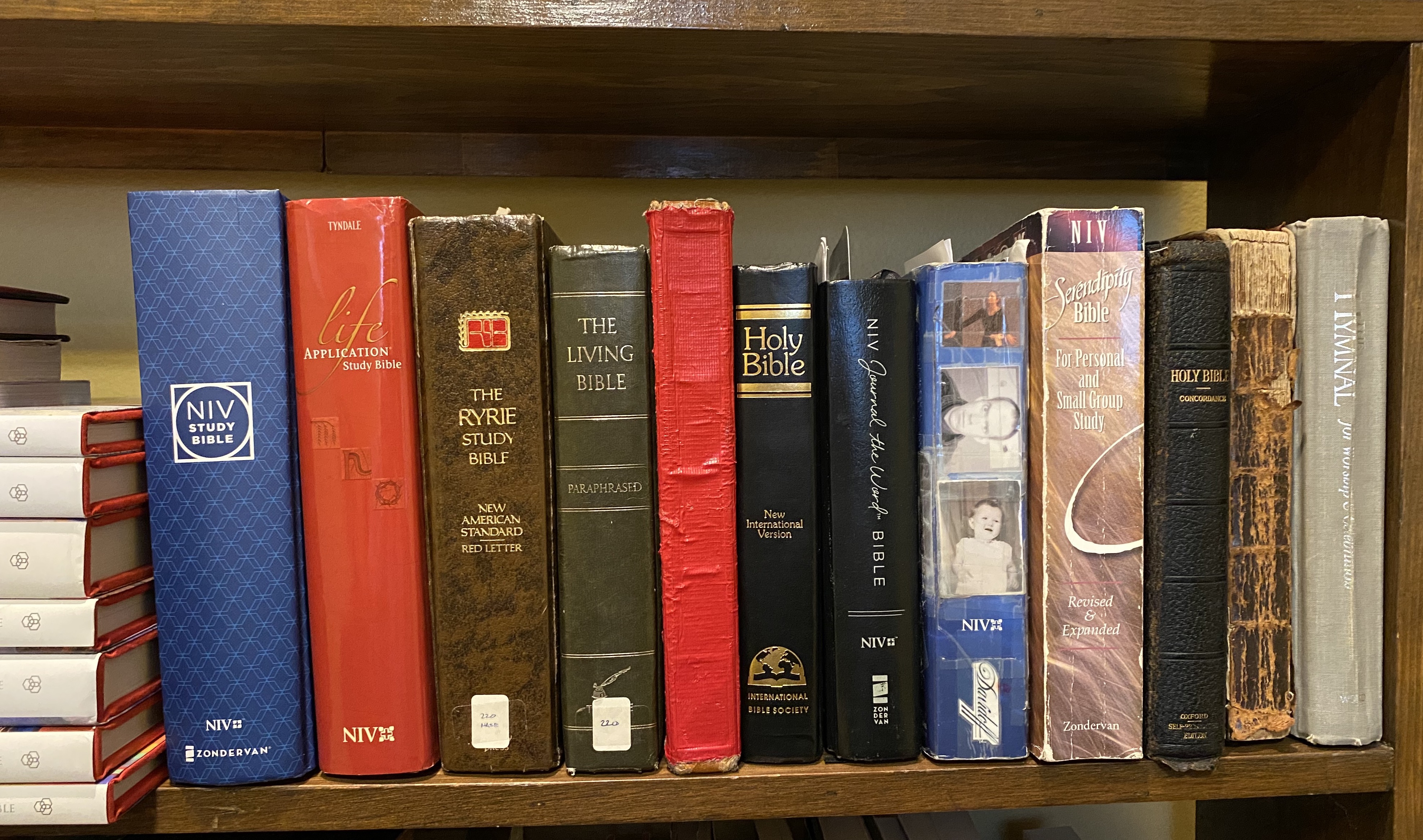
In the quiet this morning, I find myself holding the tension of both my spiritual pursuit and my personal journey. As I sit here and type, I stare over the top of my laptop at a shelf of Bibles lined up together. They are the Bibles that I have read, studied, and marked up over forty years. There’s the puke-green Living Bible my parents gave me when I was a kid. There’s the cheap faux leather version held together by red duct tape, and the paperback that’s covered with personal photos and ephemera. There are resource versions used for specific purposes across the years. And then there’s the beautiful seven-volume copy of the illuminated St. John’s Bible that I’ve collected.

And yet, like the lyricist of Psalm 119, my life has been dotted with foolish choices, acts of gross disobedience, and personal failures. You can accuse me of being a hypocrite, and I won’t deny it. In our current world of cancel culture, there are plenty of past mistakes that the mob of political and moral busybodies could use to summarily dismiss me and write me off. C’est la vie. Making the Great Story a part of my daily life hasn’t made me perfect or pure, but the Great Shepherd has always used it to find this lost sheep and call me back to the fold. My perpetual journey through the Great Story has helped me to slowly, steadily, sometimes haltingly, grow into becoming my true self. I hate to imagine the person I would be today without it.

Balak’s an Idiot (and so am I)

Then Balak’s anger burned against Balaam. He struck his hands together and said to him, “I summoned you to curse my enemies, but you have blessed themthese three times.”
Numbers 24:10 (NIV)

Yesterday morning, after writing my post and finishing my quiet time, I settled in at the breakfast table. Wendy was just finishing reading our previous chapter as she waited for me.

Balak is an idiot,” she said with a chuckle and shake of her head.

I laughed, and agreed with her. The narrative clearly portrays the Moabite king as not being the sharpest tool in the shed. Balaam the seer clearly spoke the terms up front to Balak. He would say only what the Lord told him to say, no matter how much treasure Balak offered Balaam to say what he wanted to hear.

Nevertheless, Balak makes Balaam view the Hebrew encampment from three different vantage points, expecting Balaam’s prophetic message to change with the view. When the prophecy doesn’t change to his favor, Balak tells Balaam that he’s not going to pay. Duh. Balaam reminds Balak that he knew that up front.

It is out of Alcoholics Anonymous that we got the popular notion that the definition of insanity is doing the same thing over and over again and expecting a different result. It appears Balak could have benefitted from the Twelve Steps.

In the quiet this morning, however, I’m reminded that I can often find my own reflection in the individuals I criticize. There are stretches of my own journey in which I was looped in endless cycles of brokenness. Truth be told, I have found that significant spiritual progress usually requires breaking systemic negative patterns of thought or behavior. The further you progress the deeper, more intimate, and less obvious those negative patterns are to the casual observer. Recovering Alcoholics will tell you that they once thought drinking was their problem. Journeying through the Twelve Steps you discover that your addiction is just the tip of the iceberg.

This morning as I laugh at King Balak’s idiocy, I have to humbly confess that I am also laughing at myself.

Have a good weekend, my friend.

Contrasts in Corruption

Jan_Luyken's_Jesus_21._Zacchaeus._Phillip_Medhurst_Collection

A man was there by the name of Zacchaeus; he was a chief tax collector and was wealthy.

When Jesus entered the temple courts, he began to drive out those who were selling. “It is written,” he said to them, “‘My house will be a house of prayer’; but you have made it ‘a den of robbers.’” Luke 19:2, 45-46 (NIV)

In Jesus’ day corruption was everywhere. I realized as I read this morning that today’s chapter is bookended with a fascinating parallel. It begins with the story of Zacchaeus.

Zac was a “chief tax collector.” In the days of Roman occupation, the empire broke up territory into tax regions. The tax collectors were locals who knew their neighborhoods, local businessmen, and had first hand knowledge of where the local money was. Tax collectors had a base amount of tax that the Roman Empire demanded they raise and send to Rome. There were, no doubt, others in the regional political machine getting their cut, but beyond that the tax collectors could keep whatever they could extort from their own people. The more money they squeezed out of their neighbors the richer they became, and Zac was a very wealthy man. As a “chief tax collector” Zacchaeus would not only have extorted his own share, but he was likely getting a piece of the action from other collectors in his territory. He was a extortionist and racketeer, the first century equivalent of a local mob boss.

Contrast this with the Pharisees and religious leaders who ran the temple. They judged Zacchaeus as a traitor and a sinner and they would look down their ecclesiastical noses at the extortionist. But, the religious leaders were total hypocrites. They had a thriving racket of their own. Good Jews were required to make regular pilgrimages to the temple to make sacrifices and offerings for their sins. Jews regularly came from all over the known world to make their annual sacrifices. To take advantage of this, the Pharisees in charge of the temple minted their own currency and the priests demanded that people buy the supplies for their offerings from the approved temple merchants. Of course, the temple merchants only took temple currency, so people would have to visit the temple “money changers” to exchange their local currency at exorbitant exchange rates. At least with Zac and the money changers there was no pretense about what they did with their money. The high priest and the religious leaders were corrupt extortionists, but they cloaked their racket in pious religiosity. They used God to launder their public image and both social and religious leverage to line their own pockets.

Jesus visits Zacchaeus’ house (creating all sorts of gossip, whispers and condemnation from all the good religious people). By the end of the visit, Zac’s heart and life had changed. He agrees to give away half of his wealth and make amends with all whom he’d cheated (the list was likely to be very long).

Jesus visits the temple. Unlike the sinner, Zac, the Pharisees and religious leaders refuse to repent of their extortion and racketeering. They choose, instead, to plot to have Jesus killed. His teaching, and his driving of the money changers from the temple were a threat to their power and their income. They would have none of it. Jesus needed to be rubbed out.

God’s Message teaches that sin is common to all. Both the tax collectors and the religious leaders were infected with the same appetite for greed and power. There was no difference in their sin, only in their response to Jesus. The traitorous “sinner” Zacchaeus opens his heart to Jesus’ words and turns away from his racketeering ways. The good religious people close their hearts to Jesus’ words and sink to even lower into corruption in order to safeguard their wealth and power.

Today, I’m thinking about the contrast in these two stories. I’m aware some people think of me as a good, religious person like the Pharisees, but I don’t ever want to be like the temple leaders who played a religious game to hide their lust for wealth and power. I’m also aware that some religious people think that I am not being religious enough and I don’t tow the line on their religious standards. I am divorced, I have tats, I don’t hide my love for a pint of good beer and an occasional cigar. And, I hang out with those sketchy artists and theatre types.

I am admittedly not perfect, but I hope that, like Zacchaeus, my heart and soul will always be open to Jesus’ teachings and that my life will always be enthusiastically responsive to Spirit and Truth.

jesus_money