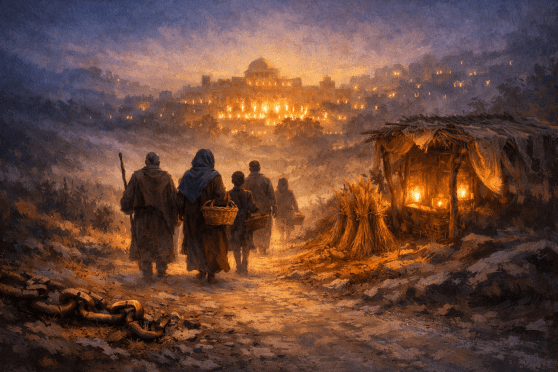
Tag Archives: Festival

Not History – A Moment Relived

Three times a year all your men must appear before the Lord your God at the place he will choose: at the Festival of Unleavened Bread, the Festival of Weeks and the Festival of Tabernacles. No one should appear before the Lord empty-handed: Each of you must bring a gift in proportion to the way the Lord your God has blessed you.
Deuteronomy 16:16-17 (NIV)

Last week we enjoyed our Christmas celebration with family. I enjoyed going to the Christmas Eve candlelight service and marking the climactic end of the Advent season and welcoming the Christ-child, God-with-us.

There is definitely a connection between the annual celebration of the Advent season and Christmas and today’s chapter. God through Moses reminds His people that when they settle in the Promised Land they are to have three great pilgrimage festivals. Everyone makes a pilgrimage to “the place God will choose” at three different times of year for three different purposes:

  1. Passover / Feast of Unleavened Bread – a remembering of liberation.
  2. Feast of Weeks (Shavuot) – a remembering of provision.
  3. Feast of Booths (Sukkot) – a remembering of dependence.

These festivals provided structure, not only for the calendar, but also for the soul.

My meditation on today’s chapter led me to a Hebrew word: Z’manim.

In its simple definition z’manim means “times” or “appointed moments.” But God’s base language is metaphor, and metaphors are layered with meaning. I’ve learned that this is especially true with the Hebrew language.

Z’manim gives breath to time.

Appointment (something set, not random)

Readiness (a moment that has ripened)

Intended timing (not just when, but why now)

This is not clock time. This is meaningful time. It is time with purpose stitched into it. Time that has been noticed. Claimed. Set apart.

God does not dwell just in places. He inhabits moments.

Which brings me back to Christmas Eve and the end of the Advent Season. Why do this every year? Why did God prescribe three festivals every year? The intention was never a rote, prescribed, go-through-the-motions religious activity. That’s dead religion not a Living God. Annual seasons and festivals were moments in time in which I commune with the divine and together we embrace a moment new and afresh.

Freedom from chains that bind me.
Gratitude for the abundance of my blessings.
Reminder that security is always borrowed.
The birth of God who became flesh and pitched His tent among us.

Along my spiritual journey I have been largely naive and ignorant of the ways God has historically revealed Himself in fullness. I understand more than ever how easy it is for institutional religion to become rote and repeated motions that are Spiritually empty and void of meaning. But from ancient days through this current day, God has invited me to meet him in z’manim – moments of time filled with His presence and a banquet of meaning on which my soul can feast and be satisfied.

On Christmas Eve, bathed in candlelight and singing Silent Night with loved ones, we welcomed a newborn baby, wrapped in swaddling clothes and lying in a manger. It wasn’t just a commemoration. It was not dusting off history. It was, once again, the event relived – together with God and with loved ones.

It was z’manim.

And in the next few days the z’manim shifts. Old things pass away with 2025. New things come with 2026.

In the quiet I am reminded that I dare not ponder what that means for me apart from the reality of “God with us.”

If you know anyone who might be encouraged by today’s post, please share.

Promotional graphic for Tom Vander Well's Wayfarer blog and podcast, featuring icons of various podcast platforms with a photo of Tom Vander Well.
These chapter-a-day blog posts are also available via podcast on all major podcast platforms including Apple, Google, and Spotify! Simply go to your podcast platform and search for “Wayfarer Tom Vander Well.” If it’s not on your platform, please let me know!
An orange icon featuring an open book symbol, representing learning or knowledge.

TGIF

TGIF (CaD Lev 23) Wayfarer

“‘There are six days when you may work, but the seventh day is a day of sabbath rest, a day of sacred assembly. You are not to do any work; wherever you live, it is a sabbath to the Lord.’
Leviticus 23:3 (NIV)

It has been so woven into the fabric of our lives for so long that we don’t even think about it. It is universal. It is unequivocally a basic human right.

The weekend.

It wasn’t always so. For most of human history, the toil of daily survival and commerce ground on mercilessly without fail. There was no stop. There were no weekends, or PTO, or rest from the grind. It was just as God poetically told Adam it would be after he and Eve ate the forbidden fruit:

“Cursed is the ground because of you;
    through painful toil you will eat food from it
    all the days of your life.
It will produce thorns and thistles for you,
    and you will eat the plants of the field.
By the sweat of your brow
    you will eat your food
until you return to the ground
…”
Genesis 3:17-19 (NIV)

And so, the painful toil had been going on for the ancient Hebrews all the days of their lives. As slaves in Egypt, they toiled seven days a week, 52 weeks a year, every year of their miserable existence in chains.

Then God showed up.

God introduced Himself to Moses, delivered them from Egypt, and is now instituting a fresh start with them. He is going to live with them at the center of their camp. He is going to teach them a new way of living in community with Him and with each other.

I’ve observed along my life journey that God gets generally characterized as a tyrannical killjoy. I’d like to refute that generalization by offering as Exhibit A today’s chapter. For the record, God has laid down plenty of rules to live by so far. The most repeated rules have been don’t commit child sacrifice and don’t have sex with your own family members. Other rules include don’t drive your daughter into prostitution. Then there’s If you’ve got a festering sore, you might want to spend some time in quarantine outside the camp. Oh my goodness, what a killjoy.

We get to today’s chapter and God demands of His people a series of festivals, celebrations, and it begins with A DAY OFF FROM WORK EVERY WEEK! A day of celebration and rest EVERY WEEK!

What a tyrant.

The “sabbath” was a radical social concept in 1500 B.C. Take a day off every week. Rest from your labor. Gather with your loved ones, your community, and with God. This pattern, by the way, had already been set when Father, Son, and Holy Spirit finished creation in six days and then took a day off to rest, celebrate, and enjoy what had been created. God is teaching His people to follow His own divine example.

But it doesn’t end with just a weekend day off. God goes on to establish annual festivals and celebrations for the whole nation to rest, gather, celebrate, mourn, and remember. Once again, NO WORK! There are eight in total when you break it down, which we’ve already learned in this chapter-a-day journey through Leviticus is an important metaphorical number. Seven is the number of completion (e.g. seven days of creation) and eight is a new beginning after the completion. So the annual festivals God ordains follow the flow of His peoples annual trip around the sun and then the beginning of a new one. God is teaching His people about the flow of life and time, and God is all about flow. It’s an essential part of who He is.

So, when we get to the end of the work week and say, “Thank God it’s Friday” we can take that literally. Sabbath was a particularly Hebrew tradition until the first Christian Roman Emperor, Constantine, learned about God’s Sabbath and decreed that the entire Roman Empire would get one day off each week. With that, what became the modern weekend was born.

By the way, the two-day weekend would not be firmly established until the 1800s in the midst of the industrial revolution. This time it was the British Empire (which had become, and remains, the largest empire in human history) that became the source of the social change. While the additional day of rest evolved over time and the lobby for it came from a host of sources, church leaders were on the front line of the crusade arguing that having Saturdays off would lead to a refreshed workforce and higher church attendance on Sundays.

So, in the quiet on this Thursday morning as I approach the end of another work week, I find myself feeling grateful for God who by His very nature enjoys rest, celebration, gathering, and festivity. I’m consciously thankful for something I have always taken for granted. I am reminded once again that the God I encounter in the Great Story stands in contrast to the killjoy tyrant that others have perceived Him to be, often twisted by humanity’s own fundamentalist religious perversions of His intended guidelines for life.

Tomorrow morning, when my eyes open and I climb out of bed, I can truly, sincerely, and genuinely utter, “Thank you God. It’s Friday.”

If you know anyone who might be encouraged by today’s post, please share.

These chapter-a-day blog posts are also available via podcast on all major podcast platforms including Apple, Google, and Spotify! Simply go to your podcast platform and search for “Wayfarer Tom Vander Well.” If it’s not on your platform, please let me know!

We Need More Festivals

Thus Moses declared to the people of Israel the appointed festivals of the Lord.
Leviticus 23:44 (NRSV)

For going on nearly a century, our small Iowa town has held a Tulip Festival every May. Everything stops for three days as residents pour their time and energy into the tens of thousands of visitors who descend on our community. Make no mistake, the festival is all about promotion and commerce. It’s the major fundraiser of the year for most of our community organizations. Nevertheless, I think everyone in our town would agree that the festival is much more than that. It celebrates our history, our heritage, and it promotes a strong sense of community and a spirit of service within it.

Festival is just a fun word. From the Latin word for “feast,” the root word is defined as “cheerful and jovially celebratory.” Who doesn’t want that? That’s one of the reasons Wendy and I wanted to get married on New Year’s Eve. What a great evening to celebrate our lives and love through time.

I find it interesting that God would program into His people’s calendar a series of “festivals.” At the top of the list is the weekly day of Sabbath or rest. The weekly day of rest was supposed to be a festival, but over time the religious people turned it into its own version of burdensome religious toil. Jesus got more grief from religious leaders about breaking Sabbath rules than anything else He said or did. The uptight religious people had perverted a festival of rest into a weekly religious burden. That was never its intention and Jesus knew it.

I can’t say that the institutional church and Jesus’ followers have done much better with our weekly day of worship which was moved from the Jewish sabbath on Saturday to the day of Jesus’ resurrection on Sunday. Each Sunday is supposed to be a festival of resurrection, but I wouldn’t describe the weekly mood in many churches as “festive.”

I knew a family who decided to try and instill this understanding of Sunday being a festival of Jesus’ resurrection in their young children. They began early in the week looking in anticipation of Sunday as a special day of celebration. Every Saturday night (the eve of Resurrection Day) they had a special family meal that the children helped plan during the week. Guests were invited to join them. They decorated with bright colors and had special desserts. There was a large brass chandelier fixture in their dining room with long swooping arms. At the end of the weekly Resurrection Eve dinner all of the meal participants would stand with a party popper, point it at the chandelier and pull their popper so that the colorful streamers would hit the chandelier and get caught on the arms. There the streamers would stay so that each week day the children would see the colorful remnant of their weekly feast and look forward to the next.

The family celebrated getting to worship on Sunday and celebrate the Resurrection. They planned special moments together on Sunday as well. Believe me. The day I was a guest in their home, the children couldn’t wait for their weekly Saturday night and Sunday festival.

This morning I’m thinking about the fact that we don’t do more to make personal festivals a way to mark special days, seasons, heritage, and history that is meaningful to us and our loved ones. Festivals are fun as well as meaningful. Who doesn’t love a nice feast in which to be cheerful and jovially celebratory? Let’s plan a little festival and invite our loved ones.

chapter a day banner 2015

Featured image by metku via Flickr

Chapter-a-Day Esther 8

Purim street scene in Jerusalem
Purim street scene in Jerusalem (Photo credit: Wikipedia)

The day chosen for this event throughout all the provinces of King Xerxes was March 7 of the next year. Esther 8:12 (NLT)

Each May, the community where I live (Pella, Iowa) has a large festival to honor the Dutch heritage of the town’s founders. Our community of 10,000 will have upwards of 100,000 guests descend upon us to feast, enjoy one of the many parades, see people dressed in traditional Dutch costumes and (if nature cooperates) to enjoy the half-million tulips blooming around town.

When I was small, Memorial Day was a time when I would accompany my Grandma Golly to the cemetery to plant flowers on the graves of family members and to remember them. When our girls were small, my mother took them to the same cemetery to plant flowers on those same graves along with the grave of my grandmother who had stood there with me.

As a lover of history, I like feasts, festivals and commemorations like our annual Tulip Time or the simple act of placing flowers on family graves on Memorial Day. I think it’s great when peoples, families or communities celebrate their heritage or keep a significant historical event alive for subsequent generations.

For those not familiar with the Jewish culture, you may not know that the story of deliverance we’ve been reading in Esther is celebrated each year with a holiday called Purim. The festival’s date is based on the Hebrew lunar calendar, so the date moves on our calendar each year and lands in February or March. In 2013 Purim will be celebrated from sunset February 23 to nightfall on February 24.

The celebration is rooted in four obligations:

  1. Public reading of the story of Esther
  2. Sending gifts of food to friends
  3. Giving charity to the poor
  4. Eating a festive meal

In an age when change happens so rapidly and culture is pressing forward at a break-neck speed, I often wonder if it will become increasingly difficult for future generations to appreciate the past. I personally believe that it is more important than ever for parents and grandparents to instill in children and grandchildren an honor and appreciation for heritage, history and key events of the past that provide a strong foundation in times when both the present and the future seem shaky and uncertain.

Tulip Time 2010

Tulip Time Day 2 018
It was a cold, rainy and blustery weekend for Pella's 75th annual Tulip Time celebration. Every one of the six weekend parades forced onlookers to wrap up in blankets in an effort to stave off the chilly temperatures and wind chills. It didn't, however, dampen the fun and celebration. On Saturday the world record was set for the most people Dutch dancing in klompen (wooden shoes). Madison joined in on the record.

We had our neice, Sophia, with us Thursday through Saturday. Sophia's mommy packed lots of shorts and warm weather clothes for the weekend, so poor little Sophia was stuck wearing the same outfit all weekend (the only one warm enough), but she didn't complain. She had a blast playing with all the kids at Chad & Shay's on Friday night as we gathered to celebrate our friend, Mark's birthday.

On Saturday, Wendy's folks and sister Suzanna came down to enjoy the day. Wendy's mom is an administrative assistant to former Iowa Governor, Terry Branstad. So, the Governor stopped by our house on his way up to the square. Wendy's college roommate, Tracy, pulled Tom out of the crowd to join in the Dutch dancing prior to the afternoon parade.

This morning (Sunday), Madison sang with the combined Pella High and Pella Christian High choirs at the community worship service. The service was scheduled on the town square but was moved inside the 2nd Reformed Church due to the weather.

So, another Tulip Time in the books!

Tulip Time Day 2 026
Tulip Time Day 2 029
Tulip Time Day 1 003
Tulip Time Day 1 032
Tulip Time Day 1 037
Tulip Time Day 2 008