
Tag Archives: Accountability

The Problem of Power

source: allen brewer via flickr

Her leaders judge for a bribe,
    her priests teach for a price,
    and her prophets tell fortunes for money.
Yet they look for the Lord’s support and say,
    “Is not the Lord among us?
    No disaster will come upon us.”
Micah 3:11 (NIV)

As I write this the next Presidential election here in the States is 16 months off, but already the candidates are queueing up and the political machinations have begun. We had a family gathering at Wendy’s folks yesterday afternoon and casual conversation has already turned to be all about elections. It’s going to be a long one, I’m afraid. It’s times like this that I wish life had a fast forward button.

I am glad I live in a land with free elections and representative republic. As a lover of history, however, I’m constantly reminded that political power is a corrupting force. As Lord Acton observed, “absolute power corrupts absolutely.” Even in a system with checks and balances, I’ve observed that political offices (both elected and appointed) become places from which individuals and parties make rules to entrench their position and take advantage for themselves and their friends.

In the days of the prophet Micah, the situation was no different, as Micah observes in today’s chapter. God’s Message teaches that we live in a fallen world. Our sin leads us, despite our best altruistic efforts to the contrary, to make self-centric decisions for ourselves and our own. The more powerful and influential position we yield the more difficult it becomes to succumb.

Today, I’m feeling a bit cynical, but I’ve got plenty of evidence from events past and present to justify my cynicism. Perhaps that is why God’s Message exhorts us so directly to pray for our leaders and those in power. At the same time that I’m pointing the finger at politicians, I’m also mindful that power’s corrupting force is present in any human system from families to churches to companies to neighborhoods and service organizations. In my admittedly meager positions of influence I am aware of the negative affects power can have on me if I am not aggressively mindful, humble and accountable.

Parental Observation from a Child’s Perspective

3717380132_abf01ea9de_z

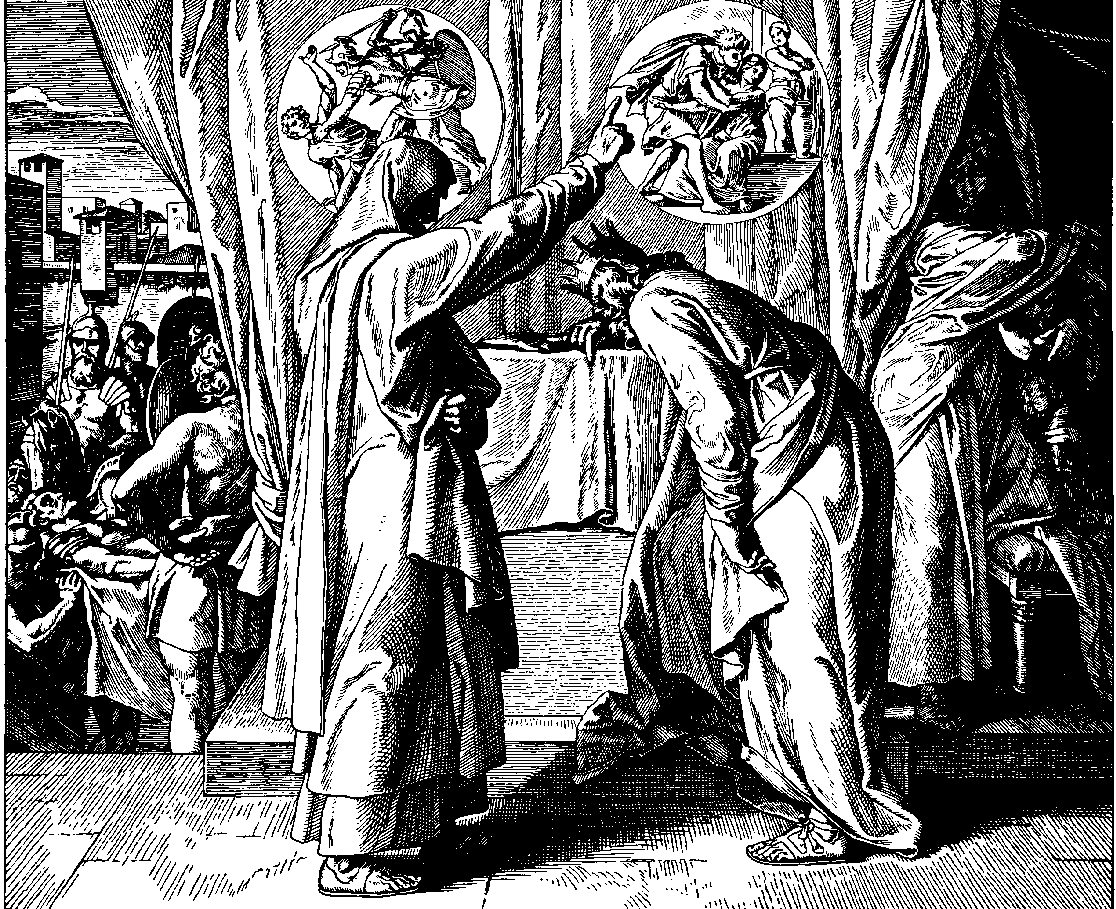
But you, Belshazzar, his son, have not humbled yourself, though you knew all this.
Daniel 5:22 (NIV)

As a parent, there is a big difference between a child who acts (or omits) out of ignorance and the child who acts (or omits) with the full knowledge that they are doing what they should not do, or not doing what they should do. Ignorance can be understood and the offense can be chalked up to a lesson that needed to be learned. When a child acts with the full knowledge that what they are doing is improper it is a very different situation. The action, or refusal to act, becomes a willing act of disobedience.

Today’s chapter fast forwards in Daniel’s story. Nebuchadnezzar is dead and Belshazzar has taken the throne. Belshazzar had witnessed all that his predecessor had gone through with the statute, his dreams, and his madness. He had heard Nebuchadnezzar acknowledge God and humble himself. Now that he is on the throne, Belshazzar throws an drunken feast and brings in the stolen gold cups from Solomon’s temple to drink from. If dishonoring the temple vessels wasn’t enough, B-Shaz and his homeys begin to honor the idols of gold, silver and wood. The lesson is clear, B-Shaz had witnessed all that Nebuchadnezzar had experienced and learned, but he didn’t learn the lesson himself.

This morning, to be honest, my heart is sober. As a parent it is easy for me to see and apply these simple lines of behavioral delineation, but then I think of myself as a child of God. I think of lessons I have learned along the journey that still have not translated into life change. There are things I know I shouldn’t do that I do, and things I should do that I don’t. Like a child caught red-handed, I am in continuous need of my Father’s grace and mercy.

[Side note: I love when I realize, discover, or rediscover the source of a common phrase. We forget how many every day sayings come from Shakespeare and from the Bible. “Weighed on the scales and found wanting” is a phrase I’ve heard referenced in books, plays, movies and conversation my entire life. Its source is today’s chapter!]

Carte Blanche Companions


Joab confronts the grieving King David

Then Joab went into the house to the king and said, “Today you have humiliated all your men, who have just saved your life and the lives of your sons and daughters and the lives of your wives and concubines. You love those who hate you and hate those who love you. You have made it clear today that the commanders and their men mean nothing to you. I see that you would be pleased if Absalom were alive today and all of us were dead. Now go out and encourage your men. I swear by the Lord that if you don’t go out, not a man will be left with you by nightfall. This will be worse for you than all the calamities that have come on you from your youth till now.” 2 Samuel 19:5-7 (NIV)

One of the most fascinating aspects of my day job is the opportunity I have to work with many different companies and to interact with people at diverse levels of the organization from the front-line to the executive suite. Long ago I realized that the culture of a company is a trickle-down affair that begins with the man or woman at the very top. I remember one client whose CEO ran the company by fear and intimidation. No one would stand up to him, even when he is clearly mistaken or making a wrong move, for fear of losing their proverbial heads in a board meeting (and, perhaps, their jobs). The result was a highly dysfunctional organization which mirrored the CEO. The entire corporate culture was one of intimidation, fear, and c.y.a. which permeated virtually every level of the operation.

One of the things I’ve observed about David as we’ve been reading his story the past few months is the fact that David had a select group of men in his life who could get in his face and call him to account even if they had to be careful about how they did it. In today’s chapter, David’s general and right-hand man Joab confronts David about the grave danger he’s putting himself in by allowing his grief for Absalom overshadow his duty as king. The kingdom was in a precarious political situation and David was close to losing it all. Joab lost no time in getting in David’s face and speaking the truth to him. To his credit, David listened to his long-time trusted general and advisor.

I have a handful of people in my life, people with whom I have intentionally surrounded myself, who have carte blanche to get in my face whenever necessary. These are people with whom I talk about and share life with on a regular basis. We talk about business, church, family, friendships, finances, and relationships. If they think I’m screwing something up, then they have permission to question me or call me out, and they would expect the same from me.

This journey through life can be a long hike. The first rule any child learns about hiking in the wilderness is “buddy up.” To go it alone is to put yourself in danger. Ironically, our greatest danger often resides within ourselves. Without faithful companions who can catch it and call us out, we may not realize it until it’s too late.

Today, I’m thankful for my faithful companions on this life journey.


Enhanced by Zemanta

Much Ado About Something

Dante's Vision of Rachel and Leah Dante Gabrie...
Dante’s Vision of Rachel and Leah Dante Gabriel Rossetti, 1899 (Photo credit: Wikipedia)

Chapter-a-Day Genesis 29


But when Jacob woke up in the morning—it was Leah! “What have you done to me?” Jacob raged at Laban. “I worked seven years for Rachel! Why have you tricked me?” Genesis 29:25 (NLT)


Wendy and I have recently been enjoying the Great Performances series on PBS called Shakespeare Uncovered. In each episode a famous actor delves deep into the story line of one of Shakespeare’s plays. It’s a wonderful primer for those who have an interest in learning more about Shakespeare’s stories and the literary genius he was.


Perhaps that is why I couldn’t help noticing that there is a Shakespearian quality to the story of Jacob and his uncle Laban. Jacob the deceiver, born from Abraham and Isaac who were also deceivers, receives a does of his own medicine when he is deceived by his Uncle. Add to that plot line the tale of two sisters, one homely and the other one hot. The hot one is seemingly barren while the homely one appears to be a baby making factory. Jacob is in love with the latter but is tricked into marrying the former. The sibling rivalry and Leah’s desperate desire to win the love and affection of her husband leads to a fertile fury of son making. Truth is sometimes as compelling as a Bard’s tale.


One of Shakespeare’s greatest qualities as a playwright was his development of characters whose tragic flaws led to tragic consequences. In this, he really is just developing what is true of human nature. We all have tragic flaws. We all have blind spots and weaknesses. We will all look back and realize that along the journey our own shortcomings led to negative consequences. The question is: What will we do about them?

We do not have to remain blind and ignorant. Through introspection, conversation, transparent relationship, and accountability we can become aware of our blind spots. We can actually learn from our shortcomings and choose to modify our patterns of behavior before they wreak too much havoc on our lives and the lives of those in our circles of influence.


Today, I’m thinking about my own weaknesses. I am aware of areas of my life that have been blind spots for me. I do not want to live passively. I’m actively working on modifying my thought patterns and behaviors. I don’t know that I will ever eliminate the negative consequences of my flaws, but I can certainly diminish them and that’s something.


On Leading and Leading Well

In questi occhi potrei perdermi / I could lose...
(Photo credit: cigno5!)

Chapter-a-Day Psalm 62

So many enemies against one man—
    all of them trying to kill me.
To them I’m just a broken-down wall
    or a tottering fence.
They plan to topple me from my high position.
    They delight in telling lies about me.
They praise me to my face
    but curse me in their hearts.
Psalm 62:3-4 (NLT)

Since being elected captain of the Woodlawn Elementary School Safety Patrol in 6th grade, I’ve spent most of my life journey in one form of leadership or another. Student Councils, Chaplain, Youth Pastor, Pastor, Elder, Committee Chairman, Director, Producer, Board of Directors, Employer, etc., and etc.  Over the past few years I’ve been investing a good bit of soul searching, reading, quiet time and mental effort ruminating on my leadership.

The truth is, I feel less comfortable as a leader today than I ever have in my entire life. Perhaps it’s the old saying “the more you know the more you realize you don’t know.” I know I can do the job, but the further I get down life’s road the more I want to do the job well and it’s the doing it well part which I find myself pondering incessantly. My personal assessment shows more room for improvement than I care to admit.

As I read King David’s lyrics today, I instantly identified the groans and frustrations of a man who has experienced the burden of leadership in ways I never will. Still, I feel an odd sense of familiarity with the emotions he expresses in his song. Leadership at all levels can leave you feeling alone at the top with a target on your back. You see smiles and hear one thing said to your face while hearing nasty things whispered behind your back.

I appreciate David’s response. It is easy to react to criticism, negativity, and open hostility with anger, vengeance, and aggression either passive or active. I’ve learned, however, that our natural reactions tend to weaken a leader’s position. Leadership requires thoughtful response. When David chooses to respond to his critics and enemies by waiting quietly for God,  he is making the choice of a wise leader. He is avoiding the trap of emotional reaction, he is making space for his own thoughts and meditations on the situation, and as a leader he is recognizing an even higher authority to whom he is accountable.

Anyone can be elected or appointed to a position of leadership. Sometimes we just find ourselves in the position and wonder how we got there. I believe every parent knows this feeling. One minute you’re having fun in bed and the next thing you know you have these big, innocent eyes looking to you for provision, protection, and all of life’s answers. Welcome to leadership. Yet, for the sake of our children, our neighbors, our communities, our businesses, our nation and our world we need leaders who do their jobs well.

Chapter-a-Day 2 Thessalonians 1

Derivative of 30px and 30px.Red version of Ima...
Image via Wikipedia

Dear brothers and sisters, we can’t help but thank God for you, because your faith is flourishing and your love for one another is growing. 2 Thessalonians 1:3 (NLT)

“How am I doing?”

As a child growing up, I wanted to know the answer to that question. School gave me regular feedback in the form of grades to help gauge where I was doing well and where I needed to put in extra work. When I entered the work force I soon learned that employers often built in regular feedback loops to help employees know how they were doing in their jobs. Much of the work I do today is part of my clients process of giving employees regular feedback regarding the quality of the service they are delivering to customers.

When it comes to our spiritual lives, there are precious few feedback loops. If I want feedback on how I’m doing in my spiritual journey I need to actively seek it out. It is usually going to come out of some kind of friendship that grows deep enough to bear the fruit of loving transparency, honesty, and accountability.

I thought about that as I read the verse above from today’s chapter. Paul’s gratitude for the Jesus followers in Thessalonica was spurred by two visible traits. First, their faith was flourishing. Second, their love for one another was growing. What a good litmus test for spiritual growth.

Is my faith flourishing? How so? In what ways? What’s the evidence?

Is my love for others growing? How so? In what ways? What’s the evidence?

Today, I’m asking God to help me determine where I’m at, how I’m doing, and where I need to grow.

Chapter-a-Day Ezra 8

HOUSTON, TX - AUGUST 6:  Manuel Rodriguez of P...
Image by Getty Images via @daylife

So we fasted and prayed about these concerns. And he listened. Ezra 8:23 (MSG)

Prayer is a lot like exercise:

  • It’s good for you.
  • It’s beneficial on multiple levels.
  • A little goes a long way.
  • You almost can’t do enough of it.
  • It’s hard to get started when you haven’t developed a good habit of it.
  • Starting requires a conscious choice.
  • Developing a habit of it generally requires a plan.
  • You’re more likely to keep at it if someone holds you accountable.
  • You don’t always see the visible results instantaneously
  • The more you do it, the more you find you want to do it.

And, the cool thing about prayer is that it comes with a built-in partner!

Enhanced by Zemanta

Chapter-a-Day Deuteronomy 1

Image by Russell Reno via Flickr

“But how can I carry, all by myself, your troubles and burdens and quarrels? So select some wise, understanding, and seasoned men from your tribes, and I will commission them as your leaders.”  Deuteronomy 1:12-13 (MSG)

Throughout the journey I’ve been in various positions of leadership. It started when I was elected Captain of the Woodlawn Elementary School Safety Patrol. I still remember getting the little Captain’s badge to put on my bright orange safety patrol belt as I went out to the corner of Madison and Lower Beaver to hold up my arms and direct students safely across the street.

With all of the leadership opportunities I’ve had since then, I can still scarcely imagine the task Moses faced. Some 600,000 men, their families and herds all wandering from campsite to campsite and Moses was the lone voice of leadership. I can’t imagine the daily burden that he faced. It is no wonder that circumstance drove Moses and the people to develop a structure of governance.

Today I’m reminded that even in the beginning of the story God said it was not good to be alone. It still holds true, even in daily life, corporate life, spiritual life, and family life. We need companions for the journey to share in the burden and ease the load. We need others to provide both encouragement and accountability. Going it alone is risky business.

Chapter-a-Day 2 Kings 22

Not listening. When the king heard what was written in the book, God's Revelation, he ripped his robes in dismay. And then he called for Hilkiah the priest, Ahikam son of Shaphan, Acbor son of Micaiah, Shaphan the royal secretary, and Asaiah the king's personal aide. He ordered them all: "Go and pray to God for me and for this people—for all Judah! Find out what we must do in response to what is written in this book that has just been found!" 2 Kings 22:11-12 (MSG)

I am not, by nature, an angry person. It generally takes a lot to push my buttons and get me riled. However, as a person in authority, I've discovered that there is nothing quite as aggravating to me than when someone blatantly ignores what I've asked or said. To hear what I've asked and simply disregard it feels disrespectful and tears down whatever trust I might have placed in that person. I have found that disobedience stokes the fire of my anger.

Because of this, I kind of get it when God continually expresses his anger and outrage at the kings and people in the ancient days. How refreshing to read about Josiah's response to God's message. He immediately responded by seeking how he needed to change in order to be obedient to what God asked.

For several years I've been making this journey through God's message one chapter at a time. As I read this morning, I felt Holy Spirit calling me to a quiet conversation about my own life. Am I reading just to read? Is this really just about checking off my to-do list of spiritual good works? Or am I honestly responding to God's message by changing my behavoir in a sincere attitude of active obedience?

Creative Commons photo courtesy of Flickr and saynine

Chapter-a-Day 2 Kings 12

But by the twenty-third year of Joash's rule, the priests hadn't done one thing—The Temple was as dilapidated as ever. 2 Kings 12:6 (MSG)

Renovations, upkeep, and maintenance aren't fun. Whether it's my body, my house, or my car, there seem plenty of better things to do with my time, energy, and money. The priests of Joash's day worshipped every day in a crumbling temple. The need confronted them daily. They had even been told to allocate resources to renovation. But, they did nothing.

It wasn't until the King held the high-priest accountable that changes were made to the financial allocations, and the work began.

We all need accountability. I would not have read a Chapter-a-Day for the past seven years unless I knew my friend Kevin was out there, reading the same chapter and expecting a phone call or waiting to add his comments to the post. If Kev had not raised the alarm and the need to be more faithful in reading God's message, we would not have embarked on this journey.

Today, I'm contemplating my need for accountability in other areas of my life.