Tag Archives: Raw

Interpersonal and International

Interpersonal and International (CaD Ezk 23) Wayfarer

“Therefore this is what the Sovereign Lord says: Since you have forgotten me and turned your back on me, you must bear the consequences of your lewdness and prostitution.”
Ezekiel 23:35 (NIV)

In this election year, the headlines and pundits have gone into overdrive in analyzing the United States’ relationships with the international community and certain individual nations. Foreign policy is a major issue. I have regularly read think pieces purporting that World War III is near. Lord, have mercy on us.

I have grown up reading and hearing a euphemism that addresses political alliances between nations. That euphemism is that one nation “is in bed with” another nation.

I’m no etymologist, but given today’s chapter, it’s obvious that the euphemism has roots in the ancient prophets like Ezekiel.

In today’s chapter, God through Ezekiel offers a raw and rather shocking metaphor regarding the unfaithfulness of the divided kingdoms of Israel (Samaria) and Judah (Jerusalem). They are presented as daughters of the same mother who become prostitutes, getting “in bed” with other nations. The language is neither subtle nor ambiguous, and it would certainly make my late mother blush. Ezekiel’s message is certainly worthy of a parental advisory as he describes one wantonly promiscuous “daughter” as lusting after her lovers, “whose genitals were like those of donkeys and whose emission was like that of horses.” (I’m sorry, who said the Bible is “boring?”)

It was, of course, the shock value that God was trying to leverage in giving this explicit message through Zeke. He was trying to get through to His people who, the chapter reports, were committing acts of child sacrifice in Solomon’s Temple, the temple dedicated to Him who demanded of His people that they look out for, protect, and provide for orphans, widows, and foreigners. To get through to their shockingly hard hearts, God is resorting to a shockingly hardcore metaphor.

So what does this have to do with me?

There are a couple of thoughts rattling around in my head and heart as I meditate on today’s chapter.

First, my 40+ years of being a follower of Jesus has taught me that God is not like the uptight “Church Lady” type caricature that the world likes to paint. Though I admit that certain self-proclaimed followers help to promote the notion. When Jesus talked about His willingness to leave the flock to rescue one last sheep, He was speaking of the great lengths to which He would go to get through to the lost. In Ezekiel’s message we learn that He’s willing to get downright crude, if necessary, to get through to deaf ears and the thick walls of a hardened heart.

Second, I continue to believe that Jesus’ teachings were specifically addressed to individuals and intended to direct a person’s interpersonal relationships and behaviors. They were not intended as prescriptions for international politics. When one confuses the two, things get wonky.

That said, it does not mean that God is not concerned about kingdoms and nations. The Great Story makes clear that He very much is concerned with kingdoms and nations. They play a crucial part in the Great Story, as today’s prophetic chapter makes clear. It is, however, a very different type of relationship. The Great Story makes clear that the nations and “kings of the earth” are currently under the dominion of the “Prince of this World” who, while standing condemned, will lead “the kings of the earth” into an ultimate conflict against God (Revelation 19:19).

So, where does that leave me?

In the quiet this morning I am reminded of the things that I control and the things that I don’t control. I control my thoughts, words, and behaviors. As a disciple of Jesus, this means following His instructions regarding those thoughts, words, and behaviors in my interpersonal relationships, my daily life, and my dutiful citizenship. It means that I am mindful and prayerful about current events and the individuals affected by them, being generous and active as I am able and led to do so. But it also means having faith with those things that I don’t control, and trusting God with the Story He is authoring with each passing day.

Speaking of which, it’s time to once again enter the fray. Have a great day, friend.

If you know anyone who might be encouraged by today’s post, please share.

Guernica

Guernica (CaD Ps 35) Wayfarer

Contend, O Lord, with those who contend with me;
    fight against those who fight against me!

Psalm 35:1 (NRSVCE)

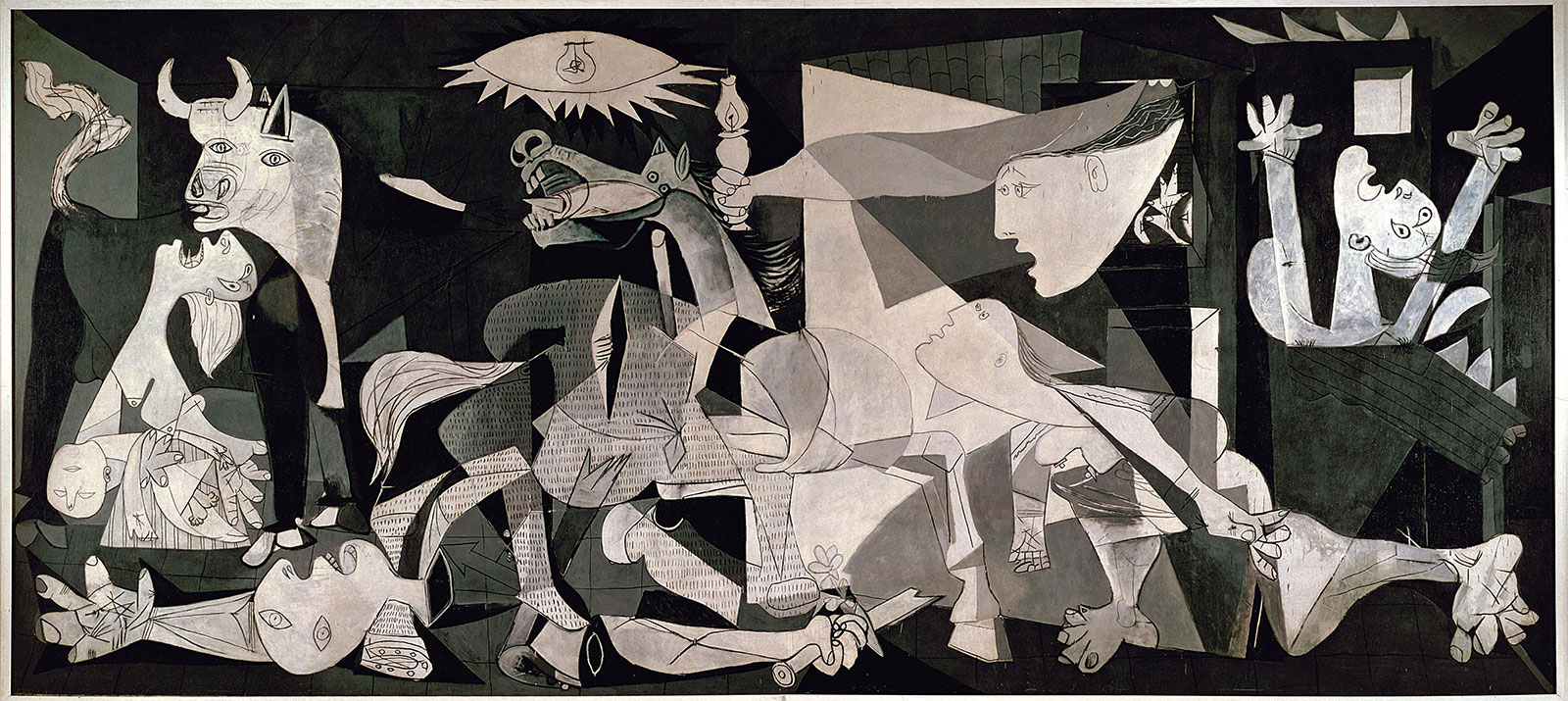
In January of 1937, Pablo Picasso was commissioned to do a painting for his native Spain to be displayed in the Spanish pavilion at the 1937 World’s Fair. His initial sketches for the project show very little difference from the theme of his other works at that time.

On the 26th of April, Nazi German and Italian Fascist air forces bombed the town of Guernica, Spain at the request of Spanish Nationalists who desired to strike against their Spanish political rivals in the region. According to local accounts, it was market day and most of the villagers were gathered in the town center when the bombs began to fall. In his diary, the commander of the Nazi squadron recorded that the town was still burning the following day. It was utterly destroyed. There were no military targets in the area. Guernica was the most ancient town and the cultural center of the Basque region. It was a terror attack designed to wipe out political rivals.

Guernica in Ruins after 1937 bombing

On May 1, Picasso read eyewitness accounts of the attack. He immediately abandoned his original ideas for his commission and began to work. The 25.5 foot wide and 11.5 foot tall painting, entitled Guernica, was finished in 35 days. Containing images of the suffering of people and animals wrought by violence and chaos, the painting prominently displays a gored horse, a bull, screaming women, dismemberment, and flames. Picasso painted it in black and white using a specially requisitioned matte house paint that was void of any gloss to give it the feeling of a black and white photograph recording a moment in time. Guernica is considered among the most moving and powerful paintings of all time.

What do artists do in response to powerful forces beyond their control? They create. They channel and express their emotions, even their most raw, painful, and socially unacceptable emotions, into their creative work.

I find today’s chapter, Psalm 35, among the most unique songs David ever wrote. As I mentioned in yesterday’s post, David’s life is quite a story. He had a lot of enemies throughout his life. There were military enemies from neighboring regions who wanted him dead. There were also internal enemies everywhere he turned. His own King wanted him dead, and therefore all of Saul’s political allies were against David. David’s own son rebelled against him, turned David’s political allies against him, and led an armed rebellion against him. David’s life journey was not an easy road.

Psalm 35 is David pouring out his emotions to God in song. You can almost feel the desperation as he begs God to take up his cause. Surrounded by those who want his life on every side, and betrayed by friends and family who he loved, David begs God to take up his cause. He pours out his soul in raw anger at his enemies, asking God to destroy them. It is not an easy read.

What do artists do in response to powerful forces beyond their control? They create. They channel and express their emotions, even their most raw, painful, and socially unacceptable emotions, into their creative work.

One of the things that I love about the Psalms is the diversity of them. David wrote liturgical, religious songs for corporate worship events. David wrote the blues when he was down. David wrote songs of intense joy when he was delivered. David wrote songs of intense contrition when faced with his tragic flaws. David wrote songs of intense anger when enemies outside his control were closing in all around him.

In the quiet this morning I find myself thinking about our emotions. Emotions can have significant negative consequences when they lie hidden, suppressed, and ignored within us. Finding healthy ways to get out my negative emotions has been one of the greatest lessons of my life journey. Many people think of God as a strict moral judge who will be shocked and punish us for expressing our “negative emotions.” I don’t find God to be that at all. Like David, I find God to be a loving creator who is not shocked, dismayed, or surprised by any of my emotions – even the negative ones. I can cry, scream, rail, and vent to God, who is Love incarnate, because love is patient, kind, and gracious.

I imagine God listening to David’s angry rant of a song, that we now call Psalm 35. I imagine David getting to the end and being almost out of breath from the pouring out of his emotions. I imagine God smiling and saying, “There. Nice. Feel better?”

If you know anyone who might be encouraged by today’s post, please share.

“Get it Out, Little Dude”

"Get it Out, Little Dude" (CaD Ps 6) Wayfarer

I am weary with my moaning;
    every night I flood my bed with tears;
    I drench my couch with my weeping.

Psalm 6:6 (NRSVCE)

This past week I was in the dentist’s chair. Neither Wendy nor I had braces when we were young, and we both have some dental issues as a result, so we’re finally pulling the trigger on doing Invisalign and doing it together. So if my voice sounds a little strange on my podcast for the next year, know that it’s because all of my teeth are wrapped in plastic!

Anyway, my dentist and I got into an interesting conversation that started when he asked me how long I’ve been doing this chapter-a-day blog. I don’t think he expected to hear that it has been fourteen years! We then proceeded to talk about some short posts that he has been writing and posting on social media, which I’ve been reading and enjoying very much. He then shared with me that he found himself with these things he was feeling and thinking that he “had to get out.” I couldn’t help think of the prophet Jeremiah when used the metaphor of the message God was giving him being a “fire shut up in my bones” that just has to get out.

Today’s chapter, another song lyric by King David, is one of the examples I have used when I tell people that the psalms read like the blues. I’m sure that the ancient music didn’t sound anything like the blues, but I’m quite certain that Robert Johnson or Jonny Lang would identify with David’s spirit and could do something amazing with the same lyrics.

In both the cases of my dentist, and King David, the same theme has contrasting lessons to teach. Sometimes, there is stuff inside that I’ve just got to get out. With the former, there is something positive inside that needs to come out because others need to hear it, learn from it, be inspired, encouraged, or comforted by it. In the latter case, there is negative energy shut-up within that needs to be exorcised and expressed so that it can’t do spiritual, emotional, mental, and relational damage that always occurs when I suppress and hold in my shame, loneliness, fear, anxiety, anger, pain, frustration, grief, hurt, [insert your own negative emotion here].

Wendy and I are opposites when it comes to handling negative emotions. As an Enneagram Eight, Wendy tends to explode with volcanic eruptions of emotion that often run hot like lava. But she exorcises those emotions quickly and then quickly settles and becomes solid rock again. As an Enneagram Four, I tend to broodingly hold the negative emotions as they boil and churn deep in my heart until daily life begins to tremor and toxic fumes start seeping out in my words and actions. It sometimes takes Wendy, or one of my close companions, to consciously drill down with me in order to release the crap that needs to be released.

Along my life journey, I’ve both experienced in myself and observed in others the tragic consequences of suppressing and holding in the toxic shit that builds up as we walk through life and relationship. I love David’s lyrical laments because they remind me of two things. First, I need to get out the crap I’m feeling even though it might be negative, raw, and even toxic. Better to get it out than to let it wreak havoc in my life. Second, God is not surprised by nor worried about my emotional crap any more than I am worried when my two-year-old grandson goes into full-tilt tantrum mode for the silliest of reasons. I totally believe that God looks at me in full tantrum mode and says the same thing to me that I’d say to Milo: “Get it out, little dude. Then take a nap. You’ll feel better.”

If you know anyone who might be encouraged by today’s post, please share.