Tag Archives: Devotioinal

Namesake

Namesake (CaD John 20) Wayfarer

Then he said to Thomas, “Put your finger here; see my hands. Reach out your hand and put it into my side. Stop doubting and believe.”
John 20:27 (NIV)

I’m not sure why my parents named me Thomas. Perhaps there was an alliteration piece to it since they already hat Terry and Tim. It’s ironic that the etymological root of the name Thomas meant “twin,” since I wasn’t a twin and brothers are. That always felt like a mistake in my book, though my parents confessed to me that I was an “oops” baby, so there’s been no forethought given to having to name another boy.

As a child, I remember names and namesakes being discussed on the playground and in friend groups. There were certain bragging rights for those who had really cool etymological roots or definitions to their names like “King” or “Mighty Warrior.” Some kids linked their names with famous people who happened to have the same moniker.

Of course, in that playground conversation I always got linked to “doubting Thomas.”

Great.

In retrospect, as an Enneagram Type Four, it was probably prescient that my parents named me the same as Mr. Doubt. I have the deep pessimistic streak that comes naturally to Fours. I have a very vivid memory of my mom rolling her eyes at me in frustration and exclaiming, “You’re such a pessimist!” (I didn’t know what it meant at the time.) So perhaps the doubting one is an apt namesake for me, despite the angst it created within me during playground conversations.

And, Fours like to be special. We have a flair for the dramatic. So it would fit that Thomas enjoys the rather special, and dramatic moment when Jesus suddenly appears behind locked doors and tells Thomas to touch His scars and feel the hole in His side. I’ve always had a personal love for Caravaggio’s dramatic depiction of the moment.

In the quiet this morning, I find my thoughts less focused in the story, and more focused on my identity and my connection to the Story. Which is what John point out at the end of the chapter. As he is wrapping up his biography, he rather blatantly reminds his readers of the thing I’ve observed multiple times in these posts over the past few weeks. John had a limitless number of stories and anecdotes about Jesus that he could have shared with readers. He chose specific stories for a specific purpose:

Jesus performed many other signs in the presence of his disciples, which are not recorded in this book. But these are written that you may believe that Jesus is the Messiah, the Son of God, and that by believing you may have life in his name.
John 20:30-31 (NIV)

John’s biography is the first thing I read after becoming a follower of Jesus. This doubting Thomas, this pessimistic, dramatic Enneagram Four, counts myself among John’s readers who have believed and received; I am numbered among those whom Jesus named when He said to Thomas, “Blessed are those who have not seen and yet have believed.”

Mom? Dad? I think you got my name right.

If you know anyone who might be encouraged by today’s post, please share.

Guernica

Guernica (CaD Ps 35) Wayfarer

Contend, O Lord, with those who contend with me;
    fight against those who fight against me!

Psalm 35:1 (NRSVCE)

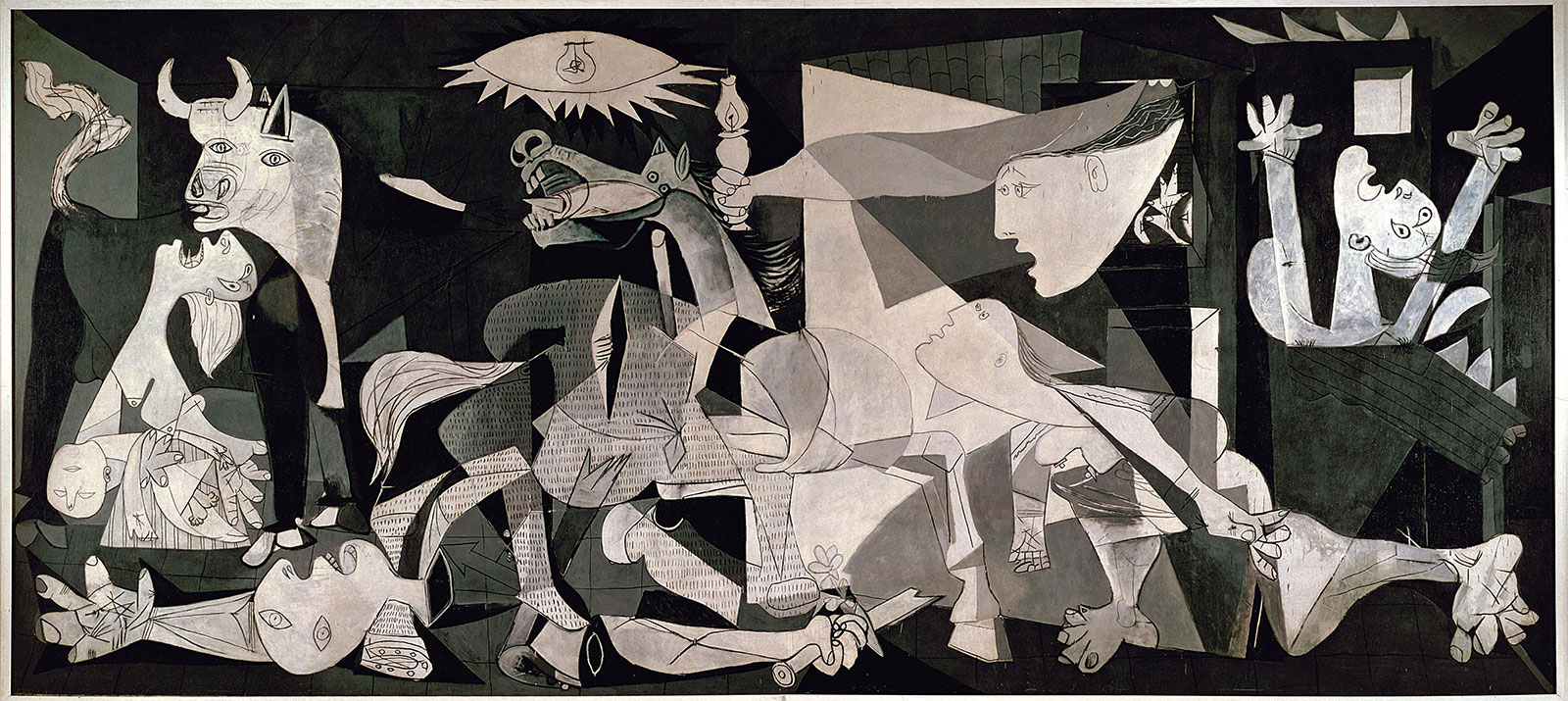
In January of 1937, Pablo Picasso was commissioned to do a painting for his native Spain to be displayed in the Spanish pavilion at the 1937 World’s Fair. His initial sketches for the project show very little difference from the theme of his other works at that time.

On the 26th of April, Nazi German and Italian Fascist air forces bombed the town of Guernica, Spain at the request of Spanish Nationalists who desired to strike against their Spanish political rivals in the region. According to local accounts, it was market day and most of the villagers were gathered in the town center when the bombs began to fall. In his diary, the commander of the Nazi squadron recorded that the town was still burning the following day. It was utterly destroyed. There were no military targets in the area. Guernica was the most ancient town and the cultural center of the Basque region. It was a terror attack designed to wipe out political rivals.

Guernica in Ruins after 1937 bombing

On May 1, Picasso read eyewitness accounts of the attack. He immediately abandoned his original ideas for his commission and began to work. The 25.5 foot wide and 11.5 foot tall painting, entitled Guernica, was finished in 35 days. Containing images of the suffering of people and animals wrought by violence and chaos, the painting prominently displays a gored horse, a bull, screaming women, dismemberment, and flames. Picasso painted it in black and white using a specially requisitioned matte house paint that was void of any gloss to give it the feeling of a black and white photograph recording a moment in time. Guernica is considered among the most moving and powerful paintings of all time.

What do artists do in response to powerful forces beyond their control? They create. They channel and express their emotions, even their most raw, painful, and socially unacceptable emotions, into their creative work.

I find today’s chapter, Psalm 35, among the most unique songs David ever wrote. As I mentioned in yesterday’s post, David’s life is quite a story. He had a lot of enemies throughout his life. There were military enemies from neighboring regions who wanted him dead. There were also internal enemies everywhere he turned. His own King wanted him dead, and therefore all of Saul’s political allies were against David. David’s own son rebelled against him, turned David’s political allies against him, and led an armed rebellion against him. David’s life journey was not an easy road.

Psalm 35 is David pouring out his emotions to God in song. You can almost feel the desperation as he begs God to take up his cause. Surrounded by those who want his life on every side, and betrayed by friends and family who he loved, David begs God to take up his cause. He pours out his soul in raw anger at his enemies, asking God to destroy them. It is not an easy read.

What do artists do in response to powerful forces beyond their control? They create. They channel and express their emotions, even their most raw, painful, and socially unacceptable emotions, into their creative work.

One of the things that I love about the Psalms is the diversity of them. David wrote liturgical, religious songs for corporate worship events. David wrote the blues when he was down. David wrote songs of intense joy when he was delivered. David wrote songs of intense contrition when faced with his tragic flaws. David wrote songs of intense anger when enemies outside his control were closing in all around him.

In the quiet this morning I find myself thinking about our emotions. Emotions can have significant negative consequences when they lie hidden, suppressed, and ignored within us. Finding healthy ways to get out my negative emotions has been one of the greatest lessons of my life journey. Many people think of God as a strict moral judge who will be shocked and punish us for expressing our “negative emotions.” I don’t find God to be that at all. Like David, I find God to be a loving creator who is not shocked, dismayed, or surprised by any of my emotions – even the negative ones. I can cry, scream, rail, and vent to God, who is Love incarnate, because love is patient, kind, and gracious.

I imagine God listening to David’s angry rant of a song, that we now call Psalm 35. I imagine David getting to the end and being almost out of breath from the pouring out of his emotions. I imagine God smiling and saying, “There. Nice. Feel better?”

If you know anyone who might be encouraged by today’s post, please share.