Tag Archives: Process

Shame-less

source: fabbriciuse via flickr

They will forget their shame and all the unfaithfulness they showed toward me when they lived in safety in their land with no one to make them afraid. Ezekiel 39:26 (NIV)

I reached a point as an adult in which I realized that for much of my life journey I had been plagued with an underlying sense of shame, 

Shame (noun) \ˈshām\ a painful emotion caused by consciousness of guilt, shortcoming, or impropriety.

I felt a constant sense of being “less than” some sort of ubiquitous “should be.” I had a friend and therapist who once asked me to place a label to the core pain I felt deep in my spirit. After pondering the question for a week or two the answer I came up with was “not enough.”

This led me on a journey of learning more about shame. There is healthy shame and there is unhealthy shame. Like our appetite for food, healthy shame is a necessary part of a balanced life. Shame for our honest mistakes and shortcomings motivates us to check our behavior and make positive changes. But, appetites unbridled lead to unhealthy places. Shame that is unchecked and out of control leads to all sorts of negative consequences like negative self image, depression, seeking to cover our nagging negative feelings in unhealthy ways, and etc.

I came to realize over time that I was not alone in my struggle. Most people, whether they realize it or not, grapple with an underlying sense of shame. I have come to the conclusion that unhealthy shame is a very natural part of the human condition after The Fall. My discoveries led me to a time of study, introspection, and change. I began catching myself when my thoughts were given over to shame. I started consciously allowing myself to be affirmed in an active counter balance to my destructive self talk. As a result, I have I’ve found myself in much healthier places over time.

Today’s chapter is a continuation of the prophetic foreshadowing of the end times that began in yesterday’s chapter. I found it interesting that one of the restorative spiritual promises God gives is that the people will, in this climactic conclusion, “forget their shame.” I look forward to the Day when I can completely forget my shame.

Until then, I will continue on in my struggle to keep unhealthy shame in check, one day at a time.

Process, Not Results

Wendy Vander Well, Doug DeWolf (Dean De Haas) and Jana De Zwarte (Marian De Haas).
Wendy enjoying the rehearsal process with Doug and Jana.

You must speak my words to them, whether they listen or fail to listen….
Ezekiel 2:7a (NIV)

Wendy and I have often conversed about our love of process as it relates to the theatre. As actors, we love the process of character development and scene exploration during the rehearsal period perhaps more than we enjoy performing in front of an audience. Don’t get me wrong. Performances are wonderful and intoxicating, but they are often a very momentary high. In the rehearsal process you grow, you make new connections, you explore new challenges, and delve to new depths in ways that stick with you long after the final curtain falls on a production.

I found it interesting this morning that God tells Ezekiel to speak the words given to him without regard to the results. Ezekiel was not to worry about whether people listened or not. He was not to concern himself with huge Billy Graham style calls for salvation. The only thing Ezekiel was to concern himself with was being faithful in the process of listening and speaking. The results were not his responsibility, nor were they an indicator of success or failure.

These things were rattling around in my head and heart this morning as I prepared to walk up to my office and write this post. I’ll admit that there are days that I question why I write these posts each day. It’s Monday. I didn’t sleep particularly well last night. My morning feels fubar-ed before it ever began. Arrrghhhh. Who cares? I confess that there are days when I feel quite profound and the response is the internet’s equivalent of crickets chirping. Other days I feel like I just puke something on the page in order to hit “Publish” and be done with it and someone, somewhere replies that it was just what they needed to read that day. Go figure. Whether you’re a prophet, a preacher, a poet, a playwright, a blogger, a writer, a songsmith, an actor, a filmmaker, a dancer, et cetera, or et cetera the truth remains: It’s about the process. The results will take care of themselves.

Happy Monday. Grind it out.

A New Song

Musician in Funchal
Musician in Funchal (Photo credit: lode.rummens)

I will sing a new song to you, my God;
Psalm 144:9a (NIV)

Can people really change, or are we stuck in patterns of behavior over which we are powerless?

That is a pretty important question for anyone who gives serious consideration to their life and path. Over the years I’ve run into a lot of people who truly and honestly raise the white flag of surrender on their habits and destructive behaviors:

  • I was born this way.”
  • It’s genetic.”
  • It’s just who I am. I can’t change.”
  • There’s nothing I can do about it.”

I have come to recognize that there are some things that we can’t change, although I’ve discovered that most of the things that I can’t change are circumstances and people I don’t and shouldn’t control. My own thoughts, words, and behaviors however are things I’ve found that can and do change.

I was struck this morning by David’s commitment to sing a new song to God. He’s not just singing a song, but a new song. It’s an important recurring theme in David’s lyrics. Across the anthology of psalms you’ll find the phrase “new song” in psalms 33, 40, 96, 98, 144 and 149. I love the word picture because God is a God of transformation. Through victories, defeats, major successes and abysmal failures David continued to recognize God’s continuous and transformative act of creation in his life.

My personal experience of following Jesus is that it leads to a never ending call to examine, confess, and change. My life is a churning process of personal re-creation. The theme of my life’s song changes from season to season. Old things pass away, and new things come. And, it never ends in this lifetime unless I choose out. And, choosing out is always an option. Many people do.

This morning I am more committed than ever to the music God is composing through my life. There are dissonant notes coming out of my thoughts, words, and actions which I know I need to change. There are parts of the orchestration that I don’t control and I must be content to make changes and improvisations that weave my notes into harmony with them. The one thing I don’t want to do is stop playing.

Enhanced by Zemanta

Some Things Bear Repeating

Gnomeo & Juliet
Gnomeo & Juliet (Photo credit: Wikipedia)

My heart, O God, is steadfast;
    I will sing and make music with all my soul.
Awake, harp and lyre!
    I will awaken the dawn.
I will praise you, Lord, among the nations;
    I will sing of you among the peoples.
For great is your love, higher than the heavens;
    your faithfulness reaches to the skies.
Be exalted, O God, above the heavens;
    let your glory be over all the earth.
Psalm 108:1-5 (NIV)
[and Psalm 57:7-11 (NIV)]

Wise King Solomon said, “There is nothing new under the sun.” We are always taking what has been and repurposing it, recycling it, or building on it anew. It’s part of the creative process God bred into us when He, the master Creator, molded us in His own image. For example, consider Shakespeare’s famous romance Romeo and Juliet. One does not have to search far to find countless adaptations of the Bard’s timeless story:

Adaptations and regurgitations aren’t inherently wrong or bad (though some of them are certainly poor reflection of the original). The truth is that some things bear repeating. As children we hear our parents repeat the same things over, and over, and over. As parents we repeat the same things to our children over, and over, and over. It often takes us hearing the same message repeated ad nauseam before it finally sinks in and gets applied. As an actor, I repeat the same lines over and over and over again as part of the memorization and rehearsal process. It never ceases to amaze me how often I will say a particular line countless times, but find new depth of understanding and meaning after hundreds of repetitions.

When reading through the collective lyrics of the Psalms, it’s easy to feel like we’re reading the same thing over and over. That’s because, in some cases, we are. The opening verse of Psalm 108 is an almost word-for-word repeat of the last verse of Psalm 57. Likewise, the third verse of Psalm 108 is a repeat of last verse of Psalm 60.

Some things bear repeating, and some do not. Wisdom is knowing the difference.

Preparing for a Role: Bits & Moments in the Grind

This slideshow requires JavaScript.

It’s been a few weeks since I’ve posted about my preparations for a role in the Central College Theatre Department’s production of Ah, Wilderness!. The last time I posted we had the show blocked and had begun the process of really digging into our characters and working the scenes in rehearsal.

One of the things that you learn in the rehearsal process is that, in most productions, there is a natural flow to it. The initial excitement and fun of launching into the work together eventually gives way to a rehearsal grind. You work the same scenes over and over and over again. You get tired of being there. You stop looking forward to rehearsal and feel a sort of “here we go again” groan as you head to the theatre. It’s natural. It will eventually lead to a second wind of excitement and adrenaline before performance. The rehearsal grind is necessary and profitable for finding deeper layers of understanding, relationship and authentic moments on stage.

“Bits” and “Moments”

It’s in the grind of working scenes over and over again that you begin to find “bits.” “Bits” are small actions on stage, typically physical in nature, that generally provide a little humor. For example, in one scene my character is coming home just in time for family dinner after having gotten a little tipsy at a Fourth of July picnic. The script calls for me to greet our housemaid, Nora, with a simple “Hello, Nora” while giving her a courtly bow. As we worked the scene I realized that I’m greeting Norah just as she’s coming out of the swinging kitchen door with a serving bowl full of hot soup. I suddenly thought it would be a funny to hide behind the door so she doesn’t see me as it swings open, then jump out from behind and scare the daylights out of her. The first time I did it I think I actually did give actor Abbi Hartman, who plays Nora, a small heart attack (sorry, Abbi!).  The bit got a good laugh, however, and Director Ann Wilkinson let me keep it in the show.

Compared to a physical bit, a “moment” is more of a relational connection that is made between two characters. It might not be verbal or physical. A moment could be a look or a silent connection. These moments begin to emerge only as you grind out the scene over and over again and delve deeper into the character and the circumstances that are happening within the scene. For an actor, there can be a feeling of magic when moments happen. In that moment the lines, blocking, and character work all combine to create a very real, very emotional moment between you and a fellow actor within the scene. This is when you know you’ve begun to press beyond just “going through the motions” and are creating a reality on stage which will cause audiences to suspend their disbelief and get lost in the world of the play.

For example, there is a subtle “moment” that happens when my character confronts his young son, capably played by Jacob Anderson, about whether he’s been trying to take advantage of his girlfriend. In his defense the 16 year-old son spills that he and the neighbor girl are engaged. As we worked the lines in the scene the reality of the moment sunk in that my 16 year-old son is surprising me with news that he’s engaged. That reality caused me to reel back with a look of paternal astonishment. That look, in turn, caused Jacob to respond with a defensive pull back and the way he played his next line changed. It’s a small moment, but it allowed me to feel that this is a very real moment between father and son.

Some of my other favorite moments happen in the final scene of the play in which my character and his wife, Essie, are sitting together in the quiet of a summer evening having a marital conversation about their children, the days events, and engaging in that subtle non-verbal dance of flirtation between husband and wife that eventually leads to bed (don’t worry – only the flirtatious non-verbal part is in the script). First of all, I have to compliment my fellow actor Tiki Steen who has had to face the challenging task of being a young female college student thrown into an on-stage marriage with a strange man old enough to be her father. Acting can put you in weird situations and Tiki has handled it with cheerful humor and a generous amount of maturity for an actor her age. I bring years of marital experience to the scene which helps tremendously. I can totally relate to late evening conversations about children and worries and subtextual flirtations that happen between husband and wife. Tiki has had to do the yeoman’s work of learning, exploring and discovering. The reward for both actor and audience is some very genuine moments that happen in the scene.

As I rolled out of bed this morning about 2 hours later than normal, Wendy commented on how much of a toll “the grind” of rehearsal has taken on me. When you work a part hard and rehearse well, it can tax you physically and mentally. I tend to come home from rehearsal tired, but buzzing from the experience. I have to take some time to wind down, debrief with Wendy about the rehearsal, have a small bite of something and a nightcap, and let my brain and body relax. That usually means getting to bed a little later than normal and being a little more worn out than usual.

The grind is over. Tomorrow is a long technical cue-to-cue rehearsal. Then it’s three dress rehearsals before opening night.

Ticket and Production Information for Ah, Wilderness!

Preparing for a Role: Rehearsal Process

Ah Wilderness Rehearsal

Time is flying and between work, sleep, and rehearsal I’ve not had much time to write. I’m finding that the rehearsal process for college is shorter and more intense than I’d remembered. In community theatre you tend to rehearse a show for 8-12 weeks and have about three rehearsals a week. With Ah, Wilderness! we’ve been rehearsing five times a week and only have 5-6 weeks.

For those who’ve never been in a show, the rehearsal period can basically be broken into:

  • Blocking: In which you go through the scene, script in hand, and the director decides where she/he wants you to move as you say your lines. You do a lot of jotting down where you are on stage and where you’re supposed to move.
  • Working: The scenes are “blocked,” but now you start running through them top to bottom to get a feel for how it flows. You dig in to what your characters are doing and thinking. Eventually, you put down the script and run it “off-book.” The stage manager is generally sitting there with the script. If you forget your line you yell “Line” and she/he feeds it to you.
  • Run & Polish: With everyone off book and things starting to come together, you begin running scenes, acts, and the show from top to bottom. Costumes, props, and set pieces are incorporated. The director begins targeting scenes that need to be polished. Eventually, the director tells you you’re “off-book” and if you drop your line you’re on your own.
  • Tech Rehearsal/Cue-to-Cue: These rehearsals (typically in the later stages of the process) are all about incorporating sound effects and lighting changes. Actors typically do a lot of standing around and running scene changes over and over again as the tech crew get their cues set.
  • Run/Dress Rehearsal: With all the elements in place, you begin running the show as you will in performance. The director waits until the end of the night to “give notes” in which she/he will tell you what you need to work on or change before the next rehearsal.

I’ve really been enjoying rehearsals at Central College. We’ve finished blocking the show and are beginning to work the scenes and acts. It’s been fun working with the students and we’re getting to know one another. Chatting in the dressing room with Jacob Anderson who plays my son Richard in the play, I came to find out that Jacob and his family used to be members of Westview Church where I was a member before moving to Pella. I knew Jacob when he was a baby and now he’s a freshman in college and I’m in a show with him [cue: weary groan] Dang, I’m old.

The students have been great to work with. I have the advantage of having seen many of them in multiple shows at Central, and I’ve gained respect for their abilities even though I’ve never truly met them. They’ve never seen me on stage, however, and don’t have a clue who I am. So, we’re getting to know one another.

So, what am I learning?

  • Life makes you a better actor: Wendy and I were watching Derek Jacobi on PBS’ Shakespeare Uncovered yesterday. Sir Derek was watching himself play Richard II when he was 30 years younger. “I wish I could do it again,” he said. “I could do it better.” Wendy and I said in unison, “Of course you could.” The truth is that actors draw from life experience in developing their characters. The more you experience in the life, the more you have to bring to your character. The other night I had a conversation with Tiki Steen, a fine young actor, who plays my wife Essie in the show. There’s some subtext in one particular scene in which husband and wife are doing the subtle, unspoken flirtations that husbands and wives weave into everyday situations as they toy with the idea of making love that night. Obviously, Tiki has never experienced these flirtations so I was able to shed some light on what Nat and Essie are really communicating with one another.
  • Productions have different motivations: Actors talk about their character’s motivation all the time, but the entire production has a motivation, as well. Wendy and I were having a conversation with Ann Wilkinson who is directing Ah, Wilderness! the other night after rehearsal. She spoke about the transition she’s had to make from being a professional casting director to small college professor. A hollywood film is about motivated to make money, but a college production is motivated to educate students. The atmosphere in a Central production is different than a USP production because college and community theatre have slightly (though not completely) different motivations. Sometimes you have to alter your personal expectations and lean into the production’s motivation.
  • I love the process as much as the performance: I can’t say I’m learning it for the first time, but I’m rediscovering it again, as I do every time I get the opportunity to dig my teeth into a role. While there is no rush like making your entrance with a packed house watching, there is a subtle and somewhat more satisfying rush from the process of discovery, work, and collaboration in rehearsals.

Preparing for a Role: Digging Into the Character

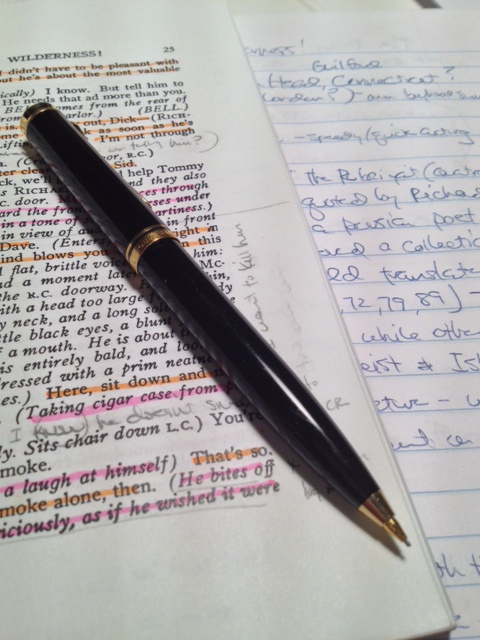
scriptworkAs an actor, I want an audience to willingly suspend their disbelief for a couple of hours and really believe that I am the character I’m portraying. When I step on stage in Ah, Wilderness! I want those who know me to forget that they’re watching Tom Vander Well and get sucked into the life and times of Nat Miller. The better I understand the character of Nat Miller, the more likely I am to succeed, and understanding the character takes work. It means being researcher, detective, historian, psychologist, artist, and writer.

Character work is one of the most enjoyable parts of the acting process for me. Here is a brief description of some of the steps I go through as I’m digging into a character:

  • What does the playwright say about the character? Eugene O’Neill does a nice job of describing his characters. Nat Miller is described: “in his late fifties, a tall, dark, spare man, a little stoop-shouldered, more than a little bald. Nat’s face has large, irregular, undistinguished features, but he has fine, shrewd, humorous gray eyes.” I may not look exactly like O’Neill describes, but I get a sense of Nat from words like “spare,” “stoop shouldered,” “humorous,” and “shrewd.”
  • What do other characters in the play say about my character? In one scene my character is off stage, my wife and the other adults talk about the fact that Nat always talks about being allergic to a certain kind of fish even thought my wife has served it to me for years without me knowing it. So, I like to repeat myself and have certain strong beliefs that might not always be accurate. It hints at a playfulness between Nat and his wife. In another scene, a salesman and bartender speak about my characters ability to make life difficult for them, hinting at Nat’s prominence and clout in the community.
  • What do I learn about my character from his own words and actions? Nat uses “hm” a lot, which is very interesting. We all have vocal idiosyncrasies, and that’s one of his along with repeating phrases: “Couldn’t help it. Just couldn’t help it!” Nat puts on a strong, authoritative role when his children are around, but when it comes to actually having an intimate discussion with his son he’s reduced to babbling.
  • In what time and culture does my character live? How would that make him different than me? What was life like then in that place? 1906 was a more proper time. Proper in the way people dress, talk, and the manners they use around the house. The Millers have a servant and an automobile, hinting at the fact that they are well off in that time. How would that change the way I act and relate to others compared to being lower class at that time? How does that effect my expectations of the children in their lives, words, actions, and how they are viewed by the community?
  • What is my characters age and occupation? What was that like? Nat owns a newspaper. Some internet research about what the newspaper business was like in 1906, specifically in Connecticut yielded some interesting results. Yellow journalism was rampant in that day. Newspapers not only reported the news but helped rise and destroy people and their careers. Most newspapers were backed by political parties and were the vehicle of how a political party got their views out. What party was Nat Miller affiliated with? What were his political connections? How did he use his paper to get ahead or influence his community?
  • What is my characters life story? One of the exciting things about acting is the fact that you get some creative control. I will often take my character journal and spend some time doing free writing in a stream-of-consciousness style. I’ll invent an entire back story. What were Nat’s parents like? When did his family come to America? What was his childhood like? Where did he go to school? How did he meet his wife? What dreams did he have as a child? How did he come to own the newspaper? It can be challenging to take hints and clues you find in the script and fill in gaps. The more completely you flesh out the character, the easier it becomes to step into character when you’re on stage. Your lines and the relationships with other characters on stage take on new depth and layers of meaning.
  • What is my relationship with the other characters on stage? Nat has four children in the show and two who do not appear in the play. What does he think of each of his children? Does he have a favorite? His sister is visiting. What was their relationship like growing up? Again, a character journal and some free writing can yield interesting thoughts and discoveries that may turn into interesting choices for how to play a line or react to another character.

Of course, this is all work that takes place outside of rehearsal. It is the homework of an actor’s preparation. Just like school, the more work you do outside of class the more prepared you are when it comes to the discussion in class and the eventual test. It is no different when it comes to the stage. A little work outside of rehearsal can make a big difference in both the rehearsal and in the eventual performance.

[Ah, Wilderness! is being produced by the Theatre Department of Central College under the direction of Ann Wilkinson. It will be performed on the campus of Central College in Pella, Iowa Feb 27 through March 3, 2013.]

Chapter-a-Day John 7

“Look beneath the surface so you can judge correctly.” John 7:24 (NLT)

One of the things Wendy and I have learned about acting over the years is that we enjoy the character work as much as we do the actual performance. Building a character means doing the ground work, investigating the character’s history and relationships, and peeling back the layers of who a person really is below the lines of the script and the movement of the director’s blocking. The character work an actor does brings depth to the character on stage.

One of the life lessons that doing character work has taught me is that people are complex, multi-faceted creatures. If I simply memorize the lines and move from point A to point B like a trained dog I do a great disservice to the complex creature I am portraying. Plumb the depths of a character’s heart and mind and you begin to empathize with who he is and why he does the things that he does. Only then can my acting begin to serve the character and the story well.

As I read today’s chapter I could almost feel the chaos of public opinion swirling around Jesus. The religious leaders were saying one thing about Him, some of the crowd another, His family were saying something different, while within His own inner circle of followers there was an on-going debate about Him. Like all who find themselves in the public spotlight, Jesus was finding Himself judged, labeled, and branded. He knew that people were misjudging Him because they had not taken the time to look below the surface of what they saw and heard, to plumb the depths, and to understand who He really was.

Whenever we brush over another person with a swash of generalization, we diminish them so as to justify our simplistic judgement of them. I have done the same thing. I do it all the time. We would all do well to obey Jesus’ command to look below the surface so we can judge correctly. We would all do well to do a little character work for those creatures and characters we dismiss, diminish, hate, or simply avoid. If we do so, we might find there’s more to their story than we ever imagined. We might just treat them with a little more love and understanding. We might just become better creatures ourselves for having done so.

Chapter-a-Day James 4

god
Image by the|G|™ via Flickr

You want what you don’t have, so you scheme and kill to get it. You are jealous of what others have, but you can’t get it, so you fight and wage war to take it away from them. Yet you don’t have what you want because you don’t ask God for it. And even when you ask, you don’t get it because your motives are all wrong—you want only what will give you pleasure. James 4:2-3 (NLT)

The study of acting is really the study of humanity. To portray a character realistically, you have to understand who this person is, how they think, how they talk, and how they move. You have to understand what makes this character, this person tick. Great actors peel away the layers of a character and get to the heart of who he or she really is. The deeper you understand the character, the more fully you can embody him or her on stage.

As I step into a role, one of the first things that I do is a process called “beating the script.” I break my scenes into “beats” or sections determined by what the character is thinking. The underlying premise is that the character wants or desires something at all times. His or Her words are driven by an internal desire. If you identify the characters ultimate “want” then you can begin to connect the dots of “wants” in each moment of the scene from beginning to end. Then, when you play the scene, you don’t play the words, you play the wants.

What’s interesting about this process is that the truth of it is identified right in God’s Message. It’s in today’s chapter. We are all driven by our wants. We each have deep, core desires that determine the things we do and say each day. We want to be secure. We want to be loved. We want to be rich. We want to be famous. We want [fill in the blank]. As we live in relationship each day, those motivations lead us to thoughts, ideas, words, interactions and behaviors.

So, what is it I really want? That is a question with which we each need to grapple, and find the answer for ourselves. When we do, a lot of other things come into focus.

Chapter-a-Day Isaiah 11

S7300939_800x600 Each morning he'll pull on sturdy work clothes and boots, and build righteousness and faithfulness in the land. Isaiah 11:5 (MSG)

This past winter we started a construction project that will continue through this coming summer. It's partially finished and the upstairs part looks beautiful. But, there's also a downstairs part that looks really ugly, bare and dirty. Someday it will be beautiful, but for now it's more than a bit unsightly and anyone who ventures down there will get dirt on them.

I remember when I was a young man I felt the expectation and need to be perfect through-and-though. I was really uncomfortable with some of the unsightly parts of my character and my flawed humanity. So, I dressed up the "upstairs" parts of me that looked finished to perfection and tried to hide the door to the basement where others could see the bare, ugly mess that was just as much a part of me as the finished parts.

I'm reminded this morning that Jesus, the Branch of Jesse, came to do a work in me until it's completed. I am still under construction as God builds righteousness, faith and Christ-like-ness in me. There's a lot to be done. A construction site is a messy, muddy, dusty, and chaotic place. You can't dress a construction site up with a nice area rug and pretend that it's a finished room.

Somwhere along the way I gave up trying to pretend I'm a finished project. I decided to let people see the messy part of me that's under construction. They'll just have to pardon the mess. To my amazement, loved ones were not only gracious, but more than willing to get thair hands dirty and help with the work.