Tag Archives: Robin Hood

Legendary

Legendary (CaD 1 Ki 9) Wayfarer

This temple will become a heap of rubble. All who pass by will be appalled and will scoff and say, ‘Why has the Lord done such a thing to this land and to this temple?’
1 Kings 9:8 (NIV)

I have recently been listening to a podcast called This is History with Dan Jones. For any fellow history geeks reading this, I highly recommend it. The first season tells the story of the “Plantagenet” kings of England, including the crusading Richard the Lionheart and his brother, Prince John, who are typically familiar to most people because of their presence in our regular, contemporary retellings of the legend of Robin Hood. The truth is that the Robin Hood legend was not originally set in the same period of time as Richard and John. Modern writers and producers have connected the two to give the story a little more pizazz.

How fascinating that most people today have better recall of the fictional Robin Hood legend than anything about the very real histories of Richard, John, and their Plantagenet family whose real stories are every bit as entertaining as that of the legendary outlaw.

In today’s chapter, Solomon receives a second appearance from God in which God acknowledges the now completed and consecrated Temple in Jerusalem and then warns Solomon and his descendants that if they are unfaithful and worship other gods the Temple will be reduced to rubble and publicly ridiculed. The rest of the chapter goes on to list other accomplishments of Solomon’s impressive 40-year reign.

As I was pondering these things in the quiet this morning, I couldn’t help but mull over the reality that there is scant evidence that King Solomon ever existed. In fact, I had teachers in school who proudly boasted that the entire story of King Solomon was as legendary a fabrication as Robin Hood. It is true that compared to other historical figures such as Richard the Lionheart and Prince John, we have little actual physical evidence to corroborate the story. Of course, Solomon lived a couple thousand years before the Plantagenet kings.

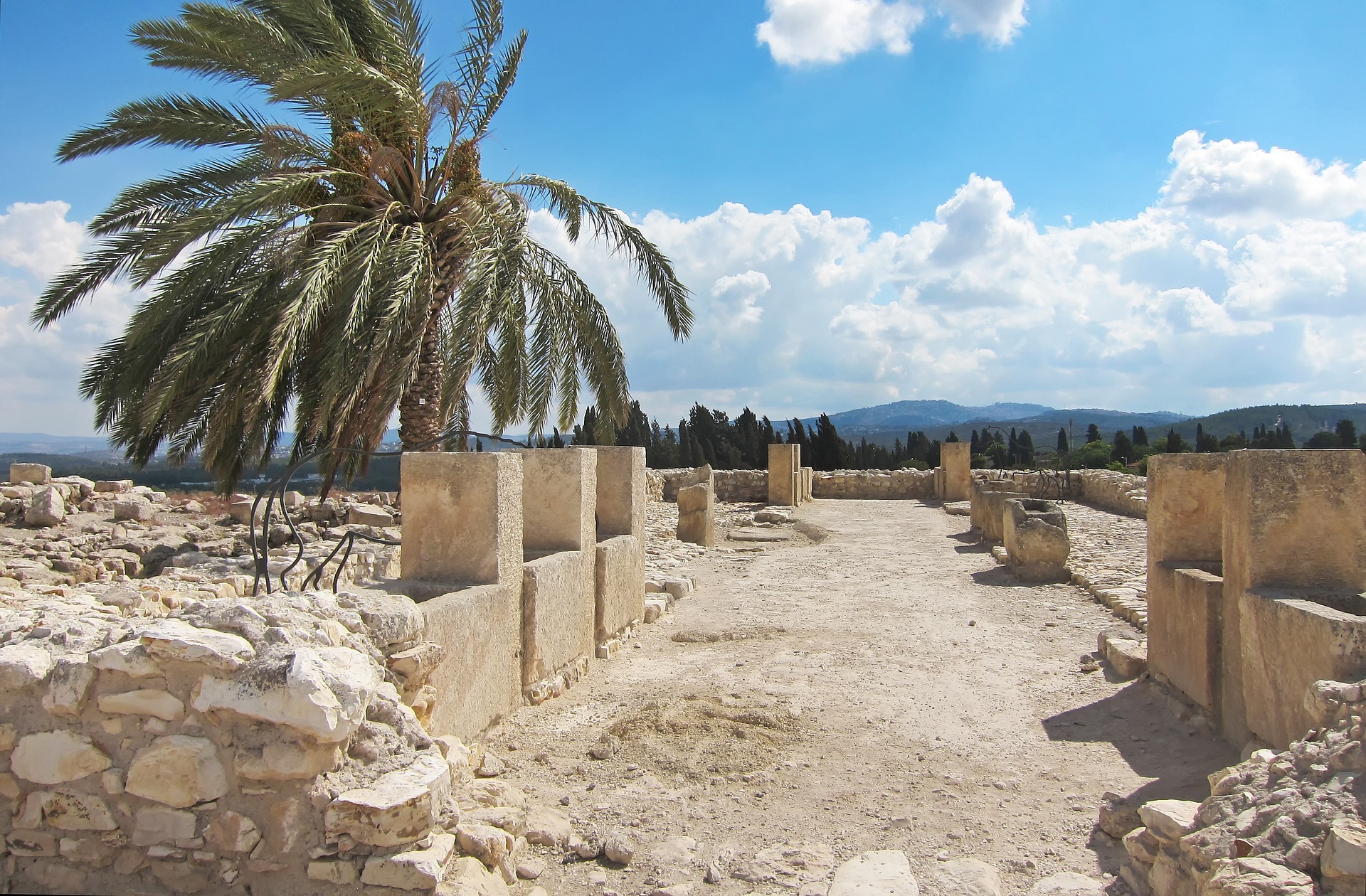
Having said that, modern archaeology has unearthed actual evidence of the building of fortifications at Hazor, Megiddo, and Gezer that date to the time of Solomon and corroborate the text in today’s chapter. In addition, horse stables have been unearthed as described in the text (note: today’s featured photo is of unearthed horse stables at Megiddo). Recently unearthed clay seals have also provided historical evidence to prove the historicity of both David and Solomon.

What I find fascinating, however, is the spiritual lesson that lies at the heart of this modern doubt and dismissal of the great and successful Solomon. Solomon had a successful forty-year reign. He fortified the territory his father conquered. He pulled off extensive building campaigns. He established trade routes on both land and sea and established treaties and alliances with neighboring kingdoms and empires. He was, according to the text, the most successful king by earthly standards in the history of Israel.

And he’s popularly dismissed in modern times as nothing but an exaggerated religious legend.

God warned Solomon and his descendants that their lack of faithfulness would result in the destruction of the Temple. What was also destroyed was Solomon’s legacy. Everything Solomon worked for, everything he built, everything he accomplished, and all of his worldly success ended up on the scrap heap of history that is still publicly ridiculed as rubbish to this day. His legendary success is dismissed as nothing but a legend.

In the quiet this morning, I can’t help but think about Jesus telling His followers to be mindful of what I treasure on this earthly journey. It’s basically a riff on the message Solomon received. If I invest my time, energy, and resources in building God’s kingdom, the “treasure” is an eternal legacy. All of the earthly treasures I acquire in chasing worldly success will, on the other hand, end up completely forgotten on the scrap heap of history right next to Solomon’s.

If you know anyone who might be encouraged by today’s post, please share.

Prayer of Desperation

Prayer of Desperation (CaD Ps 54) Wayfarer

Surely God is my help;
    the Lord is the one who sustains me.

Psalm 54:4 (NIV)

It could be argued that in King David’s young adult years he was a loose archetype of the legendary character we know as Robin Hood. He is living in the wilderness with a rag-tag band of some 600 vagabonds, mercenaries, and outcasts. David’s got a price on his head and mad-king Saul is hell-bent on killing his young rival whom he knows is God’s anointed replacement to his throne.

The thing about having a big price on your head is that you never know who you can trust. David and his merry band of exiles have been on the move, trying to stay one step ahead of Saul and his army. While hiding in a region known as the Desert of Ziph, the people of that area see a prime opportunity to cash-in on the sizable bounty Saul has laid out for David’s capture and strengthen their diplomatic ties with the current ruler.

In short order, David and his men find themselves on the run. Saul and his army are closing in. It’s a dire situation and things look hopeless. In the midst of his desperation, David writes a song. It’s the song we know as Psalm 54.

I love about Psalm 54 is short, sweet, and to the point. It’s like a guttural prayer that surfaces in the heat of the moment. It’s just seven short verses that begin with a plea for God’s vindication and end with David’s proclamation of faith that God will rescue David from his tight spot. As I’ve mentioned in previous posts, Hebrew songs like this were structured to be symmetrical with the center verse being the key to the entire thing. The center verse is the heart of what the songwriter is trying to express:

Surely God is my help;
    the Lord is the one who sustains me.

Along this life journey, I also encounter moments when I feel pinned down by circumstances stacked against me. There are times when I feel like I’m stumbling around with the darkness closing in. I have flashes when my prayer feels like Princess Leia’s hologram.

In the quiet this morning I found myself ear-marking Psalm 54 for those times when I, like David, have the enemy bearing down on me and there are others who seem to be against me. David’s song makes a great prayer of faith and assurance in the midst of desperation.

Psalm 54 is also a reminder that God does answer prayer. Just as Saul and his army were about to capture David and his men, a messenger arrives to tell Saul that a foreign army was raiding the land. Saul and his army had to stop their pursuit. David and his men escaped to a hideout in another area. It turns out that David’s musical prayer was prophetic:

You have delivered me from all my troubles,
    and my eyes have looked in triumph on my foes.

May you be blessed to find yourself delivered from your troubles today, my friend!

Of Robin Hood and Corrective Lenses

Douglas Fairbanks as Robin Hood; a screenshot ...
(Photo credit: Wikipedia)

David left Gath and escaped to the cave of Adullam. When his brothers and his father’s household heard about it, they went down to him there. All those who were in distress or in debt or discontented gathered around him, and he became their commander. About four hundred men were with him…. But the prophet Gad said to David, “Do not stay in the stronghold. Go into the land of Judah.” So David left and went to the forest of Hereth.
1 Samuel 22:1-2;5 (NIV)

Most people know the childhood story of David and Goliath. Many people know the more adult story of David and Bathsheba. Many people know of King David the great. Few people really know that between the time Samuel anointed David as king and the time that David actually became king, there were over two decades in which David was an outlaw, a wanted man, and a man on the run.

This morning’s chapter is a description of the early days of David’s years as a successful outlaw. There are two observations I made this morning as I read:

  • David is a cunning warrior and a charismatic leader. Wanted by the king, he gathers around himself a rag-tag group of followers who were themselves outcasts. On the advice of the local friar, they take up residence in the forest. Think about that for a second. Does it sound like anyone familiar? Yep, David is the original Robin Hood.
  • The group of people who become David’s closest followers are described as in distress, in debt, and discontented. These are not the polished, educated and well-to-do members of society. These people who gather around David are the dregs of society, and in this David becomes a type of Jesus, who started his own career on the outskirts of Israel with a rag-tag group of disciples who were themselves outcasts and societal leftovers.

As a culture it is easy to become enamored with the best and the brightest, and yet God continually reminds us that His ways are not our ways. As we journey through God’s Message we find that, time and time again, God eschews the best and brightest and surrounds Himself with the dregs. This morning I am once again faced with the hard reality that I spend most of my life looking at things through the lens of contemporary culture and fail to perceive things with a Kingdom perspective.

God, forgive me my spiritual astigmatism. Heal my eyes, or at least give me corrective lenses, that I might see life, circumstance, and others with 20/20 vision of your Kingdom’s perspective.