Tag Archives: Deuteronomy 6

The Story We Tell With Our Lives

Hear, O Israel: The Lord our God, the Lord is one. Love the Lord your God with all your heart and with all your soul and with all your strength
Deuteronomy 6:4-5 (NIV)

As my family’s unofficial historian and pastor, I’ve become a repository for old family bibles.

“What should we going to do with great-grandma’s bible? Anyone want it?”

Nah! Give it to Tom.”

Yes, I will take it. The first thing I will do is look to see what it contains besides the pages and the printed text. When a Bible is well-used it collects things. Ephemera of all kinds gets stuffed in the pages. It’s fascinating what people choose to keep. Handwritten notes are often found scribbled in the margins. It can be a window into an ancestor’s head and heart.

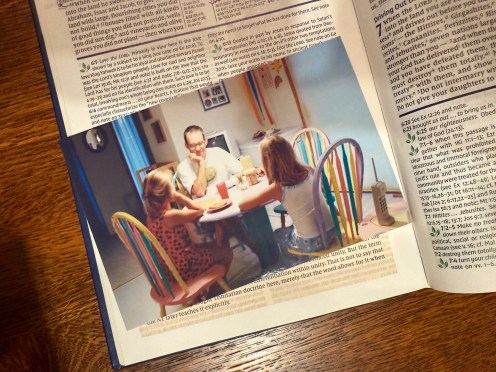
In my Bible there is a photograph. I don’t even remember putting it there. I think it randomly surfaced and I just shoved it inside the cover of my bible because it was convenient in the moment. It’s still there years later. The photograph is of my daughters and me at the breakfast table. They are about eight or nine years old and are eating their breakfast. I’m sitting there right where they found me when they got up, bible open. I’ve been doing this early morning meditation thing for a long time.

Today, our grandson Milo celebrates his eighth birthday. A generation has come and gone since that photograph in my bible was taken. When Milo comes to visit, his room is across the hall from my home office. Like me when I was his age, Milo is a morning person. So, amidst my quiet time I will hear the pocket door to my office slowly slide open and Milo will slide up on Papa’s lap. Just like my daughters used to do.

I could sit in today’s chapter for a long, long time. It is Moses at his most intimate and loving as a patriarch of his people. Remember, Deuteronomy is Moses’ final deathbed message. Today’s chapter is a loving father and grandfather’s heart fully open and on display.

Moses begins with what is known as the Shema in Jewish tradition. Shema means “hear” in Hebrew. This verse is recited morning and evening. It’s sung, whispered, shouted, taught to children as soon as they can speak. It’s what Jesus referenced as the greatest commandment. Love God with all your heart, soul, (Jesus added mind) and strength. God is one – not just a monotheism – but the unifying center of reality. Nothing exists outside of His oneness.

Moses begins with the Shema — the heartbeat of Israel. Then, like every wise elder, he moves from proclamation to formation – from hearing to teaching. Moses tells every Hebrew to share their family’s story with every child: Slavery, God’s deliverance, the miracles, the mess in the wilderness, God’s faithful provision, and the gracious promise and prosperity of the Promised Land.

“Tell them the Story,” Moses urges his children, “So they can trust the Story.”

Later in his message, Moses urges his children to action: Do what is right and good in the Lord’s sight, so that it may go well with you…”

James echoes this same sentiment in his letter to Jesus’ followers:

“Do not merely listen to the word, and so deceive yourselves. Do what it says.”
James 1:22 (NIV)

As I meditated on these things in the quiet this morning, I found myself focused on two intertwined thoughts.

First, the Hebrew word for “heart” intimates far more than just emotion. It is the wholeness of my inner self. It is the union of mind, will, and desire. To love God with my “heart” is to let Him sit enthroned on my decision-making center.

Second, I recognized that there is a flow to what Moses commands. The words can’t get from the ear to heart or hand – nor can they can’t be shared with the mouth – without passing through the mind. Perhaps that’s why our Lord added “mind” to the Shema.

Ear —> Head —> Heart —> Mouth/Hands/Feet

Along my life journey, I’ve observed individuals for whom the word has completely by-passed the heart. They hear the word. It enters the brain as plain text, rules, and religious commands. The hands might obey in legalistic fashion. The mouth regurgitates the text in heartless, rote, religious obedience.

But there’s no heart in it.

The words aren’t just laws, commands, and decrees. When channeled through grateful and believing hearts they’re paths to life, abundance, and longevity in all that God is providing in the future to which He is leading.

Here in the quiet, I find myself staring back at the photo of me at the table with my young daughters, my bible open to whatever chapter I was meditating on in the quiet that morning. I find myself looking forward to the next few weeks and the next time Milo slides open the pocket door of my office and staggers in on my lap, my bible open to whatever chapter of Deuteronomy we’ll be on that day. I look forward to sharing the Story in whatever way flows in our conversation.

My mornings in the quiet, this chapter-a-day trek, isn’t religious obedience. It’s my heartbeat. It’s my spirit breathing. It’s nourishment for my soul that fuels my day. It’s my personal embodiment of the heart of the Shema.

And so, I will tuck the photo back in my bible along with the other ephemera that I’ve mindlessly collected over the years. Perhaps one day a great-grandchild or great-great grandchild will inherit it. Perhaps it will whisper to a future generation about the pattern God established through Moses:

Hear the Story. Trust the Story. Tell the Story.

If you know anyone who might be encouraged by today’s post, please share.

Promotional graphic for Tom Vander Well's Wayfarer blog and podcast, featuring icons of various podcast platforms with a photo of Tom Vander Well.
These chapter-a-day blog posts are also available via podcast on all major podcast platforms including Apple, Google, and Spotify! Simply go to your podcast platform and search for “Wayfarer Tom Vander Well.” If it’s not on your platform, please let me know!
An open Bible with a photograph tucked inside, depicting a nostalgic moment of a parent and children at a breakfast table.

Words in My Heart

You shall love the Lord your God with all your heart, and with all your soul, and with all your might. Keep these words that I am commanding you today in your heart.
Deuteronomy 6:5-6 (NRSV)

I’m posting a little late today because, I’ll be honest with you, it’s been a really rough couple of weeks. I don’t want to whine and I’m not complaining. It just is what it is. There has been unexpected trials in business. There has been unforeseen relational conflict with friends that hit like a blind-side tackle. Then last night we discovered our basement flooded. Somehow the electrical plug to our sump pump got pulled a tiny bit out of the outlet. The heavy rains of last week and the watering of our newly seeded lawn backed up into our storage room and family room. I’ve spent much of the past 24 hours in Noah mode.

As I was working the wet-vac into the wee hours last night, I found myself thinking about Job, for whom things were much worse than a wet basement, and yet he said, “The Lord gives and takes away. Blessed be the name of the Lord.” I had other verses come to mind like those from James when he wrote “Consider it pure joy when you encounter various trials knowing that the testing of your faith produces endurance.” Or, the prophet Isaiah who said, “Don’t fear for I am with you. Do not look anxiously about you, for I am your God. Surely I will strengthen you. Surely I will help you.” Or the prophet Jeremiah who while looking over the desolation of his home town said, “This I recall to mind. Therefore I have hope. God’s love never ceases. His compassion does not fail. His mercies are new every morning. Great is His faithfulness.”

These various words are not just in my head. They are in my heart. And, as I read Moses command this afternoon to keep God’s Message in our heart, it struck me that the difference between having these words in your head and having them in your heart is all the difference in the world. When they are in your head they affect your thinking. When they are in your heart they affect your life.

Last night was a long evening of sorting through our ruined belongings. Many of them were irreplaceable and with priceless sentimental value. We had a very short night’s rest and woke sore and worn but got right back to the clean up. Mid-morning, Wendy and I took a breather. We found ourselves laughing. We hugged, and between the two of us we found a few silver linings for which to be grateful. Among the things for which we are grateful are God, His promises, and His mercies that are new each morning – even when that morning calls you back to the clean up.

Chapter-a-Day Deuteronomy 6

Mezuzah at the entrance of the Museum am Juden...
Image via Wikipedia

Write these commandments that I’ve given you today on your hearts. Get them inside of you and then get them inside your children. Talk about them wherever you are, sitting at home or walking in the street; talk about them from the time you get up in the morning to when you fall into bed at night. Tie them on your hands and foreheads as a reminder; inscribe them on the doorposts of your homes and on your city gates. Deuteronomy 6:6-9 (MSG)

It is interesting the things that stand out about other countries and cultures when you visit. When I traveled to Israel several years ago, one of the first things that stood out to me were the little ornate boxes that were attached to seemingly every door frame of every house, shop or hotel room.

I learned very quickly that the box is called a mezuzah and it is hollow inside so that a scroll with God’s word could be treasured inside it. It was Israel’s way of being literally obedient to the command in Deuteronomy 6 to take God’s commands and “inscribe them on the doorpost of your homes.” As you go in and out of the house you will see the mezuza and you will remember Deuteronomy 6 and both God’s command and his promised blessing.

I bought a mezuzah in Israel and brought it back with me. I have hung it on the most used door in every home I’ve lived in since. When Wendy and I moved into our house I brought it with me. It’s been sitting on a bookshelf in the living room.  A while back I asked Wendy to pick out some verses she wanted placed in our mezuzah. I then picked out some verses of my own, but like many other things in life I shoved the “to-do” of hanging the mezuzah on the back burner. After reading today’s chapter, I can think of no better day to get off the dime and hang it.

There is nothing magical about the mezuzah. It’s simply a mnemonic device. It’s a reminder. As I go out my door and return each day in the hustle and bustle of life, my mind is usually buzzing to remember a million “urgent” things. The mezuzah reminds me in that moment that I need to give both my mind and my heart to remember those things that are eternally significant.

Enhanced by Zemanta