Tag Archives: Certainty

Presence, not Possession

If what a prophet proclaims in the name of the Lord does not take place or come true, that is a message the Lord has not spoken. That prophet has spoken presumptuously, so do not be alarmed.
Deuteronomy 18:22 (NIV)

It is New Year’s Eve day. It’s always a special day for Wendy and me as we celebrate our anniversary. This year marks 20 years, which makes it all the more special. There are many things I love about having our anniversary on New Year’s Eve. We always have the evening off, along with the rest of the world. I have never forgotten my anniversary. And, it’s already a fun day of celebration, so celebrating our marriage just adds another layer to the festivity.

On the day of our wedding, I remember feeling another apt connection with holiday. Old things pass away. New things come.

New Year’s by its nature causes a pause for reflection on what has been. It prompts a view toward the road ahead with a curiosity for the path forward and what lies ahead. There will be many prognosticators and prophets throughout media today making proclamations and predictions.

In a very similar fashion, the Hebrews in our chapter-a-day trek through Deuteronomy stand at a precipice in time. The wanderings are over. The promised land awaits on the other side of Jordan. Moses’ message in the entirety of Deuteronomy is a father’s heartfelt preparation for his children and grandchildren regarding what has been, and what is yet to come. Today’s chapter whispers wisdom for me on this precipice of time between 2025 and 2026.

The chapter begins with a reminder that the tribe of Levi will not inherit land once the dust settles in the promised land. No acreage. No deed. No security blanket tucked into a filing cabinet. “The Lord is their inheritance.”

It’s a strange economy, isn’t it?
Everyone else gets fields and vineyards. The priests get… presence.

Not everything valuable can be owned. Kingdom economics never promises deeds, dividends, or earthly security. Jesus asks me to forego earthly treasure and invest in valuables of an eternal kind . Some callings are intentionally unmoored. Some lives are meant to be lean so they can listen. As the year exhales its last breath, that question hovers: What have I been holding that was never meant to be possessed?

Then Moses turns, almost urgently, to forbidden shortcuts.
No divination.
No sorcery.
No necromancers knocking on the thin wall between worlds.

Why? Because uncertainty makes us desperate—and desperation makes us sloppy lovers of truth. When the future feels slippery, we reach for anything that promises control. The people are warned not against curiosity, but against counterfeit certainty. And counterfeit certainty comes cloaked in many guises.

Ouija boards.
Retirement funds.
Spreadsheets and infographics.
Fundamentalist rulebooks.
Charismatic leaders.
Preachers with prophesies.

Counterfeit certainty seduces me into believing I don’t need faith..

But, without faith, it is impossible to please God.

And here—oh here—is the heart of the chapter. Moses promises his Hebrew progeny that God will not leave them guessing.

“The Lord your God will raise up for you a prophet like me from among you… You must listen to him.”

This is not a vague spiritual shrug. It is intimacy offered. God knows their fear—that unmediated holiness once made them beg at Sinai, “Do not let God speak to us or we will die.” And so God leans closer, softer, clothed in flesh and voice and language they can bear.

The true prophet, Moses says, is not measured by charisma or confidence, but by fidelity. Does the word align with the character of God? Does it call people forward into faithfulness rather than sideways into fear? Does it come true—not because it was clever, but because it was obedient?

False prophets, by contrast, speak with urgency but no authority. They rush. They seduce. They promise control instead of covenant.

And that brings me back to New Year’s Eve. To the road forward and what awaits Wendy and me the 21st year of our marriage. What awaits this nation in the celebration of 250 years. What awaits our globe in the approximately 2026th journey around the sun since Jesus’ own earthly journey.

Moses wisdom whispers to my soul at this precipice of time.

Presence. Faith. Listening with discernment.

As the year turns its page, that distinction matters. Not every loud voice is a true one. Not every confident prediction deserves my trust. And not every silence means God has stopped speaking—sometimes it means He is waiting to be trusted.

If you know anyone who might be encouraged by today’s post, please share.

Promotional graphic for Tom Vander Well's Wayfarer blog and podcast, featuring icons of various podcast platforms with a photo of Tom Vander Well.
These chapter-a-day blog posts are also available via podcast on all major podcast platforms including Apple, Google, and Spotify! Simply go to your podcast platform and search for “Wayfarer Tom Vander Well.” If it’s not on your platform, please let me know!
Logo of Bible Gateway, featuring an open book icon against an orange background with the text 'Bible Gateway' below.

My Desire

“Because of the increase of wickedness, the love of most will grow cold, but the one who stands firm to the end will be saved.”
Matthew 24:12-13 (NIV)

One of the spiritual lessons that I’ve learned along my earthly journey is to be aware of synergies between different things in my life and meditations. I begin each weekday reading a chapter and sharing my thoughts in this post/podcast, but my trek through the Great Story does not end here. I listen to and read other sources of study and meditation. I study as part of preparation for messages I’ve been tasked to give. Usually it’s like striking down a separate path of thought. Sometimes, those roads converge, and it’s then that I have learned to pay heed.

I’ve mentioned in previous posts/podcasts that I’ve been listening to a series of podcasts by the Bible Project on the metaphor of mountains throughout the Great Story. One of the most impactful for me was an episode about the prophet Elijah. Elijah had a great spiritual victory on Mount Carmel, but despite the miraculous and big-screen worthy triumph he inexplicably sank into suicidal depression. He flees to Mount Sinai where he gives up, hands in his resignation, and God accepts it.

Elijah did not finish well.

Nevertheless, the prophet Malachi prophesied that Elijah would return. Jesus stated clearly that John the Baptist was that Elijah. Just this past Sunday I gave a message in which John sends his disciples to Jesus to ask if He is really the Messiah or if he should expect someone else. John was languishing in Herod’s prison. It was not what he expected, and it prompted a crisis of faith. Jesus cryptically tells John to expect no such miraculous deliverance, then adds: “Blessed is anyone who does not stumble on account of me.”

John did not finish well.

Just last week I celebrated my 59th birthday. That mean’s I’ve entered my 60th lap around the sun. And, that has me thinking about what’s out there on the horizon.

In today’s chapter, Jesus has left the Temple and His showdown with the power brokers of that earthly religious kingdom. He and His disciples camp out on the Mount of Olives just outside of Jerusalem (More synergy. There’s that theme of mountains cropping up!). Jesus is talking about the end times. As I read all the prophetic words that create so many questions, I decided to focus in on what can’t be questioned. I paid heed to the things Jesus demanded of His disciples in light of the events He prophesied. I found three (and there’s that number three again).

Don’t be alarmed. (vs. 6)
Don’t let your love grow cold; Stand firm to the end. (vss. 12-13)
Keep watch. Be ready. (vs. 42, 44)

In the quiet this morning, I find myself simply feeling the desire to spiritually end this earthly journey well and meditating on that desire. I don’t know the number of my days. I could have 31 years (or 14,976 days) left on this earthly journey and make it to 100. Nevertheless, there are certainly fewer days ahead than there are behind (today is day 21,558). The world I observe around me is not the same place I remember from my youth. I can already see how easy to fall into cynicism, criticism, negativity, and despair. I witness it in others. But, I have yet to see what Jesus described as “distress, unequaled from the beginning of the world until now—and never to be equaled again. And, the fruit of the Spirit includes the attributes of joy, peace, patience, and faithfulness.

So I enter this another day of the journey determined to practicing the things I need to do to keep cultivating and bearing the fruit of God’s Spirit to the end. Not being alarmed, not letting my live grow cold, and being ready for the end. The end of my days, or the end of the age, whichever comes first.

If you know anyone who might be encouraged by today’s post, please share.

These chapter-a-day blog posts are also available via podcast on all major podcast platforms including Apple, Google, and Spotify! Simply go to your podcast platform and search for “Wayfarer Tom Vander Well.” If it’s not on your platform, please let me know!

Humility and Uncertainty

…then I saw all that God has done. No one can comprehend what goes on under the sun. Despite all their efforts to search it out, no one can discover its meaning. Even if the wise claim they know, they cannot really comprehend it.
Ecclesiastes 8:17 (NIV)

This past weekend, we watched a stand-up comic waxing humorous on this past year of pandemic. He joked that 2020 is the only year in which the U.S. government could admit that there are UFOs and nobody cares. It’s funny, and it’s true.

In case you missed it, the Pentagon is going to release a report this month in which it details findings on Unidentified Aerial Phenomena (UAP). I’m sure it will create quite a stir. I’m personally prepared for the dramatic conclusion of the report: “We just don’t know.”

We live in a complex universe in which there is a lot that we simply don’t know, and can’t comprehend. Wendy and I just introduced a young friend to the famous double slit experiment in physics this past weekend, as well. It’s really fascinating. Basically, it seems that atoms behave differently when they are not being observed. Really. In one of the videos I watched on the subject, Jim Al-khalili of the Royal Institution humorously explains the experiment then ends with, “If you can explain this using common sense and logic, do let me know, because there’s a Nobel Prize for you.”

In today’s chapter, the ancient Hebrew Sage of Ecclesiastes wraps up a list of life’s conundrums by coming to the conclusion that there are certain things that are beyond comprehension. Even if someone claims to know, he states, they really don’t.

Along my life journey, I’ve observed that creation, life, and relationships are complex things. There are simple truths, but there are few simple answers. Nevertheless, I observe that we as human beings like to try and force issues into simple binary boxes. We do this with all sorts of issues in faith, science, politics, and society. I’m either “this” or “that.” If I’m not “that” then I’m certainly “this.” The further I progress in this journey, the more I’ve found that there’s a humility required of me in this life to admit that I don’t really know everything, while continuing to engage in asking good questions, seeking to know and be known, and knocking on the door of opportunity to grow in love and understanding.

I’ve also come to a place in which I’m always cautious whenever I find myself confronted with the proud, loud certainties of others, no matter the source or subject. Jesus said that all those who exalt themselves will be humbled. His example was that of being “humble, and gentle-hearted.”

I’m quite certain that this world could use more of that. As a disciple of Jesus, I’m also quite certain that Jesus wants me to follow that example.

UFO’s and why atoms behave differently when they’re being watched. I’m not certain.

If you know anyone who might be encouraged by today’s post, please share.

The Two Certainties

The Two Certainties (CaD Ecc 7) Wayfarer

It is better to go to a house of mourning
    than to go to a house of feasting,
for death is the destiny of everyone;
    the living should take this to heart.

Ecclesiastes 7:2 (NIV)

Just this last month, Wendy and I happened to run into a couple with whom we are acquainted. They are a stretch or two ahead of us on this road of Life, and we rarely get an opportunity to chat with them. We took the occasion of our running into them to ask them about their respective journeys, and what they have been doing with their lives. Their answer intrigued us. In fact, Wendy and I talked about it multiple times ever since. We’d like to hear more.

What our friends shared with us is that they have been been working together in a personal initiative to help both individuals and organizations to understand that in our current era a person can spend almost as many years in retirement as they spent in the workforce. Their desire is to see individuals realize the value of remaining engaged and productive, while helping organizations tap the value that this growing number of “retired” individuals can bring with their wisdom and experience.

This conversation came to mind this morning as I read the chapter. Last night Wendy and I spent time praying as we drove home from the lake. As I prayed about work and business, it struck me that for my entire life the thought of “retirement” has been just an idea. It has always resided well beyond the horizon. Suddenly, it’s a fixed point on the edge of the horizon.

Then I woke to read the wisdom of Ecclesiastes’ Sage, who tells me that there is wisdom in beginning each day with the end in mind. In this case, he’s talking about the permanent retirement from this earthly journey that lies ever before me. Unlike retirement from labor, which is somewhat fixed on the calendar as a planned end-date, my permanent retirement is less certain.

It might be closer than I think.

It also, to our friends’ line of thinking, might be further away than I imagine. What if I reach that waypoint of “retirement” and still have 20 or 30 years in which I am relatively healthy and capable? What am I going to do with those 7,000-11,000 days?

In the quiet this morning, I hear God’s Spirit reminding me through the words of the Sage that all my tomorrows are simply “what ifs.” There are really only two certainties. Today, thus far, is the first. My permanent retirement, that mysteriously sits “out there” on my horizon is the second. This means that from a practical perspective, “What am I going to do with this day, which is a certainty?” is one of the most important questions with which I could occupy myself, in light of the permanent retirement that certainly lies ahead.

It’s time for me to occupy myself with the first certainty.

Have a great day, my friend.

If you know anyone who might be encouraged by today’s post, please share.

Iron-Clad Uncertainty

As for you, go your way till the end.
Daniel 12:13a (NIV)

Many years ago I was asked to lead a study with a large group of young people about prophecy and the book of Revelation.  The room was packed each week, not that this had anything to do with me or my teaching. My lessons rarely commanded such interest. Only one of my classes garnered such popularity and that was the one on the topic of sex (go figure). There’s something about the prophetic and the idea of knowing what’s going to happen in the future that intrigues people.

I thought of that class from 30 years ago as I read today’s final chapter of Daniel. There are a couple of specific and unique references in the chapter. In one, the angelic figure in Daniel’s vision tells him that the events he describes will be for “a time, times, and half a time.” In another, the angelic figure makes a specific reference to 1,290 days and then 1,335 days. In the school of thought in which I was raised and educated (and then taught 30 years ago), the phrase and days are referenced as part of a future time referenced in the book of Revelation as “The Great Tribulation,” which is said will last 3.5 years:

a time” = 1
times” = 2
half-a-time” = .5
Sum= 3.5

As I’ve progressed in my journey, experienced more life, and read other learned commentators on the subject, I’m less certain of the iron-clad interpretation with which some of my teachers pompously prognosticated and which I emphatically parrotted 30 years ago. It’s possible that the interpretation is correct, of course, and I have no problem suggesting it as such. There are just so many variables.

Daniel was originally written in Hebrew and Aramaic. Hebrew is an ancient language and the definition of many words remain mysteries to the most scholarly of linguists. Aramaic is a dead language no longer even used today. Interpretations of the strange phrase the angel used vary, and the two numbers don’t seem to coincide with any particular events in the past or in prophecy. The Babylonian culture and the educational system in which Daniel was schooled was steeped in very sophisticated arithmetic that they connected to both astronomy and their native religion. So, to emphatically state that the word translated “times” absolutely means “two” and this certainly relates to 3.5 years of the seven-year Tribulation referenced in the seventh chapter of Revelation which was written almost half a millennium later, well…you catch my drift.

I also remind myself that the most learned and emphatic prophetic prognosticators of Jesus’ day believed that the Messiah was going to arrive as a warlord, wipe out the Romans, and set up a global kingdom. Even Jesus’ own followers believed that right up to the time He was hanging on a cross. Oops. The lesson I’ve tried to learn from this is simply to be humble about that which can be known and that which requires faith, defined in God’s Message as “the assurance of what we hope for and the evidence of that which we cannot see.”

In the quiet this morning I’m reminded that the further I travel this earthly existence the less need I feel to be emphatically certain about some things, and the more en-joy-ment I derive from living in the mystery. I love the way the angelic being leaves Daniel scratching his head and reeling with confusion about all the mysterious prophetic numbers and phrases. I love that the angel ends the book by telling Danny Boy: “As for you, go your way until the end.”

Keep going.  Press on. Just keep going doing the things I’m doing. When it comes to the prophetic, I can have faith that things will take care of themselves.

Lessons on the Prophetic

“This is the end of the matter. I, Daniel, was deeply troubled by my thoughts, and my face turned pale, but I kept the matter to myself.”
Daniel 7:28 (NIV)

As I’ve gotten older I’ve found it fascinating to realize how prophecy in its various forms plays a big part in so many of our epics and stories. It is most often found in our fantasy epics and mythological tales. Nevertheless, I find it also popping up in the most unusual places. Wendy and I have a favorite series of contemporary spy novels. In the series, the protagonist has a small handful of episodes with a mysterious old woman who knows things about him she couldn’t possibly know and sees what is going to happen to him. The mysterious world of the prophetic is part of our human experience.

Of course, if one journey’s through God’s Message at all you’re going to run into prophetic passages. In today’s chapter, the book of Daniel switches from stories of Daniel’s life to a series of journal entries recording dreams and visions that he had.

There are a few lessons that I’ve learned about prophecy as I’ve read and studied it over the years. This morning I am reminded of three – make that four – lessons I’ve learned that I try to always remember when I’m reading prophetic passages.

First, there is a mystery to the prophetic. Here I’m reminded of a line from one of my favorite mystics, Richard Rohr. He states that mystery isn’t something you can’t understand but something you can endlessly understand. It’s not easy to pin down, and just when you think you’ve got a hold on it, it slips away from you. If you’re left-brained and want a simple, black-and-white answer then prophecy will drive you crazy. Which leads to a second discovery.

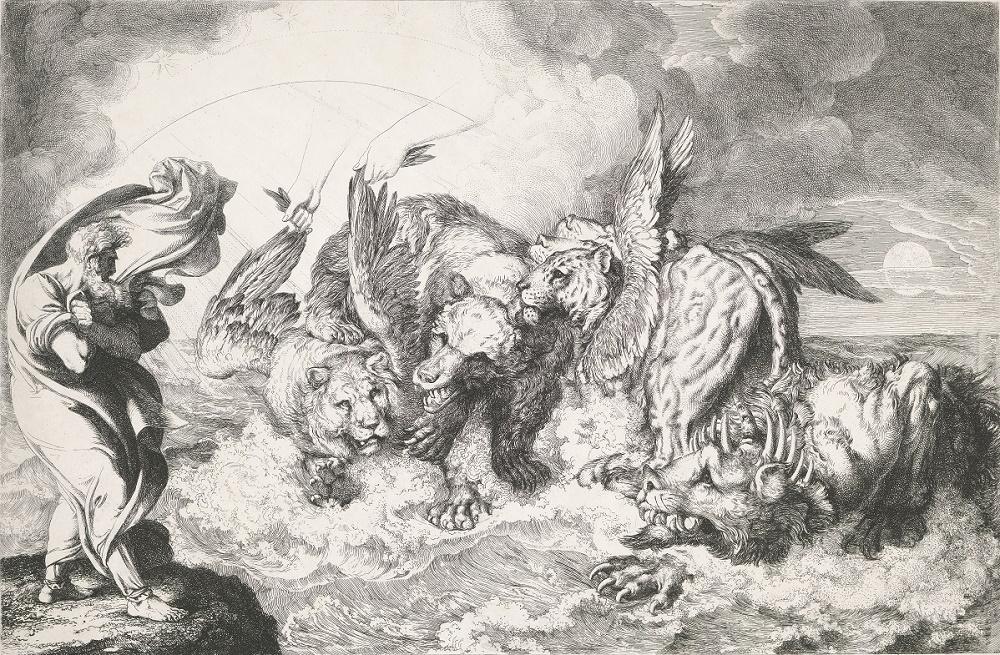
The prophetic can be layered with meaning. In today’s chapter, the beasts of Daniel’s vision have all sorts of connections to the Babylonian myths and literature that he was forced to study when he was taken into captivity. These connections are largely lost on us today. Yet, it can also connect to other prophecies written by other prophets in scripture. Its imagery can connect to contemporary symbols of which Daniel had no knowledge. Unlike parables that typically have one main lesson to teach, the prophetic can be layered with meaning for both the times it was written, times that came later, and times yet to come. Which leads to my third observation.

Prophetic literature is the source of endless debate. You can see pieces of it that have a very clear meaning. Psalm 22 and Isaiah 53 are good examples. Written hundreds of years before Jesus, they both eerily and accurately describe the events surrounding Jesus’ death. Yet most of it, like the beasts Daniel sees in today’s chapter, sounds like the writers were tripping on LSD.  There are many theories as to their meaning, and because prophecy can be layered with meaning whose to say that more than one theory is correct? Which leads to my final observation.

The prophetic is a tempting rabbit-hole to fall into. I have known some individuals along my life journey who delve so deeply into the prophetic that it consumes them. Trying to nail down the exact meaning of a prophetic passage with absolute certainty can be like trying to solve a complex puzzle. Prophecy is a cool subject to study, but if it becomes consuming to the point of ignoring everything else and becoming spiritually out of balance, then it’s time to give it a break.

At the end of today’s chapter, we read that Daniel, troubled by his dream, recorded it in his journal and then moved on. I find that a good example to follow when it comes to the prophetic. Don’t ignore it, but don’t obsess about it either. Focus on what I’m supposed to be doing. Loving God, loving people, and continually trying to do the right thing as I walk the journey each day.

Mysteries Within Mysteries

Son though he was, he learned obedience from what he suffered and, once made perfect, [Jesus] became the source of eternal salvation for all who obey him and was designated by God to be high priest in the order of Melchizedek.
Hebrews 5:8-10 (NIV)

The further I have progressed on this life journey the more I have come to understand that I must embrace mystery if I am going to progress spiritually in certain places. This flies in the face of a system of reason in which I was raised and educated. Our culture is one that places what I have come to understand as an undue premium on knowing. Theories are stated as certainties quite frequently whether they come from the institutions of religion, education, politics, or science. I find that our culture has lost sight of the value of embracing the knowledge of knowing that we do not know or cannot know.

I have found that the desire to try to replace mystery with false certainty is a fool’s errand. I see this repeated over and over again in history. It leads down all sorts of silly and hurtful paths. Minor issues become major battlegrounds, honest exploration is sacrificed on the altar of exclusionary social litmus tests, and institutions make all sorts of embarrassing mistakes (sometimes with deadly consequences). Embracing mystery, on the other hand, has pushed my heart and mind to new avenues of possibility, exploration, discovery and faith. I love how Catholic mystic Richard Rohr puts it: “Mystery is not something we can not understand. Mystery is something we can endlessly understand.”

The letter to Hebrew believers has always been shrouded in mystery, not the least of which is the identity of the author. Two centuries after it was penned we are still not certain who wrote the letter. My fundamentalist Bible professors taught me that I must believe it was Paul who wrote it. Textual critics in education laugh at such a claim, telling me it certainly couldn’t be Paul. Arguments have been made for a host of first century figures (i.e. Luke, Apollos, Barnabas). More recently, some scholars have argued that it was most certainly a woman, Priscilla, who was among Jesus larger circle of 70 disciples and travelled with Paul. I find this possibility fascinating and stimulating. It has led me to discover more about this amazing woman through whom God did amazing things. I know, however, at least one of my fundamentalist professors would have said it most certainly wasn’t Priscilla and would certainly have marginalized and subtly punished me educationally had I steadfastly held to the possibility in his class.

I do not know who wrote the letter to the Hebrew believers, and that’s perfectly fine for me. It is a mystery that has much for me to discover in its exploration of possibility.

In today’s chapter we encounter yet another mystery in the revelation of Christ as eternal High Priest. The Hebrew believers who first received this letter would have intimate knowledge about how the Hebrew priestly system worked as prescribed by the Law of Moses. Only descendants of Aaron (Moses’ right-hand man) were to be priests, and the High Priest could only come from those genetic ranks. According to the prophets, however, the Messiah was to come from the tribe of Judah and the house of David as Jesus did. Remember Christmas? Mary gives birth to Jesus in Bethlehem, the “City of David.” Joseph and Mary had to go to Bethlehem for the census because they were both descendants of David in the tribe of Judah.

But now the mysterious author of Hebrews lays out a claim that Christ is our eternal “High Priest,” the cosmic conduit between God and man. But the Hebrew readers would know that Jesus was not from the line of Aaron, so how could He be High Priest? The author reveals Jesus as High Priest “in the order of Melchizedek.” In Genesis 14:18 Abram (who would soon be known as Abraham) meets a mysterious King of Salem named Melchizedek who was “priest of God Most High.” He serves Abram bread and wine (remind you of anything?) and blesses Abram. Abram in return presents the priest Melchizedek an offering of a tenth of everything.

That’s all we know about Melchizedek. This mysterious person was “priest of God Most High” before Abram was Abraham, before Israel was a people, before the Law of Moses was given, before the Hebrew priesthood was defined as descendants of Aaron. It’s a mystery, and the author of Hebrews attaches the mystery of Christ the cosmic High Priest to the lineage to the mysterious Melchizedek who appears within the Hebrew tradition but outside the system of Moses.

This morning I’m once again perplexed, stimulated, and inspired by the mystery of Melchizedek, of Jesus, and of Hebrews. As I humbly embrace the mystery I push deeper into that which can be endlessly understood and so take another step forward on the path of faith and Spirit.