Tag Archives: Physics

The Time Paradox

The Time Paradox (CaD 1 Cor 7) Wayfarer

What I mean, brothers and sisters, is that the time is short. From now on those who have wives should live as if they do not; those who mourn, as if they did not; those who are happy, as if they were not; those who buy something, as if it were not theirs to keep;those who use the things of the world, as if not engrossed in them. For this world in its present form is passing away.
1 Corinthians 7:29-31 (NIV)

Thanks to Mr. Einstein and his cohorts, we’ve come to realize in the last 100 years that time is far more complex than anyone realized . It’s relative, not absolute. Though I believe that God was already hinting at this to us when through Moses’ prayer we learn:

A thousand years in your sight
    are like a day that has just gone by,
    or like a watch in the night.

Psalm 90:4 (NIV)

And, of course, God exists outside of time, which blows my mind open to all sorts of thoughts and considerations.

I’m not going to pretend to thoroughly understand the intricacies of time relativity, but I can certainly understand that our perception of time has an impact on how we think and live. In yesterday’s post I wrote/said that this earthly life is like a marathon 162 game baseball season and I need to learn to “take the loss” some days. At the same time, it is also true that the time left on my earthly journey likely is shorter than my grandchildren, which changes my perspective and perhaps my life decisions.

Today’s chapter is fascinating on a number of levels as Paul addresses a number of questions that the Corinthian believers had posed to him regarding singleness, marriage, divorce, and sexual relationships in light of their newfound faith in Jesus and desire to follow His teaching. Corinth was steeped in Roman and Greek thought, which contrasted culturally with the Jewish traditions with which Paul was raised and which were foundational to Jesus’ teachings. Add to that, however, that time plays a huge role in understanding Paul’s perspective on these matters, and informing my own.

In over 40 years as a disciple, I’ve heard today’s chapter quoted regularly in defense of individual’s beliefs about sex, marriage, divorce, and remarriage. To be honest, this chapter was quoted to me more than once in condemning me for getting divorced and remarried. I am in good company in this regard, I’m quite sure. However, I’ve never in all that time heard anyone seriously address the three verses I quoted above/at the tope of the podcast in which we learn that everything Paul is writing and instructing is based solely on Paul’s perspective of time.

Jesus told His followers that He would return one day, and we know from all of Paul’s writing that he was convinced that this return was imminent. “Time is short” he tells the Corinthians. He wanted the Corinthian believers to live as uncomplicated and simple lives as they could because he was convinced they didn’t have much time. Except they did, and I’ll get to that in a second.

Add to this perception of time the fact that I am reading Paul’s thoughts and instructions from a different waypoint in time. Not only has Jesus yet to return 2,000 years later, but my perceptions of time and life are different because time is different. Life spans are much longer and change is taking place much faster than Paul could have ever imagined.

So, what should my perspective be? Should I live today as if life is a marathon or should I live today as if today may be all I’ve got?

Yes.

I don’t think it’s an either-or question. Time, as God created it, provides this finite human being with paradoxes. The answer is both. And, this creates a certain tension, but that tension has always been present in the Great Story. I ultimately don’t know the number of my days and today might be my last, so that should factor into my perspective. At the same time, the number of my days is certainly getting shorter so I know that I am closer to the finish line than ever before, and that should inform my perspective. At the same time, it’s also true that people today commonly to live into their 90s and I could have another 30-40 years before I finish this earthly journey, so I need to factor that possibility into my perspective. At the same time, I believe that this entire earthly journey is but a tiny dot on the eternal time line, and this should inform my perspective today, as well.

So in the quiet this morning, I’m thinking back to what I wrote/said in yesterday’s post/podcast. I only have so much time, but even I don’t know exactly how much time I ultimately have on this planet. It could be a breath. It could be 40 years. Either way, I have to give consideration to how I best invest my time today for either possibility or eventuality, and let it inform my thoughts, words, actions, and relationships.

If you know anyone who might be encouraged by today’s post, please share.

These chapter-a-day blog posts are also available via podcast on all major podcast platforms including Apple, Google, and Spotify! Simply go to your podcast platform and search for “Wayfarer Tom Vander Well.” If it’s not on your platform, please let me know!

Seen and Heard

Seen and Heard (CaD Job 42) Wayfarer

“My ears had heard of you
    but now my eyes have seen you.
Therefore I despise myself
    and repent in dust and ashes.”
Job 42:5-6 (NIV)

In this book, Imagine Heaven, John Burke summarizes his 30 years of studying people who physically died, were resuscitated, and claimed to have had an after-life experience while they were deceased. They are known as Near Death Experiences (NDE) and it is a fascinating read.

One of the common things that these individuals talk about is the beauty of what they saw on the other side. In particular, some mention that everything is so beautiful with colors a visual detail that they couldn’t quite describe in human terms because they’d never seen it before.

Nobel Prize winning physicist, Frank Wilczek, wrote an article in the Wall Street Journal a few years ago about how quantum mechanics work in our vision and hearing. He uses the metaphor that our hearing is like having a piano in each ear with its 88 keys that, depending on the pressure with a key is struck, can produce a dynamic range of sound for neurons to fire and our brains to interpret. Our eyes, on the other hand, should be thought of a poorly turned, three-string harpsichord because light vibrates faster than the mechanical engineering of our eyes can handle. There are distinct patterns of illumination created by different combinations of photons that our human eyes can’t discern. “In this way,” Wilczek writes, “we are all profoundly colorblind.”

I find it fascinating to ponder the possibility that those who experienced the heavenly after-life were seeing with eyes unbound by human limitations of the poorly tuned, three-string harpsichord. When sent back to their bodies, they returned with visions of things they couldn’t describe, because there are no human words to suffice.

In today’s chapter, we wrap up the Job story. God has spoken and Job has heard God’s message. What’s more, Job claims to have “seen” God, though from a human sensory perspective, only God’s voice in the storm is ever mentioned. Along my spiritual journey, I’ve had very distinct experiences in which my spirit suddenly perceives something I had not “seen” before. As Paul wrote to Jesus’ followers in Ephesus, “I pray that the eyes of your heart may be en-lightened in order that you may know the hope to which he has called you….” (Eph 1:18 NIV, emphasis added).

There is physical seeing and there is spiritual seeing.

With the eyes of his heart en-lightened, Job understands that his human knowledge has not, can not, and will not perceive God’s power and purposes. Job is humbled by this. Ironically, sitting there on the ash heap of the local burn pile, he says he “despises” himself using a Hebrew word whose root means “trash.” He repents.

Eli the younger is not even mentioned in the epilogue. Having given Job and his three friends an ear-full, the young man must have moved on with his “perfect knowledge” to pass judgment on others and tell them how to solve their problems and fix the world from his omniscient perspective.

The spiritual contest prompted by the evil one is ended. Job did not curse God, though he certainly questioned God emphatically. God restores Job’s fortunes and doubles Job’s blessing. The three amigos, Eli, Bill, and Z, are chastised for proudly proclaiming to have knowledge about both God and Job that they did not have. They are told to repent and have Job offer the priestly act of making sacrifices and praying for them. One commentator I read made the point that Job spoke to God, while his three friends spoke about God.

From beginning to end, there is familiarity and an implied relationship between the Almighty and Job. Not so with his three friends. In the quiet this morning, that’s a big part of my take-away from this ancient story. I don’t simply want to know about God. I want to know Him each day of this earthly journey in a spiritually experiential way. I want to hear and see God with the ears and eyes of my heart, trusting that when this journey is over, I will trade in my poorly tuned, three-string harpsichord and actually see things I can’t even imagine and could never describe in human terms.

If you know anyone who might be encouraged by today’s post, please share.

The Alpha Point and the Omega Point

The Alpha Point and the Omega Point (CaD Rev 5) Wayfarer

In a loud voice they were saying:
“Worthy is the Lamb, who was slain,
    to receive power and wealth and wisdom and strength
    and honor and glory and praise!”
Revelation 5:12 (NIV)

A year or two ago, my friend shared with me a story about the 20th-century Jesuit priest, anthropologist, philosopher, and mystic Pierre Teilhard de Chardin. The story inspired me, and I ended up using it in a message a few weeks later. It also inspired me to learn a little more about de Chardin and his teachings. Later in his life, the philosopher-priest was silenced by the institutional church and ordered not to teach or publish anything. As an amateur historian, this always tells me that he must have been on to something true.

One of de Chardin’s most popular theories was that of the “Omega Point.” Just as He believed that the universe began as a tiny “Alpha Point” of matter that exploded into being with a big bang, he saw everything in the universe as connected, transforming, and flowing towards an “Omega Point” in which everything recedes back to that tiny point. His ideas not only inspired scientists and physicists but also artists and writers. Flannery O’Connor’s Everything that Rises Must Converge is a riff on Chardin.

For me, the inspiration led me to look with new eyes at the Great Story that God authors from Genesis to Revelation (the “alpha point” and “omega point”). The Great Story is clear that Jesus was the “alpha point” through which all things were created (Jhn 1:3) and it is He who “holds all things together” (Col 1:17).

In today’s chapter, John’s visit to the throne room of heaven continues. He sees a scroll that is sealed with seven seals. A call goes out in heaven asking who is worthy to break the seals and open the scroll. No one is found worthy, which has John weeping with grief. Then “the lamb who was slain” (e.g. Jesus) is revealed who, because of His surrender and sacrifice, is worthy to open the scroll. A choir of innumerable angels then sings:

In a loud voice they were saying:
“Worthy is the Lamb, who was slain,
    to receive power and wealth and wisdom and strength
    and honor and glory and praise!”

There are seven attributes that Jesus is worthy to “receive” according to the angel’s song. Seven is the number of “completeness” or “completion.” The number is used 55 times in Revelation. As I have read, pondered, and studied Revelation over the years, I was always a bit confused by the fact that “power” and “wealth” were included in this complete list of what Jesus is worthy to receive in the end.

Then I started considering what Chardin’s “omega point” was getting at in connection to who Jesus was, what Jesus taught, and who Jesus is revealed to be in today’s chapter.

Jesus is the beginning, the alpha point of Creation from Whom all things flow.

Jesus taught His followers not to treasure the power and wealth of this transient, created world because it doesn’t last, it isn’t eternal, and eventually…

Everything, including all the power and wealth in creation, along with everything in this universe will flow back to Jesus, the Creator, the Omega point, in the end.

In the quiet this morning, I find myself pondering the effect and consequence of my embracing this notion. It means that everything I have in this physical world is not really mine. It flows from the Alpha point and it will flow back to the Omega point. If this is true, then it transforms me from an owner of everything I have to a steward of everything I have. Suddenly I am a character in a very real version of Jesus’ parable of the talents, caring for and investing all that the Alpha and Omega has entrusted to me on this earthly journey. In this Light, I see my earthly journey in the context of an eternal reality that begins before the Great Story and will flow beyond its final chapters. I suddenly find that other things begin to make more sense.

Do you not know that your bodies are temples of the Holy Spirit, who is in you, whom you have received from God? You are not your own; you were bought at a price. Therefore honor God with your bodies.

And so, I enter another day in the journey, echoing a heavenly chorus:

“Worthy is the Lamb, who was slain,
    to receive power and wealth and wisdom and strength
    and honor and glory and praise!”

If you know anyone who might be encouraged by today’s post, please share.

Behind the Veil

Behind the Veil (CaD Matt 17) Wayfarer

After six days Jesus took with him Peter, James and John the brother of James, and led them up a high mountain by themselves. There he was transfigured before them. His face shone like the sun, and his clothes became as white as the light. Just then there appeared before them Moses and Elijah, talking with Jesus.
Matthew 17:1-3 (NIV)

I was never much of a science guy back in school. It just wasn’t my jam. The further I get in my life journey, however, the more fascinated I’ve become by it. In particular, I find it fascinating the mysteries being uncovered and discovered. I learned as a child that the atom was the smallest “building block” of matter, but physicists have discovered a number of subatomic particles, with even more of them theorized. What’s crazy is that they behave in strange ways we don’t understand. I find it fascinating that we are at once discovering the expanding universe and its mysteries at the same time we’re discovering newer layers of the building blocks of the universe and their mysteries. In either direction, macro or micro, we’re making mind-blowing discoveries beyond our current comprehension. Amazing.

I mention this because the further I get in my spiritual journey, the more aware I’ve become of the connectedness of the Great Story and the mysteries of eternity to which it points. Jesus was always making a distinction between earth-bound thinking and eternity-centric thinking. He continually contrasted the kingdoms of this world to the kingdom of God, earth as opposed to heaven, temporal as opposed to eternal. This is not confined to Jesus. In fact, it’s connected throughout the Great Story.

In today’s chapter, Matthew records one of the most mysterious episodes in Jesus’ story. Jesus takes His inner circle of followers and goes up a mountain. In an instant, Jesus is revealed in His eternal glory. Light brighter than you can imagine, a dense cloud, a voice from within the cloud, and then two beings appearing with Him: Moses and Elijah.

Jesus said in His message on the hill that He didn’t come to “abolish the Law and the Prophets, but to fulfill them.” The climactic event for the Hebrew people was their deliverance from slavery in Egypt and the God giving of the Law to Moses on a mountain. If you go back and read about that event in Exodus chapters 19 and 20, there are amazing parallels between that episode and the episode described in today’s chapter.

Both events happened on mountains. Jesus shines like the sun, just like Moses whose face was so bright after returning from the mountain that he had to wear a veil over his face (Ex 34:29-35). Both involved seemingly natural phenomena of clouds/smoke and God’s voice from the midst. The former event precipitated the giving of the Law, the latter precipitated the fulfillment of it. Why did Moses and Elijah appear with Jesus? Moses was the instrument of giving. Jesus was the instrument of fulfillment. Moses represented the Law, Elijah represented the Prophets, and Jesus was the fulfillment of both just as He said He came to do. The Transfiguration was a bookend event to Moses’ receiving the Law on Mt. Sinai.

What struck me as I read the episode again today was the instantaneous transfiguration from temporal normal to eternal glory and then the instantaneous transfiguration back from eternal glory to temporal normal, along with the disciples’ terror.

In the quiet this morning, I find myself contemplating the probability (based on evidence in the Great Story) that the veil between earth and glory is thinner than I’ve ever imagined. I live, move, and have my being in an earthbound, three-dimensional world which frames my thinking and perception. But physicists now theorize that there are actually 11 dimensions (or more). There’s more to it than I ever realized, which is exactly what Jesus continually tried to get His followers to understand.

“Truly I tell you, if you have faith as small as a mustard seed, you can say to this mountain, ‘Move from here to there,’ and it will move. Nothing will be impossible for you.”

In essence, Jesus is saying that there is an eternal reality that is more real than the earthy reality I experience in three dimensions with my five senses. He called it “the Kingdom of God” and He asked me as His follower to seek it, find it, see it, believe it, and allow it to transform the way I live, move, and have my being on this earthly journey.

Jesus chastised Peter in yesterday’s chapter for being so bound to his earthy perceptions that he couldn’t see heaven’s intentions. The further I get in my spiritual journey, the more convinced I am that every time Jesus tells His followers to expand their faith, He’s encouraging me to open my mind and spirit to see what is beyond my human senses yet just as real as physical matter. It is already woven into creation itself. I believe it’s right there behind the veil that is thinner than I imagine.

If you know anyone who might be encouraged by today’s post, please share.

Humility and Uncertainty

…then I saw all that God has done. No one can comprehend what goes on under the sun. Despite all their efforts to search it out, no one can discover its meaning. Even if the wise claim they know, they cannot really comprehend it.
Ecclesiastes 8:17 (NIV)

This past weekend, we watched a stand-up comic waxing humorous on this past year of pandemic. He joked that 2020 is the only year in which the U.S. government could admit that there are UFOs and nobody cares. It’s funny, and it’s true.

In case you missed it, the Pentagon is going to release a report this month in which it details findings on Unidentified Aerial Phenomena (UAP). I’m sure it will create quite a stir. I’m personally prepared for the dramatic conclusion of the report: “We just don’t know.”

We live in a complex universe in which there is a lot that we simply don’t know, and can’t comprehend. Wendy and I just introduced a young friend to the famous double slit experiment in physics this past weekend, as well. It’s really fascinating. Basically, it seems that atoms behave differently when they are not being observed. Really. In one of the videos I watched on the subject, Jim Al-khalili of the Royal Institution humorously explains the experiment then ends with, “If you can explain this using common sense and logic, do let me know, because there’s a Nobel Prize for you.”

In today’s chapter, the ancient Hebrew Sage of Ecclesiastes wraps up a list of life’s conundrums by coming to the conclusion that there are certain things that are beyond comprehension. Even if someone claims to know, he states, they really don’t.

Along my life journey, I’ve observed that creation, life, and relationships are complex things. There are simple truths, but there are few simple answers. Nevertheless, I observe that we as human beings like to try and force issues into simple binary boxes. We do this with all sorts of issues in faith, science, politics, and society. I’m either “this” or “that.” If I’m not “that” then I’m certainly “this.” The further I progress in this journey, the more I’ve found that there’s a humility required of me in this life to admit that I don’t really know everything, while continuing to engage in asking good questions, seeking to know and be known, and knocking on the door of opportunity to grow in love and understanding.

I’ve also come to a place in which I’m always cautious whenever I find myself confronted with the proud, loud certainties of others, no matter the source or subject. Jesus said that all those who exalt themselves will be humbled. His example was that of being “humble, and gentle-hearted.”

I’m quite certain that this world could use more of that. As a disciple of Jesus, I’m also quite certain that Jesus wants me to follow that example.

UFO’s and why atoms behave differently when they’re being watched. I’m not certain.

If you know anyone who might be encouraged by today’s post, please share.

Positively “Horny” with Light

Positively "Horny" with Light (CaD Ex 34) Wayfarer

When Aaron and all the Israelites saw Moses, his face was radiant, and they were afraid to come near him.
Exodus 34:30 (NRSVCE)

“Let there be light.”

That’s the first act of creation in the poetic description of the beginning of everything in the opening verses of Genesis. This simple beginning, however, is not so simple. In fact, it’s hard to contain its meaning. It is part of the mystery of God and the universe that both theology and science have endlessly been attempting to understand. I can’t explain it any better than the Encyclopedia Brittanica does:

No single answer to the question “What is light?” satisfies the many contexts in which light is experienced, explored, and exploited. The physicist is interested in the physical properties of light, the artist in an aesthetic appreciation of the visual world. Through the sense of sight, light is a primary tool for perceiving the world and communicating within it. Light from the Sun warms the Earth, drives global weather patterns, and initiates the life-sustaining process of photosynthesis. On the grandest scale, light’s interactions with matter have helped shape the structure of the universe. Indeed, light provides a window on the universe, from cosmological to atomic scales. Almost all of the information about the rest of the universe reaches Earth in the form of electromagnetic radiation. By interpreting that radiation, astronomers can glimpse the earliest epochs of the universe, measure the general expansion of the universe, and determine the chemical composition of stars and the interstellar medium. Just as the invention of the telescope dramatically broadened exploration of the universe, so too the invention of the microscope opened the intricate world of the cell. The analysis of the frequencies of light emitted and absorbed by atoms was a principal impetus for the development of quantum mechanics. Atomic and molecular spectroscopies continue to be primary tools for probing the structure of matter, providing ultrasensitive tests of atomic and molecular models and contributing to studies of fundamental photochemical reactions.

In the same way, light is fundamentally a part of the spiritually supernatural:

  • Light was the first order of creation on the first day of creation in the Genesis creation ( keep in mind the sun, stars, and moon weren’t created until the fourth day).
  • After healing a boy born blind, Jesus said, “I am the light of the world.”
  • In the sermon on the mount, Jesus told his followers, “You are the light of the world.”
  • Jesus took his inner-circle (Peter, James, and John) up on a mountain (just like Moses in today’s chapter) and was “transfigured” before them (e.g. Matthew records the He shone like the sun while Luke describes it as bright as a flash of lightning). And Moses appeared with Him.
  • Angelic beings are consistently described throughout the Great Story as shining radiantly.
  • At the very end of the Great Story in Revelation (spoiler alert: the end is a new beginning) “There will be no more night. They will not need the light of a lamp or the light of the sun, for the Lord God will give them light.”

In today’s chapter, Moses returns to the top of the mountain and spends another 40 days with God. When he returns, the text says that his face was so radiant that it freaked out the Hebrews (for the record, Peter, James, and John were equally freaked when Jesus revealed the light of His glory).

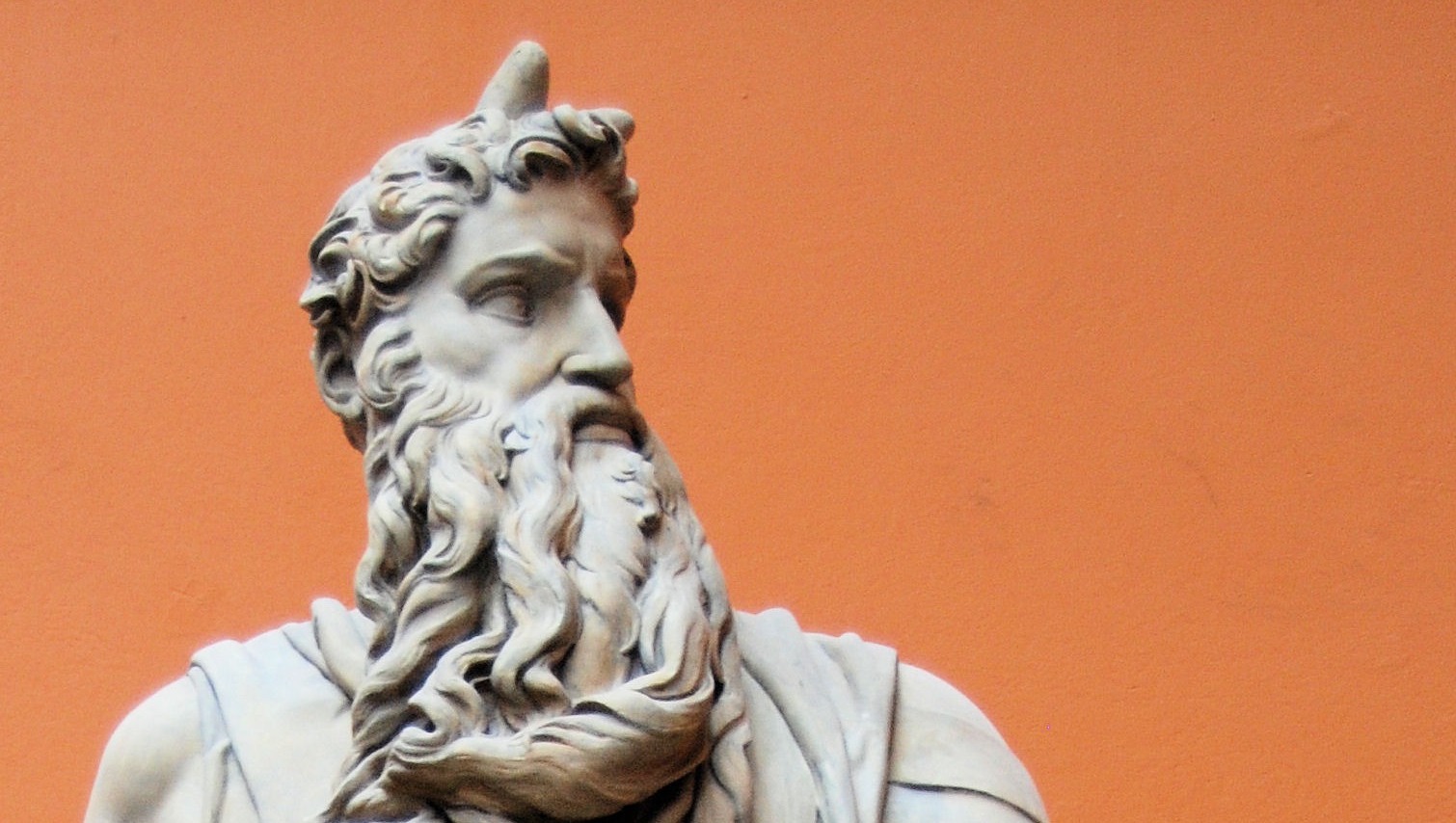
Here’s a bit of additional mystery for you. The Hebrew word used here is actually translated “horns.” That’s why many artistic depictions of Moses (the most famous is Michaelangelo) show him having horns on his head:

Moses

So, what’s up with that?! I talked in my podcast, A Beginners Guide to the Great Story Part 1 about the fact that when thinking about the ancient stories we have to consider the context of the times in which they were living. The mystery of Moses’ horns is a great example. There is an ancient Babylonian text that uses the Sumer word si which is also the word for “horn” to describe a solar eclipse in which the sun’s light appears like “horns” (think “rays of light”) shooting out from behind the darkened moon. It’s quite possible that the word “horns” was layered with meaning and the ancients understood what we call “rays” of light to be “horns of light.”

In the quiet this morning, I find my brain buzzing with all sorts of thoughts about light and how it is part of the mystery of both the spiritual and the scientific. Humanity has so often made the two into binary, either-or, opposites and enemies. The further I get in my journey, the more I am convinced that, in the end, we will understand that they are two parts of the same mystery. It’s a “both, and.”

As a follower of Jesus, I can’t help but go back to Jesus’ call for His followers to be “light” to the world”:

“Let me tell you why you are here. You’re here to be salt-seasoning that brings out the God-flavors of this earth. If you lose your saltiness, how will people taste godliness? You’ve lost your usefulness and will end up in the garbage.

“Here’s another way to put it: You’re here to be light, bringing out the God-colors in the world. God is not a secret to be kept. We’re going public with this, as public as a city on a hill. If I make you light-bearers, you don’t think I’m going to hide you under a bucket, do you? I’m putting you on a light stand. Now that I’ve put you there on a hilltop, on a light stand—shine! Keep open house; be generous with your lives. By opening up to others, you’ll prompt people to open up with God, this generous Father in heaven.”

-Jesus (Matt 5:13-16 [MSG])

What does that mean for me? Am I a light-bearer? Do these posts and podcasts shine? More importantly, do my daily words and interaction with family, friends, neighbors, strangers, community, enemies, acquaintances, and foreigners radiate with love, joy, peace, patience, kindness, goodness, gentleness, faithfulness, and self-control? Am I being generous with my life? Is my house open? Am I opening up to others?

It’s what I’m endeavoring to do increasingly today, each day of this earthly journey. I want the words of my mouth, the meditations of my heart, the work of my hands, and my interactions with everyone to be positively “horny” with Light.

If you know anyone who might be encouraged by today’s post, please share.

Eyes Open and Aware

And Elisha prayed, “Open his eyes, Lord, so that he may see.” Then the Lordopened the servant’s eyes, and he looked and saw the hills full of horses and chariots of fire all around Elisha.
2 Kings 6:17 (NIV)

There was one summer back in my later high school days when I happened to pal around with a couple of guys who were in their early twenties. It just so happened that every time the three of us got together we found ourselves in circumstances in which we had opportunity to  help others. One afternoon we happened upon a boy who had just been struck on his bicycle by a truck. We sprung into action to try and help both the situation and the boy’s family as best we could. Another time we happened to show up at a nearby lake just as a child fell out of the boat near shore and we were able to dive in and help the boy to shore. Upon hearing of our string of adventures, the mother of one of my friends jokingly referred to our threesome as  “Angels Unaware.”

Throughout God’s message there is reference made to a spiritual dimension that exists all around us. We are, for the most part, completely unaware. There are multiple instances across the Great Story of people being visited by the divine, or by those from the spiritual realm. From the early chapters of Genesis in which Abraham receives three mysterious visitors to the visions of Revelation which, John chronicles, were revealed to him while he was “in the Spirit.” Paul speaks of being caught up to heaven “in the Spirit.” The author of Hebrews tells followers of Jesus to be hospitable to strangers because you never know when you might entertain “angels unaware.” Thus the moniker given to my trio of friends back in the day.

Here in the west our culture is one of science and reason. We tend to believe only what can be quantified by our physical senses and proven by science. I find it fascinating that science is now pushing into places that a generation ago would have seemed the make-believe world of science fiction. Physicists tell us that there are 10-11 facets, or dimensions, to what we perceive to be reality. In other words, there’s a whole lot more going on than that which our physical senses perceive. Fascinating. I find that not unlike what Elisha’s servant experienced in today’s chapter. There was a reality that existed in the spiritual dimension that he couldn’t see until his spiritual eyes were opened. The further I get in my journey the more I have come to believe that the lines between science and spirit is not as distinct or defined as many scientists and/or theologians would have us believe.

In his letter to the followers of Jesus in Ephesus, Paul wrote, “I pray that the eyes of your heart may be enlightened….” I think that’s what happened to Elisha’s servant. I think that’s what happened to Jesus companions on the road to Emmaus. There are physical eyes that see things in the physical realm, and there are spiritual eyes that perceive things in the spiritual realm.

This morning I’m thinking about the spiritual realm and the eyes of my heart. I hope that as my physical sight continues to diminish that my spiritual sight becomes more acute. I pray that the eyes of my heart will be enlightened in unimagined ways that I may see things clearly that I once may have never perceived. Until then, I hope that my physical eyes will be more attuned to identify daily opportunities to be someone else’s “angel unaware.”

“Get Me a Musician”

[The prophet, Elisha, said,] “…get me a musician.” And then, while the musician was playing, the power of the Lord came on him.
2 Kings 3:15 (NRSVCE)

I mentioned in my post the other day that while we’re at the lake Wendy and I are limited in our television viewing choices to the collection of DVDs we have there. So it was that last week I pulled out that oldie, but goodie of the cinema: Die Hard. The movie played in the background as Wendy and I sat at the dining room table with our laptops going about our work.

In case you never caught it, the underlying musical score for Die Hard is one endless string of creative variations on what most Americans know as the hymn Joyful, Joyful, We Adore Thee. The iconic melody of that familiar hymn comes from the final movement of Beethoven’s ninth and final symphony. As I sat at the dining room table, tapping away on my keyboard, the melody suddenly and unexpectedly took me to another moment, in another place.

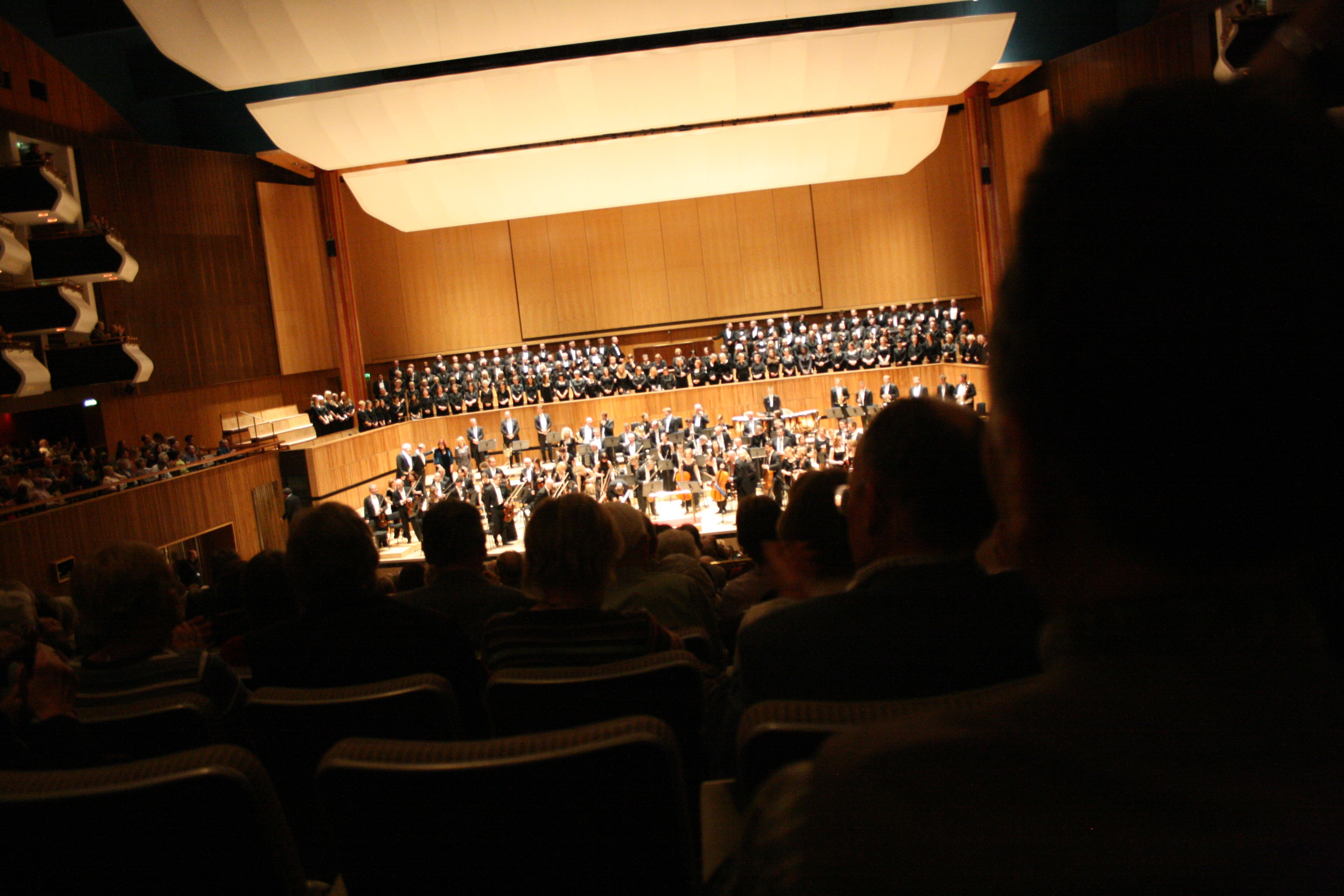
London. 2009. The Royal Philharmonic. It was our first night in London and Wendy and I had tickets to hear both Mozart’s and Beethoven’s final symphonies in one program. Wendy’s favorite was Mozart, but mine was Beethoven. There is a moment in Beethoven’s ninth when the music suddenly stops and a lone voice begins to sing. I will never forget the moment I heard that voice. I just began to cry as I listened. A chorus of voices joins the orchestra and the music continues to build to one of the most amazing and moving musical climaxes ever. What most people don’t realize is that Beethoven was completely deaf when he wrote his final symphony. He never heard a note of it with his ears. He only heard it in his spirit. Amazing.

There is something deeply spiritual about the language of music, and I have learned over time that music is a language all its own. It has a special place in creation. Music is an integral part of heaven in the glimpses provided in God’s Message and the theme of music is woven throughout the Great Story.

In today’s chapter the prophet Elisha calls for a musician. When the music begins to play the power of God comes upon him. The language of music was the conduit of God’s Spirit. I get that. The language of music is a spiritual language (both for spiritual light and spiritual darkness, btw). Music has the power to reach deep inside to touch hidden places inside us. Music has the power of inspiration, conviction, revelation, exhortation, and even transportation.

My body last week was sitting at a dining room table in central Missouri. The melody of Beethoven’s ninth playing beneath Bruce Willis’ machine gun suddenly and unexpectedly transported my spirit, in that moment, to the Royal Orchestra Hall in London. My eyes began to mist over. Physicists tells us that all of time is contained in each moment. Perhaps music is a gateway.

This morning I’m thinking about this powerful medium we call music. I’m mulling over the incredible breadth of music that has spoken to me, moved me, and inspired me over the years. Beethoven to Berlioz to Bach, Miles Davis to Bob Dylan to Yo-Yo Ma, Gospel choirs to bluegrass banjos to steel drums and a Reggae beat. I’ve come to accept that I will never know (in this life journey) fluency in the language of music that I desire. I still can experience its power in ways human beings throughout the millennia of history couldn’t even imagine. I literally have access to the entire catalog of human music in the palm of my hand.

“…get me a musician.”