Tag Archives: Mountain

Mountains

After six days Jesus took Peter, James and John with him and led them up a high mountain, where they were all alone. There he was transfigured before them.
Mark 9:2 (NIV)

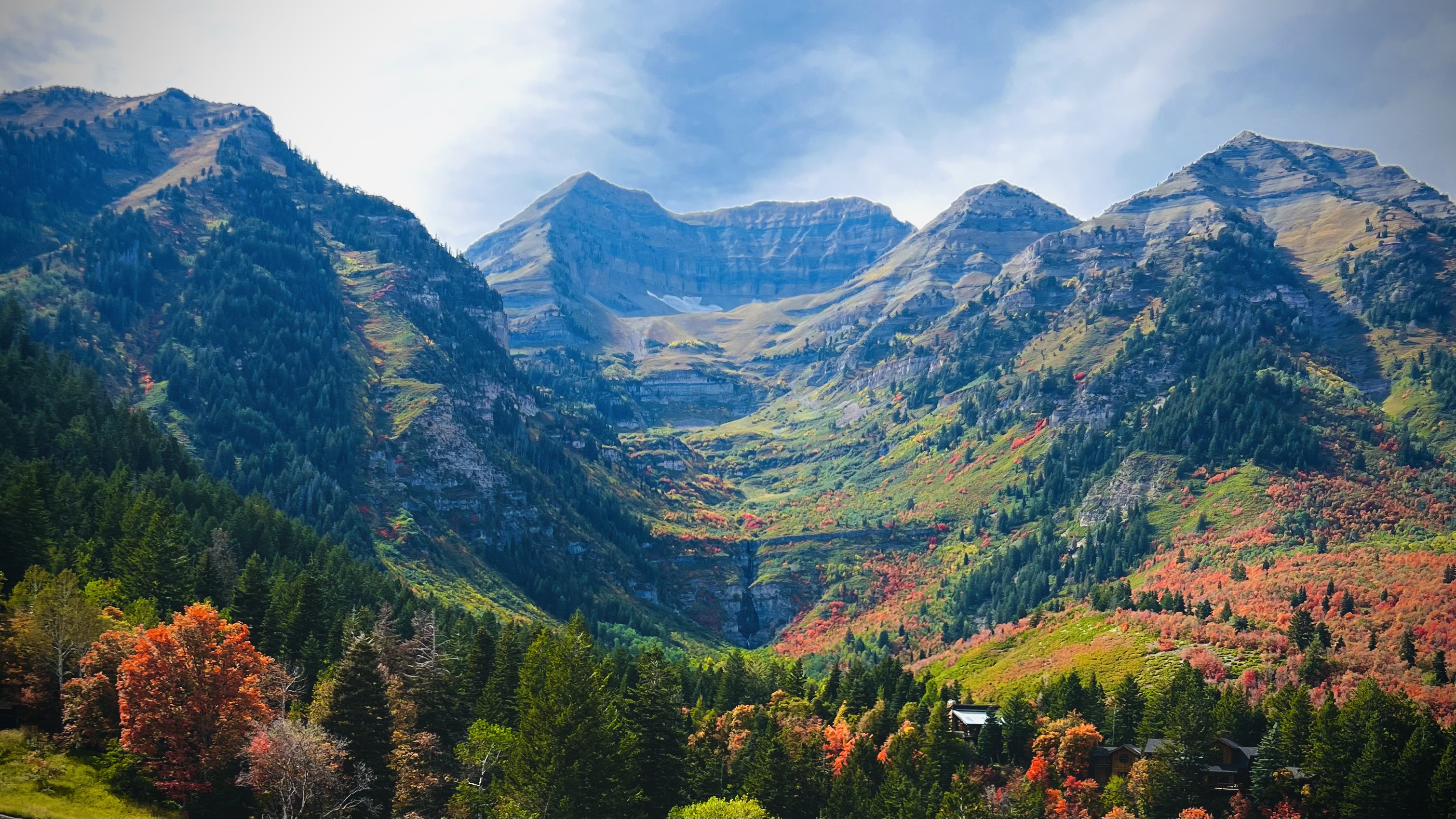
This fall, Wendy and I were invited to join friends at their place in Park City, Utah. We happened to be there for four days when the fall colors exploded in the mountains. The weather was gorgeous, and one day we drove to Sundance and rode the series of chairlifts to the top. The views were definitely not what you’ll ever see in Iowa. It was definitely a mountaintop experience in multiple ways. (I took the featured photo on today’s post as we were riding the chair-lift)

I mentioned in yesterday’s post/podcast that I’ve been listening to a series of podcasts about the meaning of mountains throughout the Great Story. And, it’s true that there are so many stories and events in the Story that happen on mountains. Mountains on which action takes place include, but are not limited to, Mount Sinai, Mount Carmel, Mount Tabor, Mount Horeb, Mount Zion, and the Mount of Olives. Mark has mentioned that Jesus commonly retreated up a mountain to be alone and pray. That was Mount Arbel off the coast of the Sea of Galilee.

Now I’ve been to Israel and I’ve been to the top of Mount Carmel, Mount Zion, and the Mount of Olives. Make no mistake, they are no Sundance Mountain. They are more in line with the bluffs in Iowa that line the Missouri and Mississippi River valleys. People who live anywhere near the rockies would laugh at the thought of them even being called mountains.

But the “mountains” in the Great Story are not meant to be accurate examples of scientific, geological definition. Building on yesterday’s post/podcast, the “mountains” are metaphors. They are high places that stretch toward the heavens relative to the area surrounding it. They are thin places where the veil between the physical and spiritual are more transparent. Mountaintops are isolated and exclusive places, in part because they require effort and sacrifice to access them. Like the narrow road that Leads to life that Jesus talked about, few are willing to do what’s required to reach the top.

In today’s chapter, there is one of the funkiest stories in the entire Jesus Story. Jesus takes his inner circle of three disciples (Peter, James, and John) and goes up a “mountain.” While there, Jesus is “transfigured.” In other words, his physical human form is transformed into the spiritual, heavenly, glorified, Light of the World that was His reality before He came to earth to be born a baby in Bethlehem. Then Moses (Law-giver) and Elijah (Prophet) appear and have a chat with Jesus. There’s a cloud that envelopes them all.

In order to understand this mountaintop moment, it’s necessary to know about Moses’ mountaintop moment on Mount Sinai where God began something new with the recently freed Hebrew slaves. On Sinai there was light in the forms of lightning and what looked like fire, and a cloud that covered the mountain. God gave Moses His guidebook for Life for the Hebrews, a blueprint for how to conduct themselves as individuals and as a community in order to be an example to all the other nations. Just as the Law came through Moses, Elijah was the great prophet who had his own mountain top experiences on Mount Carmel and Mount Horeb. He represents God’s prophets and prefigures John the Baptist.

Everything in the transfiguration event connects to the larger Story. This is a fulfillment moment that has been thousands of years in the making. It’s Mount Sinai 2.0. God Himself has come to, once again, announce that He’s doing something new. Jesus says it Himself in today’s chapter. God’s Son is going to suffer and die a human death, just as the prophets like Elijah had prophesied. Then, He will conquer death and the grave and be resurrected, pour out His Spirit and usher in a Kingdom age of grace.

“Therefore, if anyone is in Christ, the new creation has come: The old has gone, the new is here!
2 Corinthians 5:17 (NIV)

In the quiet this morning, I’m thinking back to mountain top memories like ascending Sundance mountain Utah with our friends and climbing Arthur’s Seat with our daughter Taylor in Edinburgh, Scotland. But I’m also reminded all of the ways that mountains are metaphorically layered with meaning. When the ancient Hebrews traveled to the Temple in Jerusalem to worship, they considered themselves ascending Mount Zion where they would worship God. As they made their way up the “mountain” to worship, they would sing “songs of ascent” as they journeyed. Some of them are in the Psalms, like Psalm 121:

I lift up my eyes to the mountains—
    where does my help come from?
My help comes from the Lord,
    the Maker of heaven and earth.

Wendy and I live on the Iowa prairie. I confess, there’s nothing resembling a mountain physically nearby. Yet every week as we gather with others in our community to worship we metaphorically and spiritually ascend a mountain to a thin place where “two or three are gathered” and Jesus Himself is in our midst by His Holy Spirit just as He promised. It is there that I am being transfigured and transformed into the person He is calling me to be. It is there that new things come. It is there that I catch a glimpse of the Light and Glory to come on another mountain where God is preparing an eternal City and a place for me there.

If you know anyone who might be encouraged by today’s post, please share.

These chapter-a-day blog posts are also available via podcast on all major podcast platforms including Apple, Google, and Spotify! Simply go to your podcast platform and search for “Wayfarer Tom Vander Well.” If it’s not on your platform, please let me know!

Chaos and Order

Chaos and Order (CaD Ezk 40) Wayfarer

The man said to me, “Son of man, look carefully and listen closely and pay attention to everything I am going to show you, for that is why you have been brought here. Tell the people of Israel everything you see.”
Ezekiel 40:4 (NIV)

For the past quarter of a century, our family has had a place on Lake of the Ozarks in Missouri. My parents bought the property around the time of retirement. The girls grew up there along with their cousins visiting Grandpa Dean and Grandma Jeanne. Wendy and I purchased the property from them and built a new house on it. It’s been a special place for us, our family, and friends.

In fact, our family long ago realized that our place at the lake was sacred space. It has been a place of rest away from the chaos of our everyday lives. It has been a place of healing and restoration. It’s where my sister retreated to recover from chemo in her battle with cancer. It has been a place full of life as children have grown up, families have vacationed, and relationships have been strengthened through countless conversations that would never have happened in the hectic worlds of our lives back home.

Over the next several chapters, the prophet Ezekiel describes a vision he was given of a sacred space, a temple. When this vision arrives, it has been fourteen years since the city of Jerusalem and the temple that Solomon built had been destroyed. Ezekiel and his fellow Hebrews are living in exile in Babylon. They are feeling lost and hopeless in the chaos of life in a foreign land where nothing is familiar. The rituals and routines by which they lived and measured life are gone. They are longing for hope and a future.

For casual readers, today’s chapter and the next several chapters are the kinds of passages that leave you scratching your head. Wait. What?! What can this ridiculously detailed description of an ancient temple possibly have any significance for my life in the twenty-first century? One of the things that I’ve come to learn about these kinds of passages is that I have to back up and look at the bigger picture of what God has done, is doing, and will do.

For the Hebrew people, this sacred space of a temple was not only a huge part of their story a people, but it was also a metaphor for the Great Story itself. Way back in Exodus when God is first introducing Himself to the Hebrews, He instructs them to create a mobile sacred space that could travel with them and be set up wherever they camped. The language that was used in the creation of this sacred space mirrored the creation poem in the first two chapters of Genesis. The creation poem begins with chaos and God creates order out of the chaos and then places humanity in this ordered place that is very good.

When God gave the Hebrews instructions for this sacred space they understood that it was like a new creation. An entire nation of people leaves the chaos and chains of slavery, they wander into the wilderness, and God is creating something new in them. What does God do in creation? He creates distinctions and order.

I have to believe that Ezekiel and his compatriots were recognizing that they had returned to chaos and slavery. They are longing for the hope that God will begin a new creation in them just as He had done in Genesis and in Exodus when He brought order and sacred space.

Everywhere I turn, people talk about lives being busy, crazy, frazzled, and hectic. There’s so much to do, so many distractions, and so much stress. Life happens and we feel worry and anxiety. How often do I feel the chaos of everyday life? And yet, Jesus said He came that we might know peace. What did Jesus do? He regularly went up a mountain by Himself where he would spend hours and sometimes spend the night praying. He sought out sacred space and spent time with God where He reordered His heart, mind, and soul.

Do you think that this ancient, recurring message about creating order out of chaos and having sacred space to order my life and world might have something to teach me about my chaotic twenty-first-century life today?

If you know anyone who might be encouraged by today’s post, please share.

The Other Side of the Valley

The Other Side of the Valley (CaD Gen 21) Wayfarer

Sarah said, “God has brought me laughter, and everyone who hears about this will laugh with me.” And she added, “Who would have said to Abraham that Sarah would nurse children? Yet I have borne him a son in his old age.”
Genesis 21:6-7 (NIV)

Along my life journey, I have walked through a number of dark valleys. The thing about being an Enneagram Type Four is that Fours feel the darkness more acutely. We feel the despair more deeply. We tend to savor the melancholy the way an oenophile savors a complex Bordeaux.

When Fours walk through a dark valley we don’t rush to the next mountaintop. We tend to experience the dark valley in its fullness. This can be good because we can take the time to glean everything that the journey through the valley has to teach us, and every dark valley in life has a lot to teach us about crucial spiritual fruits such as perseverance, faith, perspective, maturity, wisdom, and joy. It can also be a bad thing, however, if we fail to progress through the valley; If instead of savoring the melancholy we become intoxicated by it.

In today’s chapter, Sarah finally emerges from a decades long journey in the valley of infertility. The promise is finally realized. She becomes pregnant in old age. She bears a son, and they name him Isaac, which we learned a few chapters ago means “He laughs.” God gave Abraham and Sarah this name after they both laughed in sarcastic doubt that God’s promise would ever be fulfilled. Sarah’s laughter has now been transformed from cynicism to joy as she holds her own son.

I’ve regularly written about Wendy’s and my journey through the valley of infertility because one tends to remember most clearly the valleys on life’s road that were the most difficult to navigate and had the most to teach you. I couldn’t help but read about Isaac’s birth this morning with a mixture of both joy and sadness. I also couldn’t help but to realize that Wendy and I journeyed through that valley for a handful of years while Sarah’s trek was literally for a handful of decades. The woman deserves a jackpot of joyful laughter.

In the quiet this morning, I found myself recalling moments during our slog through that valley. There were moments (in all my Fourness) that I pessimistically wondered if I would ever hear Wendy laugh with joy again. Of course, I did. I do. I hear it regularly. Unlike Abe and Sarah, we emerged from that valley with a different kind of joy than Sarah’s laughter, but it is pure joy that springs from God’s goodness and purposes for us. It is the joy of embracing the story God is telling in and through us.

The valley of infertility is now a ways behind us on life’s road. While Sarah’s story raises pangs of memory this morning, it also brings the realization of how far we’ve come. There are a number of dark valleys on this road of life. Despite my Fourness, I have emerged on the other side of each of them with greater knowledge, experience, and wisdom with which to experience the thrill of each mountaintop vista and face each dark valley that lies before me. With each step, I find the muscle of faith strengthened to press on to the journey’s end when…

“He will wipe every tear from their eyes. There will be no more death’ or mourning or crying or pain, for the old order of things will pass away,” and He who is seated on the throne will say, “I am making everything new!”

If you know anyone who might be encouraged by today’s post, please share.

Called to the Quiet

Called to the Quiet (CaD Ex 24) Wayfarer

Moses entered the cloud, and went up on the mountain. Moses was on the mountain for forty days and forty nights.
Exodus 24:18 (NRSVCE)

A few weeks ago I made an impromptu road trip. It was a particularly stressful time, and I told a few friends that the road trip was my way of doing what Jesus did on occasion when He went up a mountain alone to pray. I chose to sequester myself in the car.

As I read today’s chapter I found a number of elements that foreshadowed Jesus’ story. Jesus, like Moses, spent a period of forty days and nights in the wilderness. In today’s chapter, Moses is the mediator between God and the people. Moses offers the blood sacrifice, the blood covers the people, and Moses then ascends to God. Jesus was the blood sacrifice which atones for sin before He rose and ascended. When Jesus went up on a mountain with Peter, James, and John and was transfigured in glory, Moses appeared there at Jesus’ side. The events of today’s chapter are an example of how the ancient Hebrew stories are linked to Jesus. It’s all part of the Great Story.

What my mind and heart came back to in the text, however, was the time that Moses spent with God on the mountain. Forty is also a theme beyond the link to Jesus time in the wilderness:

  • The rain in Noah’s flood lasted forty days and nights.
  • Joshua and Caleb spent forty days spying out the Promised Land.
  • Goliath taunted Israel’s army for 40 days before David stepped up with his sling.
  • God told Ezekiel to lay on his side for 40 days as part of a prophetic word picture.
  • Jonah prophesied to Nineveh that they had 40 days to repent.
  • The seasons of Advent (celebrating the birth of Christ) and Lent (celebrating the death and resurrection of Christ) are both 40 days.

I am reminded in the quiet this morning that this world is moving faster, and faster, and faster as the memory and processing speed of our technology and devices continues to advance more rapidly. According to Google, their quantum computer (known as “Sycamore”) recently completed a computation in 200 seconds which would take the next fastest supercomputer 10,000 years to complete. The speed of life and technology continues to increase and with it my expectations for results.

The irony is that God’s Kingdom runs opposite the world. Things of the Spirit require time, contemplation, meditation, experience, struggle, worship, and prayer. The 15-16 hours I spent alone in the car, along with a night alone in a hotel, were spent doing exactly those things. It was exactly what my soul needed to find some clarity, to get centered, and to experience a measure of peace amidst my acutely stressful circumstances.

Over the nearly 40 years (there’s another “40” for you, lol) I have been a follower of Jesus, I’ve experienced that my time of quiet with God each morning has an effect on the peace with which I handle the stress of each day. If I go a stretch without getting in my time of quiet with God, even Wendy notices an increase in my stress level and pessimistic attitude toward life and relationships.

And so, I try to carve out a little alone time with God each morning, and occasionally along the journey, I’ve needed more than that. I can feel the call to climb the mountain, take a road trip, or spend a week unplugged at the lake. I have a feeling that the faster this world gets, the more necessary the times of quiet will be spiritually required.

Hope you find a few minutes of quiet today, as well, my friend.

If you know anyone who might be encouraged by today’s post, please share.

Breaking Points and Places of Restoration

Lake Mug 2 Snapseed LRWhen [the members of the Corinthian synagogue] opposed and reviled him, in protest [Paul] shook the dust from his clothes and said to them, “Your blood be on your own heads! I am innocent. From now on I will go to the Gentiles.” Acts 18:6 (NRSV)

Wendy and I arrived home from the lake last night after a long weekend with friends. I tweeted yesterday that there are some weekends there that you just never want to end, and that’s truly the way I felt yesterday. I wasn’t ready to come home. Wendy and I have realized over time the same thing that my parents realized as they owned the place before us, that the lake is a place of soul restoration.

Our life journeys can wear us down at times. We get depleted. Our feet get dirty from walking through life’s muck. At some point, perhaps at many waypoints along the path, we reach a breaking point like Paul experienced in Corinth in today’s chapter. We can’t take any more of what life is throwing at us. We give up, give in and throw in the towel.

For Paul, showing love and kindness to those who reviled and hated him was wearying business. I think we all experience the breaking point from time to time when our spiritual, emotional, and mental reserves are tapped out. I get the feeling that the reason Jesus often stole away to a mountain side by Himself  was because He was driven by need to refresh His spiritual, emotional and mental batteries.

I’m reminded this morning that we all have breaking points. It’s part of the human journey. Jesus experienced it, Paul experienced it, I’m going to experience it too. The question isn’t “if” but “when.” Today, I’m grateful for places of restoration. I’m thankful for quiet and the encouragement of friends who recharge our soul batteries in ways that allow us to press on.

The Long Road

from odieguru via Flickr

“Please, come closer,” he said to them. So they came closer. And he said again, “I am Joseph, your brother, whom you sold into slavery in Egypt. But don’t be upset, and don’t be angry with yourselves for selling me to this place. It was God who sent me here ahead of you to preserve your lives. Genesis 45:4-5 (NLT)

Hindsight is always 20/20,” they say, and so I’ve found it to be true along life’s journey. There are many times I have not understood why it was my lot to wander through a dark valley until I was much further down the road. From my vantage point standing atop the next mountain I could look back to see where I had been and where the road had taken me. Then, it all came into focus.

As a young man, God gave Joseph dreams of the pinnacle he would some day reach. His older brothers would all bow down before him. There was, however, a long road  which wound through some deep, dark valleys that stood between his present and the future God had ordained for Him. I can only imagine how many times Joseph questioned why God would give him such a dream only to have him thrown into a well, sold into slavery, unjustly thrown into prison, and forgotten by those he selflessly helped. All along the way Joseph had every reason to question and complain about his life being unfair and the unjust way he’d been treated. Yet, he eventually learned that there is purpose in our pain.

Wise King Solomon said “wounds from a friend can be trusted.”

Jesus said, “I no longer call you servants, because a servant does not know his master’s business. Instead, I have called you friends, for everything that I learned from my Father I have made known to you.”

If we believe that God is truly good and if we believe that Jesus is our friend, then we can trust that there is a plan for the road we are on and there is a purpose for the place on life’s road in which we find ourselves. It may feel like God is unnecessarily wounding us or allowing us to be wounded. We just don’t have the perspective to fully see it or understand it from where we are standing.

That’s why we call it a “faith journey.” Faith is the evidence of what we do not see in our momentary, finite perspective and the assurance of the pinnacle we hope to reach.