Tag Archives: Thin Place

Mountains

After six days Jesus took Peter, James and John with him and led them up a high mountain, where they were all alone. There he was transfigured before them.
Mark 9:2 (NIV)

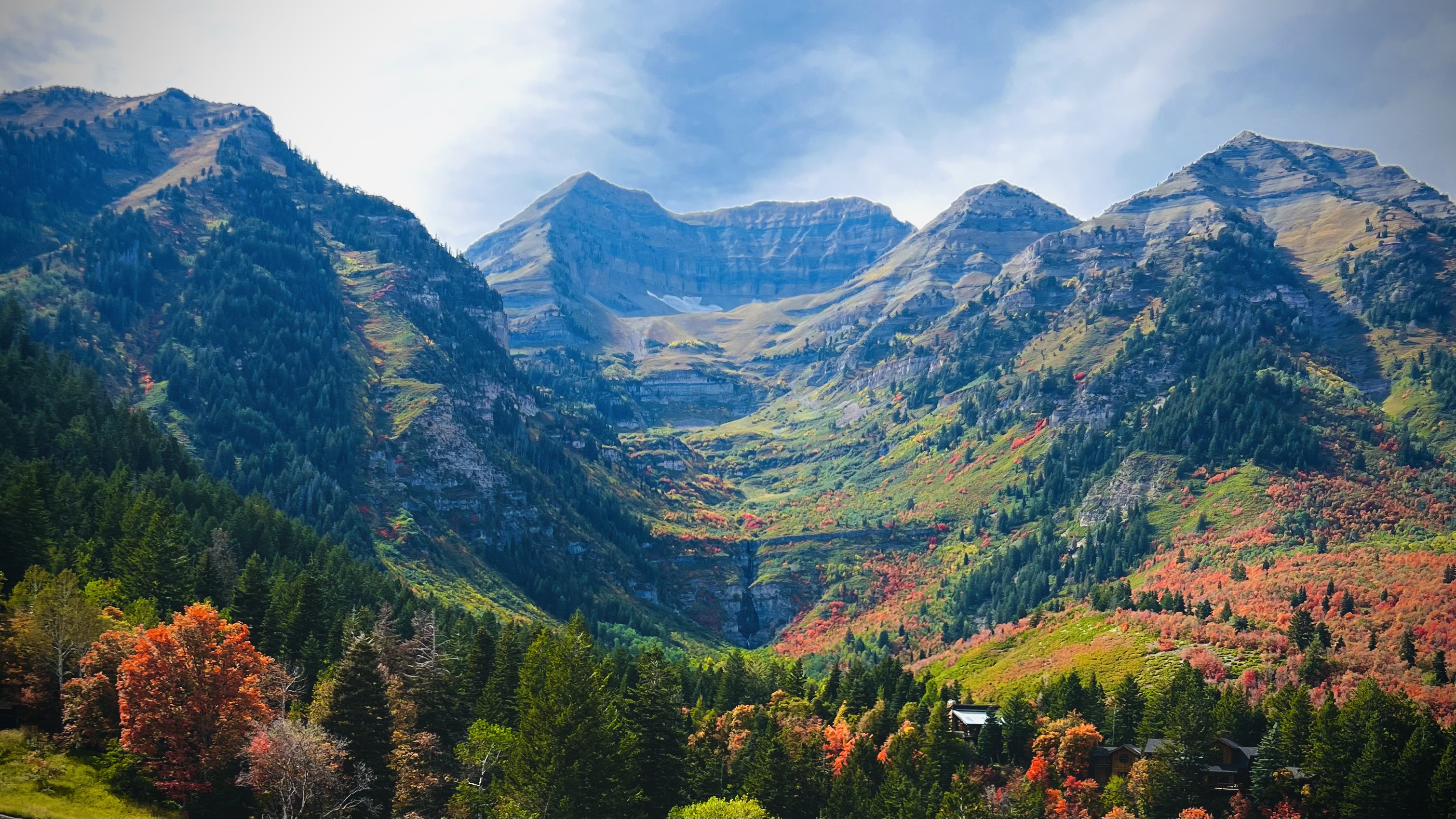
This fall, Wendy and I were invited to join friends at their place in Park City, Utah. We happened to be there for four days when the fall colors exploded in the mountains. The weather was gorgeous, and one day we drove to Sundance and rode the series of chairlifts to the top. The views were definitely not what you’ll ever see in Iowa. It was definitely a mountaintop experience in multiple ways. (I took the featured photo on today’s post as we were riding the chair-lift)

I mentioned in yesterday’s post/podcast that I’ve been listening to a series of podcasts about the meaning of mountains throughout the Great Story. And, it’s true that there are so many stories and events in the Story that happen on mountains. Mountains on which action takes place include, but are not limited to, Mount Sinai, Mount Carmel, Mount Tabor, Mount Horeb, Mount Zion, and the Mount of Olives. Mark has mentioned that Jesus commonly retreated up a mountain to be alone and pray. That was Mount Arbel off the coast of the Sea of Galilee.

Now I’ve been to Israel and I’ve been to the top of Mount Carmel, Mount Zion, and the Mount of Olives. Make no mistake, they are no Sundance Mountain. They are more in line with the bluffs in Iowa that line the Missouri and Mississippi River valleys. People who live anywhere near the rockies would laugh at the thought of them even being called mountains.

But the “mountains” in the Great Story are not meant to be accurate examples of scientific, geological definition. Building on yesterday’s post/podcast, the “mountains” are metaphors. They are high places that stretch toward the heavens relative to the area surrounding it. They are thin places where the veil between the physical and spiritual are more transparent. Mountaintops are isolated and exclusive places, in part because they require effort and sacrifice to access them. Like the narrow road that Leads to life that Jesus talked about, few are willing to do what’s required to reach the top.

In today’s chapter, there is one of the funkiest stories in the entire Jesus Story. Jesus takes his inner circle of three disciples (Peter, James, and John) and goes up a “mountain.” While there, Jesus is “transfigured.” In other words, his physical human form is transformed into the spiritual, heavenly, glorified, Light of the World that was His reality before He came to earth to be born a baby in Bethlehem. Then Moses (Law-giver) and Elijah (Prophet) appear and have a chat with Jesus. There’s a cloud that envelopes them all.

In order to understand this mountaintop moment, it’s necessary to know about Moses’ mountaintop moment on Mount Sinai where God began something new with the recently freed Hebrew slaves. On Sinai there was light in the forms of lightning and what looked like fire, and a cloud that covered the mountain. God gave Moses His guidebook for Life for the Hebrews, a blueprint for how to conduct themselves as individuals and as a community in order to be an example to all the other nations. Just as the Law came through Moses, Elijah was the great prophet who had his own mountain top experiences on Mount Carmel and Mount Horeb. He represents God’s prophets and prefigures John the Baptist.

Everything in the transfiguration event connects to the larger Story. This is a fulfillment moment that has been thousands of years in the making. It’s Mount Sinai 2.0. God Himself has come to, once again, announce that He’s doing something new. Jesus says it Himself in today’s chapter. God’s Son is going to suffer and die a human death, just as the prophets like Elijah had prophesied. Then, He will conquer death and the grave and be resurrected, pour out His Spirit and usher in a Kingdom age of grace.

“Therefore, if anyone is in Christ, the new creation has come: The old has gone, the new is here!
2 Corinthians 5:17 (NIV)

In the quiet this morning, I’m thinking back to mountain top memories like ascending Sundance mountain Utah with our friends and climbing Arthur’s Seat with our daughter Taylor in Edinburgh, Scotland. But I’m also reminded all of the ways that mountains are metaphorically layered with meaning. When the ancient Hebrews traveled to the Temple in Jerusalem to worship, they considered themselves ascending Mount Zion where they would worship God. As they made their way up the “mountain” to worship, they would sing “songs of ascent” as they journeyed. Some of them are in the Psalms, like Psalm 121:

I lift up my eyes to the mountains—
    where does my help come from?
My help comes from the Lord,
    the Maker of heaven and earth.

Wendy and I live on the Iowa prairie. I confess, there’s nothing resembling a mountain physically nearby. Yet every week as we gather with others in our community to worship we metaphorically and spiritually ascend a mountain to a thin place where “two or three are gathered” and Jesus Himself is in our midst by His Holy Spirit just as He promised. It is there that I am being transfigured and transformed into the person He is calling me to be. It is there that new things come. It is there that I catch a glimpse of the Light and Glory to come on another mountain where God is preparing an eternal City and a place for me there.

If you know anyone who might be encouraged by today’s post, please share.

These chapter-a-day blog posts are also available via podcast on all major podcast platforms including Apple, Google, and Spotify! Simply go to your podcast platform and search for “Wayfarer Tom Vander Well.” If it’s not on your platform, please let me know!

The Depressed Prophet

Cursed be the day I was born!
    May the day my mother bore me not be blessed!
Cursed be the man who brought my father the news,
    who made him very glad, saying,
    “A child is born to you—a son!”
May that man be like the towns
    the Lord overthrew without pity.
May he hear wailing in the morning,
    a battle cry at noon.
For he did not kill me in the womb,
    with my mother as my grave,
    her womb enlarged forever.
Why did I ever come out of the womb
    to see trouble and sorrow
    and to end my days in shame?
Jeremiah 20:13-18 (NIV)

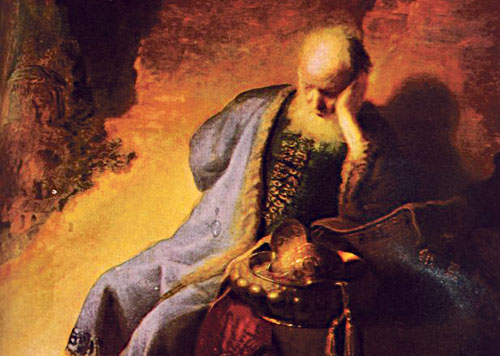
Across the ages, the ancient prophet Jeremiah has been labeled with  the moniker “The Weeping Prophet.” In our bedroom at the lake Wendy and I have a copy of Rembrandt’s portrait of Jeremiah looking depressed and sullen as he sits amidst the ruins of Jerusalem. It reminds me that the lake is a thin place where any who are burdened can find rest for their souls. Alas, it would seem that Jeremiah had no such place.

In today’s chapter we read of a confrontation between Jeremiah and a priest named Pashur, who was “the official in charge of the Temple of the Lord.” The fact that the one “in charge” was out to get Jeremiah is a good indication of just how corrupt the system had become in Jeremiah’s day. The priest in charge of the Temple was overseeing all of the pagan rituals and cults operating out of the Temple. The Temple had become a religious corporation, a powerful money-maker for those in charge (not unlike the way Jesus’ found the Temple in His day).

While Jeremiah had been protected from the death-threats that had already been made against him, Pashur decided to at least punish the prophet for his inflammatory prophesies of doom and destruction. I’m quite sure they were bad for business. In fact, I can almost hear Pashur saying, “This isn’t personal, Jer. It’s strictly business.” Once again, this is not unlike Jesus who, after His repeated rants against their corruption and His stirring up of the people, pressured the Temple leaders to plot His death .

After his time in the stocks, Jeremiah immediately confronts Pashur with a stubborn and willful repeating of his prophetic message: Jerusalem will be destroyed and its people led into captivity at the hands of Babylon. Obviously the prophet wanted Pashur to know his punishment did not have the desired effect. In fact, it simply appears to have pissed Jeremiah off.

What comes next is fascinating. The weeping prophet goes into a depression and pens a dark poem that graphically expresses his wish that he’d never been born. Obviously, the burden of his role, his prophecies, and the steady threats and persecution were getting to him. Of course they were. It would get to me too.

This morning I’m thinking about how common it is for humans to go through periods of depression. If you were privy to my medical records you’d find that I’ve had a few bouts with the blues along my life journey, and I never faced anything like what Jeremiah was dealing with. I’m also thinking about how common it is for individuals in history (artists, musicians, writers, thinkers) who saw and expressed things no one else could see were given to depression, madness, mental illness, and even suicide. I’d certainly put Jeremiah alongside the likes of Van Gogh, Hemingway, and Parker.

I’m struck by the contrast this morning between the spit-shined image I believe we often have of a “godly” person or a “servant of God.” We demand so much, expect so much, and are so quick to scapegoat individuals for their weaknesses and shortcomings. Jeremiah reminds me this morning that God’s servants were fully human, carried human flaws and weaknesses, were susceptible to all the shortcomings known to humanity, and were even given to deep depression and suicidal thoughts. Jeremiah reminds me to cut others a break. He even reminds me to be a bit more gracious with myself.

Wendy and I were at the lake late last week opening it up for the coming summer season. Once again, I saw and pondered Jeremiah’s portrait as I lay in bed.

I’m looking forward to getting back there.

(FWIW: My latest message was added to the Messages page.)