Tag Archives: Metaphor

Browsing Among the Lilies

okeefe lilyMy lover has gone down to his garden,
    to his spice beds,
to browse in the gardens
    and gather the lilies.
I am my lover’s, and my lover is mine.
    He browses among the lilies.
Song of Solomon 6:2-3 (NLT)

A few years ago Wendy and I were at the Des Moines Art Center browsing through the Center’s collection. We came across a painting by Georgia O’Keefe. “Oh my goodness,” Wendy softly exclaimed by side. “There’s no mistaking what that’s about!” O’Keefe is sometimes referred to as the mother of American modernism. She was particularly fond of painting enlarged flower blossoms, presenting them close up as if you are viewing just a part of the blossom through a magnifying glass. She often used lilies and sections of lilies.

O’Keefe came to prominence as a painter in the early part of the 20th century about the same time that Freud’s theories on psycho analysis rocked the world. Perhaps it was inevitable that O’Keefe’s paintings would be psychoanalyzed under the magnifying glass of Freudian thought just as she painted magnified views of her subjects. Despite the artists own denials, it has long been noted that her paintings seem to conjure up parallels to female sexual anatomy. Thus, Wendy’s soft exclamation upon viewing O’Keefe’s painting.

Lilies, in particular, have always had strong metaphorical parallels to sexuality dating back to ancient times. Roman and Greek mythology viewed the lily as a flower of purity, chastity and innocence. Even church tradition associates lilies with Mary, the mother of Jesus. Roman tradition was that Venus, the goddess of love, was so envious of the pure beauty of the lily that she gave the lily it’s large, long pistil in it’s center to make it less attractive. The pistil at the center of the lily’s flower has long been noted for its’ phallic metaphors; The center of the pure, white petals of the Calla Lilly being seemingly penetrated by the long, large pistil.

It is no wonder that Solomon’s ancient song of the budding, erotic love between the young king and the young woman of his harem would include imagery of the lilies. Solomon himself wrote, “there is nothing new under the sun.” Georgia O’Keefe did not invent the parallel between the lily and a woman’s sexual organs. If anything, her art was natural prey for metaphorical connections humans have made between the lily and sexuality for thousands of years.

Now, read the verse above once more and imagine an infatuated young woman saying these words as she fantasizes about the man whom she wants to marry and become her lover. Does Solomon’s song really intend these sexual metaphors? A hormonal young man writes a song about the sexual tension between himself and a gorgeous young woman whom he desires sexually. It doesn’t take a giant leap of reason.

God created us male and female. He created us as sexual beings with hormones and sexual desires. He created a natural order in which people grow, develop, desire one another and have sexual relations through which new life is created. He called it “good.” Too often in a pursuit of purifying the ranks from the sinful excesses with which many indulge  our natural appetites, the institutional church has thrown the baby out with the bath water. Many of us have forgotten to embrace, celebrate, and appreciate the natural God-given appetite which, when experienced as God intended, remains as pure as a lily.

God is Not “Either Or.” God is “Both And.”

Hammer your plowshares into swords
    and your pruning hooks into spears.
    Train even your weaklings to be warriors.
Joel 3:10 (NLT)

I know a small host of people I love for whom the “warrior God” metaphors such as we find in Joel’s prophecy today an uncomfortable pill to swallow. I totally get it, but it’s an on-going reminder to me that God is so much more than any one of us can possibly comprehend. God’s nature, as described throughout God’s Message, is so vast that it encompasses incredible contradictory elements. God is Lion and Lamb. God is Alpha and Omega. God is Artist and Warrior. God is Father, Son, and Holy Spirit. God is not “either or.” God is “yes and.”

I’m reminded this morning of Meredith Brooks‘ song, B*tch. I believe God totally relates to Brooks’ very true, very raw sentiments. They’re inspired. Just as Brooks so eloquently describes the complexities and contradictions of being a woman, God is so much more than the box we try to put Him in. He is solely confined by boundaries of His own choosing, and that can be confusing for our finite understandings.

Brooks sings:

I can understand how you’d be so confused
I don’t envy you
I’m a little bit of everything
All rolled into one

I’m a b*tch, I’m a lover
I’m a child, I’m a mother
I’m a sinner, I’m a saint
I do not feel ashamed
I’m your hell, I’m your dream
I’m nothing in between
You know you wouldn’t want it any other way

Today I’m thinking about the oft forgotten reality that we are engaged in a spiritual battle. Like all good stories, the Great Story that God is authoring throughout history is about light versus darkness, death versus life, good versus evil. It is not about what is seen, but what is unseen. That doesn’t, however, mean it isn’t real. When the climactic confrontation arrives in that spiritual conflict, I personally want a warrior God leading the charge of the forces of Light.

*i  😉

Chapter-a-Day 1 Peter 3

Christ suffered for our sins once for all time. He never sinned, but he died for sinners to bring you safely home to God. 1 Peter 3:18a (NLT)

Wendy and I are sports fans. We follow our teams and enjoy watching them through the seasons. This means it’s been busy the past few weeks as baseball season is winding down, but football season is in full swing. The result is that we’re watching a lot of sports on television and the DVR is working overtime recording shows and movies that we likely won’t get to until after the fall classic.

Though we love watching many different sports, my love of baseball has grown over the years while my love of other sports has waned. There are a number of reasons for this. Baseball, more than any other sport, is a metaphor for life. It is a day-by-day journey that starts with the promise of life each spring and ends (especially for Cubs fans) with the harsh realities of death and disappointment each fall leaving hope of resurrection “next year.” Within the long journey there are highs and lows. Even the worst of teams pull together a few winning streaks and the best of teams are going to experience a host of disappointing losses. The best of the best hitters fail seven out of ten times at the plate. The greatest of pitchers give up a home run now and then.

While I love all these things about baseball, the one thing that I’ve come to appreciate most is the simple object of the game: making it home safely. It is the same objective that this wayfaring stranger has as I day-by-day walk my journey through this world of woe. You’ll even find it in the banner of my blog. It is the same way Peter summarizes the message of Jesus in today’s chapter: Jesus died on a cross and suffered as a sacrifice for ours sins once for all and did so in order to bring we sinners safely home.

Those who’ve walked with me for a long time have watched me hit a few home runs but have more often seen me strike out swinging. I’ve been hit by pitches and have stolen a few bases. I’ve also dropped some easy pop flies. Nevertheless, I get up early each morning with the promise that it’s a new day. I can’t do anything about yesterday’s bitter loss. I can only do my best in today’s game as I make my way toward the inevitable winter that slowly approaches.

Chapter-a-Day Hosea 1

from loren javier via Flickr

When the Lord first began speaking to Israel through Hosea, he said to him, “Go and marry a prostitute, so that some of her children will be conceived in prostitution. This will illustrate how Israel has acted like a prostitute by turning against the Lord and worshiping other gods.” Hosea 1:2 (NLT)

Hosea was written in whacky period of ancient history about 750 years before Christ. After King David and his son Solomon, the small kingdom of Israel had been broken up in a civil war. The southern kingdom was called Judah and their kings followed the lineage of King David. The northern kingdom continued to call themselves Israel and their throne was occupied by anyone who could plot, assassinate or politically maneuver themselves into the position.

There are two things that I love about Hosea. First, God told Hosea to marry a prostitute and I love to imagine how that conversation went over with his parents.

“God told you WHAT??!”

Hosea stands as an eternal reminder that God does not fit inside a box of our own finite  cultural, social or political sensibilities. God is not subject to the limits of our own definition of propriety. In fact, the only limits God fits are those He has ordained for Himself.

Second, I love the way God made Hosea’s very life became an object lesson. His marriage to Gomer became a metaphor for God’s “marriage” to the idolatrous and therefore adulterous nation of Israel. Hosea’s poor children became metaphor’s for God’s message to Israel. The Great Creator as master artist turned Hosea’s life into a work of performance art.

I think God does the same with my life and yours.

How interesting to think of our very own life journeys being a metaphor for what God is doing. It’s why I love history. There are lessons, eternal spiritual lessons, to be learned from each person’s story. A few days ago I asked the question “What’s your story?” Today, I’m asking the same question for a second time with a different twist:

What is the story God is telling through your life?

(Note: Those following along on a chapter-a-day may wonder why we haven’t finished the book of Psalms. Because Psalms is 150 chapters long, I’ve opted to break it up a bit so as not to get fatigued with it. Psalms is broken up into five distinct sections or “books.” The first book ends with Psalm 41 which we walked through yesterday. We’ll pick back up again with the second section in the near future.)

Chapter-a-Day Leviticus 24

Dictionary

 It makes no difference whether he is a foreigner or a native, if he blasphemes the Name, he will be put to death. Leviticus 24:16 (MSG)

blas·pheme

/blæsˈfim, ˈblæsfim/[blas-feem, blas-feem] verb, -phemed, -phem·ing.
–verb (used with object)
1. to speak impiously or irreverently of (God or sacred things).
2. to speak evil of; slander; abuse.

Those who faithfully read these chapter-a-day posts are likely sick of hearing me say that God is a God of metaphor. And yet, in our journey through God’s Message I am continually amazed at how deeply this truth is woven into the very fabric of life. Words themselves are metaphors. A word, whether spoken or written, is something which stands for something else without using “like” or “as.” God’s Message refers to Jesus as the “Word.”

Consider that each morning we wake up with a blank verbal canvas, and the words that we choose to utter become brush strokes which paint a metaphorical self-portrait; they paint a metaphorical expression out of our deepest thoughts, emotions, and beliefs.

Think about all that you did yesterday. Recall, as best you can, all of the words that came out of your mouth: the conversations, the exclamations, the idle gossip, the song lyrics you sang along with in the car, the curses under your breath, the complaints, the arguments, the demands, the insults, the compliments, the private moments, and the deragatory remarks.

What kind of self-portrait do those words paint? Would others look at a summary of the words that came from your mouth and say that it is a portrait of love? Anger? Contentment? Hatred? Dissatisfaction? Gentleness? Pride? Greed? Compassion? Lonliness? Humility? Fear? Patience? Anxiety?

God takes the word we use very seriously. In fact, I believe God takes them far more seriously than we care to think about.

“A good man brings good things out of the good stored up in his heart, and an evil man brings evil things out of the evil stored up in his heart. For the mouth speaks what the heart is full of.” – Luke 6:44-46

“But I tell you that everyone will have to give account on the day of judgment for every empty word they have spoken.” – Matthew 12:36

“My dear brothers and sisters, take note of this: Everyone should be quick to listen, slow to speak and slow to become angry….” James 1:19

I read today’s chapter and scratch my head at the extreme reaction God had towards one man’s curse. My first reaction is to think “how can God be so upset about words?” The longer I meditate on it, the more I hear God’s return question: “How can you so easily profane the power and meaning of words themselves?”

Enhanced by Zemanta

Chapter-a-Day Leviticus 2

Gold Medal Flour at Dot's Cafe
Image by ChicagoGeek via Flickr

When you present a Grain-Offering of oven-baked loaves, use fine flour, mixed with oil but no yeast. Or present wafers made without yeast and spread with oil. Leviticus 2:4 (MSG)

When my children were still babies, I made a habit of having them close their eyes, bow their heads and hold hands while we thanked God for their food. At bedtime I would read Bible stories and we would act them out together in little bed-top improvisations. On Memorial Day, grandma would pick them up each year to help her plant flowers on the graves of loved ones. These repetitious rituals are word pictures and reminders of thankfulness, offering, obedience, and honor that, hopefully, stick with children as they grown into adolescence and adulthood.

When I read Leviticus I often picture mankind and human society in its infancy. The sacrifices, rules and offerings are ritualistic word pictures prescribed by a Father to his people, who are just a toddler society beginning to understand their place in the world.

Today, two things struck me in the word picture of the grain offerings:

First, fine flour was to be used. When we give, to others and especially to God, we should give the best we have. It reminds me of the lyric to David’s song (which we know as Psalm 112) which says “Good will come to him who is generous and lends freely.” Am I giving God and my neighbors the fine stuff or the white elephant stuff on my basement shelf?

Second, the bread offering was not to contain yeast. God uses a word picture out of what was a daily chore at that time: the baking of bread. We bake a lot of bread in our house and the last ingredient you put in to the breadmaker is the yeast. It always amazes me how a little teaspoon of yeast makes such a HUGE difference in the outcome of the bread. That’s why God used it as a word picture for sin. A little sin taints the whole person the way a little yeast taints the whole loaf. You can’t bake a loaf that’s half leavened (with yeast) and half unleavened (without yeast). Once the yeast is added, the entire loaf is tainted. We often want to think of sin as this isolated part of our person. We’re mostly “good” people who have this hidden little sin problem back in our closet. By requiring bread without yeast as an offering, God was telling us “I demand a sinless sacrifice. A pinch of sin affects the whole person, and that’s a problem.”

Enhanced by Zemanta

Chapter-a-Day Leviticus 1

“If the offering is a Whole-Burnt-Offering from the herd, present a male without a defect at the entrance to the Tent of Meeting that it may be accepted by God. Leviticus 1:3 (MSG)

My grandfather was a court bailiff and as a child I spent my spring break with him at the courthouse. I still remember the long bookshelves, stacked floor to ceiling with an important set of leather bound books entitled “Code of Iowa.” It was the “book of law” for the state of Iowa. Call it the rule book for our society. It prescribes the rules by which we live together and on which our judicial system judges those who break the rules.

Leviticus is not an inspirational book of song lyrics (like Psalms). It is not a devotional book of wise sayings (like Proverbs). It is not a biographical story (like Matthew). Leviticus is an ancient book of law. Like the Code of Iowa sitting on the county courthouse shelf, Leviticus is the “Code of (ancient) Israel.”

We also have to remember the time and historical circumstance in which the book of Leviticus was given. A couple of million Israelites had just left slavery in Egypt. An entire nation with their flocks and herds now found themselves wandering in the desert together. There was no system of government. There wasn’t an agreed upon set of rules. It was a law-less nomadic society; Imagine the entire population of the state of Iowa (complete with farmers taking their livestock) grabbing everything they could carry and making their way on foot toward Canada [Canadians will appreciate that I made them “the promised land” in this metaphor]. Leviticus was God’s attempt to provide some basic rules for life and worship to an ancient people whose daily life we can scarcely imagine in a time and culture very different from our own.

Besides being mindful of the historical context, there are two things I always try to keep in mind while wading through the Code of (ancient) Israel. First, the common link we have to that people is our sin nature. We all blow it and fall short of God’s holy perfection. The sacrificial system prescribed by Leviticus is an initial attempt in history to deal with the core spiritual problem: man is sinful, separated from God, and therefore stands condemned to die.

Second, God is a God of metaphor, so the Code of worship and conduct prescribed in Leviticus is going to provide word pictures and foreshadowing to the larger story God is authoring. For example, the first sacrificial offering prescribed is a “male without defect.” Picture Jesus, God’s own Son, a male without defect, dying on the cross. Two thousand years before Jesus’ ultimate sacrifice on the cross, God was trying to give people a word picture of the ultimate plan in the sacrifices He prescribed.

Today, I’m mindful of an epic story of grand design which is still being authored, of which I am a part. And, I’m thankful for a God of detail who has a master plan, even though my finite mind can’t completely comprehend it.

Creative Commons photo courtesy of Flickr and rachael voorhees

Chapter-a-Day Matthew 12

A word cloud of Wikipedia talk:Requests for co...
Image via Wikipedia

“Let me tell you something: Every one of these careless words is going to come back to haunt you. There will be a time of Reckoning. Words are powerful; take them seriously. Words can be your salvation. Words can also be your damnation.” Matthew 12:36-37 (MSG)

As I’ve said many times before, God is an artist and therefore He is a God of metaphor (something which represents something else without using “like” or “as”). Because we are created in His image, we are creatures of metaphor without ever thinking about it.

Take words, for example. A word is a metaphor. The word “cat” isn’t really a furry animal that purrs, but when we say the word “cat” it represents the furry animal that purrs in our language. When we use words in our conversation or in our writing, we are using metaphors. In a very basic way, we are being artistic, creating word pictures.

Jesus said that words are powerful, and they are. The old saying “sticks and stones may break my bones, but words can never hurt me” is a bunch of b.s. Most of us can still remember, vividly, a hurtful things someone said to us many years ago.

When you speak, you are painting a picture that reveals your own soul. What do others see when you speak? Anger? Criticism? Prejudice? Hatred? Fear? Anxiety? Kindness? Hope? Faith? Love?

Today, I’m going to listen to myself. I’m going to examine my words and look at the picture they paint of who I am.

Enhanced by Zemanta

Chapter-a-Day Jeremiah 24

God showed me two baskets of figs placed in front of the Temple of God. Jeremiah 24:1 (MSG)

God is Creator. God is creative. God expresses Himself endlessly in what He’s created and what He continues to create.

We are made in the image of the Creator. We are children of the Creator. We are creative. We express ourselves in our words, thoughts, and our actions; Made in the image of the Creator, we express ourselves in what we create.

It is no wonder that word pictures and metaphors are such powerful tools of communication.

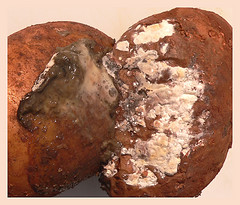
Take a message and say it plainly: The best and brightest are going into exile, and they will flourish. Those left are rotten, and will be thrown out as useless. The message is simple and straightforward enough. But, then you wrap it in a word picture: Look at the figs in those baskets. Make the connection. See the ripe, tasty, figs. Those are the exiles. See the rotten, moldy, maggoty figs. Those are the rulers left in Jerusalem. Now the message takes on new depth and power because we’ve wrapped it in new layers of understanding. In the figs we can visualize the contrast between ripe and rotten. The lesson now has texture. We can taste it. We can small the rotteness of the bad figs. In the word picture, the message gains communicative power.

The best communicators are those who understand the power of word pictures; They wield metaphor like master craftsmen. If you’re struggling to express yourself, the key is to find the right word picture for your message.

Creative Commons photo courtesy of Flickr and mythoto

Chapter-a-Day Isaiah 46

More. So to whom will you compare me, the Incomparable? Can you picture me without reducing me? Isaiah 46:5a (MSG)

No. That's the answer to God's rhetorical question. We can't picture Him without reducing him. Human metaphors catch a part of the picture, but only a fraction of His person. The only way God could be embodied was for Him to reduce Himself in the form of Jesus:

Who, being in very nature God,
  did not consider equality with God something to be grasped, 
but made himself nothing,
taking the very nature of a servant,
  being made in human likeness.
And being found in appearance as a man,
  he humbled himself
  and became obedient to death—
 even death on a cross!
Philippians 2:6-8 (NIV)

Just when you think you've finally got a handle on God, you find that God is infinitely bigger than your handle.

Creative Commons photo courtesy of Flickr and blueforce4116