The Erosion of Relationship

Jacob Talks with Laban (illustration from the ...
(Photo credit: Wikipedia)

“Why did you run off secretly and deceive me? Why didn’t you tell me, so I could send you away with joy and singing to the music of timbrels and harps?” Genesis 31:27 (NLT)

The pattern of deception and manipulation we’ve seen within the family system of Abraham, Isaac and Jacob continues to escalate between Jacob and his Uncle Laban. It finally breaks the relationship.  Jacob sneaks off in the middle of the night. When Laban asks the question above, the unspoken answer is obvious. Jacob doesn’t trust Laban because Laban has proven untrustworthy. Laban doesn’t trust Jacob because Jacob isn’t trustworthy. There can no longer be relationship between them because the foundation of relationship has been destroyed. There is no mutual trust on which to build life together.

Honesty and trust are critical to a healthy, growing relationship. Deception and passive aggressive manipulation will eventually make any kind of intimacy untenable.

Today, I’m reminded of my responsibility in the circles of relationship and influence around me. I cannot control others, but I must control my own actions and manage my end of relationships. That responsibility includes my being appropriately honest, transparent and worthy of another person’s trust. It also includes the responsibility to set boundaries between me and others when it is necessary to protect myself, my loved ones and others from relational harm.


Valentine’s Weekend 2013

Table Set for ValentinesWith my being in the throes of rehearsal for Ah, Wilderness!, the Valentine’s plans had to flex this year. I was actually scheduled in rehearsal on Valentine’s Day and so Wendy and I decided to delay any Valentine’s plans until my next free evening which was Saturday. Wendy made plans to run to Des Moines on the afternoon of Valentine’s Day and any thought of celebrating on that day were scuttled.

Then, at the last minute, my rehearsal time was pushed back and a window of opportunity opened. So, while Wendy was in Des Moines I threw together one of our favorite crock-pot recipes, set the table, got out a nice bottle of wine and surprised her with an impromptu dinner together which was wonderful.

We still celebrated on Saturday with Chad and Shay, who came over for a steak dinner here at Vander Well Manor. It was one of those dinners that had us eating, drinking, talking and laughing at the table for four hours before someone made the mistake of looking at their watch and realizing how late it was. I love those kind of dinners! 😉

The Chaos of Forcing God’s Hand

BERCHEM Nicolaes landscape With Jacob Rachel A...
BERCHEM Nicolaes landscape With Jacob Rachel And Leah (Photo credit: Wikipedia)

When Rachel saw that she wasn’t having any children for Jacob, she became jealous of her sister. She pleaded with Jacob, “Give me children, or I’ll die!”

Then Jacob became furious with Rachel. “Am I God?” he asked. “He’s the one who has kept you from having children!”

Then Rachel told him, “Take my maid, Bilhah, and sleep with her. She will bear children for me, and through her I can have a family, too.” So Rachel gave her servant, Bilhah, to Jacob as a wife, and he slept with her. Bilhah became pregnant and presented him with a son. Genesis 30:1-4 (NLT)

There is so much happening in this chapter I felt chaotic reading it this morning. There are four discontent main characters, all part of the same dysfunctional family system, all trying to force God’s hand and make things happen on their own:

  • Rachel becomes jealous of Leah and parallel’s Jacob’s jealousy of Esau.
  • When Rachel, then Leah, can’t have children on their own they take matters into their own hands repeat the mistake of Jacob’s grandmother and have him sleep with their maid servants.
  • The sisters, catty and desperate to have more sons, grasp at superstition, eating mandrakes in hope it will make them pregnant
  • While the baby-making contest continues between Jacobs wives and concubines, Jacob and Laban continue the family tradition of deception in the ordering of the family business:
    • Laban deceptively takes the sheep he agreed to give Jacob and gives them to his sons instead
    • Jacob answers deception with deception, using superstition to try to make more of the spotted sheet Laban had agreed to give him.

I get the sense that all of this jealousy, deception, superstition, desperation, and generational family sin makes for a dramatic amount of crazy in their everyday lives. It feels more than a little out of control, and I think that’s one of the points that I’m taking away from today’s chapter. When we desperately seek to take God’s will into our own hands and make things happen by our own ways and means, the results are often disastrous.

The other thing that I must acknowledge in all of this is that God continued to work His own will and purpose in and through Jacob, Leah and Rachel despite their own sinful deception and foolishness (So, I guess there’s hope for me!). As I journey through God’s Message I’m continually reminded that God’s divine purposes in this world are often carried out by unlikely and arguably unworthy individuals. There’s something unsettling and seemingly unfair about it, but it reminds me that I am not God. I do know see the big picture nor is my butt big enough to occupy His judgement seat.

Much Ado About Something

Dante's Vision of Rachel and Leah Dante Gabrie...
Dante’s Vision of Rachel and Leah Dante Gabriel Rossetti, 1899 (Photo credit: Wikipedia)

Chapter-a-Day Genesis 29


But when Jacob woke up in the morning—it was Leah! “What have you done to me?” Jacob raged at Laban. “I worked seven years for Rachel! Why have you tricked me?” Genesis 29:25 (NLT)


Wendy and I have recently been enjoying the Great Performances series on PBS called Shakespeare Uncovered. In each episode a famous actor delves deep into the story line of one of Shakespeare’s plays. It’s a wonderful primer for those who have an interest in learning more about Shakespeare’s stories and the literary genius he was.


Perhaps that is why I couldn’t help noticing that there is a Shakespearian quality to the story of Jacob and his uncle Laban. Jacob the deceiver, born from Abraham and Isaac who were also deceivers, receives a does of his own medicine when he is deceived by his Uncle. Add to that plot line the tale of two sisters, one homely and the other one hot. The hot one is seemingly barren while the homely one appears to be a baby making factory. Jacob is in love with the latter but is tricked into marrying the former. The sibling rivalry and Leah’s desperate desire to win the love and affection of her husband leads to a fertile fury of son making. Truth is sometimes as compelling as a Bard’s tale.


One of Shakespeare’s greatest qualities as a playwright was his development of characters whose tragic flaws led to tragic consequences. In this, he really is just developing what is true of human nature. We all have tragic flaws. We all have blind spots and weaknesses. We will all look back and realize that along the journey our own shortcomings led to negative consequences. The question is: What will we do about them?

We do not have to remain blind and ignorant. Through introspection, conversation, transparent relationship, and accountability we can become aware of our blind spots. We can actually learn from our shortcomings and choose to modify our patterns of behavior before they wreak too much havoc on our lives and the lives of those in our circles of influence.


Today, I’m thinking about my own weaknesses. I am aware of areas of my life that have been blind spots for me. I do not want to live passively. I’m actively working on modifying my thought patterns and behaviors. I don’t know that I will ever eliminate the negative consequences of my flaws, but I can certainly diminish them and that’s something.


Life in a Parka with the Hood Cinched Shut

SONY DSC
source: andy_emcee via Flickr


Chapter-a-Day Genesis 28


Then Jacob awoke from his sleep and said, “Surely the Lord is in this place, and I wasn’t even aware of it!” Genesis 28:16 (NLT)


When I was a kid, the Parka coat became all the winter fashion rage. The Parka’s extra large hood with fake fur lining not only covered your head, but the drawstring would cinch the hood shut until you only had a small peep hole to look through. The parka was effective at blocking the wind from your face on a blustery Iowa winter day, but became a detriment when the kids on the playground started throwing snowballs. Your vision was so terribly restricted that you were completely unaware that a snowball was hurtling toward your head with the speed of a major league fastball. In fact, given the Parka hood’s additional restriction of your hearing you probably hadn’t noticed that a snowball fight had broken out at all.


In the past couple of weeks we’ve been reading about God’s continual presence and interjection in the lives of Abraham and his descendants. I find it fascinating that in today’s chapter Jacob suddenly had an epiphany and was aware of God’s presence in a dream. The truth of the matter is, if he’d been more aware, he might have recognized God’s continual presence and work in he and his family.


How much in life do we miss simply because we bind ourselves up in a spiritual Parka with the hood cinched shut? How much of our life is spent with the eyes of our heart so insulated by self-centered concerns that we cannot see the obvious presence and work of God all around us?


Today, I want to be fully present and aware of God’s presence and purposes which are at work all around me.


Tragic Stories Touch Secret Wounds

English: Isaac Feels Jacob as Rebekah Looks On...
English: Isaac Feels Jacob as Rebekah Looks On, watercolor by James Tissot (Photo credit: Wikipedia)

Chapter-a-Day Genesis 27

Isaac said to Esau, “I have made Jacob your master and have declared that all his brothers will be his servants. I have guaranteed him an abundance of grain and wine—what is left for me to give you, my son?” Genesis 27:37 (NLT)

As an actor, I find it interesting to read the theatrical lengths to which Rebekah and Jacob went to make Jacob convincingly play the part of Esau and deceive Isaac. As  I read today’s chapter, I also thought what a tragic story is revealed in these past few chapters.

  • How twin brothers could be so different
  • The conspiracy of (seemingly) heaven and earth to favor Jacob from birth
  • The parental favoritism that divides the parents and family
  • The deceptive stealing of birthright and blessing
  • The fulfillment of Jacob’s given name (which in Hebrew sounds like both “Heel” & “Deceiver”)

I couldn’t help, as I read, to think of other epic stories told on film such as Legends of the Fall and The Godfather which deal with similar themes of fathers and sons, of favoritism and blessing, and of tragedy and loss. I believe that there is something very compelling in these stories for us because they tap into very human realities from our very own family systems and experiences. These are things which families rarely speak about or even acknowledge, and  their suppression makes the truth and reality of them even more powerful when we read or see similar themes so artfully articulated in story. It’s like scratching at an old wound.

I walk away from some stories and chapters with more questions than answers. Today’s chapter is one of them. Why did God seem to honor the deception of Rebekah and Isaac? How could Isaac so passively allow these things to happen? How and why does God utilize human brokenness and sin to bring about His will?

It’s a good morning for a cup of coffee and a thoughtful conversation around such interesting questions.

When You Marry a Spouse You Marry a Family

2012 07 21 VH Reunion Group 1But Esau’s wives made life miserable for Isaac and Rebekah. Genesis 26:35 (NLT)

Typically, when you marry, you are not just entering into relationship with a person but with an entire family. Your spouse or spouse-to-be is part of a family system with its own traditions, culture, ways and means of doing life. In my experience, people don’t talk much about family of origin when they get married. There might be the passing conversation or even a pre-marital counseling session dedicated to talking about our families, but the conversation is usually covered in the fairy-dust of two people desperately in love with one another and living in the delusion that nothing could possibly diminish the feelings of infatuation they are experiencing at the moment.

Just wait until the holidays.

The brief observation made at the very end of today’s chapter holds a huge lesson for all of us. When we enter into a marriage we enter into our spouse’s family system. Make no mistake: It’s a package deal. We can either be a blessing or a curse to that family. I can’t control whom my family members marry, nor can I control the way they behave or relate to my family. But, I can control how I behave and relate to every one, especially my wife’s family. By speaking and acting in loving kindness towards her family, I am not only honoring my wife but keeping myself from being a source of tension and conflict in her family system (I am blessed that Wendy’s family makes it easy ;-))

Today, I’m thinking about the role and responsibility of being an in-law. The truth of the matter is that part of loving my spouse well is loving spouse’s family well. If/when I dishonor or make life difficult for my spouse as it relates to her family, then I diminish my love for her. When a spouse dishonors your family, it can wound deeply, leave scars that never completely heal over, and continue to itch long after they are made.


Preparing for a Role: “How Do You Memorize All Those Lines?”

lines Ah WildernessIt’s the most common question I get as an actor from those who have never been on stage: “How do you memorize/remember all of those lines?”

There are two important things that are true about memorizing lines:

  1. You’ve simply got to do the work of memorization.
  2. There are tricks that make the work easier than you might think.

Make no mistake. Memorization does takes time and effort. You sit with your script and go over the lines again, and again, and again. I will sometimes say the line until I can repeat it perfectly, then repeat it 10 – 20 – or 30 times in a row. There is no substitute for repetition.

What those who have never been on stage do not realize is that the entire acting process does make it easier. It’s not as if you’re memorizing totally random words or thoughts. The lines you’re memorizing are generally part of a conversation. As you internalize the context of the situation/conversation the lines tend to flow naturally. If another character on stage asks your character a question, your line is the logical answer to that question. Your brain follows the order of the conversation and the line becomes like a piece of a puzzle. “This line,” the brain reasons, “fits perfectly at this point in the conversation.”

In addition, when you “block” the scene (determining when and were you move on stage) certain movements or actions become linked to a line or lines by your brain. “When walking over to the table, you’re supposed to say this,” the brain remembers.

Typically, the memorization process requires help. For our production of Ah, Wilderness! there are four stage managers who make themselves available to “run lines” with the actors. Having a wonderful wife who is a capable actor in her own right, I have the luxury of a partner who understands the need to run lines and is typically happy to do so.

Technology also affords actors simple and inexpensive tools. Using a cell phone or computer, you can easily record a “cue track.” You or another person read the line immediately preceding your line and then your line. I have an iTunes playlist of the cue track for all of my lines in Ah, Wilderness! When I’m driving or doing mindless chores around the house I play the cue track on my iPhone and listen to my lines over and over and over again. My car and iPhone also provide me with a “pause” button so I can listen to the cue line, hit pause, then try to say my line from memory.

Ah Wilderness Cue Track Sample

In the rehearsal process, you’re usually allowed to have the script (a.k.a “book”) in your hand through the blocking and working process of a scene. The rehearsal schedule will tell you when you have to be “off book” for particular scenes. One you’re supposed to be “off book” you can’t have your script with you, but for a period of time you can “call for lines.” If you forget your line you simply say “line” and a stage manager or production assistant is following along and will feed you the line. As you near performance, you are no longer allowed to call for lines and if you forget the line you and your fellow actors are required to figure it out in the moment.

Of course, the process of going “off book” is a natural stressor for actors in any production – but I think that those who’ve never been on stage imagine it to be harder and more stressful than it actually is. The repetition of rehearsals the the natural flow of the process make line recall easier than many believe it to be.


Common Love & Unique Relationships

English: Esau Sells His Birthright for Pottage...
English: Esau Sells His Birthright for Pottage of Lentils; illustration from the 1728 Figures de la Bible; illustrated by Gerard Hoet (1648-1733) and others, and published by P. de Hondt in The Hague; image courtesy Bizzell Bible Collection, University of Oklahoma Libraries (Photo credit: Wikipedia)

Chapter-a-Day Genesis 25

Isaac loved Esau because he enjoyed eating the wild game Esau brought home, but Rebekah loved Jacob. Genesis 25:28 (NLT)

In the discussion of families and family systems, the subject of “favorites” comes up a lot. I have witnessed in many families that there is a clear ranking of favorites in the truest sense of the word – in which one child receives a greater amount of favor at the expense of the children. Sometimes, however, the way parents show favor can be incongruent. I know one family in which the rebellious child, with whom the parent struggled, was granted more favor at the expense of the other children because of the parent’s guilt with not getting along with him. It can get messy.

In my own experience as grandchild, child, sibling and parent, I’ve found that relationships between family members are really no different than relationships in your broader social circle. There are some family members with whom you relate easily. There’s a natural affinity, personalities and temperaments are similar, there are common interests and world-views, and etc. Notice that Isaac’s love of Esau hinged on a common love for wild game. In fact, I’ve come to realize that it’s wrong for me expect that a genetic or experiential family relationship would create some kind of emotionally unilateral relationship between all of the members. We are human after all.

My mother has often said that the love she had for each of her four children was equal, but her relationship with each child was as unique as the child him/herself. Well said, mom. I’ve come to accept that the relationship between family members can be very different while the love with which you share and act pours out and washes over each from a common inner reservoir. When it comes to children, it is my role as a father to love each of my children fully and to love each child well despite the diverse differences between them, their personalities, and the course that each relationship takes.

Thank You….

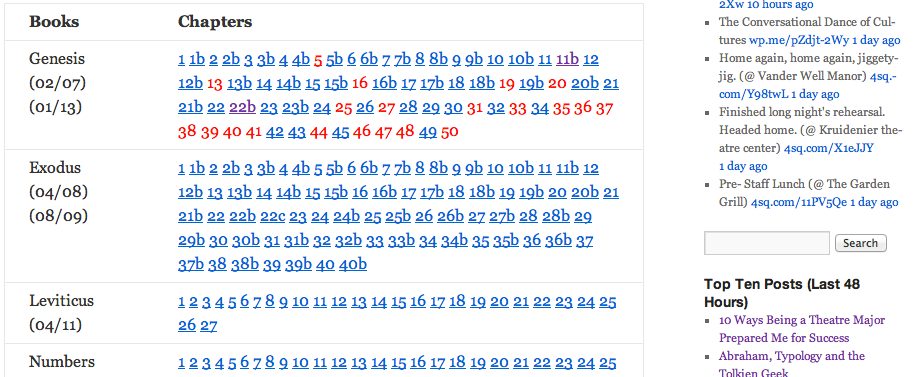
… to Lesli Nelson over at Pella Hosting who graciously fixed an HTML problem with my Chapter-a-Day Index page. It now fits on the page perfectly.

chapteraday grab

Way to go, Lesli! Woot! Woot!