Without oxen a stable stays clean, but you need a strong ox for a large harvest. Proverbs 14:4 (NLT)
For the record, I like a clean and well organized environment. Whether it’s at home or at work, I find it more peaceful and efficint when things around me are not cluttered and chaotic. I do not, however, feel the need to live in a museum. I never want my home to be a place in which I or any of my guests are afraid to touch, walk, soil, stain, spill, or generally mess up the feng shui.
The Vander Well home is intended to be a place of life. Our house is meant to be fully “lived” in. In my experience, if you are living life, then things are going to get crazy, chaotic, and occasionally messy. I love a clean and organized environment, but I find that an abundance of life usually makes it hard to keep things that way at all time.
So, when you come in the door of our home you may kick off the shoes if by doing so you are making yourself feel more at home. But don’t do so out of fear of breaking the museum rules.
Most of us have seen commercials for Siri, the digital assistant that comes with the new Apple iPhone 4s. Since getting our new iPhones a month or so ago, Wendy and I are still trying to get a handle on Siri being a part of our organizational lives. Yesterday, while arranging herself in the car, Wendy accidentally activated Siri on her phone. Realizing that she’d inadvertently triggered the robotic female voice and still frustrated with getting herself situated, Wendy lashed out and prompted the following conversation:
Wendy: Shut up, Siri!
Siri: That’s not very nice.
Wendy: (after controlling her laughter) I’m sorry.
If you ignore criticism, you will end in poverty and disgrace; if you accept correction, you will be honored. Proverbs 13:18 (NLT)
It is frustrating to have the desire and ability to help another person succeed, to offer your assistance, only to have your offer shunned. In my job as a consultant and business coach, I face this situation all the time. I’m always saddened when others’ insecurities and pride lead to their own unnecessary troubles.
I was called into a meeting with a young businessman and department head. Intelligent and gifted in certain areas, he had risen to a position of some prominence for a person his age. Like all leaders, like all human beings, his growing job description and sphere of authority placed him in new roles for which he was not as innately gifted. Even his superiors knew he needed some guidance and assistance to work on and shore up skill sets in which he was lacking.
Sitting across the desk from me, the young man flatly rejected the notion that he needed guidance or assistance of any kind. Slamming the desk with his hand, he made it clear that the perception he needed to improve in certain areas was completely wrong. When I tried to express that I was only offering some constructive criticism, he explained that he didn’t believe criticism of any kind was constructive. Criticism, he went on to say, is inherently negative and he would not tolerate it.
It became quickly apparent to me that I was wasting my breath and my time. I have observed from a distance as the young leader has struggled. His department and his company are struggling as a result.
I contrast this experience with another leader in the same company. Wildly successful, this gentleman unexpectedly called and asked me to meet with him. “You have knowledge and experience I don’t have,” he explained to me over a cup of coffee. “You’re my guy. I want to learn from you.” I soon came to learn that this leader had several “guys” who were experts in different life disciplines. Recognizing and accepting his own shortcomings, he became a sponge soaking up all of the wisdom and information he could gather from others who were gifted in areas he was not. “How am I doing?” he asks me regularly when he sees me. “What can I do to improve?”
I could not help but think of these contrasting leaders as I read the proverb above in today’s chapter. God, help me be honest and humble enough to accept my shortcomings, to accept criticism and to continually improve the areas I am lacking.
A hard worker has plenty of food, but a person who chases fantasies has no sense.
Proverbs 12:11 (NLT)
I one knew a man who chased fantasies. He did not go to college even though he could have done so free of charge because of his parents positions with a local university. Intelligent and personable, he could have easily made his way through school and found success in any number of life endeavors. He chose instead to chase after quick money in a number of schemes both legal and illegal.
For several years I had opportunity to run into this gentleman every year or so. Each time we spoke there was another get rich quick scheme he was chasing after. If there was an infomercial on at 3:00 a.m. claiming to make you rich in 30 days, my friend was putting up his money for the books, cassettes and DVDs and giving it a whirl. Of course, they never worked because he never worked.
Seeking endlessly after the fantasy job that will pay you more for working less will not lead to good places. Working hard at the job you’re given; Proving yourself faithful, reliable and willing to do the task you’re given leads to more rewarding opportunities.
As I read the proverb above from today’s chapter it struck me that “a person who chases fantasies has no sense,” he also has “no cents.”
Riches won’t help on the day of judgment, but right living can save you from death. Proverbs 11:4 (NLT)
Silvio
Stake my future on a hell of a past
Looks like tomorrow is coming on fast
Ain’t complaining ’bout what I got
Seen better times, but who has not?
Silvio
Silver and gold
Won’t buy back the beat of a heart grown cold
Silvio
I gotta go
Find out something only dead men know
Honest as the next jade rolling that stone
When I come knocking don’t throw me no bone
I’m an old boll weevil looking for a home
If you don’t like it you can leave me alone
I can snap my fingers and require the rain
From a clear blue sky and turn it off again
I can stroke your body and relieve your pain
And charm the whistle off an evening train
I give what I got until I got no more
I take what I get until I even the score
You know I love you and furthermore
When it’s time to go you got an open door
I can tell you fancy, I can tell you plain
You give something up for everything you gain
Since every pleasure’s got an edge of pain
Pay for your ticket and don’t complain
One of these days and it won’t be long
Going down in the valley and sing my song
I will sing it loud and sing it strong
Let the echo decide if I was right or wrong
Silvio
Silver and gold
Won’t buy back the beat of a heart grown cold
Silvio
I gotta go
Find out something only dead men know
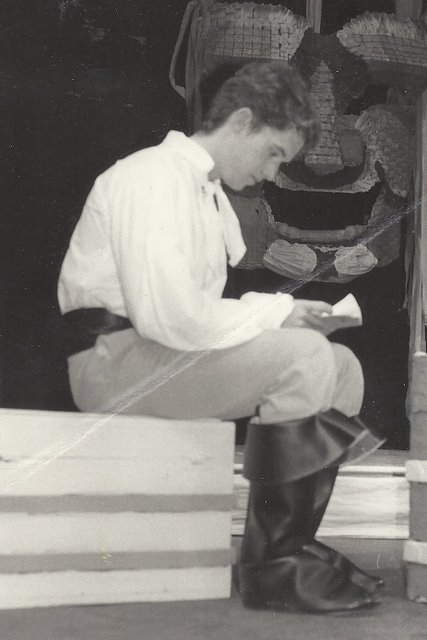
Studying lines for a production “The Servant of Two Masters”
I have a confession to make. I was a theatre major in college (yes, complete with the snooty but appropriate “re” spelling). I’ll wait for you to stop snickering. Judson University (it was Judson College when I attended), the small liberal arts college outside of Chicago labeled the major course of studies as “Communication Arts” which is what I tend to put on resumes and bios because I realize that “theatre major” tends to elicit thoughts such as “Do you want fries with that?”
When I chose my major, I had no pipe dreams about becoming a professional actor. I did it because more than one wise adult had advised me that my actual major in college would have less impact on my eventual job search than having the actual degree. “Study what you love” I was told, “not what you think will get you a job.” I listened for once and chose theatre because I’d done it all through my secondary education, I had relative success doing it, and because I simply loved being a part of it. Fortunately, my parents gave me absolutely no grief about my choice (unlike most of my fellow majors. Thanks mom & dad!)
“Arms and the Man”
Fast forward 25 years and, like many people, I am no where near the waypoint on life’s road I envisioned I’d be back in college. Almost 20 years as a business consultant and now a business owner with a modestly successful track record in my business and blogging, I realize how much being a theatre major set me on the road towards success.
Here are 10 ways being a theatre major helped me succeed:
Improvisation. The great thing about the stage is that when it’s live and you’re up in front of that audience anything can, and does, happen. Dropped lines, missed entrances, or malfunctioning props require you to improvise while maintaining your cool. Theatre taught me how to focus, think quickly and make do while giving the impression that you’ve got it all under control. It’s served me well when clients, airlines, coworkers, or technology wreak unexpected havoc at the worst possible moment.
Project Management. A stage production is basically a business project. You have teams of people making up one team working to successfully accomplish a task on time, on budget in such a way that you earn the applause and an occasional standing ovation. Being taught to stand at the helm of a theatrical production was a project management practicum.
Working with a Limited Budget. Everybody who has worked on stage knows that it’s not the road to fortune. Most plays (especially small college shows) are produced on a shoestring budget. This forces you to be imaginative, do more with less and find creative ways to get the results you want without spending money. Ask any corporate manager and they’ll tell you that this pretty much describes their job. Mine too.
Dealing with Very Different Human Beings. The theatrical community is a mash-up of interesting characters. It always has been. From fringe to freakish to frappucino sipping socialites and everything in between, you’re going to encounter the most amazing and stimulating cross-section of humanity when you work in theatre. In my business career I have the unique and challenging task of walking in the CEO’s office in the morning to present our findings in an executive summary presentation and to receive a high level grilling. I will then spend the afternoon presenting the same data to overworked, underpaid, cynical front-line employees and get a very different grilling. Theatre taught me how to appreciate, understand and effectively communicate with a widely diverse group of human beings.
Understanding the Human Condition. Most people have the mistaken impression that acting is all about pretending and being “fake” in front of others. What I learned as a theatre major was that good actors learn the human condition intimately through observation and painfully detailed introspection. The better you understand that human being you are portraying from the inside out, the better and more authentic your performance is going to be. In my business I am constantly using the same general methods to understand my clients, their customers as well as myself and my co-workers. I believe that having a better understanding of myself and others has ultimately made me a better (though far from perfect) employee, consultant, employer, and ultimately friend. I didn’t learn methods of observing and understanding others in Macro Econ, I learned it in Acting I & Acting II.
Doing Whatever Needs to Be Done. When you’re a theatre major at a small liberal arts college there is little room for specializing within your field. You have to learn to do it all. Light design, sound engineering, acting, directing, producing, marketing, PR, set design, set construction, ticket sales, budgeting, customer service, ushering, make-up, and costuming are all things I had to do as part of my college career. Within our merry band of theatre majors we all had to learn every piece of a production because at some point we would be required to do what needed to be done. I learned that I can capably do just about anything that I need to do. I may not love it and I may not be gifted or excellent at it, but give me a task and I’ll figure it out. I now work for a small consulting firm that requires me to do a wide range of tasks. The experience, can-do attitude and indomitable spirit I learned in the theatre have been essential to success.
Hard work. I remember creating a tree for one of our college shows. We had no idea how we were going to do it, but we made an amazing life-like tree that emerged from the stage and looked as if it disappeared into the ceiling above the theatre. My team mates and I cut out each and every leaf and individually hot-glued them to the branches of the tree. Thousands upon thousands upon thousands of them glued on while standing precariously on a rickety ladder high enough above the stage that it would make an OSHA inspector soil his boxers. Sleepless nights, burnt fingers and a few brushes with tragedy were needed to get that tree done. But, we got it done. It was fabulous. And a few days later we tore it down, threw it out, and got ready for the next production. C’est la vie. In business I have periods of time with unbelievable workloads in which there are sleepless nights, seemingly endless days and tireless work on projects that will be presented and then will be over. The report will be archived and I’m onto the next project. C’est la vie. I learned all about that as a theatre major.
Making Difficult Choices. You’ve got four parts and twenty four schoolmates who auditioned. Some of them are your best friends and fellow theatre majors. Do you choose the unexperienced jock because he’s best for the part or the friend and fellow theatre major who you fear will never talk to you again if you don’t cast him? My senior project was supposed to be performed outside in the amphitheater but the weather was cold, windy and miserable. Do I choose to stick with the plan because it’s what my actors are comfortable with and it’s what we’ve rehearsed and it will only stress out the cast and crew to change the venue at the last-minute? Or, do I choose to think about the audience who will be more comfortable and might actually pay attention and appreciate the performance if they are inside away from the cold, the wind and possible rain? [I changed the venue]. Any business person will tell you that difficult decisions must sometimes be made. The higher the position the harder the decisions and the more people those decisions affect. Being a theatre major gave me a taste of what I would have to digest in my business career.
Presentation Skills. Okay, it’s a no brainer but any corporate employee can tell you horror stories of having to endure long training sessions or corporate presentations by boring, unprepared, incompetent or just plain awful presenters. From what I’ve experienced, individuals who can stand up confidently in front of a group of people and capably, effectively communicate their message while even being motivating and a little entertaining are among the rarest individuals in the business world. Being a theatre major helped me be one of them.
Doing the Best You Can With What You’ve Got. Over the years I’ve told countless front line service reps that this is rule #1 of customer service. You do the best you can with what you’ve got to work with. I remember an Acting I class in college in which a pair of students got up to present a scene they’d prepared. They presented the scene on a bare stage with no lighting, make-up, costumes, props or set pieces. It was just two students acting out the script. It was one of those magic moments that happen with live theatre. The rest of the class was transfixed and pulled into the moment, reacting with surprising emotion to what they witnessed. You don’t need Broadway theatrics to create a magical theatrical moment on stage. You don’t even need a stage. The same is true of customer service. You don’t always need the latest technology, the best system, or the greatest whiz-bang doo-dads. A capable CSR doing the best they can and serving a customer with courtesy, empathy, friendliness and a commitment to resolve can and does win customer satisfaction and loyalty.
I’m proud to be an alumnus of Judson University. I’m really saddened that the school’s theatre program waned for a while and am encouraged that it shows signs of life once more. What I have learned I’ve tried to pass on to my own children. Study what you love. Follow your passion. It will serve you well wherever life’s road takes you.
Judson’s production of Ibsen’s “An Enemy of the People” 1984
Tom Vander Well graduated from Judson University earning a B.A. degree in Communications Arts with an emphasis in Speech/Theatre in 1988. He is currently President and CEO of Intelligentics, a market research and QA firm specializing in customer satisfaction research and call quality assessment (e.g. “your call may be monitored to ensure quality service”) where Tom has worked for 25 years. Tom found himself “waiting for Guffman” for over ten years and he served as President of Union Street Players, the award-winning community theatre in Pella, Iowa from 2005-2017. During that tenure he served as producer, director, actor and writer. He has also performed for Central College, the Pella Opera House, and the Pella Shakespeare Company. His play Ham Buns and Potato Saladwas presented at the Missouri Playwrights Workshop at the University of Missouri and an April 2014 premiere in Pella has been followed with subsequent area productions. His play Letters from Pella was presented at an international academic conference honoring Hendrik P. Scholte in 2018 and will be published in a subsequent academic journal with content from the conference.
Too much talk leads to sin. Be sensible and keep your mouth shut. Proverbs 10:19 (NLT)
I was doing some call coaching last week and a gentleman I was working with made an interesting observation. “The longer my call goes,” he said, “the more likely it is that I’ll say something stupid or else get myself in a situation in which I should respond a certain way and miss saying something. When I keep my calls short and to the point they tend to be better quality.”
I remember being struck in that moment by what he was saying and how wise King Solomon would have applauded this gentleman’s observation. In essence, this man was capturing the heart of the proverb above from today’s chapter. The longer we go in loose, idle talk the more easily we can slip into conversation that can be inherently negative and unproductive.
Anyone who rebukes a mocker will get an insult in return. Anyone who corrects the wicked will get hurt. Proverbs 9:7 (NLT)
One of the tasks I have in my job is to sit down one-on-one with people, listen to some of their phone calls, and help them learn how they can do a better job serving their customers. It’s not rocket science, but companies recognize that when a customer calls with a question or a need there is moment of truth taking place. That customer will walk away with a distinct impression of the company based on how that associate handled the call. So, I help them make it as positive an interaction as possible.
As you might imagine, I have coached a diverse number of people. Some of them are “mockers” who clearly do not want to be there, listen to little or nothing I have to say, and refuse to change even the simplest of behaviors. I’ve been cussed at, threatened, insulted and had people turn away cross their arms and refuse to look at me. I’ve learned over time that there is little I can do for some people other than to provide them the information as clearly and positively as I can without reacting to their negative behaviors.
Fortunately others are open, teachable and desire to do a great job. They are willing to listen to my feedback and genuinely try to change their behaviors.
I couldn’t help but think of the different people I’ve coached over the years as I read of Wisdom contrasting those who are “mockers” and those who are “wise” in today’s chapter. I’ve seen the difference and I understand why she advises not wasting your time with certain people.
When it comes to work I am paid to coach everyone and to do my best to communicate even with those who will refuse to listen. When it comes to life I have more latitude to focus my time, energy and conversation in relationships that will bring life and fill life’s well. The older I get, the more discerning I become with regard to whom I will interact.
“For whoever finds me finds life and receives favor from the LORD. But those who miss me injure themselves. All who hate me love death.” Proverbs 8:35-36 (NLT)
I’m continually reminded how the simple themes of life and death are woven throughout God’s Message. It appears again this morning as Wisdom reminds if we seek her and find her, we will find life and favor. If we choose to hate Wisdom, then we are effectively loving death.
I can’t help but think of the Shawshank Redemption when Andy says to his friend “It all comes down to a choice. Get busy livin’ or get busy dyin’.” That scene and those words come back to me regularly as they did once again this morning. It’s a good reminder. It’s a good litmus test.
Today, I’m thinking about my life, my relationships, my activities, my actions, and my choices. Am I seeking wisdom and those things which are full of life? Or, am I seeking after things that bring with them the stench of death?