Tag Archives: Riches

I’ve Never Regretted Being Generous

And here is my judgment about what is best for you in this matter. Last year you were the first not only to give but also to have the desire to do so. Now finish the work, so that your eager willingness to do it may be matched by your completion of it, according to your means. For if the willingness is there, the gift is acceptable according to what one has, not according to what one does not have.
2 Corinthians 8:10-12 (NIV)

Wendy and I quietly reached a milestone in recent weeks. In 2007, we began sponsoring a young girl in Kenya named Nyaguthi through Compassion International. Our small, monthly financial gift helped provide for Nyaguthi and her family’s basic needs along with her education. This was not, however, just a mindless financial transaction. For almost twenty years we have corresponded with Nyaguthi, learned about her life and desires, celebrated her birthday and holidays, and she has likewise gotten to know our family through our letters and photos.

Just a few weeks ago Compassion informed us that Nyaguthi is now finishing up her university education. At 22, she is graduating out of the Compassion program and will launch into finding a job and starting her life journey as an adult. I can’t explain the joy this makes us feel. We’ve watched her grow up. Her photos have been ever-present on our refrigerator. We have and will continue to pray for her.

In today’s chapter, Paul addresses a specific matter with the followers of Jesus in Corinth. The followers of Jesus in Jerusalem were experiencing terrible persecution. Some were being killed. The were being ostracized socially and financially which made life difficult just to manage life’s basic needs. Others were desperate to flee Jerusalem and seek safety in other regions, but lacked the means to do so. Paul and believers in the area of Greece were generously gathering money to send to Jerusalem to help out their spiritual brothers and sisters in Christ.

As I read Paul’s encouragement to the Corinthians to be generous, I was struck by his emphasis on desire. He directly writes that he is not commanding them, twisting their arms, or manipulating them. This is not a televangelist’s trickery of promising God will turn their financial gift into profitable personal gain. He simply appealed to the desire to be generous that he’d witnessed in them the previous year. He appeals to their eager willingness to be generous, to give what they can for others who are in need. Paul goes on to reference what he also wrote about to the believers in Philippi (Philippians 2) regarding Jesus’ example leaving the riches of heaven to become an impoverished human being, that anyone who believes in Him might know the riches of God’s grace and inherit Life both abundant and eternal.

I confess that I was not a generous person as a young man. Generosity has been something that has grown within me as I have grown and matured in God’s Spirit. Wendy has taught me much in both her heart and example. One of the things that I continuously realize and remind myself: I have never, not once, regretted being generous. Not only do I lack any regret, but I look at Nyaguthi’s face on our refrigerator, think of how she’s grown in body, mind, and Spirit over the years, and I feel a surging desire to be more generous. The words “eager willingness” that Paul uses in today’s chapter describes my feelings rather well.

So, in the quiet this morning I am celebrating Nyaguthi’s launch and also thinking about the task Wendy and I have before us of beginning our sponsorship of another child.

I am eager to do so. I have never regretted being generous.

If you know anyone who might be encouraged by today’s post, please share.

These chapter-a-day blog posts are also available via podcast on all major podcast platforms including Apple, Google, and Spotify! Simply go to your podcast platform and search for “Wayfarer Tom Vander Well.” If it’s not on your platform, please let me know!

Success and Prosperity

Success and Prosperity (CaD 1 Chr 14) Wayfarer

So David’s fame spread throughout every land, and the Lord made all the nations fear him.
1 Chronicles 14:17 (NIV)

When I was a teenager, I spent two years being spiritually mentored. The first thing my mentor had me do was memorize Joshua 1:8, the words Moses gave to his successor, Joshua:

Keep this Book of the Law always on your lips; meditate on it day and night, so that you may be careful to do everything written in it. Then you will be prosperous and successful.

It was the beginning of my fascination with the Great Story and a commitment to reading it, studying it, and applying its principles and lessons to my life. You might say it was the seed that took root and eventually led to these chapter-a-day posts.

Of course, there’s also that promise the verse gives of prosperity and success if one lives according to the Book. Which, I have meditated on long and hard over the years. The promise has been a source of both tension and wisdom.

Today’s chapter is fascinating both for its content and its placement in the Chronicler’s updated history of the Kingdom of ancient Israel. One of the things I’ve learned in my decades of studying the Great Story is that the Hebrews were very deliberate in the structure of their writing. Today’s chapter is a great example.

In the previous chapter, the Chronicler reveals the priority King David placed on his faith in the God of Abraham, Isaac, Jacob, and Moses. He leads a procession bringing the Ark of the Covenant to Jerusalem where a temple will eventually be built for it. However, the Ark is not yet brought into the city. The Ark is left at the house of a man named Obed-Edom for three months. The Chronicler is sure to mention that while the Ark was in Obed-Edom’s home he and his household were blessed.

In the next chapter, the Ark is brought into the city of Jerusalem and David makes it a major event.

So, what happens in the three-month interlude?

The Chronicler tells of God blessing David in every way.

A foreign King makes a treaty with David and builds a palace for him. This shows David’s growing prominence in the region, as well as the respect and fear neighboring Kingdoms have for the powerful David. (verses 1-2)

David is blessed with more wives and children. (verses 3-6)

David, who the Chronicler is sure to mention always inquires of God before engaging in battle, is given major military victories over the Kingdom’s biggest rival. Not only this but when David and his men capture the idols of the Philistines, he dutifully burns them in accordance with the law of Moses. A detail marking David’s obedience to God that Samuel failed to mention. (verses 8-16)

With his structured account of David’s commitment to God and David’s blessed life and reign, the Chronicler is making the same connection that Moses was making with Joshua in the verse that I memorized all those years ago. Make God your priority, live according to His Book, and you will be prosperous and successful. One might say that this is the pre-Christian version of a prosperity gospel. The Chronicler is lifting up David as the example for his people to follow.

In the quiet this morning, I feel the nagging tension that comes with the fact that I regularly observe people making God into a good luck charm and a shortcut to worldly wealth and prosperity. It’s easy to do with the simplistic equation that is given. In my wrestling with this tension over the past 40-plus years, I have made a few conclusions.

First, I believe the promise is genuine. Making God and God’s Word the center of my life has led to success and prosperity for me. But, those words are layered with all sorts of meaning that I don’t believe are intended. God’s ways are not our ways, the prophet Isaiah reminds me. His thoughts are not my thoughts. Prosperity and success in God’s Kingdom does not look like it does for the Kingdoms of this World and people who are focused on this life and worldly things. Exhibit A is God’s own Son who revealed that success at the Kingdom of God level is taking up one’s cross and laying down one’s life for their friend. Prosperity in God’s Kingdom is ultimately an eternal concept, not a temporal one.

Second, living according to God’s Word has benefitted me in so many ways. I have avoided a lot of foolish mistakes because I followed God’s wisdom. I have diminished stress and anxiety with the antidote of faith and hope. I have found joy and contentment in enjoying the blessings I’ve been given rather than the envy and stress of chasing after the blessings of others.

Finally, I have learned that God’s view of “success” and “prosperity” comes at the expense of trials, struggles, tribulations, obstacles, and suffering. The Chronicler is holding up a specific piece of David’s story and an example for his people to respect and follow. However, he does so at the cost of providing context that is essential for wisdom and understanding. Before David was king he was an outcast and branded as an outlaw. David spent years on the run, living as an exile in the desert. The anointing and promise given to little boy David that he would be king would not come to fruition for decades in which his everyday life was a constant struggle for survival.

So, in the quiet this morning I once again find myself back at a place of understanding. Yes, there is success and prosperity in surrendering to Jesus and living my life according to His Word. No, that doesn’t look like success and prosperity as the world defines it, though it may look that way at certain times for certain individuals like King David. It does not, however, change a couple of basic principles that the Great Story gives as necessary context. First, spiritual blessings and maturity in this life are rooted in struggle. Second, this world is not my home. True prosperity is found in eternity.

If you know anyone who might be encouraged by today’s post, please share.

The God Commerce

The God Commerce (CaD 1 Ki 20) Wayfarer

“I will return the cities my father took from your father,” Ben-Hadad offered. “You may set up your own market areas in Damascus, as my father did in Samaria.”
Ahab said, “On the basis of a treaty I will set you free.” So he made a treaty with him, and let him go.

1 Kings 20:34 (NIV)

Over the years, my amateur genealogical and historic studies have led me to better understand the Dutch heritage I inherited on the paternal side of my DNA and family experience. Dutch culture is a fascinating study for a number of reasons. In the 1600s, the Dutch were arguably the wealthiest nation on earth because of Dutch trading ships dominating the seas. Amsterdam became a hub of global trade and commerce and Dutch bankers in Amsterdam became bankers to the entire world.

At this same time in history, an intense rift dominated the spiritual and political landscape. The Protestant Reformation had led to entrenched rivalries (and wars) between Roman Catholics and Protestant Reformers. The Dutch, much like other European nations, had citizens in both camps zealously holding to their beliefs.

I once read a historian who declared that the reason the humanistic Dutch Catholics and the pious Dutch Reformers got along was that both religious camps ultimately cared more about the commerce that was making both camps increasingly wealthy. When Catholics and Reformers argued, it was business and the money it generated that acted as the tiebreaker and peacemaker.

Today’s chapter deals with a dispute between the King of Aram and King Ahab of the northern kingdom of Israel. Israel, somewhat like the Dutch culture of a thousand years later in history, was spiritually divided between those who clung to the God of Abraham, Moses, and David, and those who were committed to the plethora of local and regional pagan deities.

Underneath the obvious events of today’s chapter lies a political undercurrent many readers miss. It was all about trade and the subsequent wealth it generated. Israel had key strategic ports on the Mediterranean along with treaties with Tyre and Phoenecia that were incredibly lucrative. Aram was landlocked and wanted access to those trade routes. The reason that both the King of Aram and the King of Israel were so quick to surrender to one another was the same reasoning between the Dutch Catholics and Protestants. There was still a lot of money to be made and a lot of wealth to be enjoyed by both Kings if they formed an alliance.

But this arrangement is spiritually revealing. Ahab and the Kings of Israel have been operating under a spiritual policy of appeasement. The King and officials allow the prophets of God and those loyal to the God of Moses to do their thing. However, they freely ascribe to the local and regional pagan gods because doing so is good for political alliances and lucrative trade deals with other kingdoms. At the end of the chapter, God speaks through a prophet to call out Ahab regarding his complicity. Ahab cares more about trade, political aspiration, and wealth than the things of God.

In the quiet this morning, I can’t help but feel the resonance between my cultural heritage and the story in today’s chapter. Art historians claim that a key to Rembrandt’s rise to artistic prominence in the 1600s was his ability to create portraits of wealthy Protestants that portrayed them in all of their religious piety while hinting at their immense wealth. It reminds me of a local resident my friend knows who drives around our small Iowa town in his old Buick, but his vacation home in Arizona has a garage filled with extravagant luxury cars and motorcycles.

This leads me to ask myself about my own priorities. Jesus taught that my heart would be where my treasure is. So what is it I most treasure, and where does that treasure lie?

If you know anyone who might be encouraged by today’s post, please share.

Rockstar Realities

Rockstar Realities (CaD 1 Kings 11) Wayfarer

So Solomon did evil in the eyes of the Lord; he did not follow the Lord completely, as David his father had done.
1 Kings 11:6 (NIV)

A number of years ago, Nickleback made famous a song that I have always thought was the perfect embodiment of earthly desires, and it’s catchy enough to be an earworm (my apologies):

I’m through with standing in line
To clubs I’ll never get in
It’s like the bottom of the ninth
And I’m never gonna win
This life hasn’t turned out
Quite the way I want it to be
(Tell me what you want)
I want a brand new house
On an episode of Cribs
And a bathroom I can play baseball in
And a king size tub big enough
For ten plus me
(So what you need?)
I’ll need a credit card that’s got no limit
And a big black jet with a bedroom in it
Gonna join the mile high club
At thirty-seven thousand feet
(Been there, done that)
I want a new tour bus full of old guitars
My own star on Hollywood Boulevard
Somewhere between Cher and
James Dean is fine for me
(So how you gonna do it?)
I’m gonna trade this life for fortune and fame
I’d even cut my hair and change my name
‘Cause we all just wanna be big rock stars
And live in hilltop houses driving fifteen cars
The girls come easy and the drugs come cheap
We’ll all stay skinny ’cause we just won’t eat
And we’ll hang out in the coolest bars
In the VIP with the movie stars
Every good gold digger’s gonna wind up there
Every Playboy bunny in her bleach blond hair, and we’ll
Hey, hey, I want to be a rock star

With today’s chapter, the story of King Solomon’s rather amazing life comes to an end. His story started out so well and showed such promise. When given the choice, he asked God for wisdom rather than fortune and fame, so God said He would give Solomon both. As I get to the end of the story, I find that fortune and fame overpowered Solomon’s wisdom and led to foolishness.

What’s funny about this observation is the way I find Solomon continues to be revered by so many of my fellow believers. My perception of this is that most have never really read Solomon’s entire story. They only know the Cliff Notes bullet points that Sol asked for wisdom and God gave Sol everything he could possibly want. He was an ancient “Rockstar” who was both God’s man and got a life that compares to Nickleback’s lyrics.

Jesus talked a lot about the dichotomy between this temporal world and the eternal Kingdom of God. He also was quite direct about the reciprocal relationship between earthly fortune and eternal fortune. In fact, Jesus addressed the matter when a very Solomon-like individual approached Him:

One day one of the local officials asked him, “Good Teacher, what must I do to deserve eternal life?”

Jesus said, “Why are you calling me good? No one is good—only God. You know the commandments, don’t you? No illicit sex, no killing, no stealing, no lying, honor your father and mother.”

He said, “I’ve kept them all for as long as I can remember.”

When Jesus heard that, he said, “Then there’s only one thing left to do: Sell everything you own and give it away to the poor. You will have riches in heaven. Then come, follow me.”

This was the last thing the official expected to hear. He was very rich and became terribly sad. He was holding on tight to a lot of things and not about to let them go.

Seeing his reaction, Jesus said, “Do you have any idea how difficult it is for people who have it all to enter God’s kingdom? I’d say it’s easier to thread a camel through a needle’s eye than get a rich person into God’s kingdom.”


“Then who has any chance at all?” the others asked.

“No chance at all,” Jesus said, “if you think you can pull it off by yourself. Every chance in the world if you trust God to do it.”


Luke 18: 18-27 (MSG)

In the quiet this morning, I have to confess that I have my own “Rockstar” fantasies though they look a little different than the Nickleback version. I am also conscious of the fact that my impression of wealth is always in relationship to the small percentage of earthly Rockstars who have way more of it than me. By that standard, I never think I’m wealthy. Yet, I am wealthy in relation to the vast majority of people on this earth that have far less than me. The conclusion is that it doesn’t take Rockstar wealth to lead me to Solomon-like, spiritual foolishness. It takes just enough to fuel discontent, fear, pride, greed, lust, and/or envy within me. Once that’s done spiritual wisdom can easily give way and can be overcome by foolishness.

“Wherever your treasure is,” Jesus said, “is where your desire is and where you’ll end up.”

If you know anyone who might be encouraged by today’s post, please share.

Of Riches and Rubble

Of Riches and Rubble (CaD Mk 13) Wayfarer

As Jesus was leaving the temple, one of his disciples said to him, “Look, Teacher! What massive stones! What magnificent buildings!”

“Do you see all these great buildings?” replied Jesus. “Not one stone here will be left on another; every one will be thrown down.”

Mark 13:1-2 (NIV)

I still remember my first trip to Chicago. I had never been to a major city. My hometown of Des Moines was my only frame of reference, and even at a young age I knew Des Moines like the back of my hand. A person could get from one end of the Des Moines to the other in about 20 minutes. It just wasn’t that big. Chicago was a revelation. I and my friends went to the observation deck of the John Hancock building, and I stared out at city as far as my eye could see. It was impressive.

For Jesus’ followers, the pilgrimage to Jerusalem, and to the Temple, was a similar experience. As far as we know, the Twelve were from small rural villages in the Galilee, and the Temple complex in Jerusalem was the equivalent of the John Hancock building, the Sears Tower, or the Empire State Building.

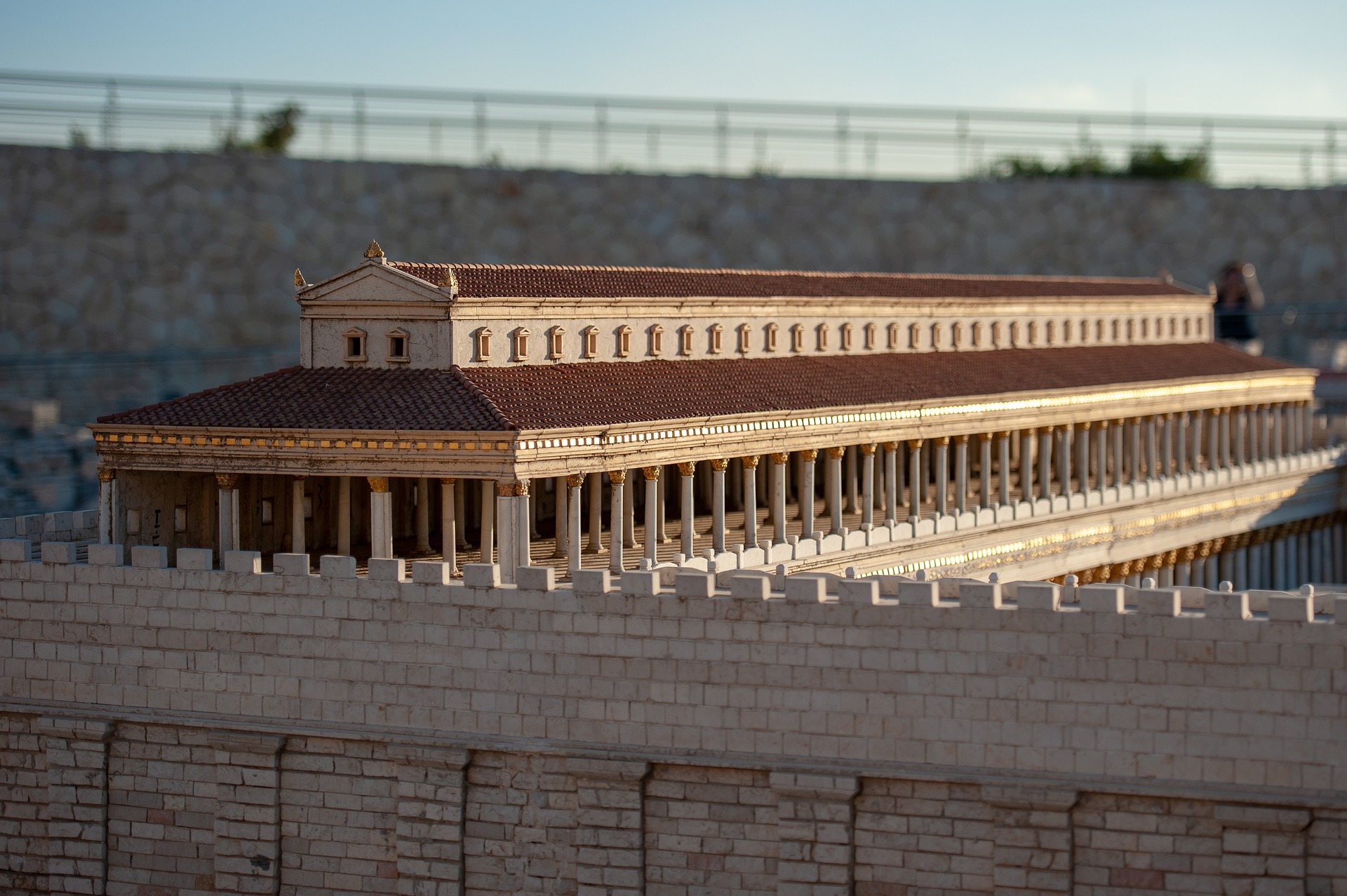
Casual readers may not realize that the temple in Jesus’ day was not the same Temple that Solomon built. That temple was razed to the ground by the Babylonians in 586 B.C. A generation later, it was rebuilt by Hebrews who returned from exile. Then, Herod the Great came to power around 37 B.C.

Like many egomaniacal tyrants, Herod had an edifice complex. He wasn’t Jewish, but he understood that his constituency was, and the temple in Jerusalem was the center of that constituency’s worldly power. Herod was shrewd. He knew it was in his political best interest not only to keep peace with the power brokers of the Jewish community, but he knew it would be even better if this potential threat to his power felt indebted to him. So, Herod decided to invest his vast riches to fix-up the five-hundred year old Temple.

Of course, egomaniacal tyrants with edifice complexes aren’t just going to do a little sprucing up. They have to spend their vast riches to build something that will bear their name (whether officially or unofficially) so the size of the project must be in relative proportion to the size to their egos. The original size of the Temple was relatively small compared to the impressive temples built by the Greeks and Romans. Herod made sure to not just rebuild the Temple itself, but he built an entire Temple complex around it. Sure enough, it’s still known today as “Herod’s Temple.”

That’s why, in today’s chapter, Jesus’ disciples are still exclaiming what a magnificent complex it is even after they’ve spent two entire days listening to Jesus teach in the Temple courts. They can’t get over the sheer size and architectural beauty of it.

And then, Jesus ruins the moment: “It will all be rubble 40 years from now.”

And, it was. The political tension between the Jewish people and their Roman occupiers will continue to grow. There will be wars and rumors of war. It will eventually boil over. The Romans will raze Jerusalem and Herod’s Temple in the year 70 A.D.

Enjoy the view while you can.

In the quiet this morning I couldn’t help but think of the spiritual lesson in this brief exchange. The rest of today’s chapter is Jesus’ prophetic foreshadowing of where the Great Story is headed in the climactic final chapters. It’s not idyllic.

Wars
Earthquakes
Famine
Deception
Tyranny
Families divided
Betrayal
Hatred
Exile
Darkness

I’m reminded as I contemplate it that every good story ends up there. The death eaters descend on Hogwarts. Gandalf and Aragorn stand surrounded and outnumbered at the Black Gate of Mordor. Aslan is bound and lying on the White Witch’s stone table. Jesus lies dead and buried in a borrowed tomb.

There’s always darkness before the dawn.

Without catastrophe there’s no eucatastrophe.

“Be careful what your heart treasures,” Jesus said. “Cars rust and end up at the dump. Today’s fashions will end up at the thrift store where nobody wants them. That expensive gadget will be obsolete in a year. Herod’s Temple will be nothing but rubble in a generation.”

“Invest in the only things that remain,” Holy Spirit whispers to me in the quiet. “Faith, hope, and love.”

I’m off into another day reminded to enjoy the view while I can.

If you know anyone who might be encouraged by today’s post, please share.

All Worthwhile Things…

Those who work their land will have abundant food,
    but those who chase fantasies have no sense.

Proverbs 12:11 (NIV)

When I first met the man he was a drug dealer. He knew it was wrong, but it was so easy and the money was good. He’d never really given college a serious thought (even though he was very intelligent and had been offered a full-ride). His job options, therefore, were somewhat limited. As the years went on I would see him on an occasional basis. He gave up dealing, but it appeared to me to have given him an appetite for easy money. There was a period of time in which each time I saw him he was trying a different get-rich-quick scheme. I observed that every new scheme he was convinced was his golden ticket to wealth had an up-front-cost to get started which, ironically, quickly made him poorer. The “get rich” part of the schemes never panned out. He eventually worked a few menial jobs for a period of time but his life continued to spiral into despair and depression. Last I knew, he hasn’t had a job for a long time and lives in depressive isolation.

I thought of him this morning when I read the proverb pasted to the top of this post. I have never met a person who so diligently sought a shortcut to riches and ended in such a tragic place, though I have certainly encountered others like him along my life journey. I am reminded of a visit that I paid to a former high school teacher many years ago. As he shared with me the changes that he’s witnessed in students over the years of his career he said, “If my students simply took the time and energy they expend trying to cheat and applied it to their studies they’d be fine.”

In the quiet this morning, I’m reminded that work is work, and there is no avoiding this fact. It’s stated plainly right at the beginning in the Genesis story. Ironically, I just heard it referenced on Ash Wednesday last week as a young man rubbed ashes on my forehead:

“Cursed is the ground because of you;
    through painful toil you will eat food from it
    all the days of your life.
It will produce thorns and thistles for you,
    and you will eat the plants of the field.
By the sweat of your brow
    you will eat your food
until you return to the ground,
    since from it you were taken;
for dust you are
    and to dust you will return.”

Genesis 3:17-19 (NIV)

There is something in me that desires for life to be easy, but I long ago embraced the reality that worthwhile things require time, energy, attention, and discipline. In other words: it’s work. This is true in pretty much every area of life including education, career, relationships, family, physical health and wellness, and spiritual growth. I’m not perfect by any stretch of the imagination, but I know that work is required for results. Right now I’m struggling with the changing body metabolism that occurs naturally at my stage of life. I need more sleep. My body doesn’t burn energy as efficiently. The same diet and exercise regimen suddenly has diminishing effects in comparison to a few years ago. It takes more work than it used to.

Worthwhile things require work. It is what it is. I can try to avoid it, or I can embrace it.

It is Monday morning. Time to get to work.

Have a good week!

The Call to Contentment

Not that I was ever in need,  for I have learned how to be content with whatever I have. I know how to live on almost nothing or with everything. I have learned the secret of living in every situation, whether it is with a full stomach or empty, with plenty or little. Philippians 4:11-12 (NLT)

Jesus never told poor people to seek after earthly riches.
Jesus told certain rich people to give up all their earthly riches.
Jesus told all people to seek after heavenly riches.
God’s Message tells us all to learn to be content.

I have come to believe that God’s call to contentment is one of the most critical spiritual concepts we have most consistently ignored.

Eternal Investment

English: Image of an Saracen king of West Afri...
Mansa Musa (Photo credit: Wikipedia)

Chapter-a-Day Psalm 49

Those who are wise must finally die,

    just like the foolish and senseless,
    leaving all their wealth behind.
The grave is their eternal home,
    where they will stay forever.
They may name their estates after themselves,
     but their fame will not last.
    They will die, just like animals.
This is the fate of fools,
    though they are remembered as being wise.
Psalm 49:10-13 (NLT)

Can you quickly tell me anything about the following people?

  1. Mansa Musa
  2. Richard Fitzalan
  3. William de Warenne
  4. Alan Rufus
  5. Osman Khan

I’m pretty good at trivial knowledge, but these names were completely lost on me when I saw them. The truth is, these five men were among the richest men ever. While they lived they amassed vast fortunes to rival and even surpass names you do probably have heard of such as Rockefeller, Carnegie and Vanderbilt. I say that they were rich, because like everyone else, they died and left their fortunes behind. As the old saying goes, you’ll never see a hearse pulling a U-haul.

That is the point of this morning’s chapter. Jesus said that there will always be poor people around. I guess that means there will always be rich people around as well. Death is the great equalizer. Time and time again God reminds us not to invest our hearts and minds in material things which will rot, rust and be left behind when we die. The economy in God’s Kingdom bears little or no resemblance to the economy of this world. Citizens of God’s Kingdom invest in things of eternal value which all flow from Love: joy, peace, patience, kindness, goodness, faithfulness and self-control.

FYI:

  1. Mansa Musa: rule of Malian empire, at one point he personally owned more than half the world’s supply of commodities.
  2. Richard Fitzalan: English nobleman.
  3. William de Warenne: Norman nobleman.
  4. Alan Rufus: fought next to William the Conqueror.
  5. Osman Khan: last ruler of Hyderabad. Owned a 184 carat diamond which he used as a paperweight.

Chapter-a-Day Proverbs 22

Lord Voldemort
Image via Wikipedia

Choose a good reputation over great riches; 
      being held in high esteem is better than silver or gold.
Proverbs 22:1 (NLT) 

There was a certain executive I knew. Bright, intelligent and charismatic, this man made things happen. He made good things happen to the mutual benefit of everyone in his company. This gentleman was a winner and was on the fast track to great things.

Then, one day, he was gone. Suddenly, without warning, he wasn’t there and the company has kept their lips tightly sealed with regard to the reason. One coworker quipped that the departed executive had become Voldemort (e.g. “He who must not be named”). Another, who could not and would not speak of the circumstances for the exec’s leaving simply said of the man, “He’s dead to me now. So sad. Worse than the fortune he gave up was the loss of his reputation around here.”

Perhaps it’s because of that last statement that the image of this person came to mind when I read the first proverb in today’s chapter. No one is perfect. Everyone makes mistakes. Lord knows, I can’t point a finger without three pointing back at me. Nevertheless, I am reminded this morning that a man’s reputation – whether it is justly or unjustly destroyed – is incredibly difficult to rebuild.

Chapter-a-Day Proverbs 11

Riches won’t help on the day of judgment, 
      but right living can save you from death.
Proverbs 11:4 (NLT)

Silvio

Stake my future on a hell of a past
Looks like tomorrow is coming on fast
Ain’t complaining ’bout what I got
Seen better times, but who has not?

Silvio
Silver and gold
Won’t buy back the beat of a heart grown cold
Silvio
I gotta go
Find out something only dead men know

Honest as the next jade rolling that stone
When I come knocking don’t throw me no bone
I’m an old boll weevil looking for a home
If you don’t like it you can leave me alone

I can snap my fingers and require the rain
From a clear blue sky and turn it off again
I can stroke your body and relieve your pain
And charm the whistle off an evening train

I give what I got until I got no more
I take what I get until I even the score
You know I love you and furthermore
When it’s time to go you got an open door

I can tell you fancy, I can tell you plain
You give something up for everything you gain
Since every pleasure’s got an edge of pain
Pay for your ticket and don’t complain

One of these days and it won’t be long
Going down in the valley and sing my song
I will sing it loud and sing it strong
Let the echo decide if I was right or wrong

Silvio
Silver and gold
Won’t buy back the beat of a heart grown cold
Silvio
I gotta go
Find out something only dead men know

Copyright © 1988 by Special Rider Music