Tag Archives: Trauma

Trauma Bragging and Paul’s Chains

Now I want you to know, brothers and sisters, that what has happened to me has actually served to advance the gospel.
Philippians 1:12 (NIV)

There has been a trend of late on social media. Generation Z are those generally born from 1997 to 2012, so individuals around 13-28 year olds today. The trend that has been observed is that of this generation going onto social media and oversharing about the trauma they have or are experiencing in their lives. It’s been dubbed “trauma bragging.” It dovetails with recent scholarship revealing that this “anxious generation” has experienced and is experiencing unprecedented levels of mental health issues. This coincides with Gen Z being the first generation to grow up with smartphones. The first iPhone launched when the oldest of Gen Z turned 10 years old.

I have been curiously following this unfolding conversation. In part, it is because as the elders of Gen Z arrive in their late 20’s they are changing the consumer landscape in major ways. My company, Intelligentics, has been doing customer research for clients for almost 40 years and we are seeing radical shift that impact companies in everything from marketing to sales and customer support.

What has been fascinating for me to observe is that, in general, Generation Z has arguably grown up as the most safe, healthy, and affluent generation in the history of human civilization. Yet they are experiencing record levels of mental health issues and bragging about the trauma of their lives on Tik Tok. I confess that this has me scratching my head, but it also has me desperately trying to understand.

Today, our chapter-a-day trek returns to Paul’s letter to the followers of Jesus in the city of Philippi. We’ve been making our way through Paul’s “prison letters” (e.g. Philemon, Colossians, Ephesians, and Philippians) and Philippians is the only one left.

In each of these “prison letters” Paul references his chains, typically referencing that he is “in chains for Christ.” He does so in today’s chapter, the opening of his letter to the followers of Jesus in Philippi. He also states that his suffering has “served to advance” the Message of Jesus and has had the positive effect of making others more confident in their faith and in sharing it (vss. 12-14). Later in the chapter, Paul makes an astonishing statement, telling the Philippians that it has been “granted” to them to not only believe in Jesus but to “suffer” for Him.

Spiritually speaking, suffering serves a purpose.

Time and time again followers of Jesus are told to respond to suffering with joy, rejoicing, and exultation. Why? Because it is only through suffering that we develop character qualities that are the mark of spiritual maturity and completeness. Qualities such as patience, perseverance, faith, and hope.

And Paul should know, he did a little trauma bragging himself in his second letter to the Corinthians. Paul lists being shipwrecked (three times), spending a day and a night floating helplessly in the open sea, whipped to the point of death (five times), beaten with rods (three times), and stoned and left for dead. Being under house arrest in Rome must have seemed like a cake walk in comparison. I confess, I find myself comparing Paul’s sufferings in my mind with those of Generation Z and their trauma bragging.

And yet, in the quiet this morning, I am reminded that the spiritual principle is the same no matter the relative suffering. I can look back at some seasons of “suffering” in my own life journey at which my current self would love to go back and tell my younger self to grow up. And, that’s kind of the point. As civilization advances, the shape of suffering changes with it. The “suffering” I may have experienced in my own journey pales in comparison to my grandparents who suffered through two world wars and the Great Depression. They suffered things that are as unimaginable to me as Paul’s resume of physical suffering.

Suffering, no matter what it looks like for any individual or any generation, still provides a choice. I can ceaselessly wallow in my suffering, play the victim card to excuse my poor behaviors, and/or try to escape the relative amount of pain I’m feeling in all sorts of unhealthy ways. I can also follow Jesus, who along with Paul, taught that any suffering is a gift, granted to serve a purpose of moving me toward spiritual maturity and the wisdom that comes with it. If only I have the faith to obediently follow Him in the midst of it.

If you know anyone who might be encouraged by today’s post, please share.

These chapter-a-day blog posts are also available via podcast on all major podcast platforms including Apple, Google, and Spotify! Simply go to your podcast platform and search for “Wayfarer Tom Vander Well.” If it’s not on your platform, please let me know!

Chorus to a Tale of Pain & Purpose

In the third year of the reign of Jehoiakim king of Judah…
And Daniel remained there until the first year of King Cyrus.
Daniel 1:1a, 21 (NIV) 

In the history of theatre, Greece was the first great age. The Greeks developed several theatrical conventions that are still widely used today including the use of what was called a Chorus to prepare the audience for what they are about to watch and to narrate the events. Shakespeare used the same convention widely in his plays, as do many modern productions.

The first chapter of Daniel is the literary equivalent of a Chorus. The author, traditionally ascribed to Daniel himself, uses the opening of the book to provide a quick lay of the land with regard to the background of the story and introduces us to the major players. The fact that the chapter describes Daniel and his companions as being learned young men who were then given a thorough course in Babylonian literature and culture, is ironic. It seems to me that the chapter itself gives evidence to this in its structure and content.

In the next year, our local gathering of Jesus’ followers will be studying the theme of exile. I’ve written in previous posts about the theme of wilderness throughout the Great Story. The exile of God’s people in Babylon is one of the major examples and many casual readers don’t realize just how many characters, psalms, and books come out of this period. Jeremiah, Lamentations, Daniel, Esther, Ezekiel, and Nehemiah are all books that chronicle parts of the Babylonian exile and return.

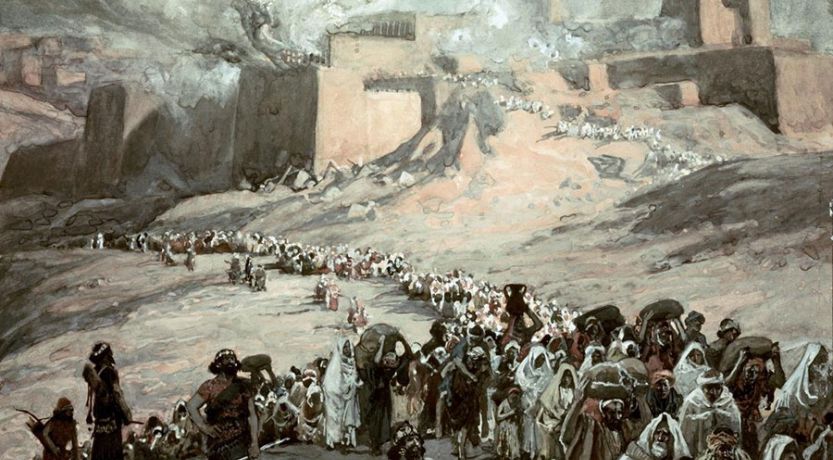
In today’s chapter, Daniel provides bookend dates of the story he’s about to pen. It starts in the “third year of Jehoiakim king of Judah” and ends the first year of King Cyrus. A little study shows this to be 605-539 B.C. In other words, Daniel was an educated young man from nobility in Israel’s southern kingdom of Judah. His hometown is destroyed in a long Babylonian siege in which Daniel watched people starve to death and, according to the prophet Jeremiah, reduced to cannibalism to survive.

Out of this horrific event, Daniel is taken captive by his enemy. He is torn from his family, his people, and his hometown which has been reduced to rubble. He ends up in the capital city of his enemy, Babylon, and finds himself subject to indentured servitude to his people’s enemy number one: King Nebuchadnezzar. Daniel’s own name is taken from him and he is given a new name. He is forced for three years to learn everything about the history, culture, and literature of his enemy.

A young man of God forced to live in captivity and exile and to serve his enemies for about 65 years. Welcome to the story of Daniel, whom many people only know from brightly illustrated children’s books in the dusty Sunday School memory bins of their brains.

But the real story is far deeper and more complex than that, as Daniel tries to tell me as a reader in his opening Chorus. It is the story of a young man who finds a way to survive. He courageously maintains and lives out his faith in the midst of the unbelievably difficult circumstances that make up nearly his entire life.

In the quiet this morning I find myself mulling over the common misperception I observe followers of Jesus often have, and that I confess I find myself unconsciously falling into from time to time. It’s partially driven, I believe, by the American Dream and the Protestant work ethic. If we believe, work hard, and live good lives then life should be a breeze of material blessing and pain-free existence. But as I journey through God’s Message I find that this has never been the message. Daniel fires an explosive shot across the bow of that notion from the very beginning of his story.

Trauma, suffering, starving, captivity, bondage, indentured servitude, and life-long exile in the land of his enemies serving a mad king.

I find God’s purpose in my pain. That’s the message Daniel foreshadows in the Chorus of his book, and the one I’ve been reminded of over and over again on my life journey.