Tag Archives: Chorus

Life’s Chorus

Life’s Chorus (CaD Matt 21) Wayfarer

[The chief priests and Pharisees] looked for a way to arrest [Jesus], but they were afraid of the crowd because the people held that he was a prophet.
Matthew 21:15 (NIV)

In theatre, it’s called the Chorus.

Every major theatrical production has a Chorus. It’s where almost every actor begins their journey on stage. For me, it was the musical Mame my freshman year in high school. Craig got the lead as a sophomore because he was over six feet tall and the only dude in school who could naturally grow a full beard.

I was in the Chorus.

I was a minion switching costumes for each of the big production numbers. An anonymous party-goer at Mame’s New York City penthouse apartment in one scene, then suddenly a mint-julep sipping southern gentleman in a tux later in the show. A face in the crowd.

As I studied acting in college, I was taught the importance of doing a character study for any role I’m playing.

But what if I’m a member of the Chorus?

It’s a legitimate question. It’s a legitimate role.

In today’s chapter, the crowd plays a significant role.

The crowd welcomes Jesus to Jerusalem in a triumphant parade in which they shout His praises, wave palm branches, and spread their cloaks on the ground before His donkey.

The crowd has Jesus #trending. He’s who everyone is talking about. He’s all the buzz. So much so, in fact, that the religious leaders are indignant.

Later in the chapter, the indignant religious leaders try to trap Jesus in a debate. Jesus skirts His way out of the trap by leveraging his enemies’ fear of the crowd.

A third time (there’s that number three again) Matthew mentions Jesus’ enemies were so upset that they became determined to get rid of Him, but they were afraid of the crowd.

By the end of the week it will be a different scene in a different Act. The crowd will have switched costumes and will be calling on Pontius Pilate to crucify Jesus.

It’s easy to be dismissive of the Chorus in any musical, but it has a significant role to play. In the same way, it’s easy to pretend the crowd doesn’t exist in life, but it plays a larger role than I care to admit.

The number of “likes” and “comments” I get on social media from the crowd.

The movies, shows, and songs that the crowd is buzzing about.

The fashions and styles everyone in the crowd is wearing.

The fickle winds of popular opinion being tweeted, chanted, and shouted by the crowd online and in the media.

In the quiet this morning, I find myself wrestling with my own relationship with and participation in the crowd of life. I can’t escape it anymore than Jesus could escape it. He rode His donkey through the crowd shouting His praises. He knew the crush of the crowd following Him wherever He went for three years. He will feel the sting of the crowd turning on Him in the end. There is a Chorus in life whether I choose to recognize it or not. Sometimes I’m a part of it. Sometimes I’m on the outside being influenced by it.

As I ponder, I’m reminded of an observation that John made about Jesus and the crowd of Jerusalem:

Now while he was in Jerusalem at the Passover Festival, many people saw the signs he was performing and believed in his name. But Jesus would not entrust himself to them, for he knew all people. He did not need any testimony about mankind, for he knew what was in each person. John 2:23-25 (NIV)

I might not be able to escape the Chorus in my life’s production, but I can certainly be mindful of the role it’s trying to play in my story. I can be discerning. I can choose not to take the role when it’s offered. I, like Jesus, can choose whether to entrust myself to it or not. The further I get on this earthly journey, the more I think it wise to do so.

If you know anyone who might be encouraged by today’s post, please share.

These chapter-a-day blog posts are also available via podcast on all major podcast platforms including Apple, Google, and Spotify! Simply go to your podcast platform and search for “Wayfarer Tom Vander Well.” If it’s not on your platform, please let me know!

Chorus to a Tale of Pain & Purpose

In the third year of the reign of Jehoiakim king of Judah…
And Daniel remained there until the first year of King Cyrus.
Daniel 1:1a, 21 (NIV) 

In the history of theatre, Greece was the first great age. The Greeks developed several theatrical conventions that are still widely used today including the use of what was called a Chorus to prepare the audience for what they are about to watch and to narrate the events. Shakespeare used the same convention widely in his plays, as do many modern productions.

The first chapter of Daniel is the literary equivalent of a Chorus. The author, traditionally ascribed to Daniel himself, uses the opening of the book to provide a quick lay of the land with regard to the background of the story and introduces us to the major players. The fact that the chapter describes Daniel and his companions as being learned young men who were then given a thorough course in Babylonian literature and culture, is ironic. It seems to me that the chapter itself gives evidence to this in its structure and content.

In the next year, our local gathering of Jesus’ followers will be studying the theme of exile. I’ve written in previous posts about the theme of wilderness throughout the Great Story. The exile of God’s people in Babylon is one of the major examples and many casual readers don’t realize just how many characters, psalms, and books come out of this period. Jeremiah, Lamentations, Daniel, Esther, Ezekiel, and Nehemiah are all books that chronicle parts of the Babylonian exile and return.

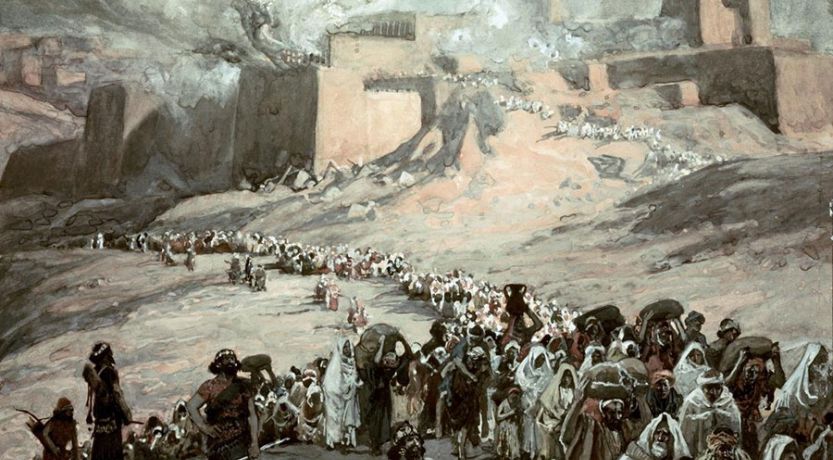
In today’s chapter, Daniel provides bookend dates of the story he’s about to pen. It starts in the “third year of Jehoiakim king of Judah” and ends the first year of King Cyrus. A little study shows this to be 605-539 B.C. In other words, Daniel was an educated young man from nobility in Israel’s southern kingdom of Judah. His hometown is destroyed in a long Babylonian siege in which Daniel watched people starve to death and, according to the prophet Jeremiah, reduced to cannibalism to survive.

Out of this horrific event, Daniel is taken captive by his enemy. He is torn from his family, his people, and his hometown which has been reduced to rubble. He ends up in the capital city of his enemy, Babylon, and finds himself subject to indentured servitude to his people’s enemy number one: King Nebuchadnezzar. Daniel’s own name is taken from him and he is given a new name. He is forced for three years to learn everything about the history, culture, and literature of his enemy.

A young man of God forced to live in captivity and exile and to serve his enemies for about 65 years. Welcome to the story of Daniel, whom many people only know from brightly illustrated children’s books in the dusty Sunday School memory bins of their brains.

But the real story is far deeper and more complex than that, as Daniel tries to tell me as a reader in his opening Chorus. It is the story of a young man who finds a way to survive. He courageously maintains and lives out his faith in the midst of the unbelievably difficult circumstances that make up nearly his entire life.

In the quiet this morning I find myself mulling over the common misperception I observe followers of Jesus often have, and that I confess I find myself unconsciously falling into from time to time. It’s partially driven, I believe, by the American Dream and the Protestant work ethic. If we believe, work hard, and live good lives then life should be a breeze of material blessing and pain-free existence. But as I journey through God’s Message I find that this has never been the message. Daniel fires an explosive shot across the bow of that notion from the very beginning of his story.

Trauma, suffering, starving, captivity, bondage, indentured servitude, and life-long exile in the land of his enemies serving a mad king.

I find God’s purpose in my pain. That’s the message Daniel foreshadows in the Chorus of his book, and the one I’ve been reminded of over and over again on my life journey.


The Junior Babcock of History

He was twenty-five years old when he began to reign; he reigned sixteen years in Jerusalem.
2 Chronicles 27:8 (NRSVCE)

The very first role I had in a main stage production was my freshman year in high school. I played the role of Junior Babcock in the musical Mame. Remember that one? Didn’t think so. I still remember the day scripts were handed out. My script had one page in it which contained both of my monumental lines along with the last few words of the “cue line” or the line just before mine. That was it. I had no idea what the context of my lines or where it fit into the storyline of the musical.

I had a great experience in Mame. Along with my walk on, walk off part as Junior Babcock I got to sing and dance in the chorus. I learned the jazz square. I dressed in a tuxedo for the first time. I met a ton of new friends, including some Juniors and Seniors who actually treated me like a real person. I even got invited to cast parties. My unremarkable role was such a great experience that I decided that being involved in theatre was something I wanted to explore.

Today’s chapter is a short one. The Chronicler slips in one paragraph (only nine verses) summarizing the sixteen year reign of Judah’s King Jotham. Poor Jotham gets the Chroniclers thumb’s up rating for being a good king and following the ways of the Lord. Yet even with that Jotham only gets one paragraph, and two of the sentences in the paragraph are basically repeated word-for-word!

Jotham’s reign appears to have been unremarkable in the mind of the Chronicler. “All the world’s a stage,” Shakespeare wrote, “and all the men and women merely players.” Jotham appears to have been cast as Junior Babcock.

This morning I find one of my life verses welling up in my spirit:

“…make it your ambition to lead a quiet life: You should mind your own business and work with your hands, just as we told you, so that your daily life may win the respect of outsiders and so that you will not be dependent on anybody.” 1 Thessalonians 4:11-12

As I’ve shared in the past, I’m a Type Four on the Enneagram. Type Fours are all about having purpose and significance. It’s easy for types like me to equate purpose and significance with greatness, the spotlight, and starring roles. Yet along my life journey I’ve learned and have been continually reminded that there is both purpose and significance to bit parts and roles in the chorus. My unremarkable role as Junior Babcock had all sorts of purpose and significance for me and my journey. In fact, I’ve had a few “lead” roles which were not nearly as significant or purposeful.

Most all of us are part of the Chorus in this grand production of Life. Like Jotham we will play our unremarkable part and get a paragraph (maybe two) in the Obituary section of our town’s newspaper. Today’s chapter is a good reminder. I want to make sure I nail my couple of lines, hit my cues, support the production, build great relationships with other members of the Chorus, and play my part well.

“Places.”