Tag Archives: Paul

Chapter-a-Day Hosea 2

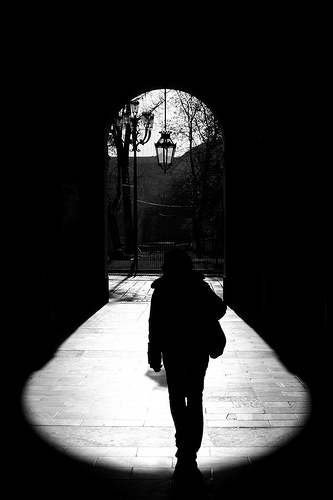
Path off Coombs Road, Bakewell, Derbyshire
(Photo credit: eamoncurry123)

“But then I will win her back once again.
    I will lead her into the desert
    and speak tenderly to her there.”
Hosea 2:14 (NLT)

As one who has walked the faith journey for a good long while, I am repeatedly amazed at God’s patience, grace and long suffering with those of us who choose into relationship with Him. I can look back and see so many times that God could have, and perhaps should have, cut me loose and cast me aside. To be honest, there were many times that He gave me freedom to make foolish choices and harvest the consequences of my actions.

Nevertheless, God has always proven faithful. St. Paul wrote to his protege Timothy that even when we are faithless, God is faithful because God cannot disown who He is. Faithfulness is at the core of God’s being. Despite the fact that Israel acted like an unfaithful spouse and even though our own thoughts, motives, and actions show us to be no better, God waits for our return like the Prodigal’s father. When we come to our senses and return, God does not just grudgingly accept us, but woos us with kindness and tenderness. God goes the extra mile to win our hearts back again.

Today, I am humbly reminded of God’s faithfulness to this wandering wayfarer. His kindness leads me once more to repentance, and gratitude, and a renewed commitment to faithfully and lovingly follow.

Chapter-a-Day Acts 26

by pigliapost via Flickr

Agrippa said to Festus, “This man could have been set free if he had not appealed to Caesar.” Acts 26:32 (NLT)

There is mysterious union of our choices and God’s divine purposes. We make decisions that determine our steps. God weaves His plan in, through and around those decisions to direct our ultimate path. I don’t pretend to understand it, but marvel to see it at work in my own journey and those with whom I share it.

In 2004 amidst the throes of a long-troubled marriage and two daughters entering adolescence I chose to take the step of uprooting the family and moving to Pella. The thought of moving to and living in Pella had never been on my radar. It was not my idea, but I chose in. It was my decision. Within a few years I would find my marriage over. I would meet and marry Wendy. The girls would graduate and step out onto their own individual paths. I made choices without any comprehension just where the path would lead. I can play the “what if” game as long as I want to, but it is a waste of time and mental energy. Those who know me best and have journeyed with me the longest will testify to witnessing God’s divine purpose in the circuitous trail on which my choices led. I look back on the past eight years and scratch my head as I perceive the eternal mystery of the intersection of my temporal choices and God’s divine purposes.

In today’s chapter we learn that Paul could have been free had he not appealed to Caesar, but he did appeal to Caesar. Paul will go to Rome in chains and continue to proclaim God’s Message there. Did God want Paul free, or did God want Paul in Rome? How does God’s omniscience and eternal purposes intersect with Paul’s finite thought, human emotions and earthbound motivations?

Today, I’m praying for wisdom in choosing my steps, and gratefully trusting God with the direction of my path.

Chapter-a-Day Acts 25

Regional Art Museum, Uzhgorod, Ukraine
Regional Art Museum, Uzhgorod, Ukraine (Photo credit: Wikipedia)

So the next day [King] Agrippa and [his sister] Bernice arrived at the auditorium with great pomp, accompanied by military officers and prominent men of the city. [Governor] Festus ordered that Paul be brought in. Acts 25:23 (NLT)

Confession time. When I was a young man, I was incredibly intimidated to be around people of worldly influence, social status, and power. When I began working for c wenger group, I was occasionally asked to accompany my employer and colleagues into meetings with prominent business leaders. I was nervous and self-conscious. My heart would pound and I could feel my cheeks become flushed if I was ever asked to speak. It took all of my training as a theatre major to act calm.

Over the years, the nerves, fear and anxiety faded. Time and experience taught me that I had nothing to fear. In fact, I began to realize two very important life lessons. First, I came to understand that the people in those positions of relative power are very much human like I am. They have the same human emotions and weaknesses as anyone else. In fact, often because of their position those individuals can feel more lonely and isolated than you might expect. Second, I learned that my position afforded me the sometimes unique opportunity to have relationships and show love to some of these individuals. God was giving me an open door to be a person of influence with persons of influence.

I thought about that as I read in today’s chapter about Paul getting called into deposition after deposition with the various leaders and rulers of the day. Each interview and trial was a unique chance to share his story and share God’s Message with an audience few if any could otherwise reach. It was also a direct fulfillment of Jesus’ prophetic message to His followers:

“But before all this occurs, there will be a time of great persecution. You will be dragged into synagogues and prisons, and you will stand trial before kings and governors because you are my followers. But this will be your opportunity to tell them about me. So don’t worry in advance about how to answer the charges against you, for I will give you the right words and such wisdom that none of your opponents will be able to reply or refute you!  Even those closest to you—your parents, brothers, relatives, and friends—will betray you. They will even kill some of you. And everyone will hate you because you are my followers. But not a hair of your head will perish! By standing firm, you will win your souls.”

Today, I am thankful for the unique positions God places us in our jobs, our communities,  and in life circumstances – that we might have the opportunity to be people of influence. I pray that I will be a good steward of the opportunities I am given.

Enhanced by Zemanta

Chapter-a-Day Acts 23

English: Pharisees in the Temple in the synagogue
English: Pharisees in the Temple in the synagogue (Photo credit: Wikipedia)

Paul realized that some members of the high council were Sadducees and some were Pharisees, so he shouted, “Brothers, I am a Pharisee, as were my ancestors! And I am on trial because my hope is in the resurrection of the dead!”

This divided the council—the Pharisees against the Sadducees— for the Sadducees say there is no resurrection or angels or spirits, but the Pharisees believe in all of these. So there was a great uproar. Acts 23:6-9a (NLT)

One of the tasks of my job is to provide one-on-one call coaching to my client’s employees. Tasked with helping individuals improve their customer service skills on the phone, I often find myself alone in a room with people who don’t want to be there and certainly don’t want to be coached. So, over the past twenty years I’ve learned a host of basic tricks used by people to avoid confronting the issues at hand such as the silent treatment or the happy distraction.

I find it ironic and a bit humorous that there is a reference to Paul’s sister in today’s chapter, for I believe that many of the tactics we learn to divert attention away from the subject of our own crime and punishment are learned as children with our parents. Paul played the artful dodge well, like a child who knows that if they can get his parents conflicting about how to render verdict on the child’s infraction, that child often slips through the cracks of the ensuing argument unscathed.

By raising the contentious issue of resurrection with the council, Paul effectively turned the spotlight off of himself and onto a religious debate that would keep the council arguing about something other than himself and would actually get a large part of the council to defend him.

Sometimes the important thing is not just in what we communicate but how and when we communicate it.

Chapter-a-Day Acts 20

Fluoxetine (Prozac), an SSRI
Fluoxetine (Prozac), an SSRI (Photo credit: Wikipedia)

“But my life is worth nothing to me unless I use it for finishing the work assigned me by the Lord Jesus—the work of telling others the Good News about the wonderful grace of God.” Acts 20:24 (NLT)

It is a depressing thing not to have purpose in life. We were created for a purpose. When we are blind to or unaware of that purpose, it can slowly erode the health of our soul. Days become burdensome. Existence feels meaningless. At that point, I’ve observed that we either seek after endless distraction and pleasure to medicate and cover the growing sense of emptiness, or we fall into despair.

I watched a recent television news program that cited statistics showing well over half of all Americans are on antidepressant medication. We are in arguably the wealthiest, most well provisioned and stable nation on the face of the Earth where we recognize everyone’s  right to life, liberty and the pursuit of happiness. And yet, a majority of us are so depressed we are taking prescription medication for it.

Contrast that with Paul who, despite a terrible problem with his eyesight, worked the menial job as a tentmaker so that he could frugally travel from town to town sharing with others the Message of Jesus. He was ceaselessly harassed, beaten, imprisoned, shipwrecked and threatened. He was constantly on the run from those who sought to kill him. Multiple attempts were made on his life. And, his soul experienced a fullness of meaning, purpose, and joy.

Somehow, in our “pursuit of happiness,” I believe we have misplaced our understanding of what gives life true and motivating worth, meaning, and purpose.

Chapter-a-Day Acts 18

Paul lived and worked with them, for they were tentmakers just as he was. Acts 18:3 (NLT)

I love the fact that Paul did what he had to do in order to fulfill the task God gave him. Not willing to be completely dependent on others, he worked diligently at the menial task of tent making so he could provide for himself. Coming from my Dutch Protestant heritage, I learned a lot about the worth of working hard and doing a job well no matter what the task. Being faithful with a small, menial task is generally rewarded with the opportunity to be given more responsibility with greater reward.

I’ve worked a lot of different jobs in my life. I’ve been paid to do a lot of different things:

  • Delivering newspapers
  • Babysitter
  • Lawnmower
  • Envelope stuffer
  • 35 mm film inspector/duster/splicer
  • Outbound telemarketer
  • Counter of nuts/bolts/screws for inventory
  • Corn pollinator
  • Package sorter
  • Bus boy
  • Book store clerk
  • Library clerk
  • Cook
  • Janitor
  • Driver
  • 35 mm film inspector/duster/splicer
  • Voice talent on radio commercials
  • PA Announcer for sporting events
  • Speaker
  • Writer
  • Napkin folder
  • Table setter
  • Cameraman
  • Photographer
  • Actor
  • Director
  • Administrator
  • Pastor
  • Counselor

I’m sure there’s more.

I sometimes get a kick out of people who sit in relative paralysis and endlessly wonder “what does God want me to do?” The longer I live the more I’m convinced that we are a lot like a jet ski. You can’t steer the dumb thing unless it’s moving forward.

Do something. Do anything. Just GO! God will direct you if you’re moving, working, and doing. He can’t direct us if we’re sitting dead in the water.

Chapter-a-Day Acts 16

When I was a teenager working in a bookstore at the mall, I came across a quirky little book called The Philippian Fragment by Calvin Miller. The premise of the book is wonderfully simple. A pastor mysteriously uncovers and translates an early Christian manuscript of letters between Eusibus, an early pastor of Philippi, and his friend Clement of Coos. The letters are a rib-tickling reminder of one of my favorite themes: the more things change, the more they stay the same.

As I read today’s chapter and the experiences of Paul and Silas in the Philippian dungeon, I was reminded of Pastor Eusibus’ experiences in the same cell with Coriolanus, a member of his flock (who was constantly a “thorn in his side”).

Here is 3 Clement Chapter 7:

1. Coriolanus has been arrested and has now become my cell mate. At first I protested to God that there was no justice in the universe. Coriolanus now and my own possible martyrdom in the future! Gradually I am adjusting.

2. We have lived together without resentment. 3. Tuesday night Coriolanus made a magnificent discovery. Near the base of the wall he found the Latin names Paul and Silas etched in the stone at the end of a prayer. 4. We noticed that the cell wall was crossed by fissures that could have been caused by a great earthquake. 5. Suddenly it dawned on us that perhaps this was the very cell where the Apostle Paul was a prisoner.

6. Remembering how Paul and Silas sang at midnight as God sent an earthquake to open the doors of the jail, we took courage. 7. “Do it again, God!” cried Coriolanus near midnight. He began to sing a hymn in monotone, and I joined in. We praised God at full volume with some of the great songs of the faith. 8. Ever and anon we stopped to see if we could hear even the faintest rumblings of a quake. By three in the morning we still had not raised a tremor and decided to give it up. There seemed so little to rejoice about. 9. Suddenly a jailor who had heard us singing sprang into the cell.

10. “Sirs, what must I do to be saved?” he asked.

11. We told him in great joy.

12. “I can’t do that,” he said. “It’s too risky.”

13. As he left, he yelled over his shoulder, “Would you cut out the noise. It’s three in the morning.”

14. Still, I felt better for simply having praised Him. Praise clears the heart and dusts the mind of selfishness. It lifts the spirit and transforms the prison to an altar where we may behold the buoyant love of Christ. 15. It is not jailors who make convicts. It is the self-pitying mind that makes a man a captive.Praise frees us. The jail cannot contain the heart that turns itself to attend the excellency of Christ. 16. “Gloria in excelsis!” deals with stone walls and iron bars in its own way.

17. When morning finally came, I was elated. I found a flint rock in the cell and scratched our own names above the etching of Paul and Silas: 18. “Eusebius and Coriolanus—We sang at midnight and felt much better the next morning.”

19. Was it foolish, Clement? 20. It is always right to praise God, and maybe my inscription will help the next who occupy this cell to remember the principle, earthquake or not.

Miller, Calvin (2011-04-11). The Philippian Fragment (Kindle Locations 875-889). NOVO Ink. Kindle Edition.

I am reminded today that God doesn’t always work in formulas. Just because Paul and Silas’ songs of praise raised an earthquake doesn’t mean it will happen the same way again for me. It’s still a good idea to sing praises, however, if only to raise our spirits.


Chapter-a-Day Acts 14

from typicalmacuser via flickr

Then some Jews arrived from Antioch and Iconium and won the crowds to their side. They stoned Paul and dragged him out of town, thinking he was dead. But as the believers gathered around him, he got up and went back into the town. The next day he left with Barnabas for Derbe. Acts 14:19-20 (NLT)

I was sitting with my friend the other afternoon talking about leadership. He made the comment that good leaders have a way of simplifying things for those they lead. A good leader can take a complex issue or circumstance and provide a very simple and clear explanation along with marching orders for his/her team.

That conversation came to mind this morning as I thought about Paul dealing with all sorts of complex social, cultural, political and spiritual situations. I’m intrigued by this verse about being Paul being stoned and thought dead, but then getting up and moving on with his mission. I often think that complex spiritual circumstances revolve around a deceptively simple principle of life, death, and resurrection. Paul was thought dead, but there was still life in him.

Along the journey there have been many death-like periods of time in which everything feels void of life and I seem surrounded by grief, sorrow, and emptiness. But, these times have always given way to new seasons of life, hope, and joy. Today I am thankful that death-like stretches of the journey are like Paul’s stoning – they are death-like, but they are not death itself. Death-like seasons of life give way to life-giving seasons of fresh beginnings, fullness of life and renewal.

Press on.

Chapter-a-Day Acts 9

Paul @ Bundoran
Paul @ Bundoran (Photo credit: bettlebrox)

Saul picked himself up off the ground, but when he opened his eyes he was blind. So his companions led him by the hand to Damascus. He remained there blind for three days and did not eat or drink. Acts 9:8-9 (NLT)

I had a moment of synchronicity yesterday as I sat in the back of the church during worship. The music was playing just before the morning message and I thought to myself that I’d read the chapter for today just to let it speak to me and percolate before I had to write this post. I opened to Acts 9. At that moment, the preacher stood and told everyone to open their Bibles to Acts 9. I looked up at the stage, then back down to the page. I was already there. It was a bit surreal.

The preacher called the disorienting event in Saul’s life a “Depends Moment.” Life goes along as expected. We are oriented and calibrated. Life is chugging along nicely and we are in a groove of living, thinking, and believing. Then comes a disorienting event that makes us pee our pants (hand me the Depends). Like Paul on the road to Damascus we are left blind. Everything we’ve thought, known, and believed becomes dark.

After the disorienting event – over the days, weeks and years to come, Paul’s life was reoriented. From detractor to believer, instead of being a persecutor of Jesus’ followers, he became arguably their greatest convert and leader.

Orientation, disorientation, reorientation.

My “Depends Moment” came seven years ago next Sunday when the divorce decree was filed. Seemingly all that I’d become oriented to think, live and believe over 40 years came crashing down around me. Disorientation followed and reorientation began.

The preacher reminded us yesterday to thank God for “Depends Moments.” They are the vehicle God uses to break us down so that He can take us through the process of reorientation for the next stage of our journey. Today, I’m thinking back to 40 years of orientation, to a period of blinding disorientation, and to the past seven years of reorientation.

I don’t know exactly where it leads anymore than Paul knew what was happening as he sat blindly on Straight Street in Damascus. But, I’m excited to find out for what God has been reorienting me.

Chapter-a-Day Romans 8

The embalming process includes the use of spec...
Image via Wikipedia

So don’t you see that we don’t owe this old do-it-yourself life one red cent. There’s nothing in it for us, nothing at all. The best thing to do is give it a decent burial and get on with your new life. God’s Spirit beckons. There are things to do and places to go.

This resurrection life you received from God is not a timid, grave-tending life. It’s adventurously expectant, greeting God with a childlike “What’s next, Papa?” God’s Spirit touches our spirits and confirms who we really are. Romans 8:12-15 (MSG)

I often glance back over my shoulder to view the road behind me. Not to dwell, for there’s no value in dwelling on what can’t be undone. A quick glance, however, reminds me of lessons learned and short cuts gone awry that made for long, painful delays. I need the occasional perspective. It helps me gauge my current position, and often provides wisdom for choosing my next steps.

Today, as I read, I glanced back and remembered long stretches of time tending to things dead. It’s tragic how we try to breathe life into a rotting corpse; how we hoist a decomposing cadaver onto our back and carry it around with us. We can’t really go anywhere, because the weight and responsibility of a dead man around our neck. You can’t really travel with the dead man. He requires constant tending. It takes a lot of time and energy to hide the stench. And, sometimes you just have to keep him out of sight. So, pulling him in and out of the closet requires that you stick pretty close to the closet.

Tending the dead and the grave pretty much robs you of the opportunity to travel.

Lord, I’ll follow you. But first, let me bury…”

Follow me,” Jesus said,  “Let the dead bury their own dead.”

I glance back at a lesson learned in time. When I finally walk away from the corpse and the grave tending that goes with it, all sorts of new places and possibilities open up on the horizon. With the burden lifted and clean, crisp wind of fresh air filling my lungs, I become giddy with child-like anticipation. “What’s next, Papa?” I asked God.

“Walk with me,” He said with a smile and a wink as He pulled out a tattered, well-worn copy of a Dr. Seuss’ book from His coat. He reads as we walk away from the grave:

Kid, you’ll move mountains!
So…be your name Buxbaum or Bixby or Bray
or Mordecai Ale Van Allen O’Shea,
you’re off to Great Places!
Today is your day!
Your mountain is waiting.
So…get on your way!

Enhanced by Zemanta