Tag Archives: Numbers 29

The Nations, and Me

“With each of the thirteen bulls offer a grain offering of three-tenths of an ephah of the finest flour mixed with oil; with each of the two rams, two-tenths.
Numbers 29:14 (NIV)

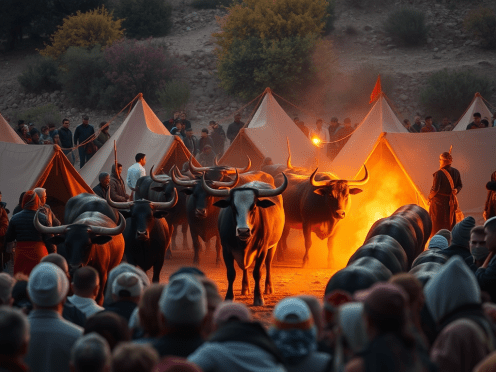
In today’s chapter, God continues to remind the people through Moses of the annual festivals He requires as part of the spiritual rhythm of the community. The final festival described is the “Festival of Tabernacles.” It was a one-week harvest festival held in the autumn. Families gathered and camped out in their own tent for the week, remembering how their ancestors camped out through the wilderness on the way to the Promised Land.

In the detail requirements for the festival, there were 13 bulls sacrificed on day one. The number of bulls sacrificed decreased by one each day until the seventh and final day of the festival in which seven bulls were sacrificed. Whenever I see a pattern like this, I know something is up. This is, after all, the book of Numbers and numbers are important in the Great Story, especially to the ancients.

If I add the total number of sacrifices for the week, it equals 70. Remember, everything in the Great Story is connected and this number 70 connects back to Genesis 10 which lists all the nations of the world. There were 70 nations listed. In our chapter-a-day treks through both Genesis and Leviticus, I observed that God promised Abraham that all the nations of the world would be blessed through him and his offspring. Then God tells the Hebrews at Mt. Sinai that the purpose of them following His ways and His priestly guidebook are so that they would be a light to the nations, showing them His ways.

How fascinating then to think that at the harvest festival, which carries all the metaphorical meaning of gathering in the fruit that has sprung from scattered seed, God asks for a daily series of sacrifices that represent what He is doing on a cosmic spiritual level throughout the Great Story. God wants the whole world to know Him, to learn His ways, and to follow. Jesus wasn’t making something new when He said,

“All authority in heaven and on earth has been given to me. Therefore go and make disciples of all nations, baptizing them in the name of the Father and of the Son and of the Holy Spirit, and teaching them to obey everything I have commanded you. And surely I am with you always, to the very end of the age.”
Matthew 28:18-20 (NIV)

Jesus was perpetuating the game plan that had been established with Abraham and clarified through Moses.

Yet as I meditated on this, there was more. The bull sacrifices during the week of the festival start with the large broad number of 13. That’s one more than the 12 representing the Hebrew tribes. It’s like saying we’re going to start with the all the nations. It’s Hebrews-Plus, the one metaphorically referencing “and everyone else.” As the week goes on, it is whittled down to the intimate and important number of seven, God’s number of “completion.” It’s like God starts with sacrifices for all the nations and then ends by bringing it back to the intimate, complete covenant He made with His people, with Abraham.

Over the past several years I’ve unpacked how God’s plan can be envisioned metaphorically like life on four levels. Level 1 is just me and God. Level 2 is me in relationship with others. Level 3 is me in relationship to the kingdoms of this world. Level 4 is me in relationship with God’s Kingdom. This too is echoed in the receding sacrifices of the Festival of Tabernacles. It begins with sacrifices for Level 3 and all the kingdoms/nations of the world. It tapers down to the final day of the festival when I’m reminded of God’s intimate and personal covenant with me on Level 1.

In the quiet this morning, I’m reminded that God’s ultimate plan for humanity in the Great Story is rooted in the individual. It started with one person in Abraham. Jesus taught His disciples that God’s Kingdom starts with each individual heart. Jesus transforms my heart and my individual life, which transforms my relationship with other individuals in my circles of influence, which then begins to transform my community, my cultures, and even nations.

“But remember,” God whispers in the Feast of Tabernacles and Jesus is saying in the Great Commission, “It all begins with Me in you.”

A good reminder for this Monday morning as I lace ‘em up and head into another work week. Have a good one, my friend.

If you know anyone who might be encouraged by today’s post, please share.

Promotional graphic for Tom Vander Well's Wayfarer blog and podcast, featuring icons of various podcast platforms with a photo of Tom Vander Well.
These chapter-a-day blog posts are also available via podcast on all major podcast platforms including Apple, Google, and Spotify! Simply go to your podcast platform and search for “Wayfarer Tom Vander Well.” If it’s not on your platform, please let me know!
An illustration depicting the significance of the Festival of Tabernacles, featuring a depiction of tents and people gathered in celebration, reflecting the biblical themes of community, sacrifice, and spiritual connection.

Preparing for Leadership Change

Moses told the Israelites all that the Lord commanded him.
Numbers 29:40 (NIV)

For almost a quarter century my vocation has afforded me the opportunity to work with a number of businesses of all shapes and sizes around the globe. I’ve worked with small, family owned firms and giant global corporations. Finance, retail, telecommunications, insurance, manufacturing, and you name it. It continues to be a fascinating journey.

One of the observations I’ve made along my tenure is that every company’s culture flows out of the executive suite. Even in publicly traded companies and global conglomerates I observe that the leader’s personality, values, and priorities ripple through the organization. Positively or negatively, employees become acclimated to this corporate culture. It becomes the culture they know and are used to working within. When there is a change in leadership, there is always a wave of anxiety that courses through the company.

The transfer of leadership can be a tenuous and troubling period for any group of people. This is especially true with charismatic, larger-than-life leaders who build large organizations over a long period of time. Perhaps no one in the history of humanity fits that description better than Moses.

One of the realities that made me scratch my head when I first began reading God’s Message as a young person was the repetition. In the past few chapters of the book of Numbers we have a repetition of the description of prescribed feast days and festivals that God has given through Moses which were already described in the book of Leviticus. Why repeat it all over again?

As we near the end of Numbers Moses is nearing the end of his tenure as Patriarch and leader of the Hebrew tribes. He led their rescue from slavery in Egypt. He led them out of Egypt. He led them to Sinai where God prescribed through Moses the law, rituals, and traditions that gave their fledgling nation identity, organization, and order. He has been leading them through the wilderness to the land God had promised. He is old and a transfer of leadership is about to begin. Joshua will soon take the mantle of leadership. Believe me when I tell you that anxiety is rippling through the Hebrew nation. Even Moses, arguably the greatest leader in history, has got to be feeling it himself.

Are they ready? Is Joshua ready? How are they going to manage? Are they going to be okay? Will they succeed without me?

And what to good leaders do when they’re transferring leadership of the organization they’ve loved and served? They prepare the team for the transition.

And how do you prepare an organization for the leadership change? You remind them of the things that are important to remember.

While Numbers is right next to Leviticus in the Bible, it was written many years apart at completely different times and occasions. In today’s chapter, Moses is reminding Joshua and the nation of the things that are important for them to remember by repeating for them the outline of prescribed sacrifices, festivals, and feast days.

This morning I’m mulling over some transitions I’ve recently experienced and am experiencing in my own personal world. As a leader I want to be mindful of how my personality, values, and priorities affect the people under my leadership and the organizational culture that results. I want it to be positive. Likewise, I’m reminded this morning that good leaders prepare the people they serve, as best they can, for transitions of leadership. That includes reminding people of the important things they need to remember.

Chapter-a-Day Numbers 29

“Sacrifice these to God as a congregation at your set feasts: your Whole-Burnt-Offerings, Grain-Offerings, Drink-Offerings, and Peace-Offerings. These are all over and above your personal Vow-Offerings and Freewill-Offerings.” Numbers 29:39 (MSG)

It’s been interesting for me to spend specific times at the lake this summer with children of different ages. It’s amazing to see how kids act and react in the different stages of life from infant to toddler to tweens to teens. For adults and parents, each stage has its blessings and each stage has its curses. As I interacted with all the children in their various stages, I found myself trying to create teaching moments when the opportunity arose.

This past weekend we were at the lake with some great young kids who, nonetheless, found themselves bored and ended up whining about it. During one of these moments I saw a big stack of laundered towels on the floor and I picked them up, asking our bored guest if he would take them down to the towel bin and put them away. There was a point to asking my young guest to do this. In fact, there were a couple of points I was subtly trying to communicate. First, if you’re bored enough to whine about it, we can certainly find something for you to do. Second, there is plenty of work that must be done to ensure that everyone has a good time at the lake and if you can participate in the fun things you can participate in the work, too.

As I read through today’s chapter and the dizzying list of offerings and sacrifices God prescribed for feast days (which was above and beyond those already prescribed), I’m reminded that there was a point He was trying to make with us His children. The point was that no human being can possibly sacrifice enough, offer enough, or do enough to achieve the status of being good enough to be acceptable for God. The impossible system of sacrifices was a giant word picture and object lesson to teach us that we can’t possibly do enough or be perfectly obedient enough to earn our salvation.

That’s why God sent Jesus to be the ultimate sacrifice for the sin of the world. God’s Message says it is by God’s grace and unmerited favor we are saved through placing our faith in Jesus, His sacrifice and resurrection. Salvation is not something we earned ourselves by keeping a system of sacrifices or doing enough good deeds to balance out the bad. Salvation is the gift of God, not the result of our human works or any good works we might think we can boast about. (Ephesians 2:8-9)

Today, I’m thankful that I’m free from having to earn God’s favor, and I’m grateful for the sacrifice God made to set me free.